
Procedural due process asks how the government acted. Substantive due process asks whether it may act at all. The same clause carries both ideas, and the difference is the difference between a complaint about the hearing and a complaint about the law.
The doctrine has a reputation for vagueness, and it earned it. But the analysis a court actually runs is narrow and highly structured: describe the asserted right precisely, decide whether it is fundamental by reference to history and tradition, then apply strict scrutiny or rational basis accordingly. Two steps, two standards, and almost no middle ground.
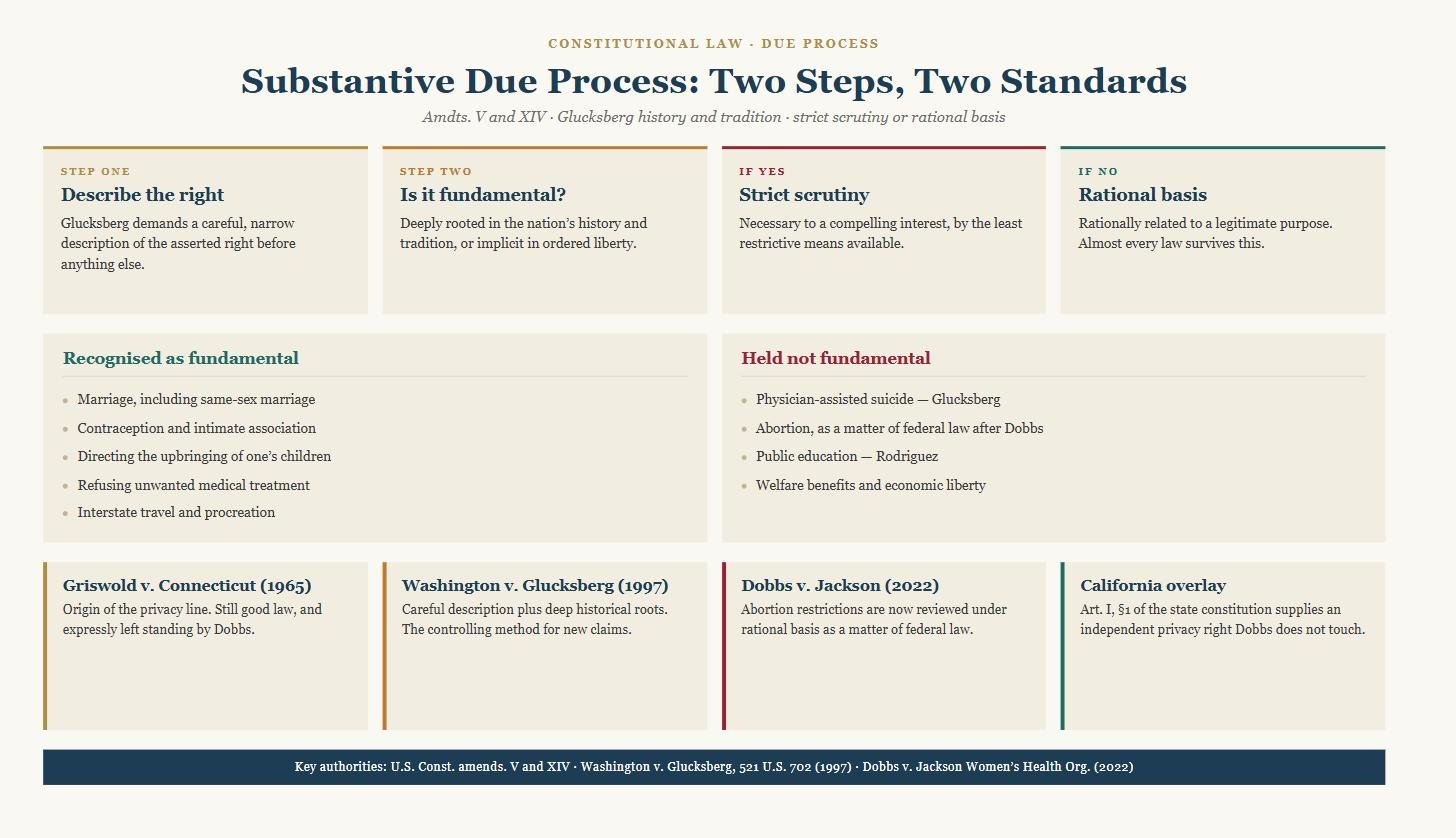
Step one: describe the right carefully
This step decides more cases than it appears to. Washington v. Glucksberg (1997) insists on a careful description of the liberty interest asserted, because how the right is framed determines whether any historical tradition supports it. A claimed right “to control the manner of one’s own death” sounds venerable; a claimed right “to assistance in committing suicide” does not, and the second framing is the one the Court used.
The practical lesson is that both sides in a substantive due process argument are really arguing about the level of generality. A litigant seeking recognition frames broadly, invoking autonomy and dignity. A state defending its statute frames narrowly, inviting the court to look for a specific practice with deep roots. Whoever wins the framing usually wins the case.
Step two: history and tradition
A right is fundamental if it is deeply rooted in the nation’s history and tradition and implicit in the concept of ordered liberty. That formulation predates Glucksberg, but Glucksberg made it the gatekeeping test, and Dobbs v. Jackson Women’s Health Organization (2022) reaffirmed and tightened it. The Court is emphatically conservative about recognising new fundamental rights, and a claim resting on modern conceptions of autonomy alone will not succeed.
Where the right is fundamental, strict scrutiny follows: the law must be necessary to a compelling government interest and must use the least restrictive means. Where it is not, rational basis applies, and rational basis is a formality — the state need only show a legitimate purpose and a rational connection to it, and courts will supply the reasoning if the legislature did not.
Exam tip: name the standard before you argue. A paragraph of eloquent balancing is worthless if the right is not fundamental, because rational basis does not balance anything.
Which rights are in, and which are out
| Asserted right | Status under federal substantive due process |
|---|---|
| Marriage, including same-sex marriage | Fundamental — Obergefell v. Hodges |
| Contraception and private intimate conduct | Fundamental — Griswold, Eisenstadt, Lawrence |
| Directing the upbringing and education of one’s children | Fundamental — Meyer, Pierce, Troxel |
| Refusing unwanted medical treatment | Protected liberty interest — Cruzan |
| Procreation and interstate travel | Fundamental |
| Physician-assisted suicide | Not fundamental — Glucksberg |
| Abortion | Not fundamental as a matter of federal law — Dobbs |
| Public education | Not fundamental — San Antonio v. Rodriguez |
| Welfare benefits and economic liberty | Not fundamental — rational basis |
What Dobbs changed, and what it did not
Dobbs overruled Roe v. Wade and Planned Parenthood v. Casey and held that the Constitution does not confer a right to abortion. The consequence for analysis is precise: as a matter of federal substantive due process, a state abortion restriction is now reviewed under rational basis, and the policy question is returned to legislatures. An answer that applies strict scrutiny or an undue-burden test to such a statute is applying law that no longer exists.
What Dobbs did not do is dismantle the privacy line. The majority went out of its way to distinguish the abortion right from the interests recognised in Griswold, Lawrence and Obergefell, and those decisions remain controlling. The broader change is methodological rather than doctrinal: history and tradition, rigorously applied to a narrowly framed right, is now the test any new claim must pass.
The California overlay
For anyone sitting a California paper, one point is easy to score and easy to miss. Article I, section 1 of the California Constitution contains an express right of privacy that operates independently of the federal Due Process Clause, and Dobbs does not touch it. A well-organised answer analyses the federal question under rational basis and then addresses the state constitutional claim separately, on its own terms.
Worked example
State G makes it a misdemeanour to use or possess any contraceptive, married or not, and defends the statute as an encouragement to procreation and a protection of traditional family structures. Married residents challenge it.
The statute falls. Describe the right carefully and it is the right of married adults to decide whether to use contraception in private — precisely the interest Griswold recognised in 1965 and Eisenstadt extended to unmarried people seven years later. That right is fundamental and remains so after Dobbs, which distinguished it expressly. Strict scrutiny therefore applies. Encouraging procreation and endorsing a preferred family form are policy preferences rather than compelling interests, and even if one of them were compelling, a total criminal prohibition is not the least restrictive means when education, subsidy and tax incentives are available. The law fails.
Change one fact. Suppose the statute instead required pharmacies to be licensed and to keep records of contraceptive sales, without restricting who may buy. The burden on the underlying right is slight, the state’s interest in pharmaceutical regulation is unquestioned, and the measure survives.
Common mistakes that cost points
- Confusing the two branches. Procedural due process is about the hearing; this branch is about the justification.
- Framing the right broadly and assuming the court will accept it. Glucksberg requires a careful description.
- Reading Dobbs as abolishing the privacy cases. Griswold, Lawrence and Obergefell stand.
- Applying Roe or Casey to an abortion restriction. That is superseded law.
- Balancing under rational basis. Rational basis is deference, not balancing.
- Omitting the California constitutional privacy claim on a California paper.
- Forgetting that many of these fact patterns support an equal protection claim in the alternative.
Frequently asked questions
Is economic liberty protected at all?
Yes, but weakly. Since the 1930s economic and land-use regulation has been reviewed for rationality only, the standard Village of Euclid described as asking whether the measure is arbitrary and unreasonable. Legislatures win these cases almost without exception.
Does the clause require the government to protect people from private harm?
No. DeShaney v. Winnebago County (1989) holds that the Due Process Clause is a limit on government action, not a source of affirmative duties, absent custody or a state-created danger. It is a bar on what the state does, not a mandate for what it must do.
When should equal protection be argued instead?
Whenever the statute draws a line between groups rather than prohibiting conduct outright. Many autonomy cases can be pleaded either way, and several leading decisions rest on both grounds, so raising both is usually the stronger course.
Substantive due process after Dobbs: California in 2026
Dobbs v. Jackson Women’s Health Organization (2022) returned abortion regulation to the states and narrowed the method for recognising unenumerated rights to those deeply rooted in history and tradition. California’s response was to write the right into its own constitution. Proposition 1, approved by voters in November 2022, added an express provision protecting reproductive freedom, including the decision to have an abortion and to choose or refuse contraceptives.
That is the general pattern in California: where federal unenumerated rights doctrine contracts, the state supplies a textual substitute. Article I, section 1 of the California Constitution expressly enumerates privacy, and California courts have applied it to informational privacy, autonomy in medical decisions and government data practices. A litigant in the Los Angeles Superior Court therefore argues from state text rather than from federal implication.
The current landscape:
- Reproductive rights rest on state constitutional text. The federal question is largely academic in California; the state provision is the operative source.
- Shield legislation limits cooperation. California statutes restrict assistance with out-of-state proceedings targeting care lawful here, and their interaction with full faith and credit is contested.
- Marriage equality is protected federally and statutorily. Obergefell (2015) governs, and voters repealed the obsolete state constitutional restriction.
- Family autonomy remains a recognised liberty. Parental rights cases in county dependency proceedings continue to apply heightened protection.
- Economic regulation gets rational basis review. Do not resurrect Lochner; occupational and land use rules are almost always sustained.
- End-of-life choices are statutory. California authorises medically assisted dying by legislation rather than as a constitutional right.
In 2026, identify the source of the right before the standard of review, since California often supplies text where federal law offers none. Read with procedural due process, the levels of scrutiny and the incorporation doctrine.
Next steps
Read this against procedural due process, its constant companion, then the three levels of scrutiny for the standards this analysis unlocks, the incorporation doctrine for how the clause reaches the states, and the right to travel for a fundamental right with a different textual home.
For primary sources, read Washington v. Glucksberg on Justia and Griswold v. Connecticut also on Justia, review the Fourteenth Amendment on Cornell Legal Information Institute, and confirm current subject coverage with the State Bar of California.
Related guides
- Advisory Opinions: Article III and Declaratory Relief
- Access to the Courts: When Filing Fees Are Unconstitutional
- Other Enumerated Powers: Postal, Bankruptcy, Admiralty
- Franchise Amendments: Congress and the Right to Vote
- Property Clause: Congress and Federal Lands Explained
- No Federal Police Power: Enumerated Powers and Enclaves
- Contracts Clause: When States May Impair Agreements
- Takings Clause: Lucas, Penn Central and Just Compensation
- Free Exercise Clause: Smith, Lukumi and Fulton Applied
- Establishment Clause: Church, State and the New Test
- Freedom of Association: Scrutiny, Dale and Disclosure
- Freedom of the Press: Publication Liability and Limits
- Campaign Finance and Anonymous Speech: The Core Rules
- Unconstitutional Conditions: Benefits and Rights Waivers
- Government Speech Doctrine: When the State Can Choose
- Vagueness and Overbreadth: Facial Challenges Explained
- Prior Restraint and Licensing: The Freedman Safeguards
- Symbolic Conduct and the O’Brien Test: The Pivot Question
- Government Employee Speech: Garcetti and Pickering Rules
- Commercial Speech and the Central Hudson Four-Part Test
- Actual Malice and the Three Tracks of Defamation Law
- Public Forum Doctrine and the Time, Place, Manner Test
- First Amendment: The Three-Question Speech Framework
- One Person, One Vote: Voting Rights Under Equal Protection
- Alienage Classifications: Strict Scrutiny and Its Pockets
- Equal Protection: The Three-Step Classification Test
- Second Amendment: The Bruen Text-and-History Standard
- Procedural Due Process: Notice, Hearing and Mathews
- Incorporation Doctrine: Which Rights Bind the States
- Full Faith and Credit: Recognising Sister-State Judgments
- The Complete Auto Test: Taxing Interstate Commerce
- The Right to Travel: Durational Residency Explained
- Article IV Privileges and Immunities: The Comity Rule
- Federal Preemption: The Three-Step Ladder Explained
- The Supremacy Clause: Floors, Ceilings and Preemption
- Intergovernmental Immunity: The Shield Runs One Way
- The Presidential Pardon Power: Four Limits That Matter
- Executive Privilege: A Qualified Right That Must Yield
- Presidential Immunity: Criminal, Civil and Private Acts
- The Removal Power: At-Will Firing and Its Exceptions
- The Appointment Power: Principal and Inferior Officers
- Take Care Clause: Enforcement Discretion and Its Limits
- Commander-in-Chief Power: Deploy Without Declaring War
- Executive Agreements: The President’s Sole Foreign Power
- The Treaty Power: Senate Advice and Consent Explained
- The Presidential Veto Power, Override and Pocket Veto
- Bicameralism and Presentment: Two Vetoes Struck Down
- The Nondelegation Doctrine and the Intelligible Principle
- Speech or Debate Clause: Absolute but Narrow Immunity
- The Impeachment Power: House Majority, Senate Two-Thirds
- Congress’s Naturalization Power and Citizenship Limits
- Congressional War Powers: Declare, Fund and Command
- Anti-Commandeering Doctrine and the Tenth Amendment
- Section 5 Enforcement Power: Remedy, Do Not Redefine
- The Spending Power and the Five Dole Test Conditions
- Congress’s Taxing Power: When a Penalty Is Really a Tax
- The Necessary and Proper Clause: Congress’s Multiplier
- Ex Post Facto Clause: Retroactive Criminal Laws Barred
- Bills of Attainder: Legislative Punishment Explained
- The Writ of Habeas Corpus: Testing Unlawful Detention
- Supreme Court Jurisdiction: Original vs Appellate Power
- Abstention Doctrine: 4 Ways Federal Courts Step Aside
- Dormant Commerce Clause: Discrimination vs Pike Balancing
- The Commerce Clause: 3 Categories and 2 Hard Limits
- State Action Doctrine: The Government Conduct Threshold
- The Eleventh Amendment and State Sovereign Immunity
- Political Question Doctrine: What Courts Will Not Decide
- Ripeness and Mootness: Timing Rules in Federal Court
- Standing in Federal Court: The 3-Part Article III Test
- Marbury v. Madison and the Power of Judicial Review
- The Youngstown Framework: Presidential Power in 3 Zones
- The IRAC Method: How to Structure a Bar Exam Answer
- Piercing the Corporate Veil: A Two-Prong Alter Ego Test
- Defamation Elements, Fault Standards and Privileges
- The Parol Evidence Rule: Integration and Exceptions
- Recording Acts: Race, Notice and Race-Notice Explained
- Partner Liability and Authority Under RUPA Explained
- Trustee Duties: Care, Loyalty, Impartiality, Accounts
- Specific Performance: A Six-Element Bar Exam Framework
- Will Execution Requirements: Formalities and Rescue
- Community Property Presumptions in California Explained
- Easements Explained: Creation, Scope and Termination
- Products Liability: The Three Defect Theories Explained
- Miranda Rights: Custody, Interrogation and Invocation
- The Character Evidence Rules: Propensity Bar and Doorways
- Adverse Possession Elements: OCEAN and the Tax Rule
- Business Judgment Rule and Directors’ Fiduciary Duties
- The Statute of Frauds: MYLEGS and How to Satisfy It
- Res Judicata vs Collateral Estoppel: Bar Exam Guide
- The Erie Doctrine Explained: A 4-Step Bar Exam Guide
- Conflicts of Interest: A 6-Step Decision Tree for the Bar
- The Rule Against Perpetuities Explained Step by Step
- Murder and Manslaughter: The Homicide Ladder Explained
- Consideration in Contract Law: Rules and Exceptions
- The Four Elements of Negligence: Bar Exam Breakdown
- The Hearsay Rule Explained: Exceptions and Exemptions
- Personal Jurisdiction: The 3-Step Bar Exam Framework
- 3 Levels of Scrutiny in Constitutional Law Explained
- The Citizenship Clause After Trump v. Barbara