
Recording acts are the tie-breaker rules of American land law. When two people hold conflicting claims to the same parcel because a grantor sold it twice, mortgaged it after conveying it, or granted an easement nobody wrote down, the recording statute decides who walks away with the land and who is left suing an insolvent seller for damages.
This guide explains what a bona fide purchaser is, how the three statutory models differ, why California follows the race-notice approach, and which fact patterns examiners use again and again to separate students who memorised a label from students who can actually run the analysis.
Why recording acts exist at all
At common law the rule was brutally simple: first in time, first in right. Whoever received a valid conveyance first owned the property, and a later buyer who paid full price to a dishonest seller got nothing. That rule protected the diligent grantee but destroyed confidence in land transactions, because no amount of investigation could reveal a secret deed sitting in a desk drawer.
Every American jurisdiction responded by building a public land records system and passing a statute that rewards recordation. The statute does not create title and it does not transfer ownership. It changes the priority between competing interests, and only for claimants who satisfy the conditions the legislature wrote down.
That distinction matters on an exam. If your fact pattern involves a forged deed, a deed that was never delivered, or a grantor who had no title to begin with, the recording act is irrelevant because there is no valid interest to prioritise. Start by confirming that both competing conveyances are otherwise effective.
The bona fide purchaser: three requirements
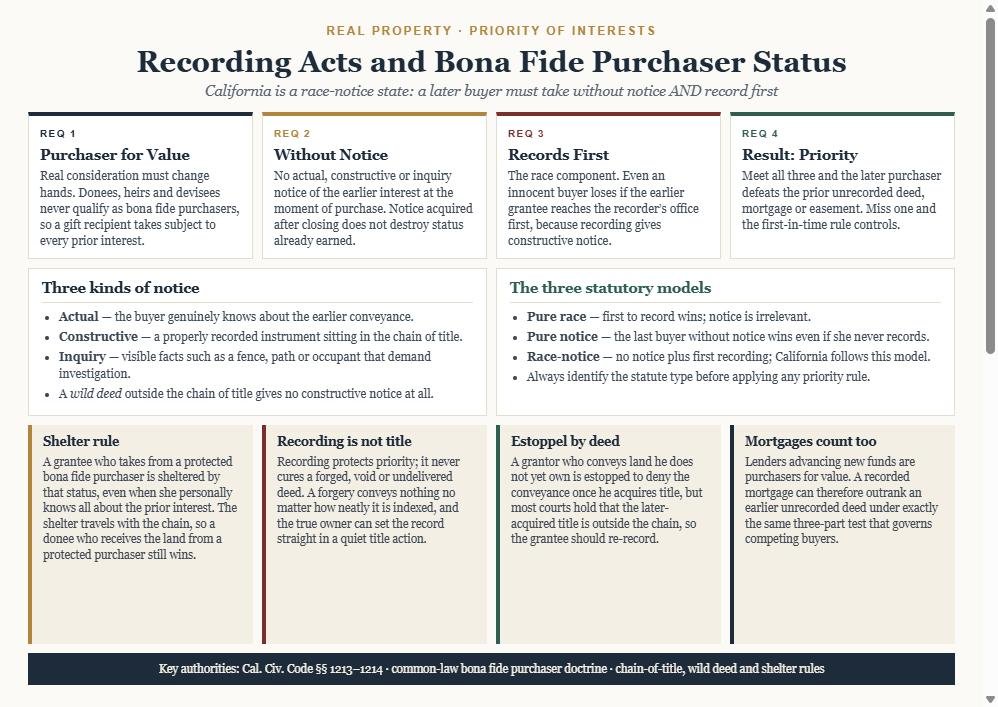
A claimant who wants the protection of a recording statute must qualify as a bona fide purchaser, usually shortened to BFP. In a race-notice state such as California the test has three parts, and all three must be satisfied.
1. A purchaser for value
The claimant must give consideration that is substantial rather than nominal. Paying market price obviously qualifies. So does cancelling an existing debt or advancing loan proceeds, which is why a mortgage lender is treated as a purchaser for value in this analysis.
People who receive land for free are excluded. A donee, an heir taking by intestacy and a devisee named in a will all take exactly the interest the grantor or decedent had, subject to every prior claim, recorded or not. This is the single most commonly missed element.
2. Without notice of the prior interest
Notice is measured at the moment the claimant pays and takes the conveyance. Learning about the earlier interest a week after closing does not retroactively destroy protected status. Courts recognise three separate categories:
- Actual notice — the buyer genuinely knew about the earlier deed, lease or mortgage, whether from the seller, a neighbour or a lawyer.
- Constructive notice — an instrument was properly recorded and indexed inside the chain of title, so a reasonable title search would have found it. The buyer is charged with knowledge whether or not she looked.
- Inquiry notice — visible facts on the ground or references inside recorded documents suggest an unrecorded interest, triggering a duty to investigate. A worn footpath, a fence set back from the boundary, or a stranger living in the house all put a buyer on inquiry.
A recorded instrument that falls outside the chain of title, the classic wild deed, gives no constructive notice at all. If a grantee records before her own grantor received title, a later searcher following the grantor index will never encounter the document, so it cannot bind anyone.
3. Records first
This is the race component and it is what makes race-notice statutes stricter than pure notice statutes. An entirely innocent buyer who pays full value and searches diligently still loses if the earlier grantee reaches the recorder’s office before she does. Speed matters, and the party who sits on an unrecorded deed for months is gambling with the property.
The three statutory models compared
| Statute type | What the later purchaser must show | Who wins the classic double-sale |
|---|---|---|
| Pure race | Only that she recorded first. Notice is entirely irrelevant. | The first to record, even if she knew about the earlier sale. |
| Pure notice | Only that she took without notice. She need never record to win. | The last purchaser without notice, regardless of recording order. |
| Race-notice | Both absence of notice and first recordation. | A purchaser who was innocent and won the race to the recorder. |
California sits firmly in the race-notice camp. Its statute protects a subsequent purchaser in good faith and for value whose conveyance is first duly recorded, which packages the notice requirement and the race requirement into a single sentence. Only a handful of states use pure race statutes; pure notice statutes are common.
Exam tip: name the statute type in your first line of analysis. Writing “because this is a race-notice jurisdiction, B prevails only if she both lacked notice and recorded first” earns the point that a conclusion about who wins never earns on its own.
The shelter rule
Once a bona fide purchaser has earned priority, that priority is an asset she can pass on. Under the shelter rule, anyone who takes from a protected BFP is sheltered by the transferor’s status, even if the transferee has full actual knowledge of the prior interest and even if the transferee paid nothing.
The reason is commercial rather than moral. If a BFP could not convey the clean title she owns, her property would be unmarketable and the protection the statute gave her would be worthless. Examiners love this rule because it produces a counterintuitive winner: the knowing donee.
Related doctrines that share the same facts
Recording problems rarely appear alone. A fence or path that puts a buyer on inquiry notice is often the same fence that supports an Easements Explained: Creation, Scope and Termination claim by prescription, or an Adverse Possession Elements: OCEAN and the Tax Rule argument if the occupation lasted long enough. Estoppel by deed, after-acquired title and marketable title acts all interact with the priority rules.
Contract doctrine matters too. A land sale contract must satisfy the writing requirement, so review the The Statute of Frauds: MYLEGS and How to Satisfy It before assuming an oral conveyance created anything at all. If the buyer wants the land rather than money, the remedy analysis runs through Specific Performance: A Six-Element Bar Exam Framework.
Common mistakes that cost points
- Treating a donee, heir or devisee as a bona fide purchaser. No value means no protection, full stop.
- Forgetting the recording requirement in a race-notice state and analysing the problem as if notice alone decided it.
- Applying the recording act to a forged or undelivered deed. Recording cannot validate an instrument that conveyed nothing.
- Missing inquiry notice from physical facts described in the question, such as an occupant, a driveway or a utility line.
- Giving a wild deed constructive notice effect because it appears in the records somewhere.
- Overlooking mortgage lenders as purchasers for value entitled to the same protection as buyers.
- Ignoring the shelter rule and awarding the land to the earlier grantee just because the final transferee knew the facts.
- Measuring notice at the wrong moment. Knowledge acquired after closing is irrelevant.
Frequently asked questions
Does recording a deed prove I own the property?
No. Recording is a priority device, not a title device. A recorded forgery is still a forgery, and a recorded deed from someone who never owned the land conveys nothing. Title comes from a valid, delivered conveyance; recording merely tells the world about it.
What happens if neither party records?
The common law default returns and the first grantee in time prevails. Recording statutes only reorder priority when someone actually uses the system, so a race that nobody entered leaves the original rule intact.
Is a judgment lien creditor protected as a purchaser?
It depends on the statute. Many recording acts expressly cover mortgagees and lien creditors, while others protect only purchasers. Read the statutory language in the question before assuming a creditor can claim BFP status.
Recording in Los Angeles County: race-notice in practice, 2026
California is a race-notice jurisdiction. Section 1214 of the California Civil Code protects a subsequent purchaser who takes in good faith, for valuable consideration and records first. Both elements are required: recording first is not enough if the purchaser had notice, and lacking notice is not enough if a competing instrument reaches the record first.
Recording in Los Angeles County is done through the Los Angeles County Registrar-Recorder/County Clerk, which serves as both Registrar-Recorder and County Clerk, and the volume is enormous. Section 1213 provides that a properly recorded instrument gives constructive notice to subsequent purchasers, and California courts add inquiry notice: facts that would put a reasonable purchaser on enquiry are imputed even if nothing appears in the chain.
The mechanics that decide title disputes here:
- Wild deeds give no notice. An instrument recorded outside the chain of title is treated as unrecorded, however diligently a searcher might have found it.
- Possession is inquiry notice. An occupant inconsistent with the record owner obliges a purchaser to investigate.
- Non-judicial foreclosure is the norm. Most California deeds of trust are enforced by trustee’s sale under section 2924 of the California Civil Code, with recorded notices of default and sale driving the timeline.
- Mechanics liens have constitutional status. The California Constitution guarantees a lien for those who furnish labour or materials, and the statutory notice and recording deadlines are strict.
- Transfer taxes are recorded at the same time. County documentary transfer tax applies, and some cities in the county impose additional transfer taxes on higher-value sales.
- Reassessment follows recording. A recorded change in ownership triggers reassessment under California’s acquisition-value property tax system, subject to statutory exclusions.
For 2026, run a full chain search and a physical inspection, and confirm current recording fees and transfer tax rates with the county. Read with easements, adverse possession and the statute of frauds.
Next steps
Practise by drawing a timeline for every priority question. Mark each conveyance, each recording date and each moment a party acquired notice, then apply the three-part test in order. The official text of the California statute is available at Cal. Civ. Code §§ 1213–1220, and a concise doctrinal overview appears in the Cornell Legal Information Institute entry on recording acts.
For the underlying good-faith purchaser concept across property and commercial law, see the Cornell LII discussion of bona fide purchasers and the parallel treatment of good-faith purchasers of goods in UCC § 2-403. Then work through the future-interest side of land titles in The Rule Against Perpetuities Explained Step by Step and the formalities that govern transfers at death in Will Execution Requirements: Formalities and Rescue.
Related guides
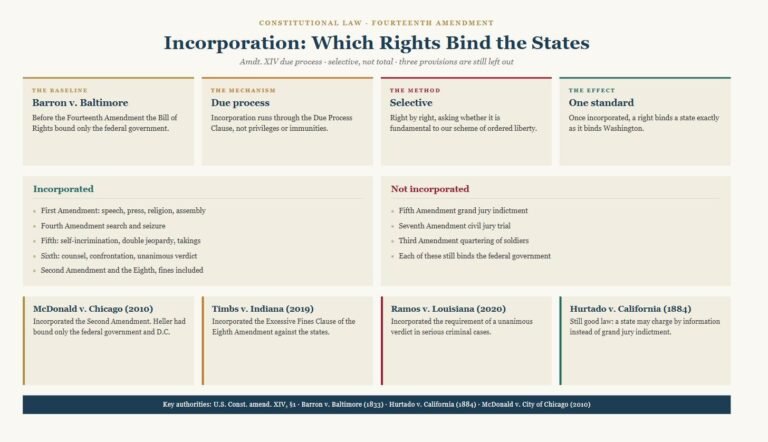 Incorporation Doctrine: Which Rights Bind the States
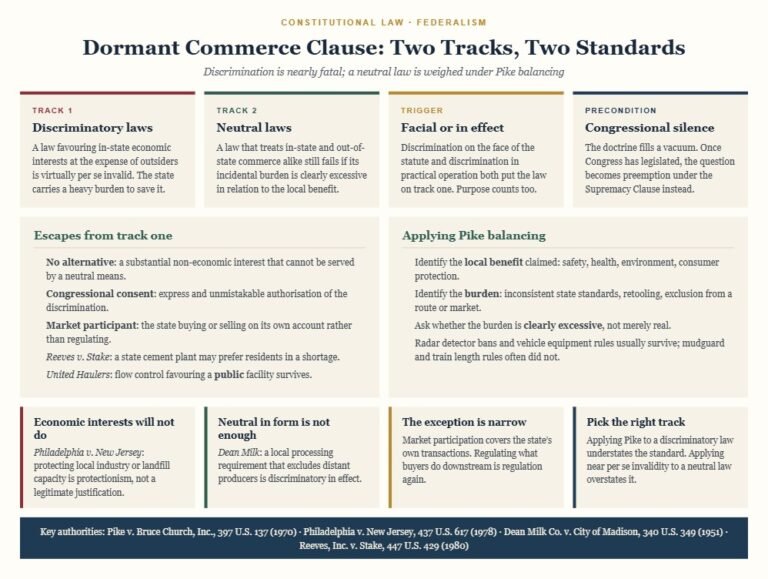 Dormant Commerce Clause: Discrimination vs Pike Balancing
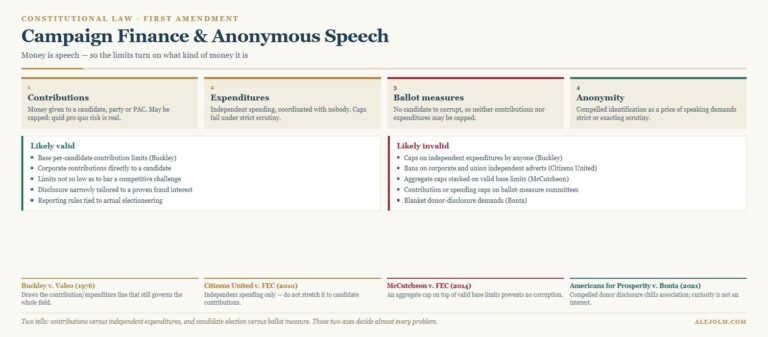 Campaign Finance and Anonymous Speech: The Core Rules
 3 Levels of Scrutiny in Constitutional Law Explained
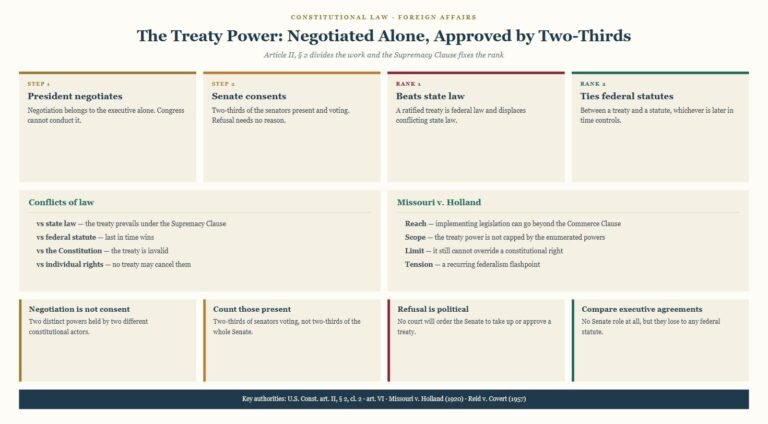 The Treaty Power: Senate Advice and Consent Explained
 Presidential Immunity: Criminal, Civil and Private Acts
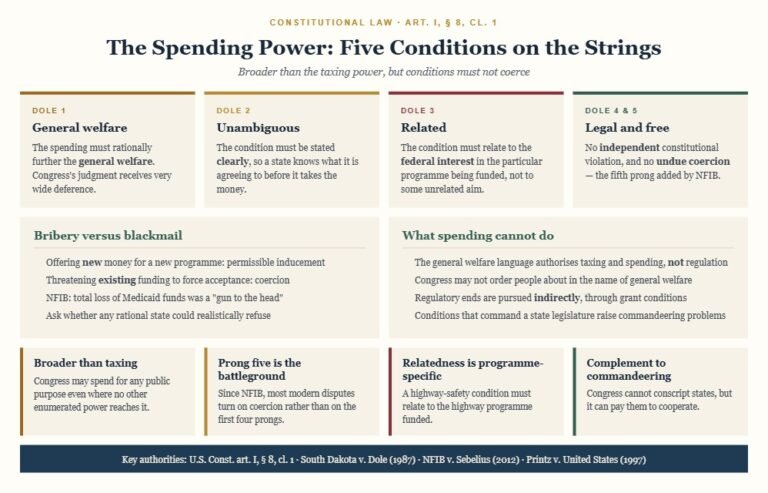 The Spending Power and the Five Dole Test Conditions
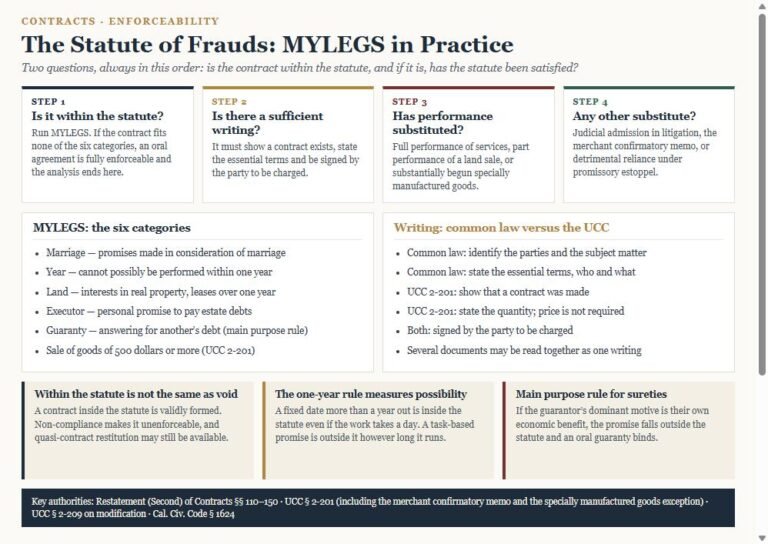 The Statute of Frauds: MYLEGS and How to Satisfy It
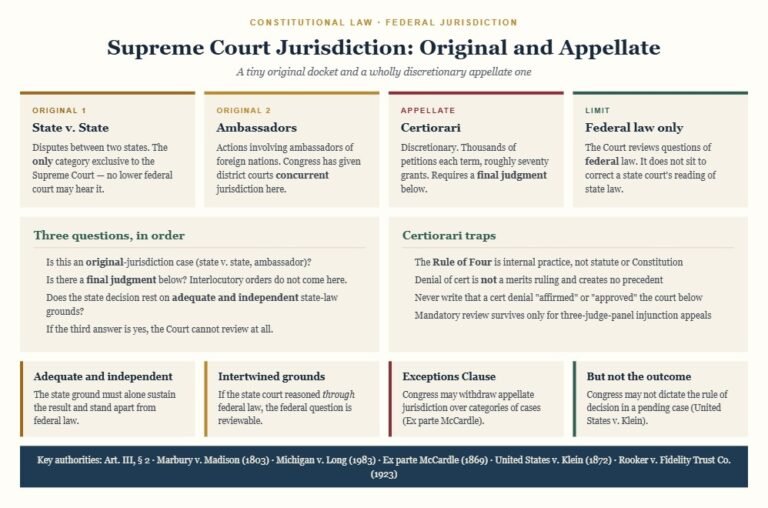 Supreme Court Jurisdiction: Original vs Appellate Power
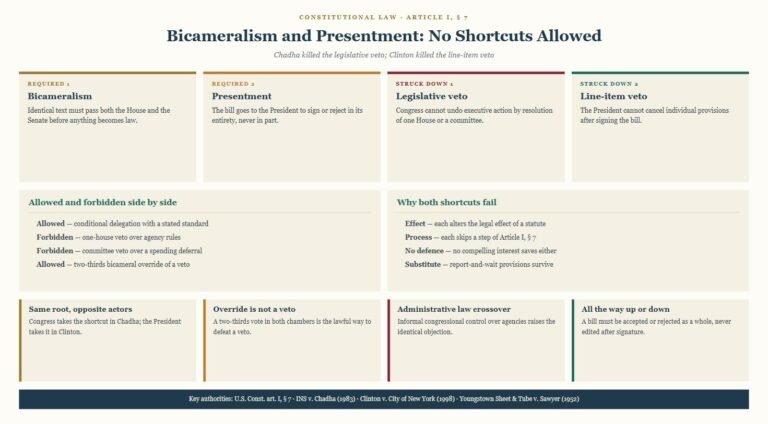 Bicameralism and Presentment: Two Vetoes Struck Down
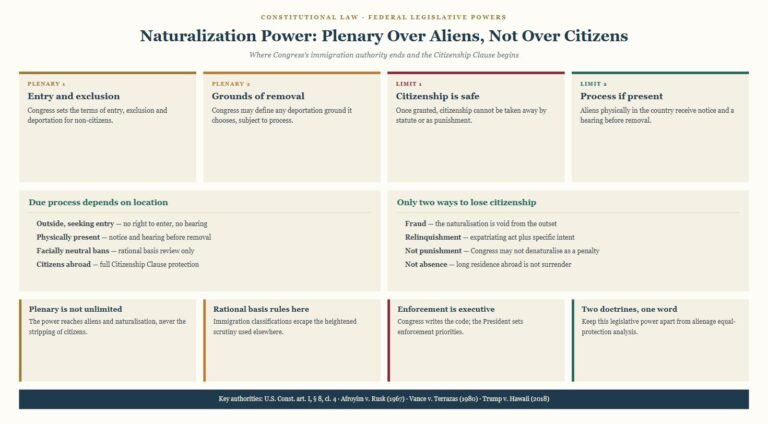 Congress’s Naturalization Power and Citizenship Limits
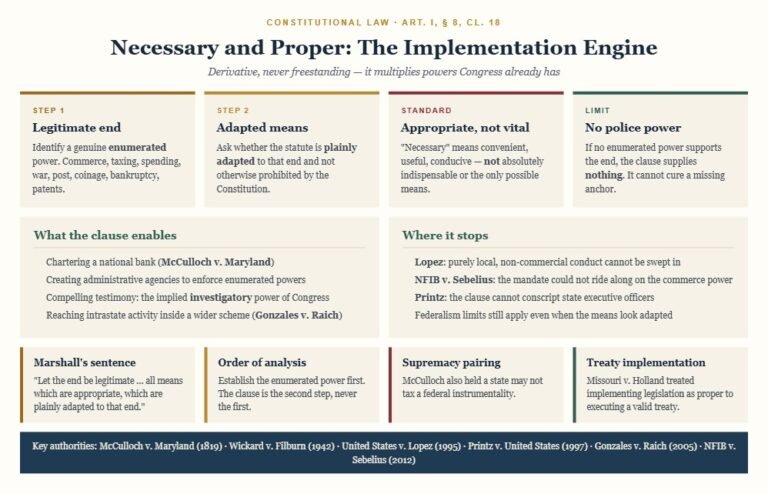 The Necessary and Proper Clause: Congress’s Multiplier