
The political question doctrine marks the small class of constitutional disputes that federal courts will not resolve at all. It is not a ruling that the government acted lawfully. It is a refusal to rule, on the ground that the Constitution gave the decision to another branch or that no court could decide it by law rather than by preference.
This guide explains the two factors that decide almost every case, the categories that fall on each side of the line, the two Nixon cases that trap unwary candidates, and how an individual rights claim can survive even when the underlying decision is political.
Where the doctrine comes from
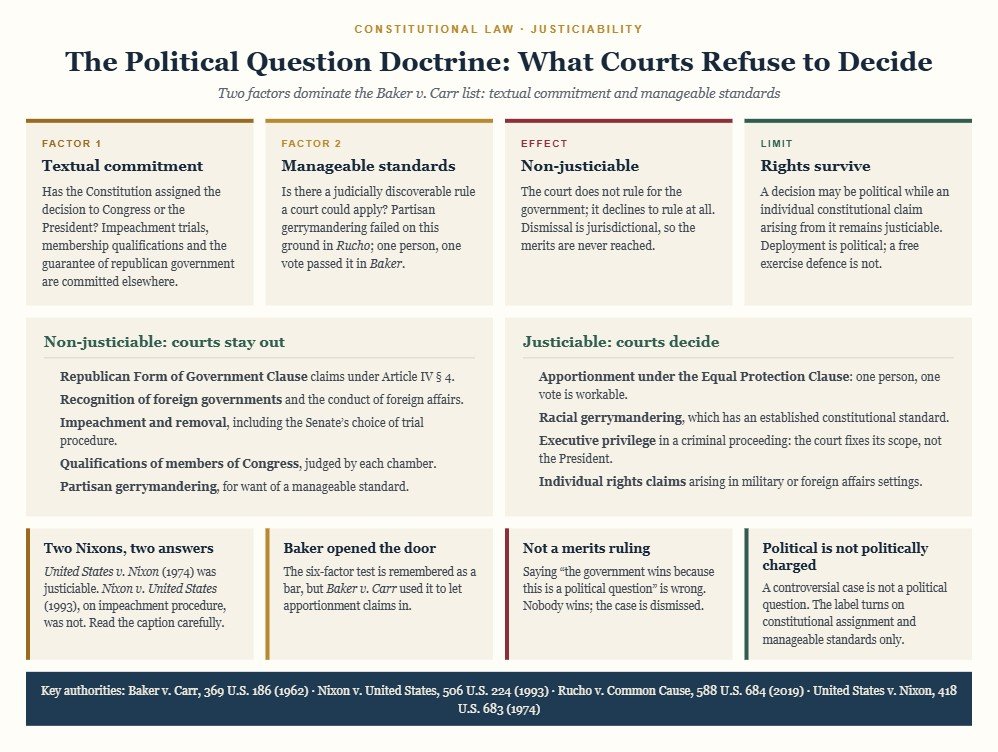
Baker v. Carr is remembered as the source of the test, which is slightly ironic, because the Court used it to open the courthouse door rather than close it. Tennessee had not reapportioned its legislature for sixty years, and the state argued that districting was inherently political. The Court disagreed, held the equal protection claim justiciable, and in the process listed six factors that identify a genuine political question.
Two of the six do nearly all the work in practice. Is the issue textually committed by the Constitution to Congress or the President? And are there judicially discoverable and manageable standards for resolving it? If either answer points firmly away from the courts, the case is non-justiciable.
Factor one: textual commitment
Some decisions are assigned elsewhere in terms. Article I gives the Senate the “sole Power to try all Impeachments”, and in Nixon v. United States the Court held that the word “sole” placed the Senate’s choice of trial procedure beyond review, even where a judge complained that a fact-finding committee had replaced the full chamber. Each house likewise judges the qualifications of its own members, and Article IV’s guarantee of a republican form of government has long been treated as addressed to Congress.
Recognition of foreign governments belongs to the executive, as does the conduct of diplomacy. Courts will resolve a dispute about which branch holds a foreign affairs power, but they will not second-guess the substance of a recognition decision.
Factor two: judicially manageable standards
The second factor asks whether a court could decide the case by law. Rucho v. Common Cause held partisan gerrymandering claims non-justiciable for exactly this reason: the Constitution offers no baseline for how much partisan advantage is too much, and any line a court drew would be an act of political judgment dressed as adjudication.
Contrast racial gerrymandering, which remains justiciable because equal protection supplies a workable rule, and legislative apportionment, where one person, one vote gives courts something to measure. The difference is not how political the subject feels. It is whether a judge has a standard to apply.
| Claim | Justiciable? | Controlling reason |
|---|---|---|
| Senate’s impeachment trial procedure | No | Article I commits the trial to the Senate alone |
| Partisan gerrymandering | No | No manageable standard for excessive partisanship |
| Guarantee of a republican form of government | No | Committed to Congress |
| Legislative apportionment under equal protection | Yes | One person, one vote is measurable |
| Racial gerrymandering | Yes | Equal protection supplies the standard |
| Scope of executive privilege in a criminal case | Yes | The judiciary defines the privilege it must apply |
Exam tip: never write that the government prevails because the claim is a political question. The consequence is dismissal for want of jurisdiction, which means no party wins on the merits.
The two Nixon cases
Two cases with almost identical names reach opposite results, and examiners know it.
- United States v. Nixon (1974) concerned a subpoena for presidential tape recordings in a criminal prosecution. The Court held the dispute justiciable and defined the limits of executive privilege itself, rejecting the argument that the President could conclusively decide the scope of his own privilege.
- Nixon v. United States (1993) concerned the impeachment trial of a federal judge and the Senate’s use of a committee to take evidence. The Court held the claim non-justiciable because Article I commits the trial of impeachments to the Senate.
Read the caption before you write. Which party appears first tells you which doctrine is in play.
A political decision can still generate a justiciable claim
The doctrine attaches to questions, not to subject areas. A deployment order is a political and military judgment that no court will review. A service member’s claim that a particular order burdens the free exercise of religion is an individual constitutional claim with an established framework, and it is justiciable even though the surrounding decision is not.
The same separation appears in structural cases. Courts routinely decide which branch holds a contested power, using the framework set out in The Youngstown Framework: Presidential Power in 3 Zones, while declining to review how the branch that holds it chose to exercise it.
A worked example
Suppose Congress passes a statute directing the President to recognise a particular government as the lawful authority of a disputed territory. The President refuses, and a citizen with commercial interests in the territory sues to compel compliance.
- Is there a textual commitment? Recognition has consistently been treated as an executive function, which points strongly toward non-justiciability of the recognition decision itself.
- Is there a manageable standard? No legal test tells a court which of two claimants is the lawful government of a territory.
- Is any part justiciable? Yes. Whether Congress may direct recognition at all is a separation-of-powers question about the allocation of a power, and courts decide those.
- Resolution: the allocation question proceeds; the demand that the court itself recognise a government does not. Note also that the plaintiff would still have to satisfy the requirements in Standing in Federal Court: The 3-Part Article III Test.
Common mistakes that cost points
- Concluding that the government wins, rather than that the case is dismissed.
- Labelling a case political because the subject matter is controversial or partisan.
- Confusing United States v. Nixon with Nixon v. United States.
- Treating all gerrymandering claims alike when partisan and racial claims diverge.
- Forgetting that Baker v. Carr held the claim before it justiciable.
- Missing an individual rights claim that survives inside a political subject area.
- Reciting all six Baker factors without saying which one decides the case.
- Using the doctrine as a substitute for standing, ripeness or mootness analysis.
Frequently asked questions
Is the political question doctrine constitutional or prudential?
Both strands appear in the case law. Textual commitment is a constitutional limit on judicial power, while the absence of manageable standards has a prudential flavour. Courts usually treat the resulting dismissal as jurisdictional either way, so the practical answer is the same.
Can Congress make a political question justiciable by statute?
Congress can supply a standard where none existed, which sometimes converts an unreviewable question into a reviewable one. It cannot override a textual commitment, because a statute cannot reassign a power the Constitution has already placed elsewhere.
Does the doctrine apply in state courts?
State courts develop their own justiciability rules, and some are more willing to hear claims that a federal court would refuse. Rucho expressly left partisan gerrymandering claims available under state constitutions, and several state courts have accepted them.
The political question doctrine in California and Los Angeles County, 2026
After Rucho v. Common Cause (2019) held partisan gerrymandering claims nonjusticiable in federal court, the obvious question became what happens in states that had built their own machinery. California is the clearest example of a jurisdiction that answered the problem institutionally rather than judicially.
Statewide districts are drawn by the California Citizens Redistricting Commission, an independent body created by voter initiative and insulated from the Legislature. Challenges to its maps go to the California Supreme Court, which exercises original jurisdiction and applies criteria written into the California Constitution rather than the open-ended fairness standard Rucho found unmanageable. Because the standard is textual, the claim is justiciable in a way its federal counterpart is not.
Los Angeles County has replicated the design at local level. Supervisorial district boundaries are set by an independent county redistricting commission, and city council districts in Los Angeles are drawn through their own commission process, a system that drew intense scrutiny after the 2021 cycle. Litigation over those maps is heard in the Los Angeles Superior Court.
Practical consequences:
- State courts are open where federal courts are closed. A partisan districting theory dismissed under Rucho may still be litigable under state constitutional criteria.
- Racial gerrymandering remains federal. Rucho did not touch race-based claims or Voting Rights Act challenges, which proceed normally.
- The California Voting Rights Act is broader. Elections Code provisions on at-large systems have forced district elections across Los Angeles County municipalities, with no federal analogue requirement to show a majority-minority district.
- Initiative review is timing-sensitive. Courts will generally not review a measure’s substance before it passes, confining pre-election challenges to narrow procedural grounds.
- Foreign affairs and impeachment stay nonjusticiable. The classic categories are unchanged; do not overextend the state-law point.
- Commission decisions are reviewable for process. Even where substance is protected, open meeting and record requirements supply a handhold.
For 2026, treat nonjusticiability as forum-specific rather than absolute. Compare one person, one vote, which remains fully justiciable, and standing, which California relaxes in public law cases.
Next steps
When a fact pattern involves Congress, the President or elections, run the two factors before anything else. Then place the doctrine among the other gateways: the timing rules in Ripeness and Mootness: Timing Rules in Federal Court, the party requirement in Standing in Federal Court: The 3-Part Article III Test, and the source of review itself in Marbury v. Madison and the Power of Judicial Review.
For primary sources, read Baker v. Carr for the six factors, Nixon v. United States for textual commitment, and Rucho v. Common Cause for manageable standards. Cornell’s note on the political question doctrine is a compact summary.
Related guides
 One Person, One Vote: Voting Rights Under Equal Protection
 Contracts Clause: When States May Impair Agreements
 The Erie Doctrine Explained: A 4-Step Bar Exam Guide
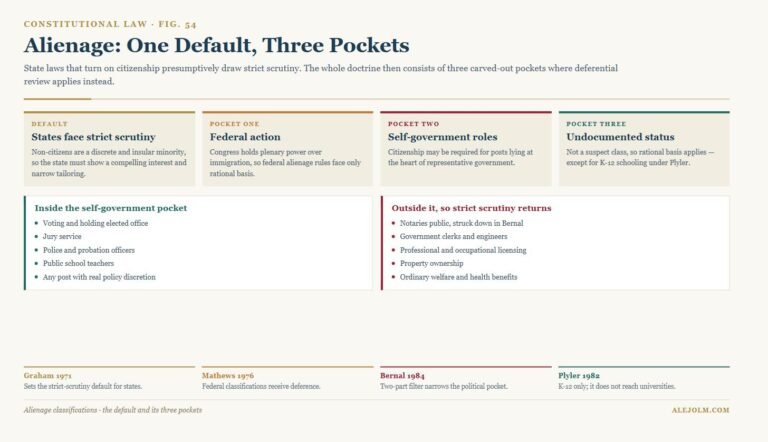 Alienage Classifications: Strict Scrutiny and Its Pockets
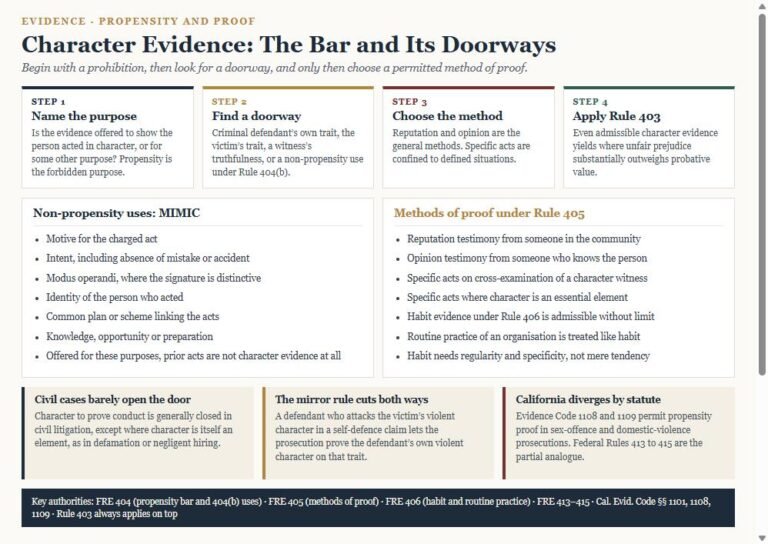 The Character Evidence Rules: Propensity Bar and Doorways
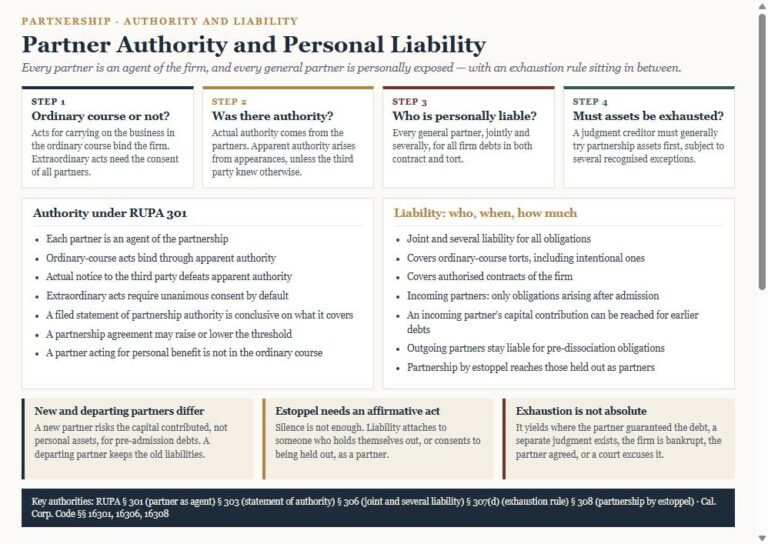 Partner Liability and Authority Under RUPA Explained
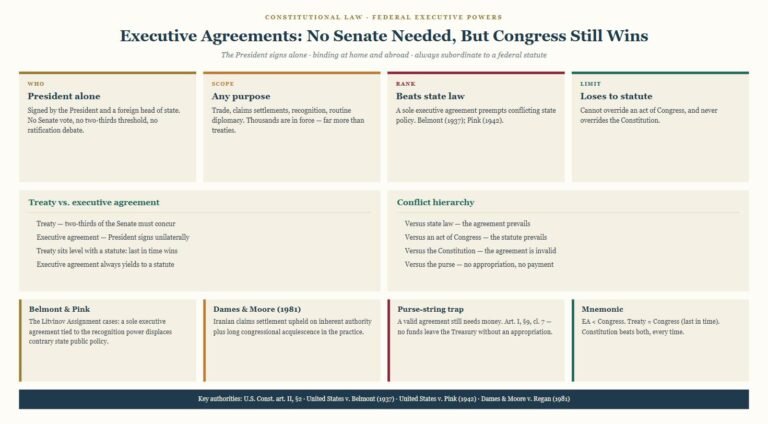 Executive Agreements: The President’s Sole Foreign Power
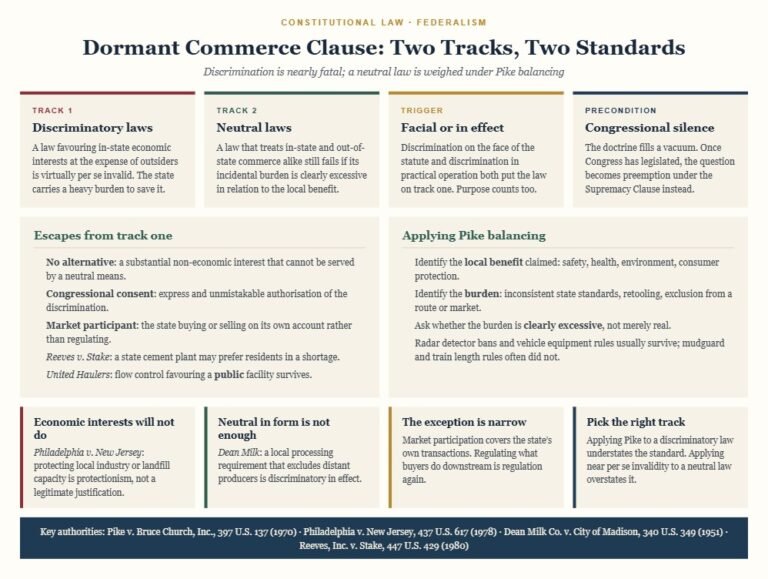 Dormant Commerce Clause: Discrimination vs Pike Balancing
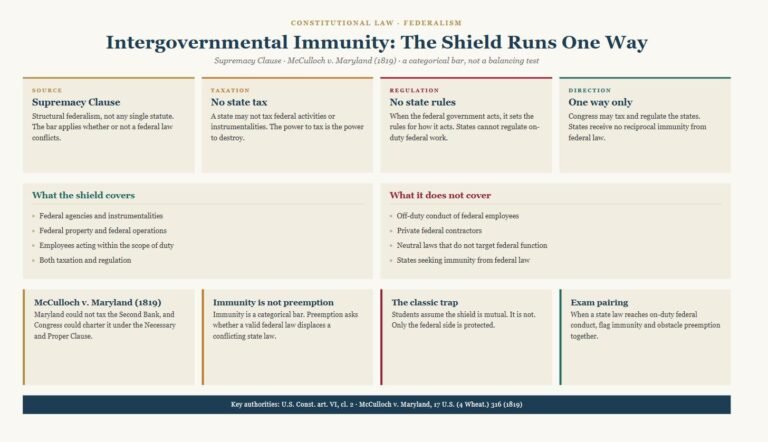 Intergovernmental Immunity: The Shield Runs One Way
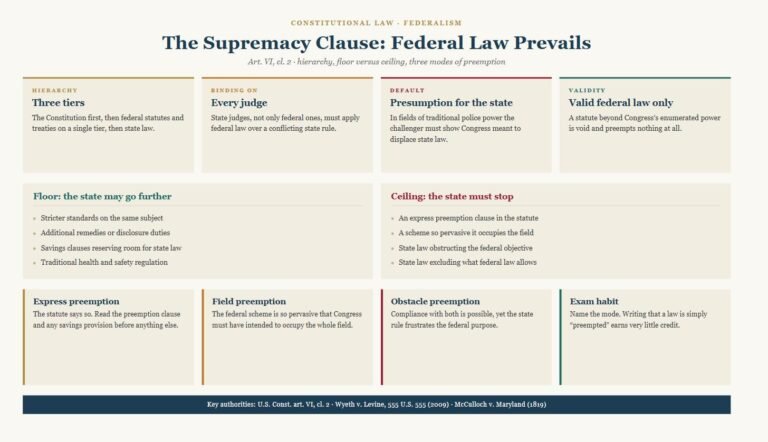 The Supremacy Clause: Floors, Ceilings and Preemption
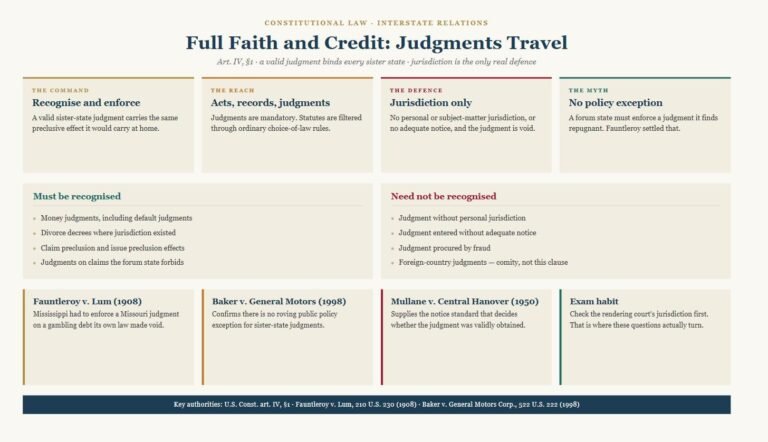 Full Faith and Credit: Recognising Sister-State Judgments
 Congress’s Taxing Power: When a Penalty Is Really a Tax