
Products liability looks generous to plaintiffs and often is, but the doctrine only works if you name the defect correctly at the outset. Manufacturing, design and warning defects use different tests, allocate the burden of proof differently, and respond to different defences. Choose the wrong theory and every subsequent paragraph is wasted.
This guide gives you a reliable way to spot each theory, the test that goes with it, the commercial-seller requirement that decides who can be sued, the causation and defence issues that follow, and the California burden shift that examiners test directly.
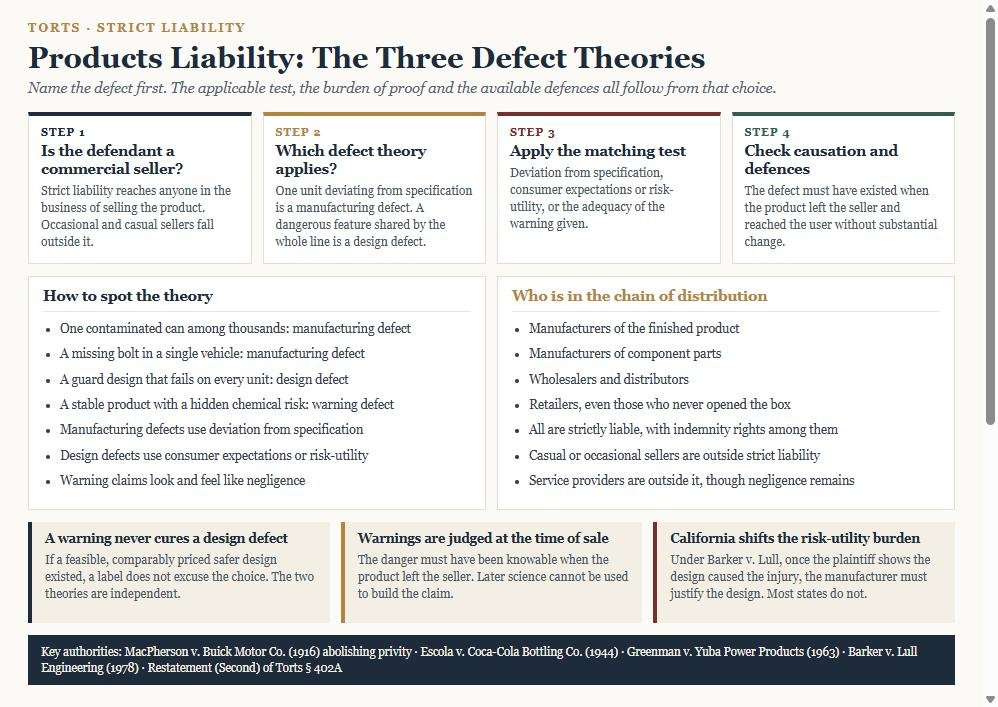
Strict liability, and why it exists
A commercial seller is strictly liable for injuries caused by a product that was defective when it left that seller’s control. The plaintiff does not have to prove carelessness. MacPherson v. Buick Motor Co. first freed product claims from the privity requirement, and Justice Traynor’s concurrence in Escola v. Coca-Cola Bottling Co. supplied the modern rationale: manufacturers place goods on the market, are best placed to spread the cost of injuries through pricing and insurance, and should bear that cost regardless of fault.
Greenman v. Yuba Power Products turned that reasoning into doctrine, and Restatement (Second) of Torts section 402A codified it: any seller engaged in the business of selling a product in a defective condition unreasonably dangerous to the user is liable, even one who exercised all possible care.
Step one: is the defendant a commercial seller?
Strict liability attaches to those in the business of selling that kind of product, which means the whole chain of distribution is exposed: component manufacturers, the manufacturer of the finished item, wholesalers, distributors and retailers. A retailer who never opened the carton is still strictly liable, though indemnity rights usually shift the loss upstream.
Two categories fall outside. A casual or occasional seller, such as a neighbour selling a used lawnmower, is not in the business of selling and faces only a negligence claim. Service providers are likewise outside strict liability, which is why a hybrid transaction requires you to decide whether the essence of the deal was goods or services.
Step two: name the defect
Manufacturing defect
One unit departed from its own design specification. The single contaminated bottle, the one vehicle assembled without a bolt, the batch that came out brittle. The test is deviation: compare the injuring unit against the intended design, and if it differs in a way that made it dangerous, the defect is established.
The spotting rule is simple. If the problem is confined to some units while the rest of the line is fine, you are in manufacturing defect territory and the consumer expectation test does the work comfortably.
Design defect
Every unit shares the dangerous feature, because the design itself is the problem. Two tests are used, and jurisdictions differ on which is available.
- Consumer expectation test. Did the product fail to perform as safely as an ordinary consumer would expect when used in an intended or reasonably foreseeable way?
- Risk-utility test. Do the benefits of the challenged design outweigh its risks, weighing the gravity of the danger, the feasibility of a safer alternative design, and the cost and practicality of adopting it?
California adds a distinctive and plaintiff-friendly wrinkle. Under Barker v. Lull Engineering, once the plaintiff shows the design proximately caused the injury, the burden shifts to the manufacturer to prove that the benefits of the design outweigh its risks. Most jurisdictions leave the risk-utility burden on the plaintiff throughout, so identify the jurisdiction before you allocate the burden.
Warning or information defect
The product was designed and built as intended, but the seller failed to give adequate instructions or warnings about a danger that is not obvious to an ordinary user. This theory behaves much more like negligence than the other two, because the question is what the seller knew or reasonably should have known.
Two constraints matter. The danger must have been knowable at the time of sale, so a plaintiff cannot build a claim on science that emerged afterwards. And the warning must be adequate in content, prominence and placement, not merely present somewhere in a manual.
| Theory | Spotting clue | Test applied | Practical burden |
|---|---|---|---|
| Manufacturing | One unit differs from the rest | Deviation from specification | Plaintiff, but usually easy |
| Design | Every unit shares the feature | Consumer expectations or risk-utility | Plaintiff, except the California shift |
| Warning | Product is fine, the danger is hidden | Adequacy of the warning given | Plaintiff, framed like negligence |
Exam tip: open with one sentence naming the theory and why. “Because every saw in the line used the same guard, this is a design defect rather than a manufacturing defect” earns credit immediately and organises everything that follows.
Step three: causation and condition
The defect must have existed when the product left the defendant’s control, and the product must have reached the user without substantial change. Both requirements generate defences. A modification by an intermediary, removal of a safety guard by an employer, or deterioration through age can each break the chain, though a foreseeable alteration will not always do so.
Causation itself works as in ordinary negligence: the defect must be both a factual and a proximate cause of the injury. In warning cases this produces a distinctive argument, because the defendant will contend that an adequate warning would have made no difference to what the plaintiff actually did.
Defences
- Comparative fault. Most jurisdictions reduce recovery for a plaintiff’s own unreasonable conduct rather than barring it.
- Assumption of risk. Knowing, voluntary encounter with a recognised danger, which overlaps heavily with comparative fault in modern practice.
- Product misuse. Unforeseeable misuse defeats the claim; foreseeable misuse does not, and may itself demand a warning.
- Substantial alteration. A change after sale that caused the injury shifts responsibility to whoever made it.
- State of the art. Relevant mainly to design and warning claims, and framed as feasibility rather than as industry custom.
- Preemption. Federal regulation of certain products can displace state law claims entirely.
Common mistakes that cost points
- Blending manufacturing and design defects instead of asking whether one unit or the whole line was affected.
- Applying only the consumer expectation test to a design claim where risk-utility is available and often decisive.
- Placing the risk-utility burden on the plaintiff in a jurisdiction that shifts it, or shifting it in one that does not.
- Judging the adequacy of a warning by what became known later rather than at the time of sale.
- Treating a warning as a cure for a feasibly avoidable design danger.
- Letting a retailer or distributor out of the case because it did nothing wrong; strict liability does not require fault.
- Applying strict liability to a casual seller or to a pure service provider.
- Forgetting the requirement that the product reached the user without substantial change.
Frequently asked questions
Must the injured person be the buyer?
No. Privity is gone. Users, consumers and, in most jurisdictions, foreseeable bystanders may recover. That breadth is one of the defining features of strict products liability compared with warranty claims.
Can the same facts support more than one theory?
Frequently, and you should plead them all where the facts allow. A design that is dangerous in use may also have been sold without an adequate warning, and a negligence count often runs alongside. The theories are independent, so success on one does not require success on another.
What about purely economic loss?
Strict products liability addresses personal injury and damage to other property. A product that simply fails to work, damaging nothing but the buyer’s expectations, is generally a contract and warranty problem rather than a tort one.
California invented strict products liability: the 2026 position
This is California’s doctrine in a very literal sense. In Greenman v. Yuba Power Products (1963) the California Supreme Court, in an opinion by Justice Traynor building on his own concurrence in Escola v. Coca Cola Bottling Co. (1944), held that a manufacturer is strictly liable when an article it places on the market proves to have a defect that causes injury. Every other state’s law in this area descends from that decision, and California has continued to develop it in ways that diverge from the Restatement.
Design defect is the clearest divergence. Under Barker v. Lull Engineering (1978) a California plaintiff may prove design defect either by showing the product failed to perform as safely as an ordinary consumer would expect, or by showing the risk of danger inherent in the design outweighs its benefits, and on the second route the burden of proof shifts to the defendant. Soule v. General Motors (1994) later confined the consumer expectations test to cases where everyday experience permits a conclusion without expert testimony.
Other California features worth knowing:
- Market share liability originated here. Sindell v. Abbott Laboratories (1980) apportioned liability among manufacturers of a fungible drug where the plaintiff could not identify the maker.
- State of the art matters in warning cases. Anderson v. Owens-Corning (1991) held that a failure to warn claim depends on knowledge available at the time of distribution, unlike design defect.
- The chain of distribution is liable. Retailers and distributors are strictly liable alongside manufacturers, which shapes who is named in county filings.
- Component and raw material suppliers have defences. Liability is limited where the component was not defective and the buyer integrated it.
- Warning statutes overlay the tort. California’s product warning requirements create parallel obligations and their own litigation.
- Mass claims are coordinated. Related California actions are assigned to coordinated proceedings, many of them managed in the Los Angeles Superior Court.
For 2026, plead both design defect theories and let the burden shift work for you. Read with the elements of negligence, warning requirements and res judicata.
Next steps
Products liability sits directly on top of ordinary negligence, so the two should be revised together. Work through the elements of negligence first, because duty, breach, causation and damages supply the vocabulary that the warning-defect analysis borrows almost intact. If your fact pattern involves a sale of goods that also failed commercially, the statute of frauds and MYLEGS and the warranty provisions of the Uniform Commercial Code become relevant alongside the tort claim.
For practice, take a single power-tool injury and rewrite it three times so that a different defect theory is the strongest. Then read the products liability overview at Cornell’s Legal Information Institute and compare the framing in the implied warranty of merchantability to see how tort and contract routes diverge.
Related guides
- Advisory Opinions: Article III and Declaratory Relief
- Access to the Courts: When Filing Fees Are Unconstitutional
- Other Enumerated Powers: Postal, Bankruptcy, Admiralty
- Franchise Amendments: Congress and the Right to Vote
- Property Clause: Congress and Federal Lands Explained
- No Federal Police Power: Enumerated Powers and Enclaves
- Contracts Clause: When States May Impair Agreements
- Takings Clause: Lucas, Penn Central and Just Compensation
- Free Exercise Clause: Smith, Lukumi and Fulton Applied
- Establishment Clause: Church, State and the New Test
- Freedom of Association: Scrutiny, Dale and Disclosure
- Freedom of the Press: Publication Liability and Limits
- Campaign Finance and Anonymous Speech: The Core Rules
- Unconstitutional Conditions: Benefits and Rights Waivers
- Government Speech Doctrine: When the State Can Choose
- Vagueness and Overbreadth: Facial Challenges Explained
- Prior Restraint and Licensing: The Freedman Safeguards
- Symbolic Conduct and the O’Brien Test: The Pivot Question
- Government Employee Speech: Garcetti and Pickering Rules
- Commercial Speech and the Central Hudson Four-Part Test
- Actual Malice and the Three Tracks of Defamation Law
- Public Forum Doctrine and the Time, Place, Manner Test
- First Amendment: The Three-Question Speech Framework
- One Person, One Vote: Voting Rights Under Equal Protection
- Alienage Classifications: Strict Scrutiny and Its Pockets
- Equal Protection: The Three-Step Classification Test
- Second Amendment: The Bruen Text-and-History Standard
- Substantive Due Process After Dobbs: A Two-Step Test
- Procedural Due Process: Notice, Hearing and Mathews
- Incorporation Doctrine: Which Rights Bind the States
- Full Faith and Credit: Recognising Sister-State Judgments
- The Complete Auto Test: Taxing Interstate Commerce
- The Right to Travel: Durational Residency Explained
- Article IV Privileges and Immunities: The Comity Rule
- Federal Preemption: The Three-Step Ladder Explained
- The Supremacy Clause: Floors, Ceilings and Preemption
- Intergovernmental Immunity: The Shield Runs One Way
- The Presidential Pardon Power: Four Limits That Matter
- Executive Privilege: A Qualified Right That Must Yield
- Presidential Immunity: Criminal, Civil and Private Acts
- The Removal Power: At-Will Firing and Its Exceptions
- The Appointment Power: Principal and Inferior Officers
- Take Care Clause: Enforcement Discretion and Its Limits
- Commander-in-Chief Power: Deploy Without Declaring War
- Executive Agreements: The President’s Sole Foreign Power
- The Treaty Power: Senate Advice and Consent Explained
- The Presidential Veto Power, Override and Pocket Veto
- Bicameralism and Presentment: Two Vetoes Struck Down
- The Nondelegation Doctrine and the Intelligible Principle
- Speech or Debate Clause: Absolute but Narrow Immunity
- The Impeachment Power: House Majority, Senate Two-Thirds
- Congress’s Naturalization Power and Citizenship Limits
- Congressional War Powers: Declare, Fund and Command
- Anti-Commandeering Doctrine and the Tenth Amendment
- Section 5 Enforcement Power: Remedy, Do Not Redefine
- The Spending Power and the Five Dole Test Conditions
- Congress’s Taxing Power: When a Penalty Is Really a Tax
- The Necessary and Proper Clause: Congress’s Multiplier
- Ex Post Facto Clause: Retroactive Criminal Laws Barred
- Bills of Attainder: Legislative Punishment Explained
- The Writ of Habeas Corpus: Testing Unlawful Detention
- Supreme Court Jurisdiction: Original vs Appellate Power
- Abstention Doctrine: 4 Ways Federal Courts Step Aside
- Dormant Commerce Clause: Discrimination vs Pike Balancing
- The Commerce Clause: 3 Categories and 2 Hard Limits
- State Action Doctrine: The Government Conduct Threshold
- The Eleventh Amendment and State Sovereign Immunity
- Political Question Doctrine: What Courts Will Not Decide
- Ripeness and Mootness: Timing Rules in Federal Court
- Standing in Federal Court: The 3-Part Article III Test
- Marbury v. Madison and the Power of Judicial Review
- The Youngstown Framework: Presidential Power in 3 Zones
- The IRAC Method: How to Structure a Bar Exam Answer
- Piercing the Corporate Veil: A Two-Prong Alter Ego Test
- Defamation Elements, Fault Standards and Privileges
- The Parol Evidence Rule: Integration and Exceptions
- Recording Acts: Race, Notice and Race-Notice Explained
- Partner Liability and Authority Under RUPA Explained
- Trustee Duties: Care, Loyalty, Impartiality, Accounts
- Specific Performance: A Six-Element Bar Exam Framework
- Will Execution Requirements: Formalities and Rescue
- Community Property Presumptions in California Explained
- Easements Explained: Creation, Scope and Termination
- Miranda Rights: Custody, Interrogation and Invocation
- The Character Evidence Rules: Propensity Bar and Doorways
- Adverse Possession Elements: OCEAN and the Tax Rule
- Business Judgment Rule and Directors’ Fiduciary Duties
- The Statute of Frauds: MYLEGS and How to Satisfy It
- Res Judicata vs Collateral Estoppel: Bar Exam Guide
- The Erie Doctrine Explained: A 4-Step Bar Exam Guide
- Conflicts of Interest: A 6-Step Decision Tree for the Bar
- The Rule Against Perpetuities Explained Step by Step
- Murder and Manslaughter: The Homicide Ladder Explained
- Consideration in Contract Law: Rules and Exceptions
- The Four Elements of Negligence: Bar Exam Breakdown
- The Hearsay Rule Explained: Exceptions and Exemptions
- Personal Jurisdiction: The 3-Step Bar Exam Framework
- 3 Levels of Scrutiny in Constitutional Law Explained
- The Citizenship Clause After Trump v. Barbara