
Article III extends the judicial power to “Cases” and “Controversies”, and those two words do a great deal of work. They mean that a federal court may resolve disputes between real parties, and may do nothing else. It may not answer a legal question posed in the abstract, however important the question or however useful an answer would be to the branch asking it.
That is the no-advisory-opinions doctrine, and it is the oldest and most structural of the justiciability rules. Its practical difficulty is not the principle but the boundary, because federal courts issue forward-looking rulings all the time. A declaratory judgment addresses conduct that has not yet happened and is perfectly justiciable. This guide sets out the three requirements of a genuine controversy, works through Muskrat and Aetna Life, and shows exactly where the line runs.
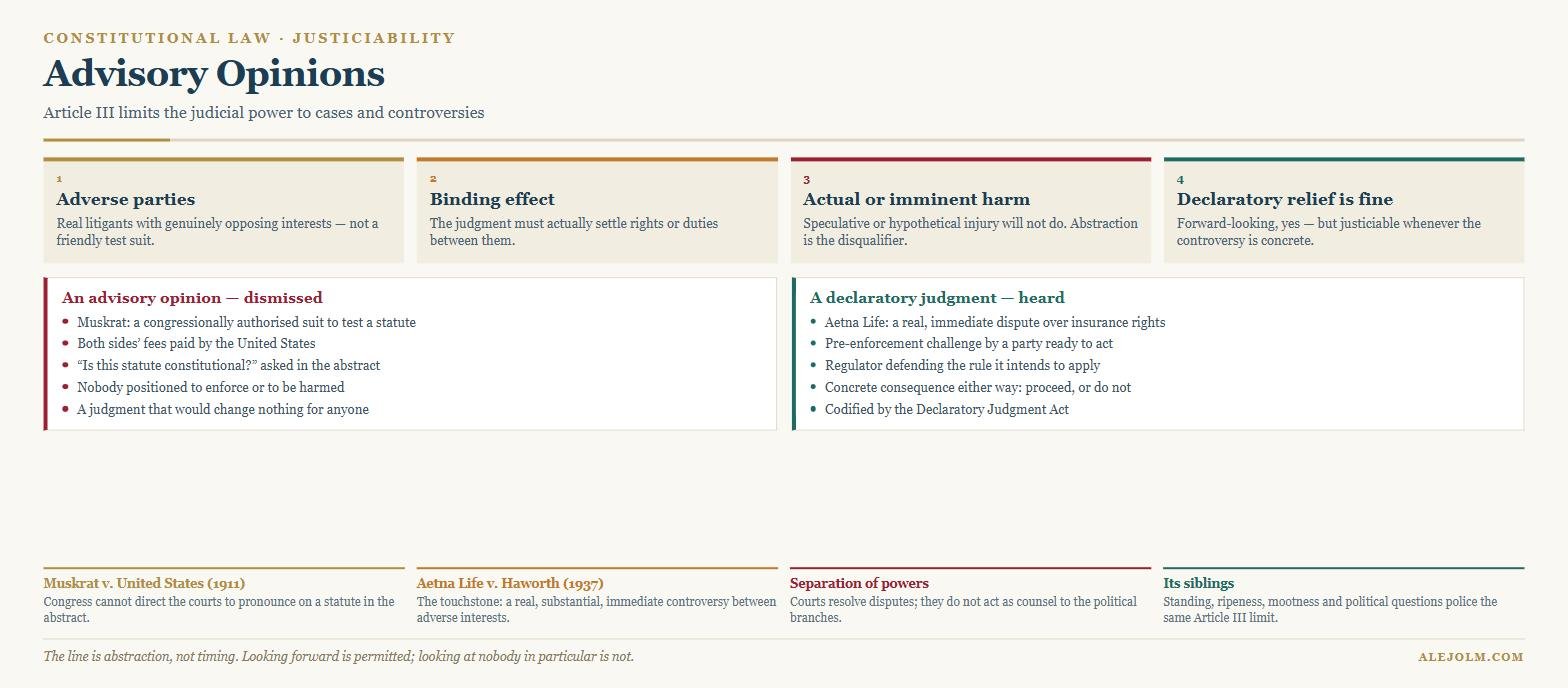
The three requirements of a genuine controversy
An advisory opinion is identified by what it lacks, so the doctrine is best stated positively. Three conditions must be satisfied before a federal court may act.
- Adverse parties. There must be real litigants with genuinely opposing interests. A cooperative arrangement in which both sides want the same outcome is not a controversy, however carefully it is pleaded.
- Binding effect. The court’s decision must actually settle rights or duties between those parties. A pronouncement that changes nothing for anyone is an opinion, not a judgment.
- Actual or imminent harm. The injury must be real or impending rather than speculative or hypothetical. Abstraction is the disqualifier, not futurity.
Behind all three lies a separation-of-powers rationale that is worth articulating on an essay. Courts that answered abstract questions would function as legal advisers to the political branches, pronouncing on legislation before anyone had been affected by it. That is a different constitutional role from resolving disputes, and it would draw the judiciary into policy formation while depriving it of the concrete factual record that adversarial litigation produces. Refusing advisory opinions therefore protects both the courts’ independence and the political branches’ primacy.
Muskrat: the foundational case
Muskrat v. United States (1911) supplies the pattern to recognise. Congress had passed legislation affecting Native American land allotments and, anticipating doubts about its validity, authorised named individuals to bring suit against the United States to test it. The statute provided that the government would pay the fees of both sides.
The Court dismissed the action. There was no genuine adversity: the proceeding had been constructed for the purpose of obtaining a ruling, with the government funding the challenge to its own statute, and nobody’s rights turned on the outcome in the ordinary way. What Congress had really requested was a judicial opinion on a statute’s validity, and Article III does not permit the legislature to direct the courts to supply one.
Two lessons follow. First, congressional authorisation cannot create jurisdiction where the constitutional requirements are absent — a statute may confer jurisdiction over cases, but it cannot convert a non-case into one. Second, the tells of a friendly suit are worth spotting: parties who agree on the desired result, litigation costs borne by the party being sued, a case brought expressly to resolve a legal question rather than a grievance.
Declaratory judgments are not advisory opinions
The most important refinement is that a declaratory judgment — a ruling on the parties’ legal rights in relation to conduct not yet undertaken — is fully justiciable, provided the dispute is concrete. Aetna Life Insurance Co. v. Haworth (1937) established the point, and the Declaratory Judgment Act codifies the practice.
The reason is that the objection to advisory opinions is about abstraction, not about timing. A party who intends to act, faces a real prospect of liability if the intended action is unlawful, and confronts a defendant who asserts the contrary position, is in a genuine dispute. The declaration binds: win, and the conduct may proceed; lose, and it may not. Rights and duties are settled, which is exactly what the third requirement asks for.
The consequence is that pre-enforcement challenges are routinely available. A business that believes a regulation invalid need not violate it and risk penalties in order to litigate; it may seek a declaration first. What it may not do is ask the court to opine on a rule it has no concrete plan to encounter. The distinction, put in one line: a declaratory judgment resolves a real conflict about prospective conduct, whereas an advisory opinion answers a question nobody is presently living with.
Exam tip: when the relief sought is forward-looking, do not conclude it is advisory. Ask whether these parties have a present stake and whether the ruling will bind them. If both are yes, it is a declaratory judgment and it is justiciable.
Applying the line: a worked illustration of the distinction
Consider a pharmaceutical company that has developed a drug and believes an agency regulation requiring particular clinical-trial data is invalid as applied to it. It has not yet applied for approval and no enforcement action has begun. It sues for a declaration that the regulation is unlawful.
This is justiciable. The company has a present, concrete interest: it intends to market the drug and faces a real choice between funding expensive trials, abandoning the product, or proceeding and risking enforcement. The agency has the opposite interest, defending a rule it intends to apply. The parties are genuinely adverse, the harm is imminent rather than speculative, and the declaration will bind — the company will know whether it may proceed and the agency whether it may insist. That the suit precedes enforcement is irrelevant.
Contrast the case that fails. Suppose instead that a legislative committee, having enacted the same regulation, asked a federal court whether it was constitutional, with no company, no application and no enforcement in prospect. Nothing distinguishes this from Muskrat. There are no adverse parties, no injury, and no judgment that would alter anyone’s legal position — and the request would be dismissed however clearly the constitutional question was framed.
Where the doctrine sits among its siblings
The advisory-opinion bar is one of several rules deriving from the same clause, and they are best learned as a family because problems frequently engage more than one. Standing asks whether this plaintiff has suffered a concrete, particularised injury traceable to the defendant and redressable by the court. Ripeness asks whether the dispute has matured sufficiently to be decided. Mootness asks whether it has since dissolved. The political question doctrine asks whether the issue is committed to another branch or lacks judicially manageable standards.
The relationship is one of overlap rather than hierarchy. A request for an advisory opinion will usually fail for want of standing too, since nobody has been injured, and it will often be unripe as well. On an essay, the efficient approach is to identify the Article III requirement most clearly absent and to note the others briefly, rather than treating them as wholly separate enquiries. Note also that these are federal constitutional limits: some state courts are authorised by their own constitutions to give advisory opinions, which is a matter of state law and no answer to the Article III objection.
| Proceeding | Adverse parties? |
|---|---|
| Congressionally authorised test suit (Muskrat) | No — both sides funded by the United States |
| Abstract question on a statute’s validity | No affected litigant |
| Declaratory claim on insurance rights (Aetna) | Yes — real, immediate dispute |
| Pre-enforcement challenge by a regulated firm | Yes — firm intends to act; agency will enforce |
| Challenge to a rule the plaintiff will never encounter | No concrete stake |
| Suit where the injury has already been remedied | Controversy dissolved |
| Dispute committed to another branch | Not a merits question |
| State court giving an advisory opinion | Governed by state law |
Common mistakes that cost points
- Treating any forward-looking claim as advisory. The objection is abstraction, not timing; declaratory relief is justiciable when the dispute is concrete.
- Assuming congressional authorisation cures the defect. Muskrat holds it cannot; a statute cannot convert a non-case into a case.
- Missing the friendly-suit tells — agreed outcomes, the defendant funding the challenge, litigation designed to settle a question.
- Overlooking the binding-effect requirement, which is often the cleanest ground for dismissal.
- Confusing this doctrine with ripeness. A concrete pre-enforcement dispute may be advisory in neither sense.
- Forgetting the separation-of-powers rationale, which is what most essay rubrics reward.
- Assuming state practice is relevant. Some state courts may issue advisory opinions; Article III courts may not.
- Analysing the merits before justiciability. If there is no case or controversy, the merits never arise.
Frequently asked questions
Why can federal courts not issue advisory opinions?
Because Article III extends the judicial power only to cases and controversies. A court answering abstract questions would be advising the political branches rather than resolving disputes, would act without the factual record adversarial litigation produces, and would enter policy formation reserved to others.
How is a declaratory judgment different?
It resolves a real, immediate dispute between adverse parties, even though the conduct in question lies in the future. Under Aetna Life v. Haworth the touchstone is concreteness, not timing, and the declaration binds the parties — which is precisely what an advisory opinion would not do.
Can Congress authorise a suit to test a statute’s constitutionality?
Not if the requirements of a case or controversy are missing. Muskrat dismissed exactly such an arrangement, where the United States funded both sides and no genuine adversity existed. Congress may confer jurisdiction over cases, but it cannot manufacture a case where none exists.
Advisory opinions in California and Los Angeles County in 2026
Federal courts may not issue advisory opinions, and California courts follow the same instinct: they require a genuine controversy rather than an abstract question. But California surrounds its courts with institutions that do exactly what Article III forbids, and knowing where to go for a binding-in-practice answer is a genuinely useful skill in Los Angeles County.
The California Attorney General maintains an opinion unit that issues formal written legal opinions at the request of designated public officials, including district attorneys and county counsel. Those opinions are advisory in the strict sense, yet courts give them substantial weight and public agencies treat them as authoritative until a court says otherwise. At county level, the Los Angeles County Counsel performs the same function internally, advising the Board of Supervisors and county departments on questions that no court would touch in the abstract.
There is also a formal bridge between federal and state courts that resembles an advisory opinion. Under rule 8.548 of the California Rules of Court, the California Supreme Court may answer a question of California law certified to it by the Ninth Circuit or another federal appellate court. No state controversy is before the court; it is answering a question so that a federal case can be resolved.
How this plays out locally:
- Certified questions are common in Los Angeles litigation. Employment and insurance cases from the Central District of California regularly reach the California Supreme Court this way when state law is unsettled.
- Declaratory relief is the litigant’s substitute. Section 1060 of the California Code of Civil Procedure permits a judgment on an actual controversy before any breach, which is not an advisory opinion but does much of the same work.
- Validation actions pre-clear public financing. Sections 860 and following let a local agency obtain a judgment confirming the legality of bonds and contracts in advance.
- Ethics advice is available prospectively. The State Bar of California and the Fair Political Practices Commission both issue advice on proposed conduct, which shields the requester who follows it.
- County counsel opinions are not public rulings. They bind no one outside the county and are often privileged, so do not cite them as precedent.
- Writ practice fills the gap for urgency. Where a real dispute exists but no judgment is available, mandamus in the Los Angeles Superior Court is the usual route.
For 2026 the takeaway is that the prohibition on advisory opinions constrains courts, not government generally. See standing and ripeness and mootness for the doctrines that enforce the limit, and the political question doctrine for questions courts decline on separation of powers grounds.
Next steps
This doctrine belongs with the rest of Article III justiciability, so read it beside standing, which asks whether the particular plaintiff has a concrete injury, and ripeness and mootness, which police whether the dispute has matured or dissolved. The political question doctrine completes the set by identifying issues committed to the other branches. Where a case does clear these hurdles, the framework that follows is the levels of scrutiny.
The opinions in Muskrat and Aetna Life are short and repay a full reading, and both are freely available through Justia’s Article III collection. Cornell’s Legal Information Institute keeps a concise entry with current citations, and candidates should confirm the tested scope against the outlines published by the State Bar of California.
Related guides
 Government Employee Speech: Garcetti and Pickering Rules
 Executive Agreements: The President’s Sole Foreign Power
 Presidential Immunity: Criminal, Civil and Private Acts
 Easements Explained: Creation, Scope and Termination
 Abstention Doctrine: 4 Ways Federal Courts Step Aside
 The Appointment Power: Principal and Inferior Officers
 Alienage Classifications: Strict Scrutiny and Its Pockets
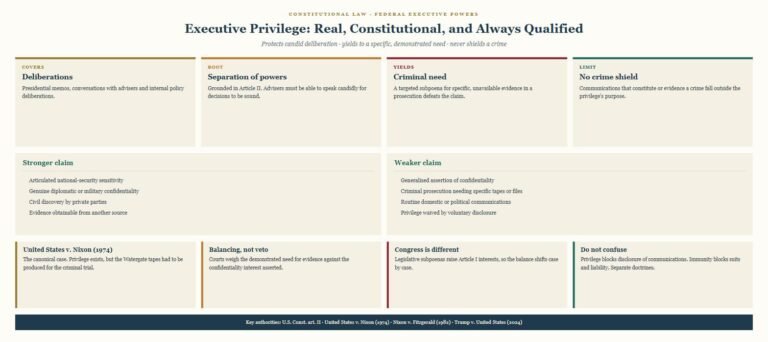 Executive Privilege: A Qualified Right That Must Yield
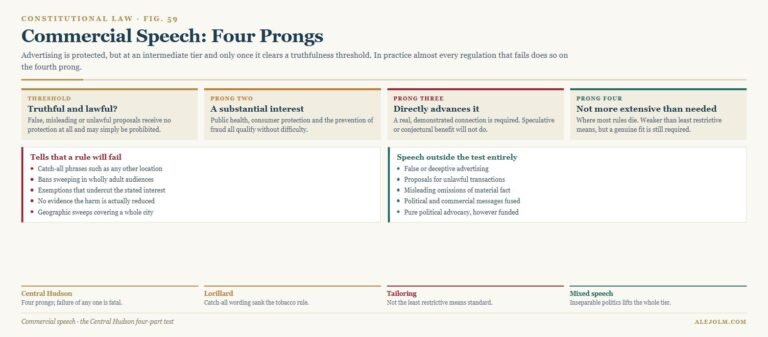 Commercial Speech and the Central Hudson Four-Part Test
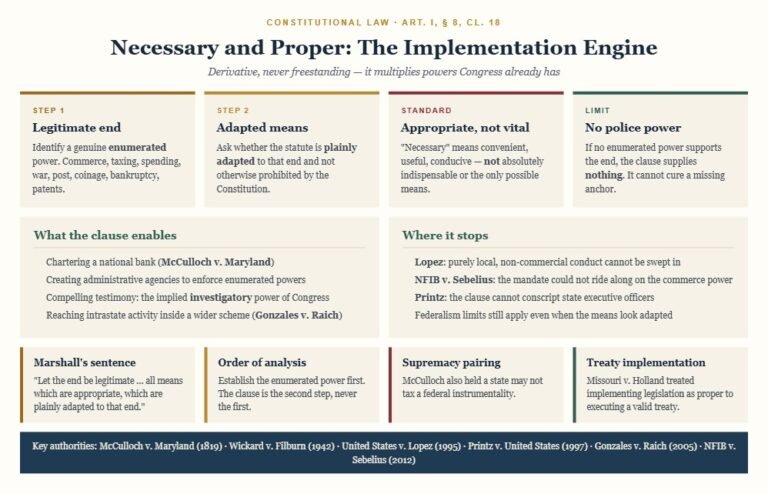 The Necessary and Proper Clause: Congress’s Multiplier
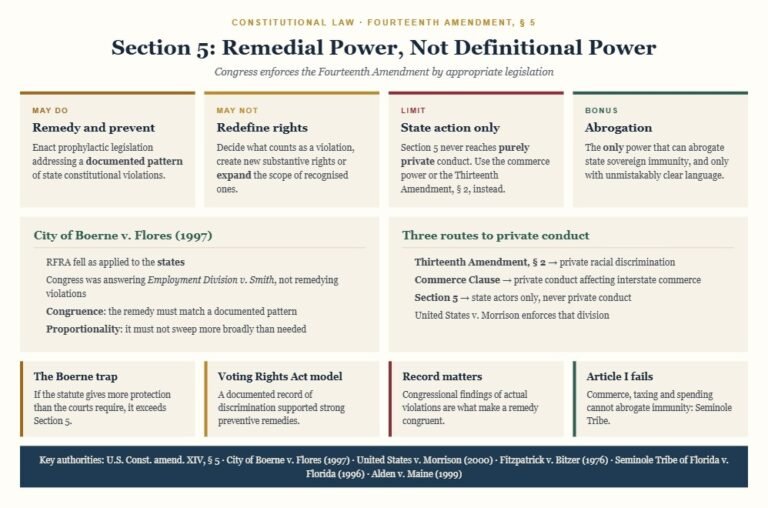 Section 5 Enforcement Power: Remedy, Do Not Redefine
 3 Levels of Scrutiny in Constitutional Law Explained