
A public employer is both an employer and an arm of the state, and the doctrine governing its employees’ speech tries to hold those two roles apart. It does so through a sequence of gates rather than a balancing exercise, which is why so many answers go wrong: candidates start weighing interests before establishing that there is anything to weigh.
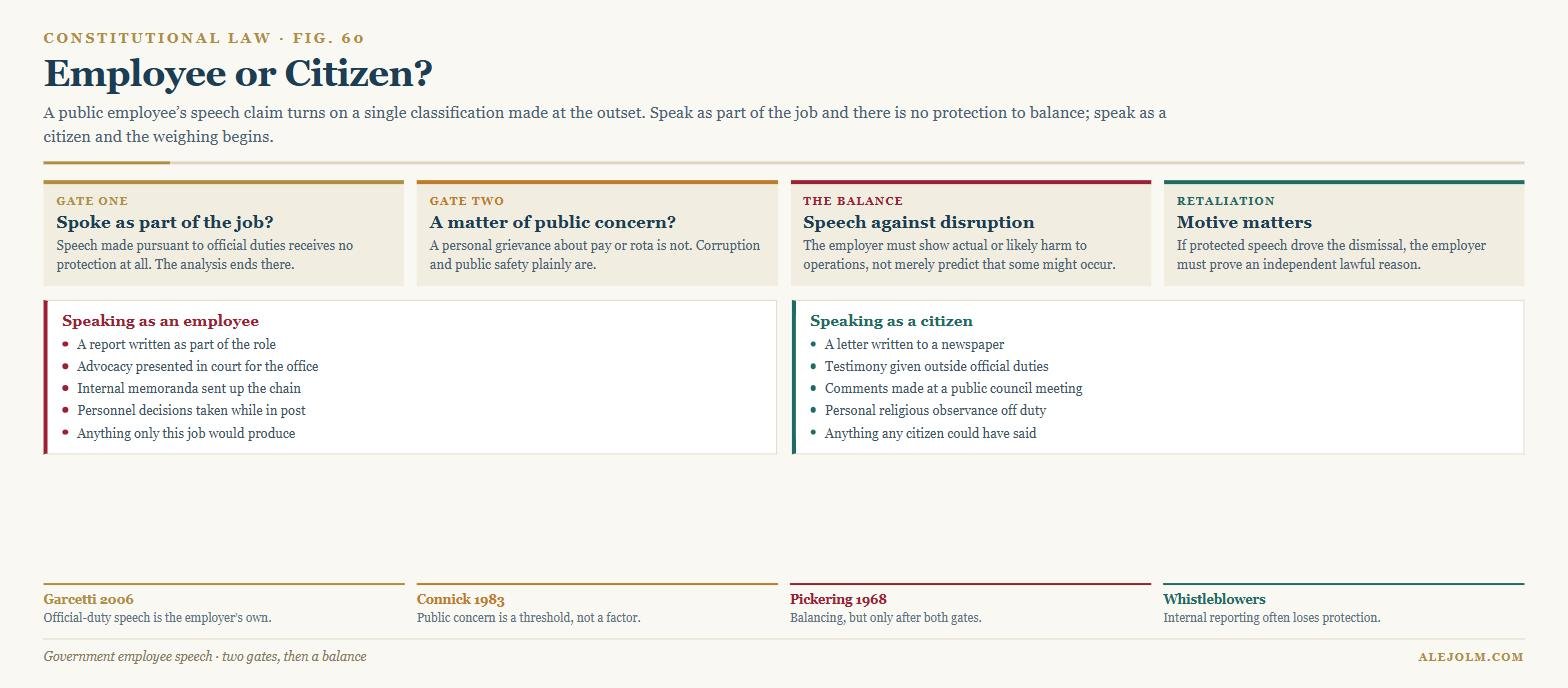
Two questions come first. Did the employee speak as part of the job? If so, the claim is over. If not, did the speech address a matter of public concern? Only when both gates are passed does the balancing begin.
Gate one: speaking pursuant to official duties
Where an employee speaks in the course of performing the job, the speech is treated as the government’s own rather than the individual’s. A report prepared because the role requires it, an argument advanced in court on the employer’s behalf, a memorandum sent up the chain of command, a decision taken in post — all of this the employer may control, direct and discipline without answering to the First Amendment at all.
The reasoning is that the government is entitled to control what it pays people to say. The consequence is stark and worth stating plainly: this gate closes even when the employee is telling the truth about serious wrongdoing. Accuracy does not rescue a claim if the speech was made as part of the role.
A useful practical test is whether an ordinary citizen could have said the same thing in the same way. If the speech exists only because the job exists — a case file, an inspection report, an internal recommendation — it is employee speech. If any member of the public could have written the letter or attended the meeting, it is citizen speech.
Gate two: a matter of public concern
Citizen speech is protected only if it addresses something of political, social or community significance. Allegations of corruption, threats to public safety, civil-rights abuses, misuse of funds and suppression of evidence all qualify comfortably. What does not qualify is a personal employment grievance dressed up as a public issue.
This distinction is genuinely load-bearing. A complaint about one’s own rota, pay grade, line manager or office allocation is a private matter, and dismissal over it raises no constitutional question however unfair it may be. The line is not about whether the employee feels strongly, nor about whether the complaint is justified, but about whether the community has a stake in the subject.
Exam tip: treat public concern as a threshold rather than as one factor in a balance. If the speech is a personal grievance, say so and stop. Sliding it into the balancing exercise as a weak factor is a structural error examiners notice.
The balance
Once both gates are passed, the employee’s interest in speaking is weighed against the employer’s interest in running an effective operation. Relevant considerations include whether the speech disrupted work, damaged necessary working relationships, undermined discipline or authority, provoked insubordination, or destroyed trust in a role that depends on it.
Two points about how the balance is actually struck. First, the disruption must be real or genuinely likely; an employer’s speculation that trouble might follow will not carry the day, and a bare assertion of reputational embarrassment is close to worthless. Second, the availability of internal channels cuts both ways. If a grievance procedure or ethics line existed and was never tried, that tells in the employer’s favour. If internal routes were exhausted, or were themselves the source of the problem because it was management that suppressed the matter, the employee’s interest in going public strengthens considerably.
| Situation | Which framework |
|---|---|
| Inspection report written as part of the role | Official-duty speech |
| Letter to a newspaper about suppressed evidence | Citizen speech, public concern |
| Internal complaint about one’s own pay | Citizen speech, private matter |
| Testimony given under subpoena | Citizen speech, usually public concern |
| Personal prayer or observance while off duty | Citizen speech |
Why whistleblowers often lose
The interaction between the two gates produces a result that strikes many people as perverse. An officer whose job is to investigate misconduct, and who reports misconduct through the proper internal channel, has spoken pursuant to official duties and has no constitutional protection. Doing exactly what the role requires forfeits the claim.
Going outside the institution can change the classification. A letter to a newspaper, evidence given to a legislature, a complaint to a body with no connection to the employee’s duties — these may be citizen speech, and if the subject is public concern the balancing stage is reached. That is not a guarantee of success, because confidentiality and operational-trust arguments remain available to the employer, but it is the difference between having a claim and having none. Statutory whistleblower schemes often fill this gap, and they operate independently of the constitutional analysis.
Worked example
An agency investigator documents pollution at a factory as part of her duties. She discovers that the director suppressed her report to shield a political donor. She writes to a local newspaper, naming herself and the agency, criticising the suppression and the risk to public health. She is dismissed for insubordination and breach of confidentiality, and sues.
Separate the two acts of speech, because they fall on opposite sides of the first gate. The report itself was written pursuant to her duties, so it carries no protection and the employer could have handled it as it wished. The letter is different: writing to a newspaper is not part of her role, and any citizen could have done it, so she spoke as a citizen. Gate two is satisfied without difficulty, since the suppression of environmental evidence to protect a donor is squarely a matter of public concern. At the balancing stage her interest is close to the strongest the doctrine recognises. The employer points to confidentiality and insubordination, but identifies no actual operational disruption, and its real objection appears to be the publicity itself, which is not a legitimate interest. Her speech was protected and the dismissal, being motivated by it, is unconstitutional.
Change one fact. Suppose she had raised the identical concerns only in a memorandum to her supervisor, as her job required, and been dismissed for that. The first gate now closes: the memorandum was official-duty speech, no balancing occurs, and her constitutional claim fails entirely. She would have to look to a statutory whistleblower protection instead.
Common mistakes that cost points
- Running the balancing test on official-duty speech, when the first gate ends the analysis outright.
- Treating public concern as a factor to be weighed rather than as a threshold to be passed.
- Assuming a personal workplace grievance becomes public concern because the employer is a public body.
- Accepting the employer’s prediction of disruption instead of requiring actual or likely harm.
- Assuming whistleblowers are always protected, when internal reporting within the role usually is not.
- Forgetting to check state action, since the whole doctrine presupposes a government employer.
- Overlooking the parallel procedural due process claim that a dismissal often generates alongside the speech claim.
- Ignoring the burden shift: once protected speech is shown to have motivated the action, the employer must prove an independent lawful reason.
Frequently asked questions
Can a public employer dismiss someone for a social media post?
It depends on the same two gates. A post made in a personal capacity about a matter of public concern is citizen speech and reaches the balancing stage, where the employer must show real operational harm. A post published as part of the role, or one dealing only with a personal grievance, attracts no protection.
Does telling the truth about wrongdoing guarantee protection?
No. Truth is not the test. If the disclosure was made pursuant to official duties it receives no constitutional protection however accurate it was, which is why external disclosure and statutory whistleblower schemes matter so much in practice.
How much disruption must the employer prove?
Enough to be real rather than hypothetical. Evidence that working relationships broke down, that discipline or authority was undermined, or that trust essential to the role was destroyed will count. Generalised concern about embarrassment or adverse publicity will not.
Garcetti came from Los Angeles County: employee speech in 2026
The controlling modern case on public employee speech is a Los Angeles County case. Richard Ceballos was a deputy district attorney in the Los Angeles County District Attorney‘s office who wrote a memorandum questioning the accuracy of a search warrant affidavit and alleged retaliation followed. In Garcetti v. Ceballos (2006) the Supreme Court held that when public employees speak pursuant to their official duties they are not speaking as citizens, so the First Amendment does not shield those statements from employer discipline.
That holding sharply limited federal protection, and California responded with statutes that fill much of the gap. Section 1102.5 of the California Labor Code protects employees, including public employees, who disclose suspected violations of law to a government agency or to a person with authority over them internally. Because it expressly covers internal reporting, it protects precisely the conduct Garcetti left exposed, and it is now the primary vehicle for retaliation claims in the Los Angeles Superior Court.
The framework a county employee actually has:
- Run the federal sequence. Official duty speech is unprotected; otherwise ask whether the speech addressed a matter of public concern and then balance under Pickering.
- Whistleblower statutes do the real work. Section 1102.5 has a favourable causation standard and allows civil penalties, making it stronger than the constitutional claim.
- Political activity is protected by statute. Labor Code provisions bar employers from controlling employees’ political activity, and separate rules restrict political activity on public time.
- Peace officers have procedural rights. The Public Safety Officers Procedural Bill of Rights in the California Government Code governs interrogation and discipline of Sheriff’s Department personnel.
- Government Claims Act deadlines apply. A damages claim against the county must be presented before suit.
- Academic and testimonial speech is different. Courts have declined to extend Garcetti to sworn testimony, which remains citizen speech.
In 2026, plead the statutory retaliation claim first and the constitutional claim second. Read with the First Amendment framework, unconstitutional conditions and government speech.
Next steps
Start with the First Amendment framework for the routine this doctrine specialises, and confirm the state action doctrine is satisfied before running it at all. Because dismissal cases almost always raise a second claim, procedural due process is essential companion reading, and public forum doctrine covers speech on government property more generally.
The leading opinions are collected at Justia, the amendment is annotated by the Cornell Legal Information Institute, and current examination scope is published by the State Bar of California.
Related guides
 Miranda Rights: Custody, Interrogation and Invocation
 Abstention Doctrine: 4 Ways Federal Courts Step Aside
 Ripeness and Mootness: Timing Rules in Federal Court
 Incorporation Doctrine: Which Rights Bind the States
 Easements Explained: Creation, Scope and Termination
 Bicameralism and Presentment: Two Vetoes Struck Down
 Symbolic Conduct and the O’Brien Test: The Pivot Question
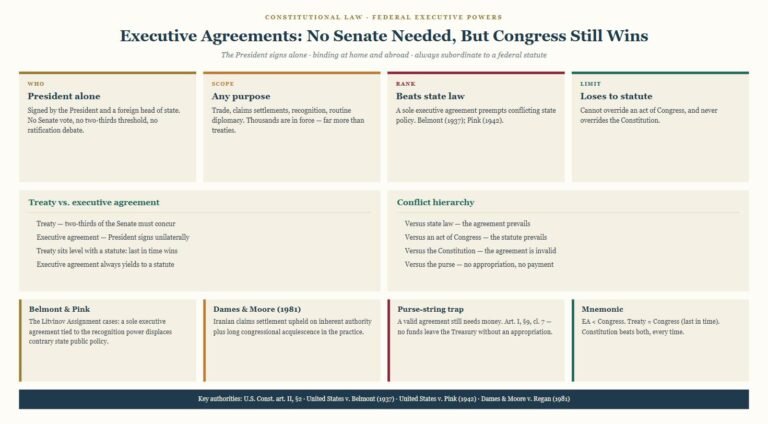 Executive Agreements: The President’s Sole Foreign Power
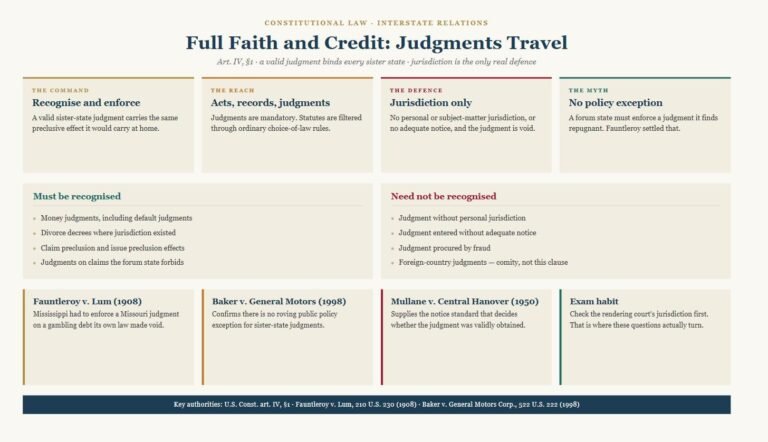 Full Faith and Credit: Recognising Sister-State Judgments
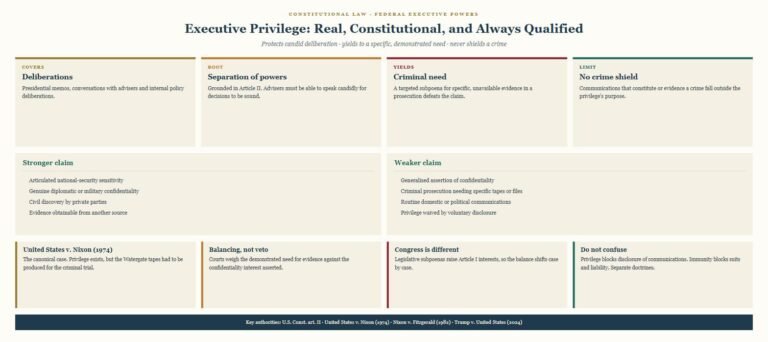 Executive Privilege: A Qualified Right That Must Yield
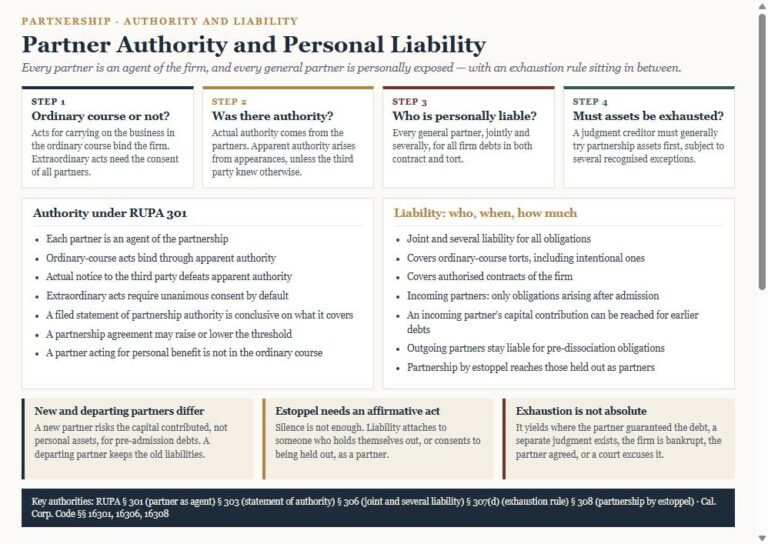 Partner Liability and Authority Under RUPA Explained
 Personal Jurisdiction: The 3-Step Bar Exam Framework