
Most students learn early that the United States makes binding international commitments through treaties approved by two-thirds of the Senate. Then they meet a fact pattern where the President signs a deal with a foreign head of state, the Senate never votes, and the deal still binds the country. That is the world of executive agreements, and it is far larger than the treaty world: thousands are in force at any given moment, and the Supreme Court has upheld them again and again.
The good news for exam purposes is that the doctrine reduces to two questions. First, is the instrument an executive agreement or a treaty? Second, what is the executive agreement colliding with — state law, an act of Congress, or the Constitution? Answer those two questions in order and almost every executive-agreement issue resolves itself.
What an executive agreement actually is
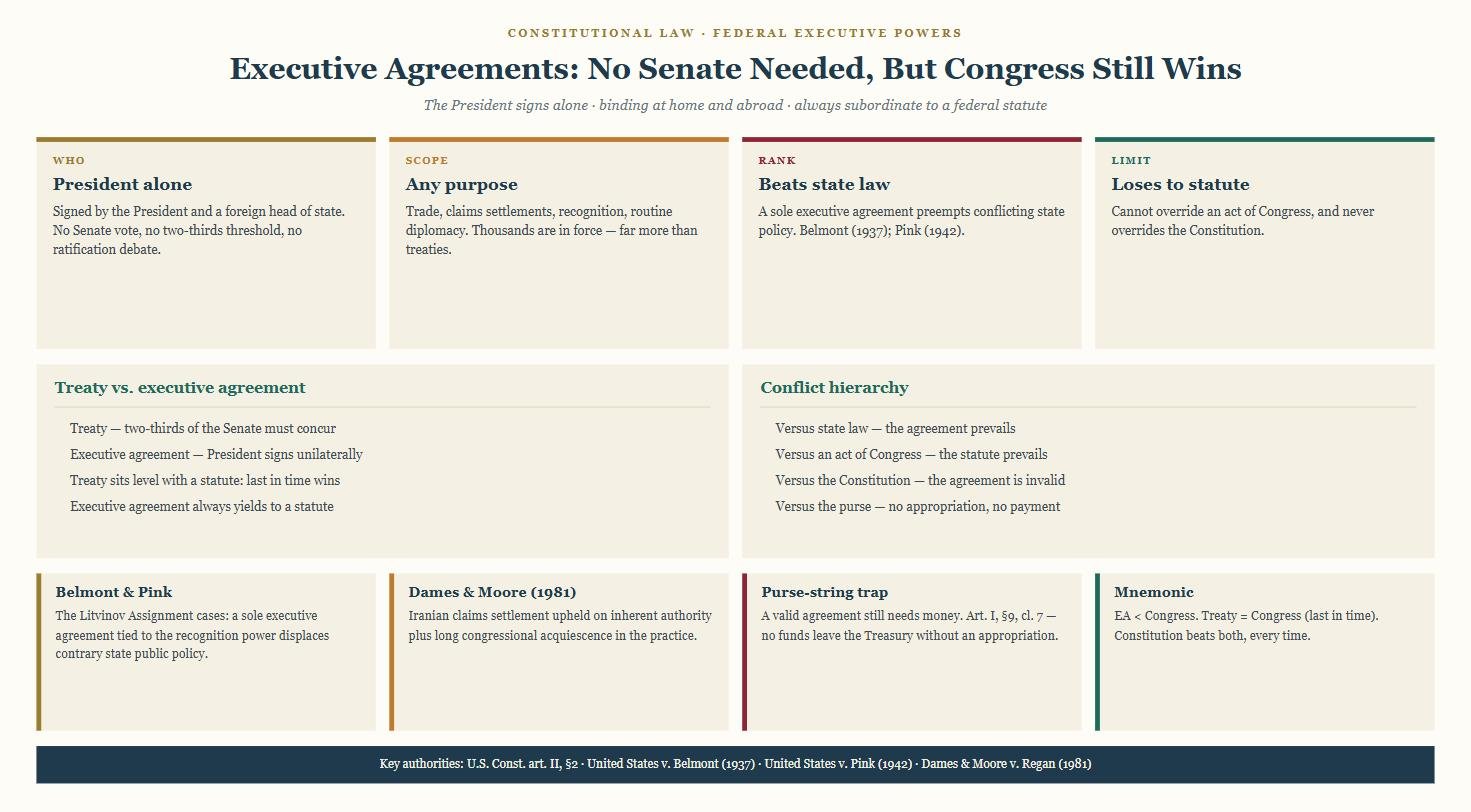
An executive agreement is an agreement between the United States and a foreign nation entered into by the President alone, for any purpose. It becomes effective when the President and the foreign head of state sign it. No Senate approval is required, and there is no formal ratification step to wait for.
The authority comes from the President’s inherent power over foreign affairs, sometimes reinforced by a prior congressional delegation. Once signed, the agreement is binding as a matter of both international and domestic law — but it sits below federal statutes and below the Constitution in the hierarchy of American law.
- The President signs unilaterally; no legislative vote is needed.
- Subject matter is unrestricted in theory, and enormously varied in practice.
- Courts have repeatedly enforced them, including against contrary state law.
- They remain subordinate to acts of Congress and to constitutional limits.
Treaty or executive agreement? The line that examiners test
There is no crisp textual test separating the two instruments, which is exactly why the distinction shows up on exams. In practice, scope, permanence, and whether the arrangement reshapes domestic law all point toward treaty status. Routine diplomatic arrangements, claims settlements, and trade deals negotiated under authority Congress already granted point toward executive-agreement status.
Courts rarely second-guess how the President characterizes an agreement. But the theoretical possibility remains that a commitment is simply too consequential for unilateral action — a defense pact promising automatic military retaliation, for example, brushes up against Congress’s exclusive power to declare war.
| Feature | Treaty | Executive agreement |
|---|---|---|
| Who approves it | President signs; two-thirds of senators present concur | President signs alone |
| Constitutional hook | Art. II, §2, cl. 2 | Inherent foreign-affairs power, sometimes plus a statutory delegation |
| Versus conflicting state law | Preempts it | Preempts it |
| Versus a federal statute | Same tier — last in time controls | The statute always controls |
| Versus the Constitution | Invalid to the extent it conflicts | Invalid to the extent it conflicts |
| Typical subject matter | Arms control, extradition, major multilateral regimes | Claims settlements, delegated trade deals, routine diplomacy |
Where an executive agreement ranks
Think of three collisions. Against state law, the executive agreement wins, because the President’s foreign-affairs authority displaces contrary state policy. Against an act of Congress, the executive agreement loses, because the President is executing law rather than making it. Against the Constitution, the agreement is simply invalid; no international commitment can cancel free speech, free exercise, or any other constitutional guarantee.
Exam tip: memorize the inequality and you have the doctrine. Executive agreement is greater than state law, but less than an act of Congress. A treaty, by contrast, is level with a statute, so the later-enacted instrument controls.
There is a fourth collision that catches careful students: the appropriations power. Even a perfectly valid agreement promising money cannot move a dollar out of the Treasury without an appropriation, because Article I, §9, cl. 7 forbids it. Validity and funding are separate questions.
The cases worth knowing
The foundational authorities are United States v. Belmont (1937) and United States v. Pink (1942), both growing out of the Litvinov Assignment. When President Roosevelt recognized the Soviet Union, the recognition was accompanied by an agreement assigning certain Soviet nationalization claims to the United States. New York tried to apply its own public-policy rule to defeat the assignment. The Court held that the sole executive agreement was valid and displaced the conflicting state rule, because the recognition power and the agreements attending it belong to the President alone.
Dames & Moore v. Regan (1981) extended the reasoning to claims settlements. The agreement resolving American property claims against Iran was upheld even though it affected individual property rights, resting on a combination of inherent presidential authority and Congress’s long acquiescence in the practice of executive claims settlement. That acquiescence point is the doctrinal engine: sustained congressional silence in the face of repeated presidential practice strengthens the President’s hand.
Worked example
The President negotiates an executive agreement with Nation X settling a claims dispute, promising a $100 million payment for past takings of property. The President signs without any congressional involvement. Congress later objects and refuses to appropriate the money. Must Congress pay?
Start with validity. Claims settlement is squarely within the tradition Dames & Moore blessed, so the agreement is a valid executive agreement even though the Senate never voted. Now separate validity from funding. Article I, §9, cl. 7 permits no money to be drawn from the Treasury except pursuant to an appropriation made by law. The President therefore cannot spend what Congress has not appropriated. Conclusion: the agreement stands, but it goes unfunded until Congress chooses to pay. Congress controls the purse, and that control is a practical veto over presidential foreign policy.
Change one fact. Suppose instead the agreement commits American forces to automatic military response if Nation X is attacked. Now the problem is not funding but scope. An automatic war commitment arguably intrudes on Congress’s exclusive authority to declare war, so the agreement may exceed what the President can do unilaterally. The lesson: an executive agreement can be attacked either for lack of money or for reaching subject matter reserved to Congress.
Common mistakes that cost points
- Assuming every international agreement is a treaty needing Senate ratification. Executive agreements are valid, common, and constitutionally settled.
- Ranking executive agreements below treaties as a general matter. Both bind domestically; the meaningful difference is how each fares against a statute.
- Forgetting that an executive agreement always loses to an act of Congress, while a treaty merely ties with one.
- Applying the last-in-time rule to executive agreements. That rule belongs to treaties and statutes, which share a tier.
- Overlooking the appropriations requirement and concluding that a valid agreement automatically obligates payment.
- Ignoring subject-matter limits. An agreement restructuring constitutional arrangements or committing the nation to war may exceed presidential power.
- Treating Belmont and Pink as preemption cases about statutes. They are about a sole executive agreement beating state law.
- Missing the Youngstown overlay. Congressional authorization, silence, or prohibition changes how much deference the President receives.
Frequently asked questions
Can an executive agreement preempt state law?
Yes. That is precisely what Belmont and Pink hold. A sole executive agreement grounded in the President’s foreign-affairs authority displaces contrary state law, and a state cannot invoke its own public policy to escape it.
Can Congress override an executive agreement?
Yes. Because an executive agreement ranks below federal legislation, a statute inconsistent with the agreement controls domestically. The United States may still bear international responsibility for the breach, but American courts follow the statute.
How often does this appear on the bar exam?
Executive agreements are tested intermittently, and usually as a foil for the treaty power or inside a broader separation-of-powers question. Knowing the approval difference and the ranking rule is enough for nearly every appearance.
Executive agreements and California foreign policy, 2026
California conducts something close to its own foreign relations, and that has produced the leading modern case on the preemptive force of executive foreign policy. In American Insurance Association v. Garamendi (2003) the Supreme Court struck down California’s Holocaust Victim Insurance Relief Act, which required insurers doing business in the state to disclose policies issued in Europe before and during the Second World War. The statute conflicted with the approach the President had adopted through executive agreements establishing claims resolution mechanisms, and it fell even though no treaty or statute expressly preempted it.
That decision sets the boundary California has had to work within since. Its subsequent international arrangements have been structured as cooperative, non-binding or market-linking measures rather than as agreements purporting to bind sovereigns. When the federal government challenged the linkage of California’s emissions trading programme with a Canadian province, the district court rejected the claim that it constituted an unlawful treaty or interstate compact, in part because the arrangement was terminable and created no binding obligation.
Los Angeles County is where the consequences are felt most directly, because the San Pedro Bay port complex is the country’s principal gateway for trans-Pacific trade. The categories to keep distinct:
- Sole executive agreements bind domestically. Dames & Moore v. Regan (1981) upheld settlement of claims by executive agreement, and such agreements can displace state and county law.
- Congressional-executive agreements are common. Most trade arrangements affecting the Los Angeles and Long Beach ports take this form rather than the treaty form.
- States may not enter compacts without consent. The Compact Clause limits binding arrangements, which is why California keeps its climate cooperation non-binding.
- Intrusive state foreign policy is preempted. Under Zschernig v. Miller reasoning, state action that requires judging foreign governments is vulnerable.
- Procurement and divestment measures are risky. County or city rules targeting foreign conduct invite preemption objections, and the Los Angeles County Counsel reviews them accordingly.
- Sister-city and trade promotion is safe. Los Angeles maintains numerous sister-city relationships, and promotional activity creates no obligations and raises no constitutional issue.
In 2026, ask whether the state or county measure binds anyone abroad or merely regulates local conduct. Read with the treaty power, preemption and the dormant Commerce Clause.
Next steps
Study this doctrine next to its neighbors. Compare the formal route in the treaty power and Senate advice and consent, then look at the military side in congressional war powers, and finish with the domestic check the President wields in the presidential veto power.
For primary sources, read Dames & Moore v. Regan and United States v. Belmont on Justia, review the text of Article II on Cornell Legal Information Institute, and confirm current subject coverage with the State Bar of California.
Related guides
 Marbury v. Madison and the Power of Judicial Review
 Speech or Debate Clause: Absolute but Narrow Immunity
 Recording Acts: Race, Notice and Race-Notice Explained
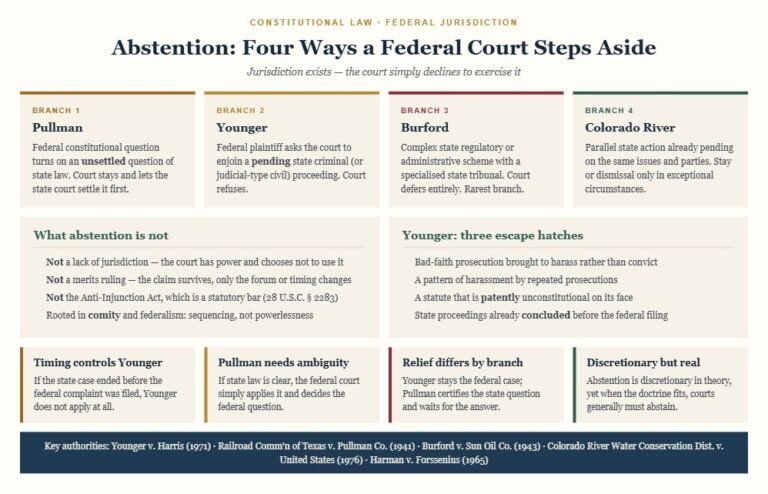 Abstention Doctrine: 4 Ways Federal Courts Step Aside
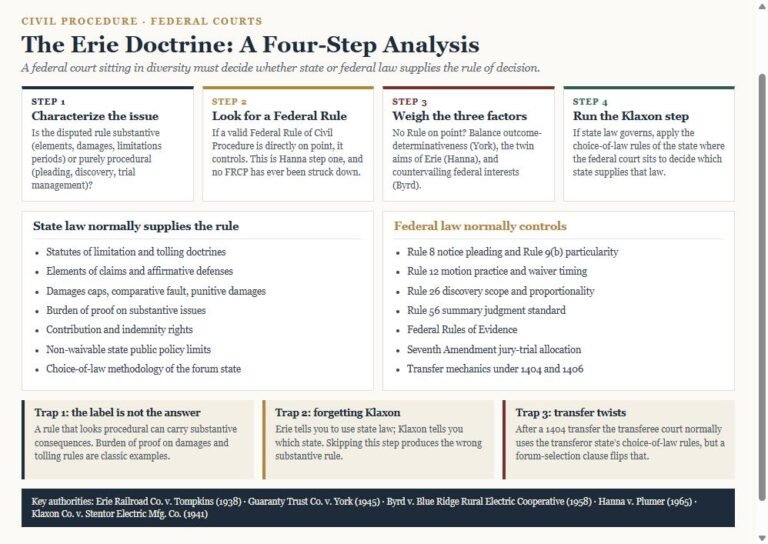 The Erie Doctrine Explained: A 4-Step Bar Exam Guide
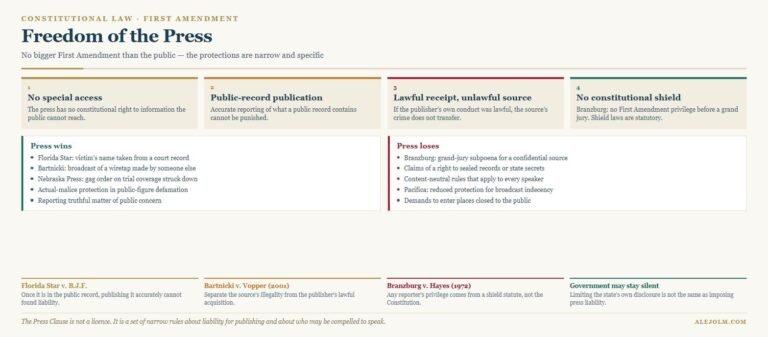 Freedom of the Press: Publication Liability and Limits
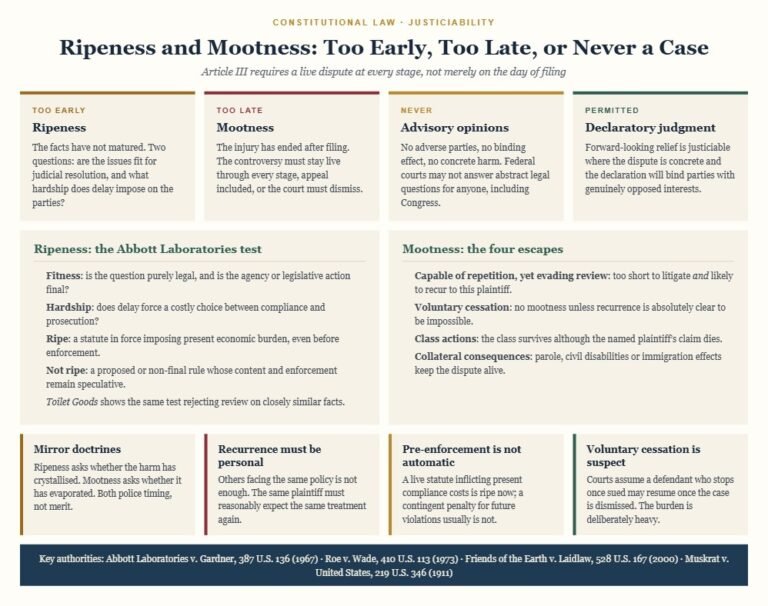 Ripeness and Mootness: Timing Rules in Federal Court
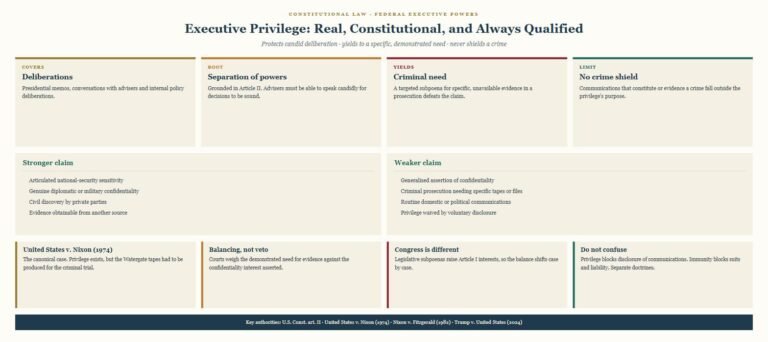 Executive Privilege: A Qualified Right That Must Yield
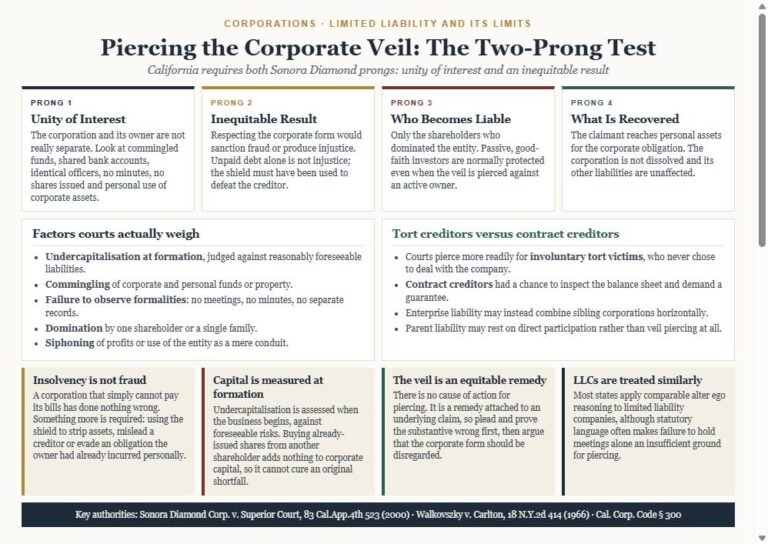 Piercing the Corporate Veil: A Two-Prong Alter Ego Test
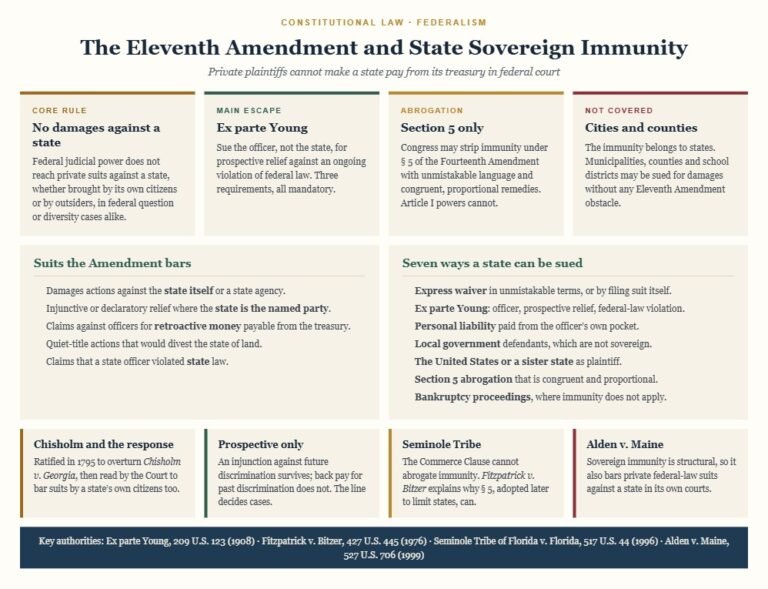 The Eleventh Amendment and State Sovereign Immunity
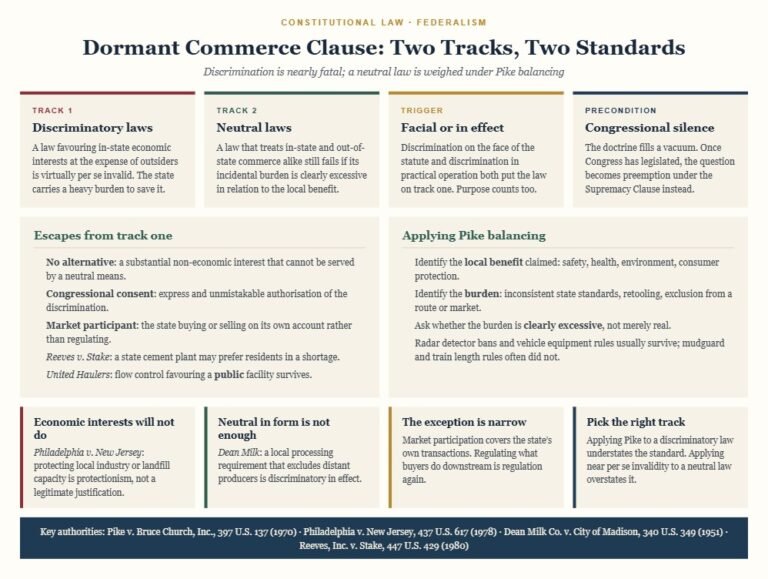 Dormant Commerce Clause: Discrimination vs Pike Balancing
 Contracts Clause: When States May Impair Agreements