
Supreme Court jurisdiction is far narrower than most people assume. The Court sits at the apex of the federal system, yet its original docket covers only a handful of disputes and its appellate docket is almost entirely discretionary. Knowing where the limits fall turns a vague question into a three-step checklist.
This guide explains the two categories of original jurisdiction, the requirements for appellate review, the meaning of the Rule of Four, why a denial of certiorari decides nothing, and how the adequate and independent state-law grounds doctrine removes cases from the Court’s reach entirely.
Original jurisdiction: two narrow categories
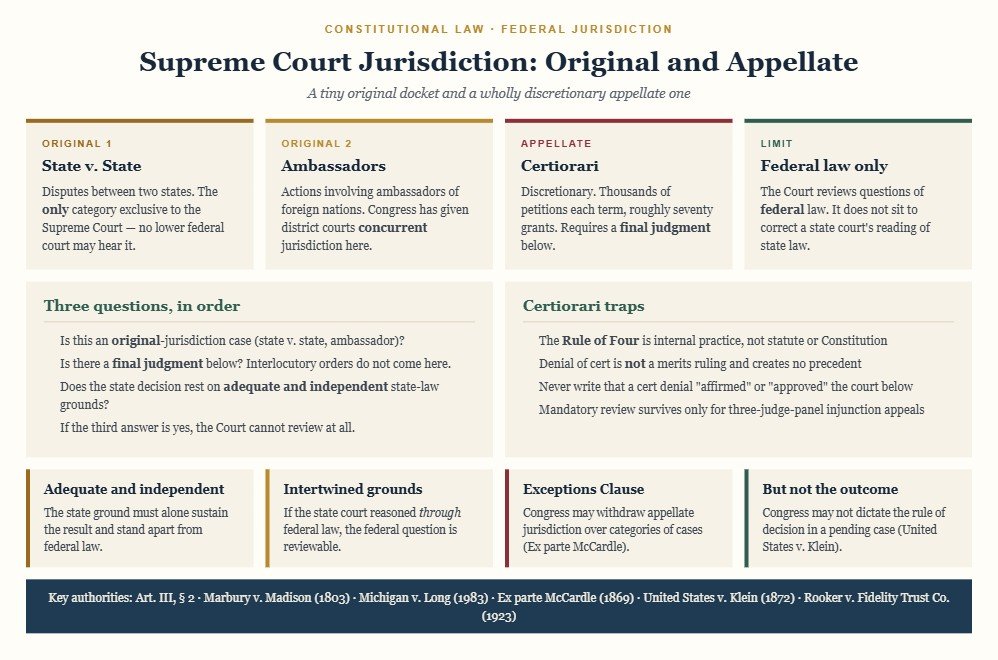
Article III, § 2 gives the Court original jurisdiction over controversies between states and over actions involving ambassadors. Only the first is exclusive: a dispute between two states can be heard nowhere else. For ambassador cases Congress has granted the federal district courts concurrent jurisdiction, so the Supreme Court is one option rather than the only one.
Marbury v. Madison supplies the structural rule that keeps this list short. Congress cannot enlarge the Court’s original jurisdiction by statute, because the Article III enumeration is a ceiling rather than a floor.
Exam tip: a fact pattern in which two states quarrel over a river boundary belongs in the Supreme Court and nowhere else. That is the only exclusive slice of the original docket.
Appellate jurisdiction and the certiorari process
Everything else arrives on appeal, and almost always by writ of certiorari. Two threshold requirements apply. First, there must be a final judgment below; a party cannot bring an evidentiary ruling or a preliminary order straight to the Court. Second, at least four Justices must vote to grant review.
The Rule of Four
The Rule of Four is an internal practice of the Court, not a constitutional command or a statute. Four Justices can bring a case in even if a majority doubts that review is warranted. Because it is a convention, it can be described but not enforced.
Why a cert denial decides nothing
A denial of certiorari means only that fewer than four Justices wanted the case. It is not a ruling on the merits, it approves nothing, and it creates no precedent for any court. Writing that the Court “affirmed” a decision by denying review is a classic and expensive error.
Adequate and independent state-law grounds
The Court reviews questions of federal law. If a state court’s judgment rests on state-law grounds that are both independent of federal law and adequate to sustain the result on their own, there is no federal question left to decide and the Court lacks jurisdiction. Michigan v. Long added a presumption of reviewability where the state court is ambiguous about its footing, which is why state opinions now often say expressly that they rely on state law alone.
The doctrine turns on two words. Independent means the state ground stands apart from federal law rather than being derived from it. Adequate means the state ground by itself supports the outcome. If the state court reasoned through the federal Constitution to reach its reading of state law, the grounds are intertwined and review is available.
| Situation | Reviewable by the Supreme Court? | Why |
|---|---|---|
| State court relies solely on a state constitutional privacy clause | No | The state ground is independent and adequate |
| State court reads state law “in conjunction with” the Due Process Clause | Yes | Federal law is woven into the reasoning |
| State court is silent about its footing | Presumed yes | Michigan v. Long presumption of federal reliance |
| Interlocutory evidentiary ruling | No | No final judgment |
| Two states dispute a boundary | Yes, originally and exclusively | Art. III, § 2 state-versus-state category |
Worked example: suppression on state grounds
A state appellate court suppresses evidence, resting expressly on a state constitutional privacy provision that it says is broader than the Fourth Amendment. The prosecution petitions for certiorari, arguing the Fourth Amendment does not require suppression. The state ground is independent, since the court did not derive it from federal doctrine, and it is adequate, because suppression follows from it alone. The Court lacks jurisdiction.
Now suppose the same court wrote that the state clause protects privacy “as informed by the Fourth Amendment”. The grounds are intertwined, the federal question is essential to the outcome, and the Court may review. The facts of the search never changed; only the state court’s stated footing did.
Congressional control of appellate jurisdiction
The Exceptions Clause of Article III, § 2 lets Congress make exceptions to the Court’s appellate jurisdiction. Ex parte McCardle upheld the repeal of appellate jurisdiction over a pending habeas appeal. The power is not unlimited: United States v. Klein held that Congress may not use jurisdiction-stripping to dictate the rule of decision in a pending case, and the Court has never accepted that Congress could strip away its essential role in maintaining a uniform body of federal constitutional law.
Common mistakes that cost points
- Treating a cert denial as an affirmance. It resolves nothing and binds nobody.
- Assuming all original jurisdiction is exclusive. Only state-versus-state disputes are.
- Letting Congress expand the original docket. Marbury forbids it.
- Applying the state-grounds doctrine when the reasoning is intertwined. Then the federal question is open.
- Forgetting the final judgment requirement and sending an interlocutory order to the Court.
- Describing the Rule of Four as a statutory or constitutional rule.
- Overlooking Michigan v. Long, which presumes reviewability when the state court is ambiguous.
- Ignoring the Klein limit when a question involves jurisdiction-stripping legislation.
Frequently asked questions
Can a case go straight from a state trial court to the Supreme Court?
Only after a final judgment in the highest state court in which a decision could be had. The Court reviews completed litigation, not cases in progress.
Does the Supreme Court ever have to hear a case?
Almost never. A narrow residue of mandatory appellate jurisdiction survives for direct appeals from three-judge federal district court panels granting or denying injunctive relief.
Why do state courts now say “as a matter of state law alone”?
Because of Michigan v. Long. A plain statement that the decision rests on state law forecloses Supreme Court review and protects the state court’s judgment.
Getting from Los Angeles to the Supreme Court in 2026
Cases from Los Angeles County reach the United States Supreme Court by two distinct routes, and confusing them is a common error. A case that begins in the Los Angeles Superior Court travels through the California Court of Appeal for the Second Appellate District, then to the California Supreme Court, and only then may be taken up on certiorari from a final judgment of the highest state court in which review was available. A case begun in the Central District of California travels through the Ninth Circuit instead.
The state route carries a trap. Review is available only if the decision turns on federal law, and under the rule confirmed in Michigan v. Long (1983) the Court will assume it does unless the state court states plainly that it rests on an adequate and independent state ground. California courts that wish to insulate a ruling therefore say so expressly, and California’s Truth in Evidence provision makes such insulation impossible in search and seizure cases, because state suppression law is tied to federal standards by the California Constitution itself.
Practical points on getting up and across:
- Exhaust state review first. A petition for review to the California Supreme Court is normally required before certiorari, even though that court’s review is discretionary.
- Denial of review is not a merits decision. A summary denial leaves the Court of Appeal opinion as the operative judgment.
- Certification runs the other way too. Under the California Rules of Court the Ninth Circuit may certify unsettled California questions to the California Supreme Court.
- Original jurisdiction is narrow. Disputes between states go directly to the Court, which is how interstate water litigation affecting California has proceeded.
- Congress controls appellate jurisdiction. The exceptions clause permits statutory limits, though attempts to strip jurisdiction raise separate constitutional questions.
- Habeas is a separate track. Federal review of a state conviction proceeds under the habeas statute, with its own exhaustion and deference rules.
For 2026, identify whether the judgment is final and whether the federal ground is clearly stated. Read with judicial review, abstention and habeas corpus.
Next steps
Supreme Court jurisdiction is the last of the structural gatekeeping doctrines, so revise it with the others. See Marbury v. Madison and the Power of Judicial Review for the foundation, Abstention Doctrine: 4 Ways Federal Courts Step Aside for federal-state deference, and Political Question Doctrine: What Courts Will Not Decide for the subjects courts refuse outright.
For primary sources, read Michigan v. Long and Ex parte McCardle at Justia, the explanations of certiorari and appellate jurisdiction at Cornell LII, and the examination scope published by the State Bar of California.
Related guides
 Marbury v. Madison and the Power of Judicial Review
 Recording Acts: Race, Notice and Race-Notice Explained
 The Youngstown Framework: Presidential Power in 3 Zones
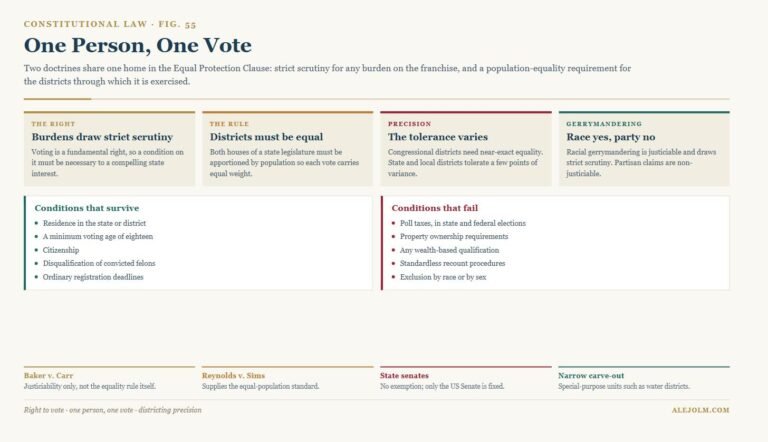 One Person, One Vote: Voting Rights Under Equal Protection
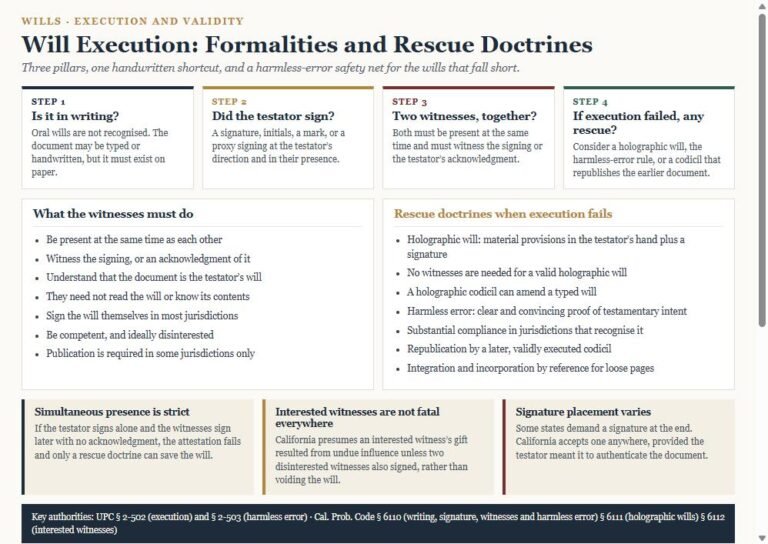 Will Execution Requirements: Formalities and Rescue
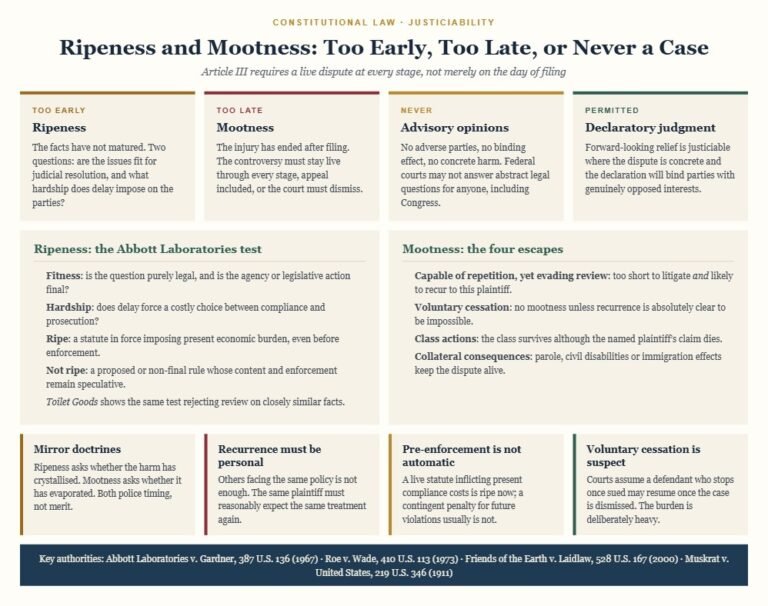 Ripeness and Mootness: Timing Rules in Federal Court
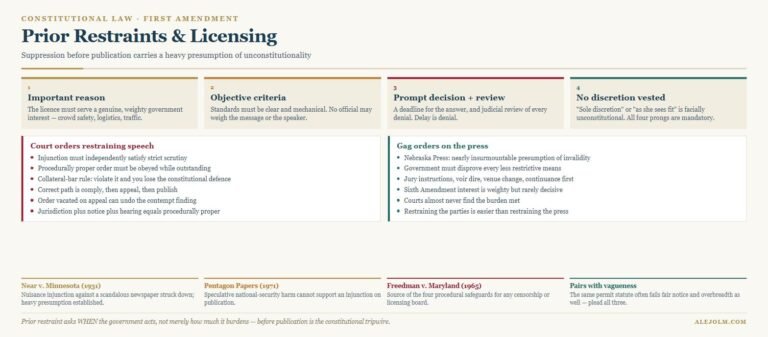 Prior Restraint and Licensing: The Freedman Safeguards
 Full Faith and Credit: Recognising Sister-State Judgments
 Partner Liability and Authority Under RUPA Explained
 Easements Explained: Creation, Scope and Termination
 The Erie Doctrine Explained: A 4-Step Bar Exam Guide
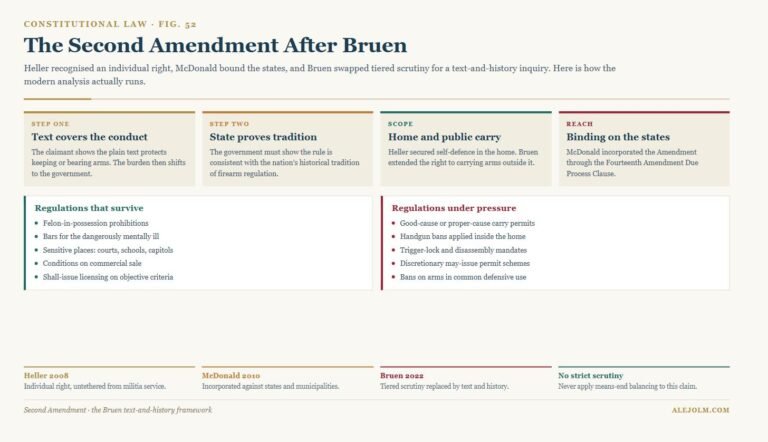 Second Amendment: The Bruen Text-and-History Standard