
A state tells out-of-state lawyers they may not join its bar unless they move in. Another charges non-resident commercial fishermen a licence fee a hundred times what its own residents pay. Both statutes run into the same one-sentence provision of Article IV, and both are almost certainly unconstitutional.
The Article IV Privileges and Immunities Clause says that the citizens of each state are entitled to all privileges and immunities of citizens in the several states. It is a comity rule: whatever a state gives its own citizens in the way of fundamental rights, it must extend to citizens of sister states. The doctrine is compact, but it has three filters and one very narrow defence, and each of them decides real cases.
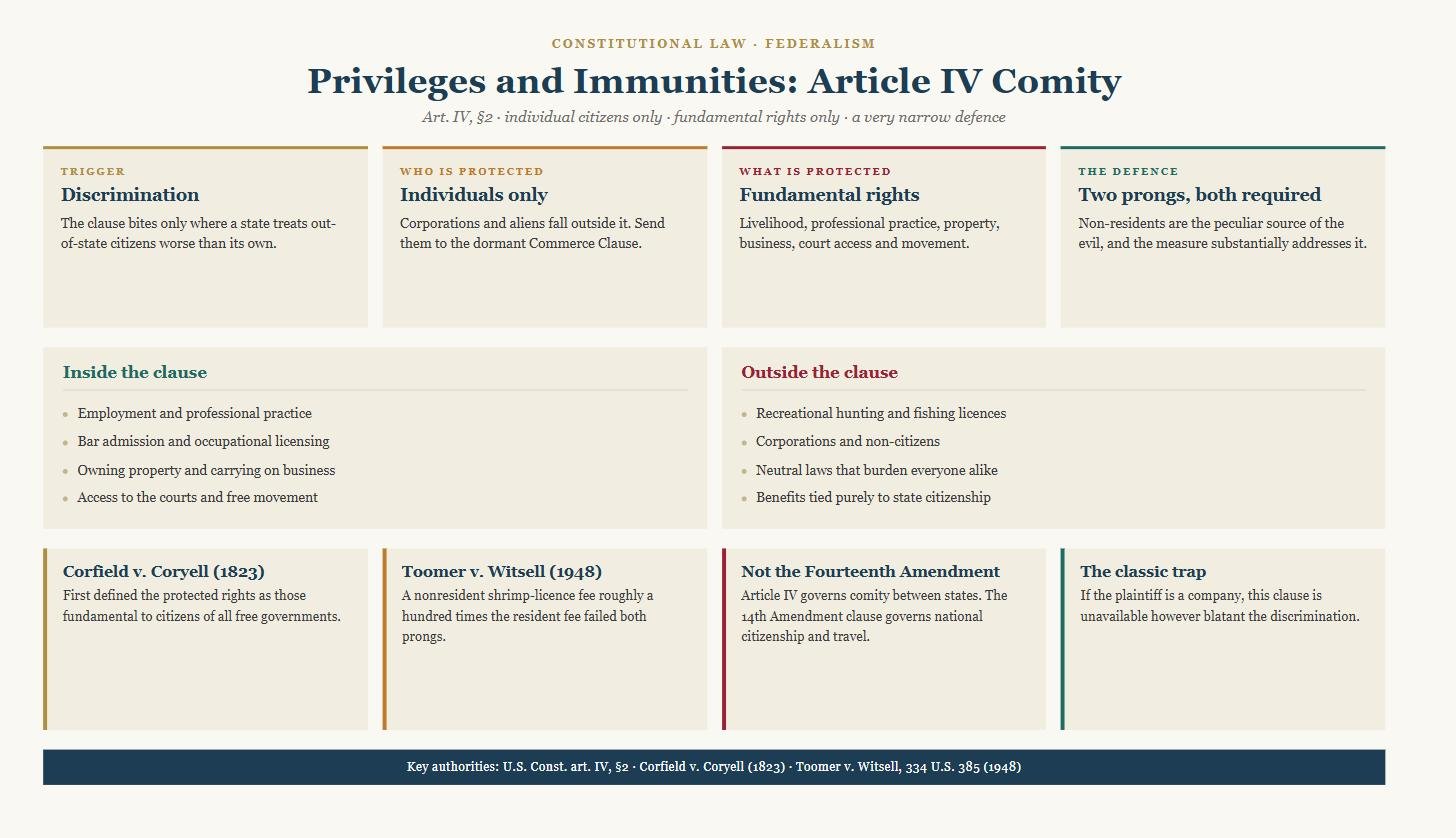
Filter one: there must be discrimination
The clause is an anti-discrimination provision, not a general guarantee of good treatment. If a state law applies identically to residents and non-residents, Article IV drops out of the analysis entirely, however heavy the burden it imposes. A high licence fee charged to everyone raises no comity issue; a lower fee for residents raises nothing else.
That makes the first question mechanical. Compare the treatment of the state’s own citizens with the treatment of citizens of other states. If the answer is the same, stop.
Filter two: only individual citizens are protected
This is the most heavily tested trap in the doctrine. The clause speaks of the “citizens of each State”, and courts have read that literally. Corporations are not citizens for these purposes, and neither are aliens. A company facing plainly protectionist state legislation has no Article IV claim at all.
That is not the end of its case, of course. It has the dormant Commerce Clause, which reaches discrimination against out-of-state commerce regardless of who owns the business. Knowing which claim belongs to which plaintiff is half of what these questions are testing.
Filter three: only rights fundamental to national unity
Not every state-conferred advantage is a privilege or immunity. The protected category, traced to Justice Bushrod Washington’s circuit opinion in Corfield v. Coryell (1823), covers rights fundamental to citizens of all free governments. In modern practice that means two clusters: civil liberties such as access to the courts and freedom of movement, and economic rights bearing on livelihood — employment, professional practice, owning property and carrying on a business.
Recreation sits outside. A state may charge non-residents far more for a hunting or sport-fishing licence, because recreational access to state game is treated as a benefit the state may reserve for those who fund it. The moment the activity becomes a trade rather than a pastime, the analysis flips, which is exactly the line that decided the shrimping cases.
The defence: two prongs, both mandatory
Once discrimination against a protected right is shown, the state carries the burden of justification, and it must satisfy both halves of a demanding test. First, non-residents must be a peculiar source of the evil the state is addressing. Second, the discrimination must bear a substantial relationship to that evil, with no adequate less-discriminatory alternative available.
The first prong does most of the killing. If residents contribute to the same problem, non-residents are not its peculiar source and the defence collapses at once. Toomer v. Witsell (1948) is the leading application: South Carolina defended a hugely disproportionate non-resident shrimp-boat fee as a conservation measure, but resident boats depleted the same stock, and the fee bore no demonstrated relationship to the extra costs the state claimed.
Exam tip: state the burden out loud. The state must prove both prongs. A question that merely asserts that outsiders are “causing the problem” has not begun to satisfy the first one.
Article IV is not the Fourteenth Amendment
Two clauses share almost the same name and almost nothing else. Article IV, Section 2 governs comity between states: it stops State A from treating citizens of State B as second class. The Fourteenth Amendment’s Privileges or Immunities Clause concerns the rights of national citizenship and is the modern home of the right to travel, as Saenz v. Roe (1999) confirmed when it struck down a durational residency limit on welfare benefits.
| Question | Which doctrine |
|---|---|
| State charges out-of-state citizens more to practise a trade | Article IV Privileges and Immunities |
| State burdens an out-of-state corporation’s business | Dormant Commerce Clause |
| State pays newcomers lower benefits than long-term residents | Fourteenth Amendment Privileges or Immunities — right to travel |
| State law burdens residents and non-residents alike | Neither — no discrimination to attack |
| State reserves cheap sport-fishing licences for residents | Neither — recreation is not a fundamental right |
| State refuses out-of-state citizens access to its courts | Article IV Privileges and Immunities |
Worked example
State M limits commercial fishing licences to its own residents, defending the rule on the ground that out-of-state boats are depleting its fish stocks. Commercial fishermen from State N sue under Article IV.
The fishermen win. Commercial fishing is a livelihood, so a protected privilege; the plaintiffs are individual citizens, so within the clause; and the rule is facially discriminatory, so the trigger is satisfied. The burden shifts to State M, which must show that non-residents are the peculiar source of the depletion. If resident boats fish the same waters and cause comparable depletion — and the record almost always shows they do — the first prong fails and the inquiry is over. Even if it did not, a flat resident-only ban would struggle on the second prong, because catch limits and seasons would address depletion without discriminating at all.
Change one fact. Suppose the plaintiff is a fishing company incorporated in State N rather than an individual. Article IV is unavailable, and the challenge must be repleaded under the dormant Commerce Clause, where the discrimination will very likely still be fatal but the framework and the defences are different.
Common mistakes that cost points
- Bringing an Article IV claim on behalf of a corporation or an alien. Neither is a protected citizen.
- Assuming every difference in treatment is unconstitutional. Recreational privileges may be reserved for residents.
- Forgetting that the clause needs discrimination. A neutral burden, however severe, is outside it.
- Confusing Article IV comity with the Fourteenth Amendment right to travel.
- Letting the state satisfy the defence by asserting a problem without proving that residents do not cause it too.
- Ignoring the less-discriminatory-alternative element inside the second prong.
Frequently asked questions
Does the clause apply to the federal government?
No. It restrains states in their treatment of each other’s citizens. Federal discrimination between residents of different states raises different questions, generally under equal protection principles applied to the federal government through the Fifth Amendment.
Are residency requirements for public employment always invalid?
Not always, but they are vulnerable. A requirement that municipal employees live in the city has been sustained in some settings on the strength of genuine local justifications, while blanket resident-preference schemes for private construction work have failed. The analysis is always the two-prong test, applied on the record.
Can a state charge non-residents higher tuition at its universities?
Generally yes. Subsidised tuition is treated as a benefit funded by resident taxpayers rather than a right fundamental to national unity, so a bona fide residency classification for tuition purposes survives.
Article IV privileges and immunities in Los Angeles County, 2026
This clause restrains discrimination against citizens of other states in matters fundamental to the national union, principally the pursuit of a livelihood. The Los Angeles connection is direct, because the leading municipal case involved exactly the kind of ordinance large California cities favour.
In United Building and Construction Trades Council v. Camden (1984) the Court held that a municipal ordinance requiring a percentage of workers on city-funded construction projects to be city residents was subject to the clause, even though it burdened in-state non-residents as well as out-of-state ones. Local hire requirements attached to public works and project labour agreements in Los Angeles therefore sit within the doctrine’s reach and must be justified by a substantial reason with a close relation between the discrimination and the evil addressed.
How the analysis runs locally:
- Livelihood is the protected interest. Employment, professional practice and commercial activity qualify; recreational licences generally do not.
- Higher fees for non-resident hunting and fishing survive. Recreation is not fundamental, so differential pricing is permissible.
- Bar admission cannot require residency. The State Bar of California admits qualified applicants without a residence requirement, consistent with the clause.
- The market participant exception does not apply. Unlike the dormant Commerce Clause, spending its own money does not exempt the county or city here.
- Corporations and aliens are outside the clause. Only citizens are protected, so corporate plaintiffs must use the Commerce Clause instead.
- Substantial reason means evidence. A city defending local hire must show unemployment data or spillover effects, not merely assert local benefit.
For 2026, ask whether the burdened interest is fundamental and then whether the discrimination is closely tailored to a real problem. Read with the dormant Commerce Clause, the right to travel and equal protection.
Next steps
Read this beside the dormant Commerce Clause, which handles the claims corporations must bring, then the Supremacy Clause and federal preemption for conflicts with federal law, and the three levels of scrutiny for the standards that govern discrimination claims elsewhere in the Constitution.
For primary sources, read Toomer v. Witsell on Justia and Saenz v. Roe also on Justia, review Article IV on Cornell Legal Information Institute, and confirm current subject coverage with the State Bar of California.
Related guides
- Advisory Opinions: Article III and Declaratory Relief
- Access to the Courts: When Filing Fees Are Unconstitutional
- Other Enumerated Powers: Postal, Bankruptcy, Admiralty
- Franchise Amendments: Congress and the Right to Vote
- Property Clause: Congress and Federal Lands Explained
- No Federal Police Power: Enumerated Powers and Enclaves
- Contracts Clause: When States May Impair Agreements
- Takings Clause: Lucas, Penn Central and Just Compensation
- Free Exercise Clause: Smith, Lukumi and Fulton Applied
- Establishment Clause: Church, State and the New Test
- Freedom of Association: Scrutiny, Dale and Disclosure
- Freedom of the Press: Publication Liability and Limits
- Campaign Finance and Anonymous Speech: The Core Rules
- Unconstitutional Conditions: Benefits and Rights Waivers
- Government Speech Doctrine: When the State Can Choose
- Vagueness and Overbreadth: Facial Challenges Explained
- Prior Restraint and Licensing: The Freedman Safeguards
- Symbolic Conduct and the O’Brien Test: The Pivot Question
- Government Employee Speech: Garcetti and Pickering Rules
- Commercial Speech and the Central Hudson Four-Part Test
- Actual Malice and the Three Tracks of Defamation Law
- Public Forum Doctrine and the Time, Place, Manner Test
- First Amendment: The Three-Question Speech Framework
- One Person, One Vote: Voting Rights Under Equal Protection
- Alienage Classifications: Strict Scrutiny and Its Pockets
- Equal Protection: The Three-Step Classification Test
- Second Amendment: The Bruen Text-and-History Standard
- Substantive Due Process After Dobbs: A Two-Step Test
- Procedural Due Process: Notice, Hearing and Mathews
- Incorporation Doctrine: Which Rights Bind the States
- Full Faith and Credit: Recognising Sister-State Judgments
- The Complete Auto Test: Taxing Interstate Commerce
- The Right to Travel: Durational Residency Explained
- Federal Preemption: The Three-Step Ladder Explained
- The Supremacy Clause: Floors, Ceilings and Preemption
- Intergovernmental Immunity: The Shield Runs One Way
- The Presidential Pardon Power: Four Limits That Matter
- Executive Privilege: A Qualified Right That Must Yield
- Presidential Immunity: Criminal, Civil and Private Acts
- The Removal Power: At-Will Firing and Its Exceptions
- The Appointment Power: Principal and Inferior Officers
- Take Care Clause: Enforcement Discretion and Its Limits
- Commander-in-Chief Power: Deploy Without Declaring War
- Executive Agreements: The President’s Sole Foreign Power
- The Treaty Power: Senate Advice and Consent Explained
- The Presidential Veto Power, Override and Pocket Veto
- Bicameralism and Presentment: Two Vetoes Struck Down
- The Nondelegation Doctrine and the Intelligible Principle
- Speech or Debate Clause: Absolute but Narrow Immunity
- The Impeachment Power: House Majority, Senate Two-Thirds
- Congress’s Naturalization Power and Citizenship Limits
- Congressional War Powers: Declare, Fund and Command
- Anti-Commandeering Doctrine and the Tenth Amendment
- Section 5 Enforcement Power: Remedy, Do Not Redefine
- The Spending Power and the Five Dole Test Conditions
- Congress’s Taxing Power: When a Penalty Is Really a Tax
- The Necessary and Proper Clause: Congress’s Multiplier
- Ex Post Facto Clause: Retroactive Criminal Laws Barred
- Bills of Attainder: Legislative Punishment Explained
- The Writ of Habeas Corpus: Testing Unlawful Detention
- Supreme Court Jurisdiction: Original vs Appellate Power
- Abstention Doctrine: 4 Ways Federal Courts Step Aside
- Dormant Commerce Clause: Discrimination vs Pike Balancing
- The Commerce Clause: 3 Categories and 2 Hard Limits
- State Action Doctrine: The Government Conduct Threshold
- The Eleventh Amendment and State Sovereign Immunity
- Political Question Doctrine: What Courts Will Not Decide
- Ripeness and Mootness: Timing Rules in Federal Court
- Standing in Federal Court: The 3-Part Article III Test
- Marbury v. Madison and the Power of Judicial Review
- The Youngstown Framework: Presidential Power in 3 Zones
- The IRAC Method: How to Structure a Bar Exam Answer
- Piercing the Corporate Veil: A Two-Prong Alter Ego Test
- Defamation Elements, Fault Standards and Privileges
- The Parol Evidence Rule: Integration and Exceptions
- Recording Acts: Race, Notice and Race-Notice Explained
- Partner Liability and Authority Under RUPA Explained
- Trustee Duties: Care, Loyalty, Impartiality, Accounts
- Specific Performance: A Six-Element Bar Exam Framework
- Will Execution Requirements: Formalities and Rescue
- Community Property Presumptions in California Explained
- Easements Explained: Creation, Scope and Termination
- Products Liability: The Three Defect Theories Explained
- Miranda Rights: Custody, Interrogation and Invocation
- The Character Evidence Rules: Propensity Bar and Doorways
- Adverse Possession Elements: OCEAN and the Tax Rule
- Business Judgment Rule and Directors’ Fiduciary Duties
- The Statute of Frauds: MYLEGS and How to Satisfy It
- Res Judicata vs Collateral Estoppel: Bar Exam Guide
- The Erie Doctrine Explained: A 4-Step Bar Exam Guide
- Conflicts of Interest: A 6-Step Decision Tree for the Bar
- The Rule Against Perpetuities Explained Step by Step
- Murder and Manslaughter: The Homicide Ladder Explained
- Consideration in Contract Law: Rules and Exceptions
- The Four Elements of Negligence: Bar Exam Breakdown
- The Hearsay Rule Explained: Exceptions and Exemptions
- Personal Jurisdiction: The 3-Step Bar Exam Framework
- 3 Levels of Scrutiny in Constitutional Law Explained
- The Citizenship Clause After Trump v. Barbara