
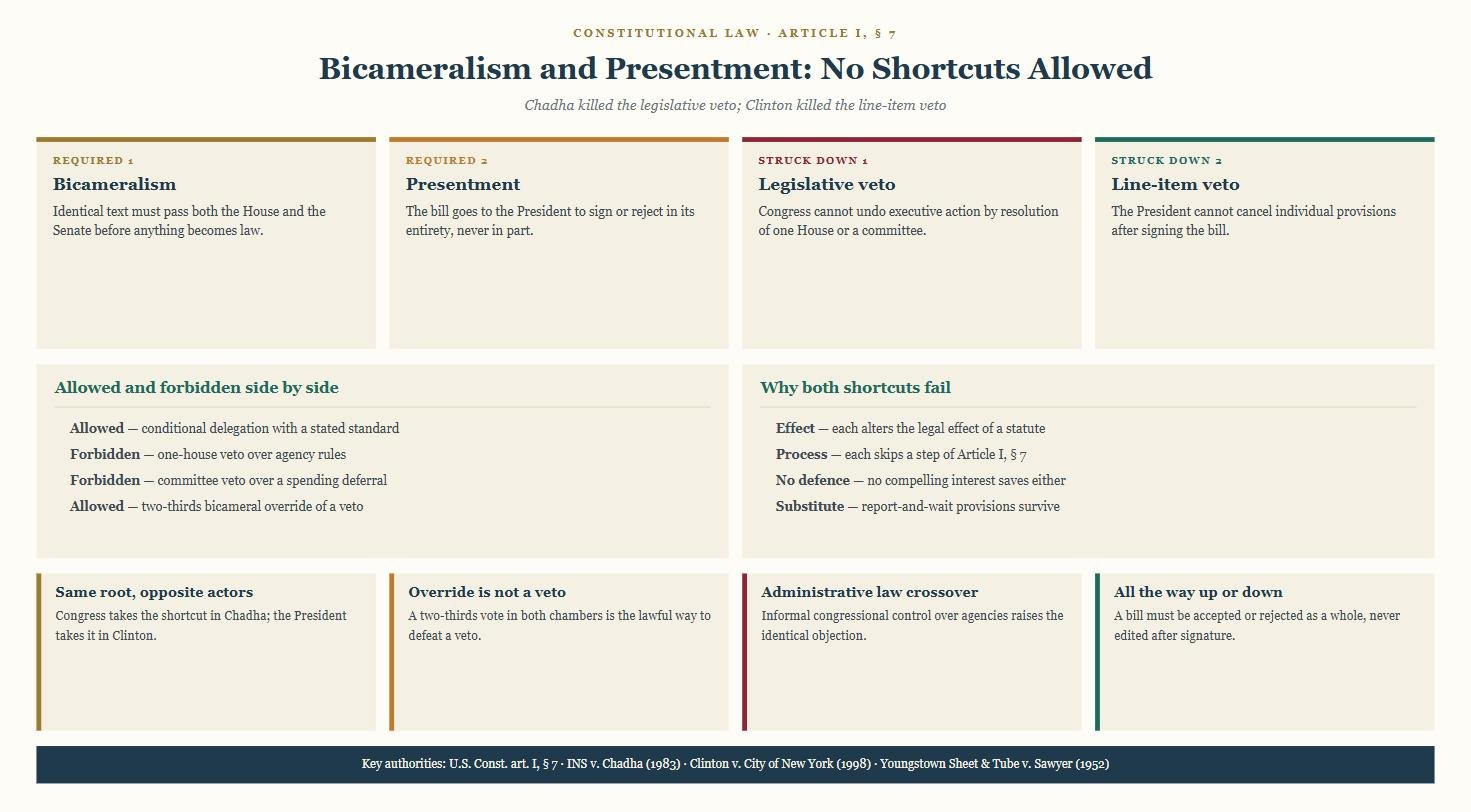
For an act of Congress to have the force of law it must satisfy two requirements, and bicameralism and presentment is the name given to both together. Identical text must pass the House and the Senate, and the resulting bill must then be presented to the President to be signed or rejected as a whole.
Two attempts to shorten that sequence have reached the Supreme Court and both were struck down. This guide explains the legislative veto invalidated in INS v. Chadha, the line-item veto invalidated in Clinton v. City of New York, and how to tell a forbidden shortcut from a perfectly lawful conditional delegation.
The two requirements
Bicameralism requires that both chambers approve the same text. It slows legislation deliberately, and it forces two differently constituted bodies to agree before the law changes. Presentment requires that the approved bill go to the President, who may sign it, return it with objections, or in narrow circumstances allow it to die.
Together the two steps define the only route by which federal law is made, amended or repealed. Every problem in this area is ultimately the same question: has one branch found a way to change the legal effect of a statute without going through both steps again?
Exam tip: if a single chamber, a committee, or the President acting alone alters what the law does, the answer is unconstitutional.
The legislative veto: INS v. Chadha
Congress had delegated authority over deportation decisions to the executive branch while reserving the power of either House to overturn a particular decision by resolution. The Court struck the reservation down. Overturning an executive action changes legal rights and is therefore legislative in character, so it must satisfy bicameralism and presentment like any other exercise of legislative power.
The holding is not limited to one-house vetoes. A committee veto fails for the same reason, and so does a two-house resolution that is never presented to the President. What Congress may do instead is enact a new statute, which of course requires the full process, or build reporting and waiting periods into the original delegation.
The line-item veto: Clinton v. City of New York
The Line Item Veto Act allowed the President to sign an appropriations bill and then cancel individual spending items within it. The Court held that this amounted to amending a statute by unilateral executive action. The veto must be exercised on the bill as presented, all the way up or all the way down.
Notice the symmetry with Chadha. In Chadha, Congress tried to change the effect of a law after delegating; in Clinton, the President tried to change the effect of a law after signing. Both are back-end shortcuts around Article I, section 7, and neither can be justified by however sensible the policy behind it.
| Mechanism | Valid? | Reason |
|---|---|---|
| Statute authorising an agency to regulate within stated standards | Yes | Conditional delegation, not a veto |
| One House may nullify an agency rule by resolution | No | Legislative action without presentment (Chadha) |
| A committee may block a spending deferral | No | Same defect, smaller body |
| Both Houses repeal the rule by new statute signed by the President | Yes | Full Article I, section 7 process |
| President cancels three items after signing an appropriations bill | No | Unilateral amendment of a statute (Clinton) |
| Congress overrides a veto by two-thirds in both chambers | Yes | The express constitutional override |
Worked example: the Senate veto over agency rules
Congress delegates rule-making authority to an environmental agency and provides that any rule may be nullified by a resolution of the Senate alone, without House action and without presentment. The agency issues a rule and the Senate votes to nullify it. The issue is whether the nullification is effective. The rule is that Congress may not overturn executive action except through bicameralism and presentment. Applying it, the Senate resolution is legislative in effect but bypasses both the House and the President, so it is an unconstitutional legislative veto. The agency rule stands.
Change one fact. Suppose instead that the delegation had required the agency to submit each rule to Congress and wait ninety days before it took effect. That is valid. Congress has not reserved a power to act unilaterally; it has simply given itself time to legislate through the ordinary route if it wishes to.
Distinguishing the lawful mechanics
Do not confuse either invalid shortcut with the ordinary operation of the veto power. A presidential veto followed by a two-thirds override in both chambers is exactly what Article I, section 7 contemplates. The pocket veto is likewise part of the lawful machinery. Chadha and Clinton concern attempts to escape that machinery, not the machinery itself.
The doctrine also constrains what a delegation may look like in the first place, which is where it meets the nondelegation doctrine. Congress may delegate broadly, but it may not delegate and simultaneously keep a unilateral power to reverse the delegatee.
Common mistakes that cost points
- Calling a conditional delegation a legislative veto. Conditions guide the grant; vetoes reverse its exercise.
- Thinking a two-house resolution cures the Chadha problem. Presentment is still missing.
- Treating the line-item veto as an inherent executive power. It was created by statute and invalidated.
- Confusing a veto override with a legislative veto. The first is constitutional, the second is not.
- Looking for a compelling interest. Both shortcuts are categorically forbidden.
- Forgetting report-and-wait provisions, which are the lawful substitute.
- Missing the administrative law dimension when Congress tries to supervise agencies informally.
- Overlooking that repeal and amendment require the same process as enactment.
Frequently asked questions
Are legislative vetoes still found in federal statutes?
Many remain on the books because Chadha did not sweep them out individually, but they are unenforceable, and in practice Congress relies on appropriations conditions and reporting requirements instead.
Could a line-item veto be enacted by constitutional amendment?
Yes. The objection in Clinton was that a statute cannot alter the process the Constitution prescribes, not that the policy is impossible.
Does presentment apply to everything Congress does?
It applies to every bill, order or resolution requiring the concurrence of both chambers, with adjournment resolutions the standard exception. Internal rules and each chamber’s own procedures are not presented.
Lawmaking in California: initiatives and the line-item veto, 2026
INS v. Chadha (1983) held that Congress may act with legal effect only through both chambers plus presentment, invalidating the legislative veto, and Clinton v. City of New York (1998) struck down the federal line-item veto because it let the President amend enacted legislation unilaterally. California’s system departs from the federal model in two ways that make an instructive comparison.
First, the Governor of California does hold a line-item veto. Article IV of the California Constitution permits reduction or elimination of individual items of appropriation, subject to override by two-thirds of each house. What was unconstitutional at federal level is a routine feature of California budgeting because it is written into the state constitution rather than granted by statute. Second, California voters legislate directly. An initiative statute passes without the Legislature and without the Governor, and an initiative constitutional amendment can be repealed only by the voters unless the measure permits otherwise.
The consequences for state and county lawmaking:
- Initiatives constrain the Legislature. Provisions such as the property tax limits and the criminal justice measures cannot be amended by ordinary legislation.
- Bicameralism still governs statutes. A California statute requires passage by both the Assembly and the Senate and presentation to the Governor.
- County lawmaking is single-body. The Board of Supervisors adopts ordinances by majority vote after two readings, with no second chamber and no executive veto.
- County voters also have initiative power. Ordinances may be enacted or repealed by county initiative and referendum.
- Delegation is not evasion. Authorising an agency to make rules is permissible; letting one chamber override the executive is not.
- Charter amendments need voter approval. Structural change to Los Angeles County government goes on the ballot rather than through the Board alone.
In 2026, ask which lawmaking track produced the provision, because that determines how it can be changed. Read with the veto power, the nondelegation doctrine and judicial review.
Next steps
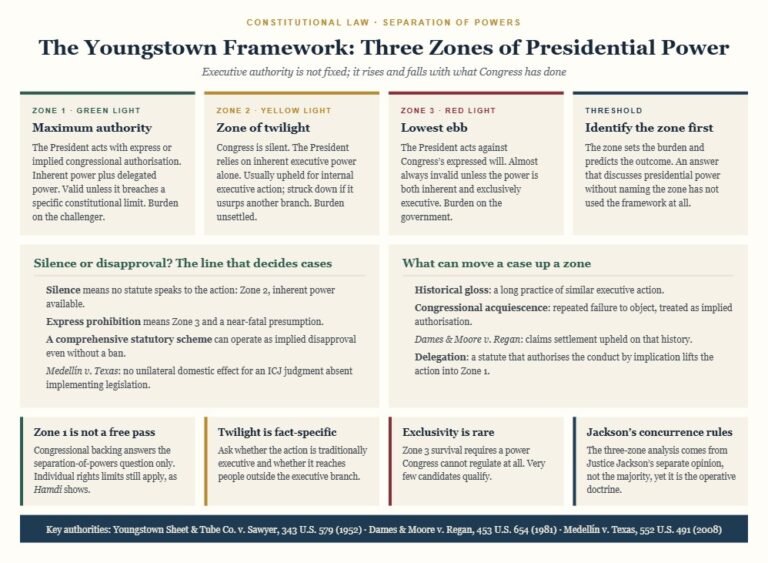
Read this with the mechanics it protects. Start with The Veto Power: Override, Pocket Veto and Limits, then The Nondelegation Doctrine and the Intelligible Principle and The Youngstown Framework: Presidential Power in 3 Zones.
For primary sources, read INS v. Chadha and Clinton v. City of New York at Justia, the annotation to Article I, section 7 at Cornell LII, and the examination scope published by the State Bar of California.
Related guides
 Miranda Rights: Custody, Interrogation and Invocation
 Dormant Commerce Clause: Discrimination vs Pike Balancing
 Campaign Finance and Anonymous Speech: The Core Rules
 No Federal Police Power: Enumerated Powers and Enclaves
 Incorporation Doctrine: Which Rights Bind the States
 The Eleventh Amendment and State Sovereign Immunity
 The Rule Against Perpetuities Explained Step by Step
 The Appointment Power: Principal and Inferior Officers
 Executive Privilege: A Qualified Right That Must Yield
 Section 5 Enforcement Power: Remedy, Do Not Redefine
 The Youngstown Framework: Presidential Power in 3 Zones
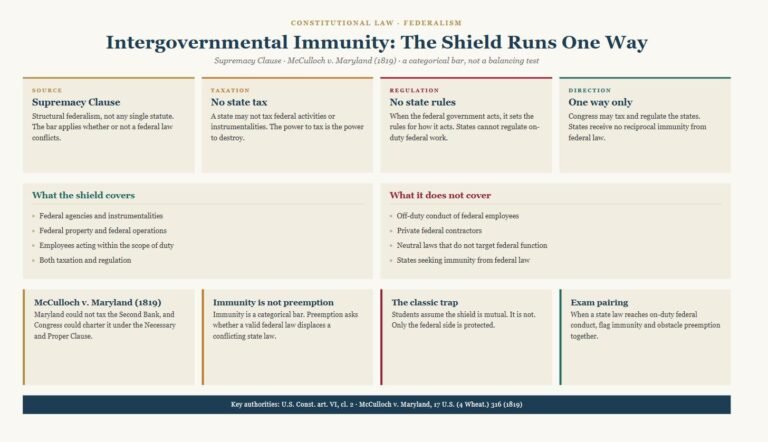 Intergovernmental Immunity: The Shield Runs One Way