
Research article · US constitutional law · June 2026
The historical evolution of the Citizenship Clause and the case law that shaped it
Trump v. Barbara, 609 U.S. ___ (2026) (Roberts, C.J.) · Decided June 30, 2026 · Alejo Leal Martín, Madrid, 2026
I. Overview and Holding
In Trump v. Barbara, the Supreme Court held that children born in the United States to parents who are unlawfully or temporarily present are “subject to the jurisdiction” of the United States and are therefore citizens at birth under the Citizenship Clause of the Fourteenth Amendment.1 The decision arose from a challenge to Executive Order No. 14160, issued January 20, 2025, which directed federal agencies to withhold recognition of citizenship from such children on the theory that they are not “subject to the jurisdiction” of the United States.2
Chief Justice Roberts wrote for the Court, joined by Justices Sotomayor, Kagan, Barrett, and Jackson. The Court affirmed the judgment of the United States District Court for the District of New Hampshire, which had provisionally certified a nationwide class and preliminarily enjoined the Order.3 The core of the opinion is historical and textual: the Court reconstructs an “unbroken line” of authority from the English common law through the founding, the antebellum period, Reconstruction, and United States v. Wong Kim Ark, concluding that the Citizenship Clause codified the common-law rule of jus soli — citizenship by soil — subject only to the narrow exceptions the common law itself recognized.4
For this article, the analytically important move is that the majority frames the Government’s position not as a plausible textual reading but as a late-nineteenth-century revisionist theory — the “international-law” or “domicile” theory of the Clause — that the Court rejected in 1898 and rejects again here. The historical narrative is therefore doing doctrinal work: it is the vehicle by which the Court decides that “subject to the jurisdiction” means territorial jurisdiction, not allegiance qualified by domicile.
II. Procedural Posture and the Question Presented
The question presented was “whether the Constitution guarantees citizenship to children born in the United States of parents who are unlawfully or temporarily present in the country.”5 Several parents sued — some on their own behalf, others on behalf of their children — arguing that Executive Order No. 14160 violates both the Fourteenth Amendment and the Immigration and Nationality Act, which tracks the constitutional language.6 The District Court agreed with the plaintiffs, certified a nationwide class of affected children, and enjoined enforcement of the Order. The Supreme Court took the case on certiorari before judgment, bypassing the First Circuit, and affirmed.
The holding is categorical: children born on U.S. soil to parents unlawfully or temporarily present satisfy both textual elements of the Citizenship Clause — they are “born . . . in the United States” and “subject to the jurisdiction thereof” — and are citizens at birth.7 The judgment was unanimous only in outcome as to the majority coalition; Justice Kavanaugh concurred in the judgment in part and dissented in part, and Justices Thomas (joined by Gorsuch), Alito, and Gorsuch dissented, while Justice Jackson filed a concurrence. Those separate writings are outside the scope of this base but are noted in Part VI as material for commentary.
III. The Historical Evolution of Birthright Citizenship
The majority organizes the history as a single doctrinal arc with one interruption. The rule of jus soli is established at English common law, crosses the Atlantic with the colonists, is consolidated in the antebellum United States, is repudiated for enslaved people and their descendants by the slave States and by Dred Scott, and is then restored and constitutionalized by the Civil Rights Act of 1866 and the Fourteenth Amendment — with Wong Kim Ark confirming the whole line in 1898. What follows tracks that arc, flagging what each stage contributes.
A. The Common-Law Origins: Protection in Exchange for Allegiance
The story begins with the English common law, under which children “born within the [sovereign’s] dominions” owed a natural “allegiance” to the sovereign who protected them at birth.8 Blackstone described a reciprocal relationship: in return for the sovereign’s “protection,” those born within the dominions owed a “duty” of allegiance (or “ligeance”). Lord Coke had captured the same idea in the celebrated Calvin’s Case, describing a “dual and reciprocal tie” connecting “the Sovereign and [his] subject[s].”9
Crucially, the rule did not turn on the duration of the parents’ presence. A child born within the realm was a natural-born subject “no matter how ‘momentary and uncertain’ ” the parents’ presence — even the child of a foreign mother who left the next day remained a subject, because the child owed an implied allegiance to the sovereign who had protected him at birth.10 The same rule applied even to children of parents subject to expulsion: children of the Roma (“gypsies”), whom English law then ordered to leave the realm on pain of imprisonment or death, were nonetheless natural-born subjects.11
The exceptions were narrow and defined by the limits of the sovereign’s own power: children born in lands the sovereign did not control, children born in areas temporarily outside his control (for example, a fort held by enemies), and children of foreign ministers, who by a “fiction of extraterritoriality” were treated as remaining on foreign soil.12 The contribution of this common-law stratum to the majority’s argument is decisive: it fixes the baseline rule as one of soil, not blood, with exceptions keyed to sovereignty rather than to the parents’ immigration status, lawfulness, or intended length of stay.
B. Transplantation to America and Antebellum Consolidation
The common-law rule “crossed the Atlantic” with the colonists and was “adopted with little fanfare after the Revolution,” as “subject[s]” of the sovereign became “citizens” of the States.13 Chancellor Kent confirmed that jus soli — “right of the soil” — prevailed in “each and all of the states,” continuing to emphasize the reciprocal pairing of allegiance and protection.14 Justice Story, riding the antebellum consensus, put it flatly: “Inglis is better settled.”15
Two applications show the rule’s breadth and its one structural limit. When Americans confronted the novel situation of the quasi-sovereign Indian tribes, Chancellor Kent reasoned that tribal members were not “citizens or subjects of the United States” but members of “alien and sovereign tribes” — a genuine intersovereign exception, not a qualification of jus soli for ordinary aliens.16 Conversely, the antebellum era’s foremost decision on the subject, Lynch v. Clarke, held that the common-law rule was “the law of the land” for the children of “citizens” and “foreigners” alike — “including those foreigners here merely on a ‘temporary sojourn,’ ” so that American citizenship extended to “all persons born within the jurisdiction of the United States.”17 Lynch is the antebellum anchor of the majority’s reading and recurs throughout the opinion; its contribution is to establish, on full consideration, that temporary presence of the parents does not defeat the child’s citizenship.
The first American legal treatises agreed that the children of aliens born in the country were citizens because they owed a duty at birth to the government under whose protection they came into existence, confirming that the rule made “no distinction on account of race or color.”18
C. The Proslavery Departure and Dred Scott
The unified rule broke down over slavery. As the Civil War approached, the slave States increasingly denied citizenship to Black Americans and openly rejected the common law to reach that result, insisting that it was “not the place of a man’s birth” but “the rights and privileges he may be entitled to enjoy” that made him a citizen.19 These decisions substituted blood for soil and caste for birth — the doctrinal inverse of jus soli.
The Supreme Court then nationalized that departure. In Dred Scott v. Sandford, Chief Justice Taney concluded that “the words ‘people of the United States’ and ‘citizen[s]’ ” carried an unexpressed racial component excluding everyone descended from enslaved people — even those, Taney conceded, who were “born in the country” and “did owe allegiance to the Government,” the precise common-law criteria for citizenship.20 Dred Scott is the anti-precedent of the whole opinion. Its contribution — negatively — is to mark the single point at which the Court abandoned the common law and “made” blood, not soil, “the rule.” The dissents of Justices Curtis and McLean, invoking the common-law rule that all “free persons born within” a State were citizens, supply the counter-tradition that Reconstruction would vindicate.21
The Court frames Dred Scott as a decision “met with shock,” condemned by Northern newspapers and by abolitionists — Frederick Douglass insisting that “[b]y birth, we are American citizens.” This sets up the crucial interpretive premise that the Fourteenth Amendment was written to repudiate Dred Scott and restore the common-law rule.22
D. Reconstruction: Bates, the Civil Rights Act of 1866, and the Fourteenth Amendment
Restoration proceeded in three steps. First, in 1862, Lincoln’s Attorney General Edward Bates issued a landmark opinion rejecting the premise that “citizenship is ever hereditary” and declaring that “every person born in the country is, at the moment of birth, prima facie a citizen . . . without any reference to race or color.” The exceptions were “few” — “the small and admitted class of the natural-born composed of the children of foreign ministers and the like.”23 Bates’s opinion contributes the Executive Branch’s formal return to soil-based citizenship and expressly grounds it in Calvin’s Case, Kent, and Lynch.
Second, Congress enacted the Civil Rights Act of 1866, declaring that “all persons born in the United States and not subject to any foreign power, excluding Indians not taxed,” are citizens.24 The Reconstruction Congress understood the Act simply to enact the common-law rule; its sponsor, Senator Trumbull, agreed that it would make citizens of “the children of . . . [immigrants] born in this country,” declaring that “even the infant child of a foreigner born in this land is a citizen.”25
Third — because opponents contended that Congress could not grant such citizenship by statute alone in the shadow of Dred Scott — Congress constitutionalized the rule in the Fourteenth Amendment, seeking to put the “great question of citizenship” “beyond the legislative power” and to “settle the issue once and for all.”26 The Clause “mirrored the common law’s criteria”: it begins with territory (“born . . . in the United States”) and ends with sovereign power (“subject to the jurisdiction”). Senator Howard, its principal author, explained that the language was “simply declaratory of . . . the law of the land already.”27
E. Fixing the Meaning of “Subject to the Jurisdiction”
The majority’s textual centerpiece is that “subject to the jurisdiction” carried an established legal meaning in 1868 — the ordinary meaning of “jurisdiction” as the “[p]ower of governing or legislating,” the “authority of government; the sway of a sovereign power.”28 The scope of that power had been “well settled in 1868, largely by ‘the celebrated case’ of The Schooner Exchange v. McFaddon,” in which Chief Justice Marshall defined “jurisdiction” as “the full and complete power of a nation within its own territories,” “susceptible of no limitation not imposed” by the nation itself.29
Marshall’s narrow exceptions matched the common law’s: they arose where exercising jurisdiction would “degrade the dignity” of a foreign sovereign — most frequently in the case of “foreign ministers.” But “private individuals” of a foreign nation who had “spread themselves through [our territory] as business or caprice may direct” were fully “amenable to the jurisdiction of the country.”30 The decisive structural point is congruence: “[t]he same groups included (and excluded) by jus soli were included (and excluded) by the conventional understanding of jurisdiction” — namely, foreign ministers and members of the Indian tribes, over whom the United States had ceded a portion of its territorial jurisdiction. Because no such intersovereign concern attaches to children of parents unlawfully or temporarily present, those children are “subject to the jurisdiction of the United States” and satisfy both elements of the Clause.31
F. Wong Kim Ark: Rejection of the Domicile / International-Law Theory
For nearly two decades after ratification, the Executive Branch, federal courts, and the State Department uniformly treated the Citizenship Clause as “simply an affirmance of the common law of England and of this country,” fixing citizenship “by the place of nativity, irrespective of parentage.”32 In 1872, Attorney General Williams determined that a child born of Austrian parents only “temporarily residing” in New York was a citizen “by reason of the place of his birth.”33
The consensus fractured as Reconstruction faded. With the Chinese Exclusion Act of 1882 and shifting politics, the State Department began denying citizenship to those with “dual or doubtful allegiance,” and several scholars — most prominently Francis Wharton and Alexander Morse — proposed a new “international-law” theory focused on the parents’ status: only if a child’s parents were “domiciled in the United States” was the child “internationally” subject to the jurisdiction required by the Clause.34 This is the theory the Government advances in Barbara; its intellectual origins in post-1884 revisionism are, for the majority, a mark against it.
In United States v. Wong Kim Ark, the Court rejected that theory. Justice Gray held that the Fourteenth Amendment was “declaratory” of the “fundamental rule of citizenship by birth” that prevailed at common law, excluding only those recognized as exempt “from the jurisdiction of this country” — the “children of ambassadors” and those born in the “alien nations” of the Indian tribes.35 All others were citizens at birth, “whether born to permanent residents or temporary visitors.” The words “ ‘subject to the jurisdiction thereof’ ” “must be presumed to have been understood . . . in the same sense” as Marshall had used them in Schooner Exchange — so that aliens present for “business or pleasure” received “no exemption from the jurisdiction of the country,” and their children were citizens.36 Wong Kim Ark is the controlling precedent, and the majority reads its holding — not merely its references to the domicile of Wong’s parents — as guaranteeing citizenship to “nearly all children born in the United States.” The Court stresses that the reasoning “cannot be squared with a domicile requirement.”37
G. Twentieth- and Twenty-First-Century Reaffirmation
Finally, the Court notes that in the 128 years since Wong Kim Ark it has “repeatedly understood” that decision “to guarantee citizenship to all children born in the United States and subject to its power,” and “see[s] no reason to depart from that view today.”38 The Court also disposes of Elk v. Wilkins — often invoked by opponents — as concerning “only . . . members of Indian tribes within the United States,” a unique intersovereign relationship with “no tendency” to deny citizenship to children of foreign parents not in the diplomatic service of a foreign country.39
IV. The Jurisprudence Catalogued: What Each Case Contributed
The following catalogue collects the principal authorities the majority relies on, grouped by era, with a one-line statement of each case’s contribution to the doctrine. It is designed as a quick-reference spine for article.
English Common-Law Foundations
Calvin’s Case, (1608) 77 Eng. Rep. 377 (K.B.) — Establishes the foundational rule: birth within the sovereign’s dominions creates a “dual and reciprocal tie” of protection and allegiance, making the child a natural-born subject regardless of how brief the parents’ presence. Defines the narrow, sovereignty-based exceptions.
Doe v. Jones, (1791) 100 Eng. Rep. 1031 (K.B.) — Restates that children born with that allegiance are “natural-born subject[s],” confirming the common-law rule at the founding-era horizon. Founding-Era and Antebellum American Cases
Murray v. Schooner Charming Betsy, 6 U.S. (2 Cranch) 64 (1804) — Presumes that any “person born within the United States” was a natural-born citizen — early Supreme Court recognition of jus soli.
The Schooner Exchange v. McFaddon, 11 U.S. (7 Cranch) 116 (1812) — Supplies the operative definition of “jurisdiction” — the “full and complete power of a nation within its own territories” — with exceptions only for foreign sovereigns and their ministers. The textual key to “subject to the jurisdiction.”
Goodell v. Jackson ex dem. Smith, 20 Johns. 693 (N.Y. 1823) — Locates the Indian-tribe exception in genuine quasi-sovereignty, not in any general carve-out for aliens — sharpening the limits of jus soli.
Inglis v. Trustees of Sailor’s Snug Harbour, 28 U.S. (3 Pet.) 99 (1830) — Justice Story’s view that jus soli is “better settled”; ties American citizenship to allegiance owed at birth “under the protection of a particular sovereign.”
State v. Manuel, 20 N.C. (4 Dev. & Bat.) 144 (1838) — Confirms that the common-law rule was “adopted with little fanfare after the Revolution,” as subjects became citizens of the States. Lynch v. Clarke, 1 Sand. Ch. 583 (N.Y. Ch. 1844) — The antebellum era’s foremost decision: on full consideration, the common-law rule is “the law of the land,” extending citizenship to children of foreigners “here merely on a ‘temporary sojourn.’ ” The pivotal antebellum authority for the majority.
The Proslavery Departure and Dred Scott
Amy v. Smith, 11 Ky. (1 Litt.) 326 (1822) — Slave-State rejection of soil-based citizenship: it is “not the place of a man’s birth” but his “rights and privileges” that make him a citizen. The doctrinal inverse of jus soli.
Bryan v. Walton, 14 Ga. 185 (1853) — Holds that not even emancipation could “confer citizenship,” citing “the taint of blood” — caste substituted for birth.
Dred Scott v. Sandford, 60 U.S. (19 How.) 393 (1857) — The anti-precedent: nationalizes the proslavery view, reading an unexpressed racial component into “citizen” and excluding descendants of enslaved people though they were born in the country and owed allegiance. The decision the Fourteenth Amendment was written to repudiate. (Curtis and McLean, JJ., dissenting, preserve the common-law counter-tradition.)
United States v. Rhodes, 27 F. Cas. 785 (C.C.D. Ky. 1866) (No. 16,151) — Justice Swayne (on circuit) reaffirms post-war that the common law “made no distinction on account of race or color.”
Reconstruction Constitutionalization
Slaughter-House Cases, 83 U.S. (16 Wall.) 36 (1873) — Cited for the proposition that one can “be a citizen of the United States without being a citizen of a State,” underscoring that national citizenship does not depend on state residence/domicile.
Ludlam v. Ludlam, 26 N.Y. 356 (1863) — New York’s highest court decides a parental-status citizenship dispute by relying on Lynch v. Clarke rather than a domicile theory — evidence against the revisionist reading.
The Controlling Precedent and Its Progeny
Elk v. Wilkins, 112 U.S. 94 (1884) — Denies birthright citizenship to a member of an Indian tribe — but only because of the tribe’s quasi-sovereign status; expressly not a domicile or allegiance-quantum limit on aliens generally.
United States v. Wong Kim Ark, 169 U.S. 649 (1898) — The controlling precedent. Holds the Fourteenth Amendment “declaratory” of the common-law rule; children of permanent residents and temporary visitors alike are citizens at birth; only ambassadors’ children and tribal members are excluded. Rejects the international-law/domicile theory. (Fuller, C.J., dissenting, states the domicile theory that “commanded only a dissent in 1898.”)
United States ex rel. Hintopoulos v. Shaughnessy, 353 U.S. 72 (1957) — Modern illustration of the settled understanding that a U.S.-born child of noncitizen parents is a citizen.
INS v. Rios-Pineda, 471 U.S. 444 (1985) — Same — the Court treats the U.S.-born child of parents unlawfully present as a citizen, confirming continuity of the Wong Kim Ark rule.
V. The Court’s Interpretive Method and Its Refutation of the Domicile Theory
Methodologically, the opinion is thoroughly originalist and common-law-historical, but it turns those tools against the Government’s originalist claim. The majority accepts several of the Government’s premises — that the Clause incorporates the “background principles” of the common law, that at common law “citizenship turns on allegiance,” and that Dred Scott departed from that tradition and was repudiated by the Clause.40 The disagreement is confined to the meaning of “allegiance.” The Government and the principal dissent contend that natural allegiance was no longer sufficient by 1868 and that some greater quantum — variously “primary,” “sufficient,” “full,” or “requisite” allegiance — was required, keyed to domicile.
The Court answers that there is “scant evidence” for this “dramatically revisionist view.” No source from 1776 to 1868 defined allegiance at birth as based on domicile; sources from that period defined “allegiance by birth” just as the British did, as “the tie or duty” owed by one “born within the dominions and under the protection of a particular sovereign.”41 Domicile and national citizenship are “distinct concepts”: one who establishes a domicile in a new country does not automatically become its citizen (he must naturalize), nor automatically lose his prior citizenship (he must expatriate). Even the principal dissent, the Court notes, ultimately concedes that domicile alone was insufficient to make someone “formally” a citizen.42
The Court makes three further moves article can build on. First, it treats post-ratification history as unable to “override the text”: the words that pervade the Executive Order — “mother,” “father,” “lawful,” “temporary” — “are absent from the Clause,” and the revisionist scholarship the Government leans on postdates 1884.43 Second, it declines to let the slightly different text of the Civil Rights Act of 1866 (“not subject to any foreign power”) narrow the Amendment, reasoning that the Amendment “better expresses” the Reconstruction Congress’s views and that any “possible doubt” under the Act “was removed” by the Clause’s affirmative words.44 Third, and rhetorically central, it reframes the common law: where the dissents cast it as “feudal” and “medieval,” the majority casts birthright citizenship as emancipatory — the “ancient liberties” of “free-born” persons, the “right to have rights,” extended by the Framers of the Fourteenth Amendment to “every free-born person in this land.”45
VI. Synthesis and Angles for the Article
Read as a whole, Trump v. Barbara is less a doctrinal innovation than a historiographical verdict: it decides a contested constitutional question by adjudicating between two accounts of the nineteenth century. The majority’s account — an “unbroken line” from Coke and Blackstone through Lynch to Wong Kim Ark — treats the domicile theory as a brief, discredited detour that never became law. That framing is the decision’s center of gravity and its most vulnerable point, since it depends on characterizing the ratification-era “temporary sojourner” statements as marginal and the international-law scholarship as post-hoc.
Several angles are available for a case comment. (1) The holding-versus-reasoning move on Wong Kim Ark — the majority’s insistence, via Bucklew, that the repeated references to the domicile of Wong’s parents are dicta — is doctrinally contestable and worth testing. (2) The opinion’s method is a striking instance of “common-law originalism,” using treatise-and-case history rather than ratification debates as the primary evidence of original meaning; that is a methodological story in itself. (3) The Court’s treatment of post-enactment practice (the 1884– 1898 State Department shift) raises the general question of how much weight liquidation or historical gloss should carry against text. (4) The reframing of jus soli as an emancipatory “right to have rights,” rather than a feudal remnant, is a normative intervention that invites comparison with the dissenters’ framing.
Finally, although this base focuses on the majority, the separate opinions are the natural foil for argument: Justice Kavanaugh (concurring in the judgment in part and dissenting in part) and Justice Alito each propose an “ad hoc exception” that the majority says cannot be reconciled with their own premises; Justice Thomas (joined by Justice Gorsuch) mounts the principal dissent built on the Civil Rights Act’s “foreign power” language and the domicile theory; and Justice Jackson’s concurrence supplies additional framing. A comment that engages the majority’s historical method on its own terms — and asks whether the record is as “unbroken” as the Court claims — would sit squarely within CLR Online’s scholarly-but-timely register.
Notes
- Trump v. Barbara, 609 U.S. ___, ___ (2026) (slip op., at 1, 12). The Citizenship Clause provides: “All persons born or naturalized in the United States, and subject to the jurisdiction thereof, are citizens of the United States and of the State wherein they reside.” U.S. Const. amend. XIV, § 1. ↩
- Exec. Order No. 14160, Protecting the Meaning and Value of American Citizenship, 90 Fed. Reg. 8449 (Jan. 20, 2025). The Order reached (1) children whose mother was unlawfully present and whose father was neither a citizen nor a lawful permanent resident, and (2) children whose mother’s presence was lawful but temporary and whose father was neither a citizen nor an LPR. Id. ↩
- Barbara v. Trump, 790 F. Supp. 3d 80, 101–02, 105–06 (D.N.H. 2025). The Supreme Court granted certiorari before judgment. See 607 U.S. 1079 (2025). ↩
- Trump v. Barbara, slip op., at 25; see United States v. Wong Kim Ark, 169 U.S. 649 (1898). ↩
- Trump v. Barbara, slip op., at 1 (syllabus). ↩
- See 8 U.S.C. § 1401(a) (conferring citizenship on “a person born in the United States, and subject to the jurisdiction thereof”); Trump v. Barbara, slip op., at 1–2. ↩
- Trump v. Barbara, slip op., at 12. ↩
- 1 William Blackstone, Commentaries on the Laws of England 354, 356 (1765). ↩
- Calvin’s Case (1608) 77 Eng. Rep. 377, 382; 7 Co. Rep. 1a, 4b–5a (K.B.); see also Doe v. Jones (1791) 100 Eng. Rep. 1031, 1035; 4 T.R. 300, 308 (K.B.) (children born with that allegiance were “natural-born subject[s]”). ↩
- Calvin’s Case, 77 Eng. Rep., at 384; 7 Co. Rep., at 6a. The mother, too, owed the King a “local and temporary” allegiance for as long as she remained in the realm. See Trump v. Barbara, slip op., at 3–4 & n.2. ↩
- 4 Blackstone, supra, at 166; see Trump v. Barbara, slip op., at 4 (noting the 1855 outcry when Massachusetts deported a pauper Irish mother with her American-born infant, “acknowledged to be a ‘native born citizen’ ”). ↩
- Calvin’s Case, 7 Co. Rep., at 18a–18b; 77 Eng. Rep., at 399; see The Schooner Exchange v. McFaddon, 11 U.S. (7 Cranch) 116, 138–39 (1812). ↩
- State v. Manuel, 20 N.C. (4 Dev. & Bat.) 144, 152 (1838); see Inglis v. Trs. of Sailor’s Snug Harbour, 28 U.S. (3 Pet.) 99, 120–21 (1830). ↩
- 2 James Kent, Commentaries on American Law 38–39 & n.a, 40 (6th ed. 1848). ↩
- Inglis, 28 U.S. (3 Pet.), at 164 (Story, J., concurring in part and dissenting in part). ↩
- Goodell v. Jackson ex dem. Smith, 20 Johns. 693, 711–15 (N.Y. 1823). ↩
- Lynch v. Clarke, 1 Sand. Ch. 583, 638, 663–64, 668 (N.Y. Ch. 1844). ↩
- See 1 Zephaniah Swift, A System of the Laws of the State of Connecticut 164, 167 (1795); United States v. Rhodes, 27 F. Cas. 785, 789 (C.C.D. Ky. 1866) (No. 16,151) (Swayne, J.). ↩
- Amy v. Smith, 11 Ky. (1 Litt.) 326, 332 (1822); see Bryan v. Walton, 14 Ga. 185, 198, 202 (1853) (holding that not even emancipation could “confer citizenship” because of “the taint of blood”); African Methodist Episcopal Church v. New Orleans, 15 La. Ann. 441, 443 (1860). ↩
- Dred Scott v. Sandford, 60 U.S. (19 How.) 393, 404, 419–20, 422–23 (1857). ↩
- Id., at 531 (McLean, J., dissenting); id., at 576–77 (Curtis, J., dissenting). ↩
- See 2 The Life and Writings of Frederick Douglass 259, 415, 424 (Philip S. Foner ed., 1950); Trump v. Barbara, slip op., at 7–8. ↩
- Citizenship, 10 Op. Att’y Gen. 382, 394, 397, 399 (1862). ↩
- Civil Rights Act of 1866, ch. 31, § 1, 14 Stat. 27. ↩
- Cong. Globe, 39th Cong., 1st Sess. 498, 1757 (1866) (Sen. Trumbull); see id., at 1116 (Rep. Wilson); id., at 1832 (Rep. Lawrence). ↩
- Cong. Globe, 39th Cong., 1st Sess. 2890, 2891, 2896 (1866) (Sen. Howard). ↩
- Id., at 2890 (Sen. Howard); see Trump v. Barbara, slip op., at 9–10. ↩
- N. Webster, An American Dictionary of the English Language 732 (C. Goodrich & N. Porter eds. 1865); 1 B. Abbott, Dictionary of Terms and Phrases Used in American or English Jurisprudence 671 (1879). ↩
- The Schooner Exchange v. McFaddon, 11 U.S. (7 Cranch) 116, 136 (1812). ↩
- Id., at 136–39, 144. ↩
- Trump v. Barbara, slip op., at 12. ↩
- Memorandum of Secretary of State H. Fish to Mr. Marsh (May 19, 1871), in 2 J. Wharton, A Digest of the International Law of the United States § 183, at 394 (2d ed. 1887). ↩
- Citizenship, 14 Op. Att’y Gen. 154, 155 (1872); see also McKay v. Campbell, 16 F. Cas. 161, 165 (C.C.D. Or. 1871) (No. 8,840); In re Look Tin Sing, 21 F. 905, 908–10 (C.C.D. Cal. 1884) (Field, J.); Ex parte Chin King, 35 F. 354, 355–56 (C.C.D. Or. 1888). ↩
- See F. Wharton, A Treatise on the Conflict of Laws § 10, at 35; § 12, at 41–42 (2d ed. 1881); A. Morse, A Treatise on Citizenship 248 (1881). These writers conceded that the common law took a different view and that the Amendment’s language “is very broad.” See A. Morse, Citizenship of Children of Aliens Born in the United States, 30 Alb. L.J. 420 (1884). ↩
- United States v. Wong Kim Ark, 169 U.S. 649, 658, 675, 681–83, 688, 693 (1898). ↩
- Id., at 676, 682–88. ↩
- Trump v. Barbara, slip op., at 16, 24–25; see Bucklew v. Precythe, 587 U.S. 119, 136 (2019) (distinguishing a holding from stray references in its reasoning). ↩
- Trump v. Barbara, slip op., at 16; see United States ex rel. Hintopoulos v. Shaughnessy, 353 U.S. 72, 73 (1957); INS v. Rios-Pineda, 471 U.S. 444, 446 (1985). ↩
- Elk v. Wilkins, 112 U.S. 94, 99–102 (1884); Wong Kim Ark, 169 U.S., at 682, 686; Trump v. Barbara, slip op., at 23 n.5. ↩
- Trump v. Barbara, slip op., at 17. ↩
- Inglis, 28 U.S. (3 Pet.), at 155 (Story, J.); see Lynch, 1 Sand. Ch., at 657; Murray v. Schooner Charming Betsy, 6 U.S. (2 Cranch), at 120. ↩
- Trump v. Barbara, slip op., at 18–19; see F. Wharton, Conflict of Laws § 40a, at 47 (1872) (“there may be domicil where there is no nationality, and nationality where there is no domicil”). ↩
- Trump v. Barbara, slip op., at 21–22; see Slaughter-House Cases, 83 U.S. (16 Wall.), at 74. ↩
- Wong Kim Ark, 169 U.S., at 675, 688; Trump v. Barbara, slip op., at 24. ↩
- Cong. Globe, 39th Cong., 1st Sess. 600 (1866) (Sen. Trumbull); see B. Bailyn, The Ideological Origins of the American Revolution 192 (1967); Trump v. Barbara, slip op., at 25–26. ↩
Birthright citizenship and California: Wong Kim Ark to 2026
The foundational birthright citizenship case is Californian. Wong Kim Ark was born in San Francisco to Chinese parents who were themselves ineligible for naturalization, and when he was refused re-entry after a visit abroad the Supreme Court held in United States v. Wong Kim Ark (1898) that the Fourteenth Amendment made him a citizen by birth. The decision established that the Citizenship Clause turns on birth within the territory and subjection to its jurisdiction, not on parental status.
California has more at stake in this question than any other state, and Los Angeles County more than any other county, given the number of births each year to parents who are not citizens. The Los Angeles County Registrar-Recorder/County Clerk issues birth records for the county, and a California birth certificate is the ordinary proof of citizenship for people born here. Because the litigation discussed above is developing, confirm the current legal position and any implementation guidance with the California Attorney General and the county before advising anyone; do not rely on a summary alone.
The stable points of the doctrine:
- Territorial birth is the general rule. Birth in a state or in most United States territory confers citizenship regardless of parental immigration status.
- The jurisdiction exception is narrow. It has historically been confined to children of accredited diplomats and, formerly, to members of sovereign tribes not otherwise subject to federal jurisdiction.
- Citizenship cannot be lost involuntarily. Afroyim v. Rusk (1967) holds that expatriation requires voluntary relinquishment.
- Naturalized and native-born citizens are equal. Only the presidential eligibility requirement distinguishes them.
- State records are evidence, not the source. A county birth certificate proves the fact of birth; the Constitution supplies the legal consequence.
- Statutory citizenship at birth abroad is different. Transmission to children born outside the United States rests on statute and has varied over time.
In 2026, distinguish constitutional birthright citizenship from statutory transmission, and verify the current position before relying on it. Read with the naturalization power, alienage classifications and equal protection.
Related guides
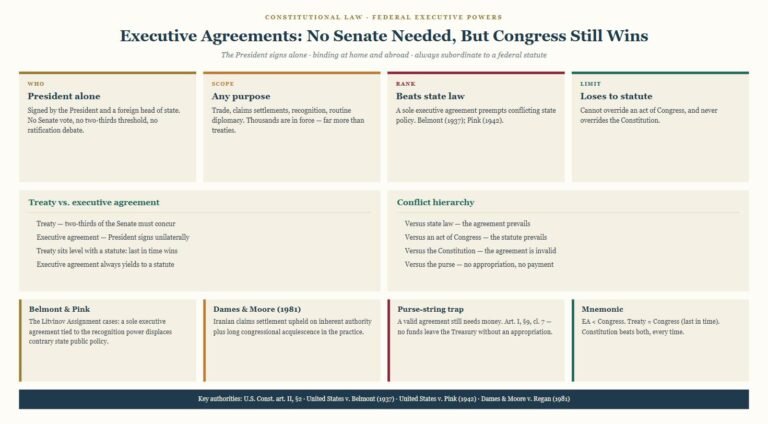 Executive Agreements: The President’s Sole Foreign Power
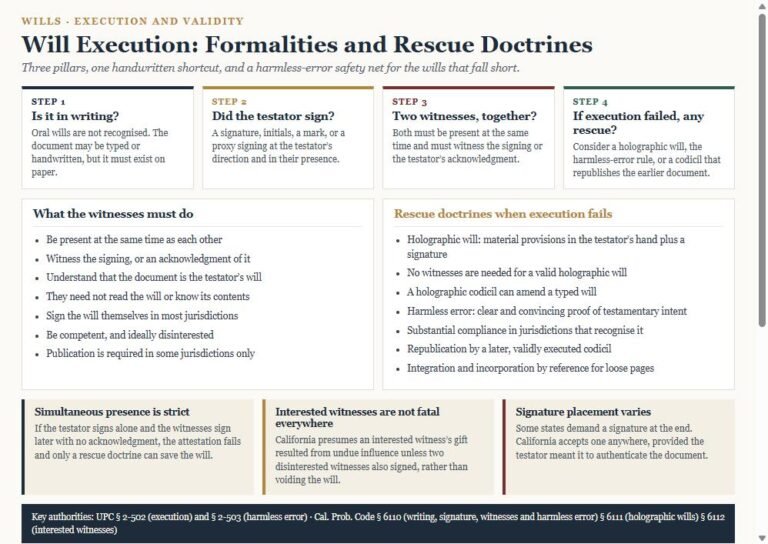 Will Execution Requirements: Formalities and Rescue
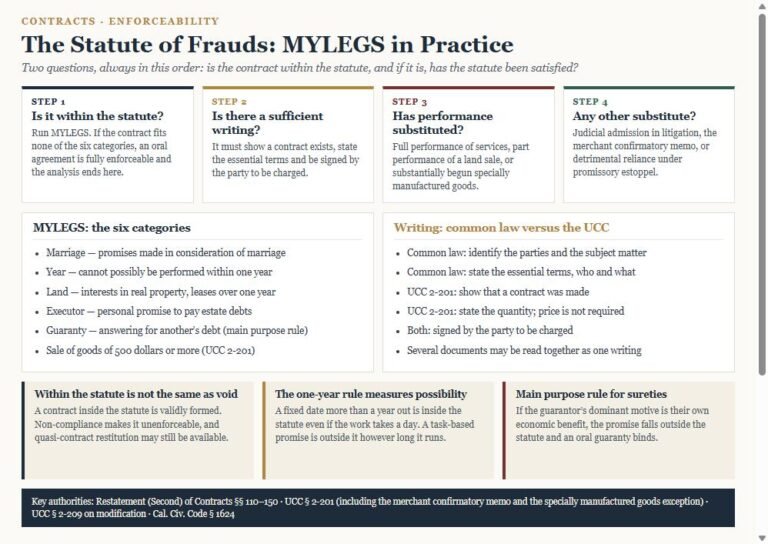 The Statute of Frauds: MYLEGS and How to Satisfy It
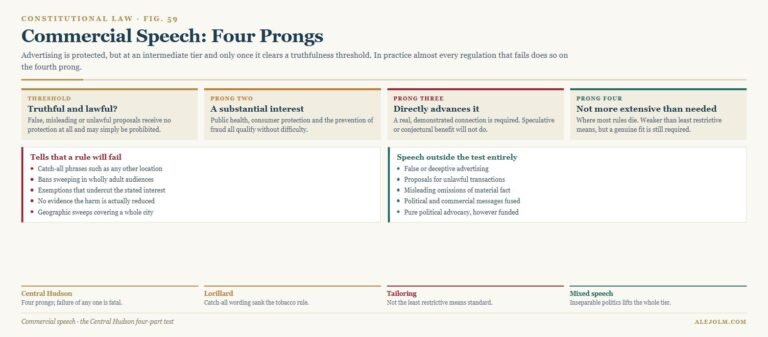 Commercial Speech and the Central Hudson Four-Part Test
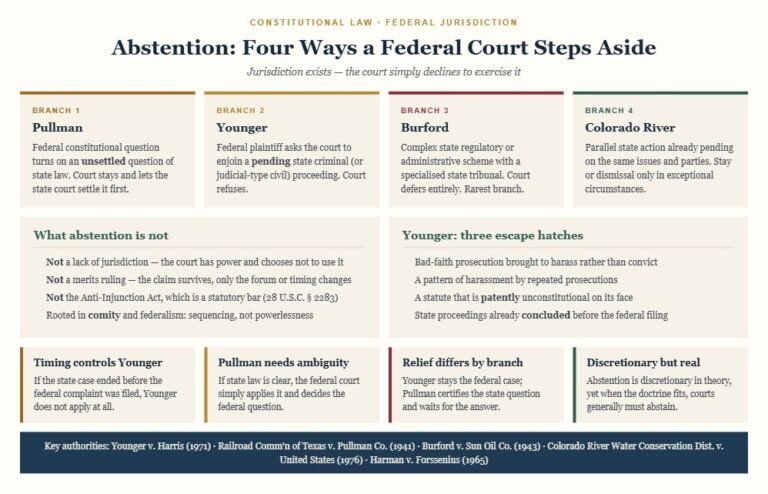 Abstention Doctrine: 4 Ways Federal Courts Step Aside
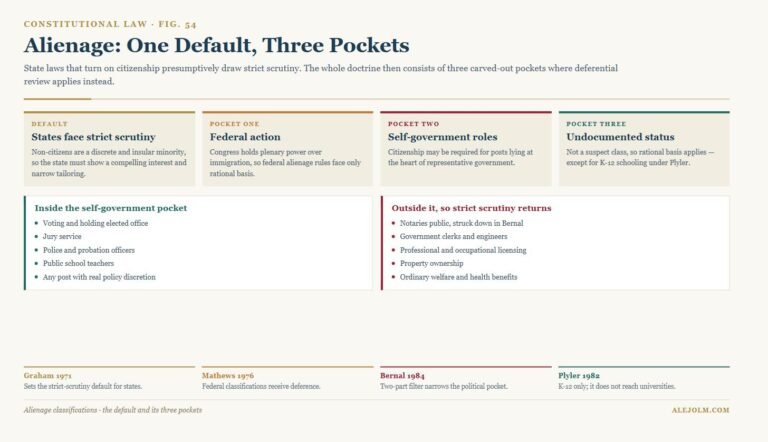 Alienage Classifications: Strict Scrutiny and Its Pockets
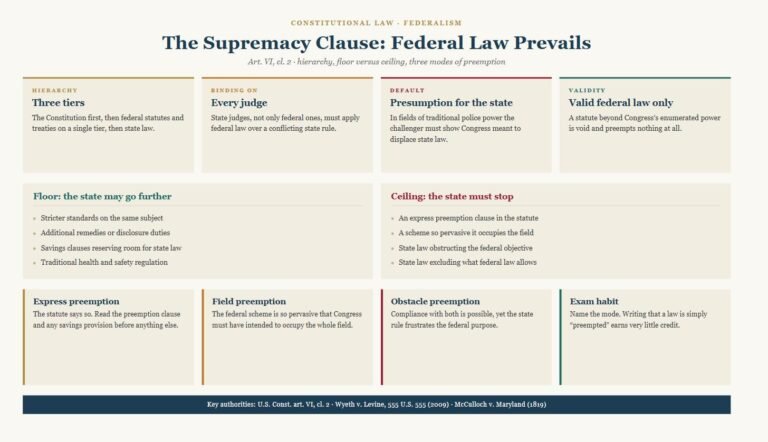 The Supremacy Clause: Floors, Ceilings and Preemption
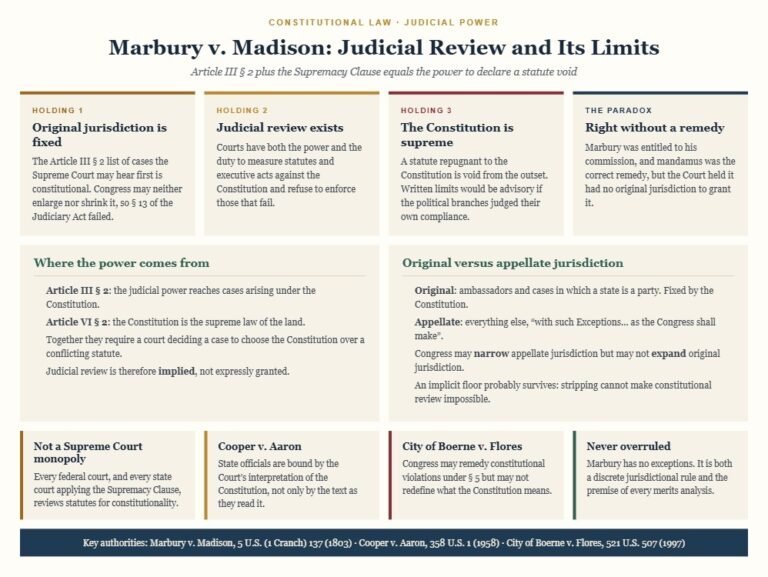 Marbury v. Madison and the Power of Judicial Review
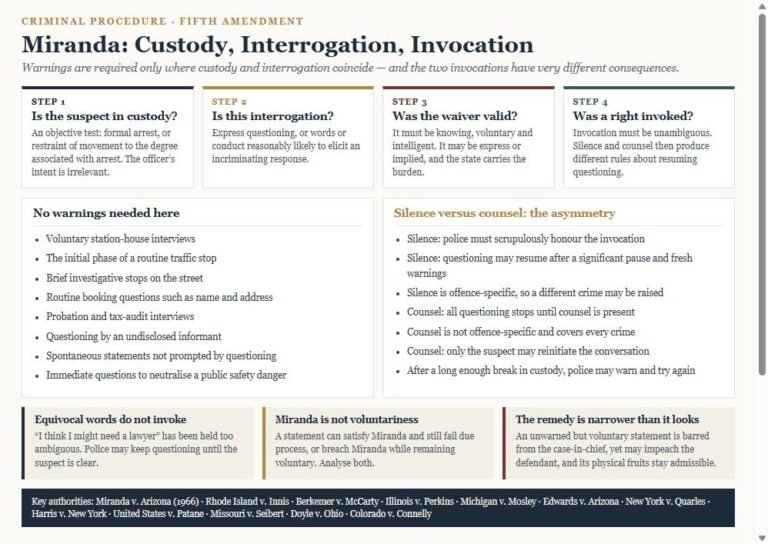 Miranda Rights: Custody, Interrogation and Invocation
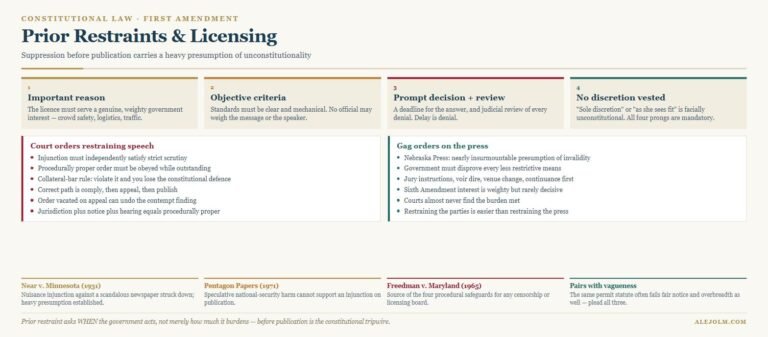 Prior Restraint and Licensing: The Freedman Safeguards
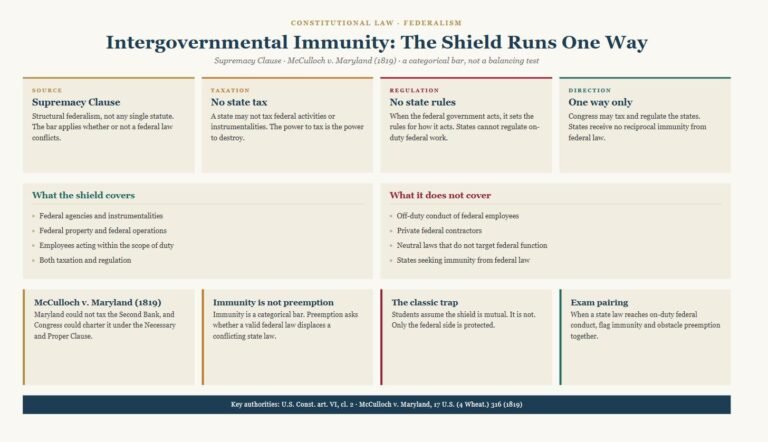 Intergovernmental Immunity: The Shield Runs One Way
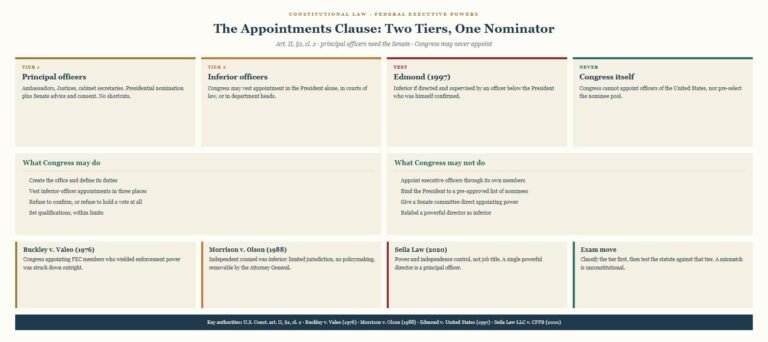 The Appointment Power: Principal and Inferior Officers