
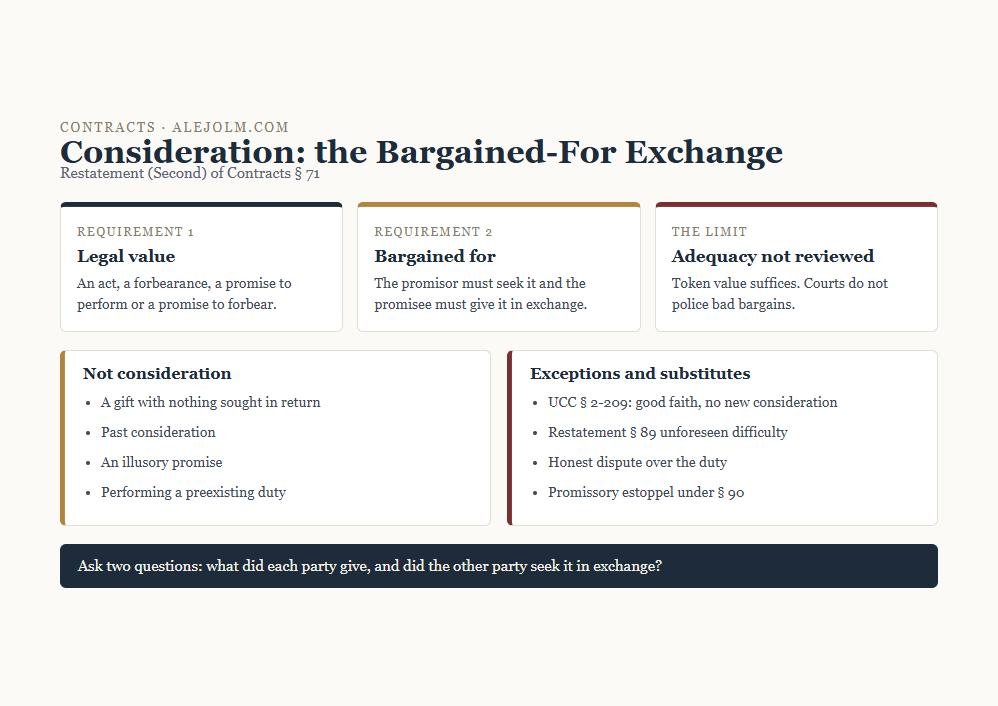
Consideration in contract law is the doctrine that separates an enforceable bargain from an unenforceable gift. Restatement (Second) of Contracts section 71 states it as a bargained-for exchange: the promisor must seek the promisee’s act, forbearance or return promise, and the promisee must give it in exchange for the promise.
Two words carry the whole test. There must be legal value, and it must be bargained for. Almost every consideration problem is really a dispute about one of those two words, so the most reliable way to write the answer is to name what each party gave and then ask whether the other party sought it.
What counts as legal value
Legal detriment takes four forms, and it is worth listing them because candidates often assume consideration means money.
- Performance of an act.
- Forbearance from acting.
- A promise to perform.
- A promise to forbear.
Hamer v. Sidway (1891) settles the second category. Giving up a legal right counts as consideration even where the forbearance benefits the promisee and costs the promisor nothing. Detriment to the promisor is not required.
A gift is the opposite case. Where a transfer is one-sided and nothing is sought in return, there is no consideration and the promise is not enforceable as a contract.
Adequacy: the question courts refuse to ask
Courts do not review whether the exchange was a good deal. Nominal or token consideration suffices and parties are free to make a bad bargain. There are only two narrow escapes.
- The purported consideration is a total sham with no value at all.
- The promise is illusory, meaning the promisor has not actually committed to anything.
An illusory promise is the more heavily tested of the two. A promise to buy “as much as I feel like” imposes no obligation, so it cannot be consideration. Contrast a requirements contract, where the good-faith obligation to buy actual requirements supplies real commitment.
Past consideration is not consideration
A promise made in recognition of something already done is not supported by consideration, because the past act was not given in exchange for the promise. The bargain element is missing in time.
There is a limited statutory-style exception: a new written promise to pay a debt otherwise barred by the statute of limitations is enforceable without fresh consideration.
The preexisting duty rule
At common law, doing or promising to do what you are already bound to do is not consideration. That is why a mid-contract demand for more money for the same work usually fails. Four recognised exceptions permit modification without new consideration.
- Added or changed performance — the party takes on something genuinely new.
- Unforeseen difficulty — under Restatement section 89, where the contract is not fully performed, the modification is fair and equitable, and the circumstances were unforeseeable at formation.
- Honest dispute over the duty — a genuine compromise is a detriment to both sides.
- A third party’s promise to pay a preexisting debt, since the third party owed nothing before.
The UCC takes a different route
For sales of goods, UCC section 2-209 rejects the preexisting duty rule outright. A modification needs no new consideration, only good faith. Good faith here means a legitimate basis for the change, fairness in the circumstances, and the absence of undue pressure or duress.
Identify the subject matter first. Whether you are in common law or Article 2 changes the answer on modification more than any other single fact.
Partial payment of a debt
This recurring problem turns on one question: is the debt due and undisputed?
| Situation | Is accepting less supported by consideration? | Effect |
|---|---|---|
| Debt due and undisputed | No | Creditor is not bound to treat the lesser sum as full payment |
| Debt genuinely disputed | Yes | Compromise binds both parties |
| Debt not yet due | Yes | Early payment is a detriment, so the accord holds |
Consideration substitutes
Some promises are enforceable without consideration at all. The main route is promissory estoppel under Restatement section 90: a promise that reasonably induces detrimental reliance may be enforced to the extent necessary to avoid injustice. It is a fallback, not a first argument, and recovery is often limited to reliance rather than the full bargain.
The new written promise to pay a time-barred debt, mentioned above, is the other established substitute.
How to structure the answer
- Identify the promise whose enforceability is in question.
- State what the promisee gave: act, forbearance, promise to perform or promise to forbear.
- Show the exchange ran both ways: the promisor sought it and the promisee gave it for the promise.
- Address adequacy only to dismiss it, unless the facts suggest a sham or an illusory promise.
- If consideration fails, turn to promissory estoppel and explain the limited remedy.
Common mistakes that cost points
- Treating economic inadequacy as a consideration problem.
- Missing that forbearance from a legal right is valuable consideration.
- Applying the common law preexisting duty rule to a sale of goods.
- Accepting a lesser sum as satisfaction of an undisputed, matured debt.
- Reaching for promissory estoppel before finishing the bargained-for-exchange analysis.
- Confusing motive or gratitude with a bargained exchange.
Frequently asked questions
Is one dollar enough consideration?
Usually yes. Courts do not weigh adequacy, so a nominal sum can support a promise, provided it was genuinely bargained for and is not a transparent sham.
Does a written contract need consideration?
Yes. Writing satisfies the Statute of Frauds where that applies, but it does not replace consideration. The two doctrines answer different questions.
Can a moral obligation be consideration?
Generally no. Moral obligation and gratitude fall outside the bargained-for-exchange test, although a small number of jurisdictions enforce promises made in recognition of a material benefit already received.
Consideration under the California Civil Code, 2026
California codified consideration rather than leaving it to the common law, and the statutory framing changes how the issue is litigated. Section 1605 of the California Civil Code defines good consideration as any benefit conferred, or agreed to be conferred, on the promisor to which they are not lawfully entitled, or any prejudice suffered or agreed to be suffered by the promisee other than what they are already lawfully bound to do.
Two evidentiary provisions do a great deal of practical work. Section 1614 makes a written instrument presumptive evidence of consideration, and section 1615 places the burden of showing want of consideration on the party seeking to invalidate the contract. In the Los Angeles Superior Court this means a defendant challenging a signed agreement starts from behind, which is the opposite of the position in jurisdictions where the plaintiff must plead and prove consideration affirmatively.
The rules that decide California disputes:
- Past consideration is insufficient. Section 1606 provides that an existing legal obligation or moral obligation supports no new promise, with narrow exceptions.
- Modifications need consideration or execution. A written contract may be altered only by a writing or by an executed oral agreement, so an oral modification acted upon is enforceable while a purely promised one is not.
- Promissory estoppel substitutes for consideration. California recognises it where reliance was reasonably induced and injustice would otherwise result.
- Illusory promises fail. Reserving unlimited discretion to withdraw destroys mutuality, a recurring problem in entertainment and distribution agreements.
- Settlement agreements are readily enforced. Section 664.6 of the California Code of Civil Procedure allows a court to enter judgment on a stipulated settlement, which is why so many county cases resolve at mandatory settlement conference.
- Recitals are not conclusive. A clause reciting consideration creates a presumption, not a bar to proof that none passed.
In 2026, start from the statutory presumptions rather than the common law bargain theory. Read with the statute of frauds, the parol evidence rule and specific performance.
Next steps
Consideration sits next to offer, acceptance and the Statute of Frauds in the formation sequence, and the modification rules connect directly to the UCC material. The same element-driven method appears in our guides to the four elements of negligence, the hearsay rule and personal jurisdiction.
For primary text, Cornell’s Legal Information Institute entry on consideration and its annotated UCC Article 2 are the quickest references.
Drill this one with modification fact patterns. Ask whether the contract is common law or Article 2, then whether anything new was given. Those two questions resolve the majority of consideration issues.
Related guides
- Advisory Opinions: Article III and Declaratory Relief
- Access to the Courts: When Filing Fees Are Unconstitutional
- Other Enumerated Powers: Postal, Bankruptcy, Admiralty
- Franchise Amendments: Congress and the Right to Vote
- Property Clause: Congress and Federal Lands Explained
- No Federal Police Power: Enumerated Powers and Enclaves
- Contracts Clause: When States May Impair Agreements
- Takings Clause: Lucas, Penn Central and Just Compensation
- Free Exercise Clause: Smith, Lukumi and Fulton Applied
- Establishment Clause: Church, State and the New Test
- Freedom of Association: Scrutiny, Dale and Disclosure
- Freedom of the Press: Publication Liability and Limits
- Campaign Finance and Anonymous Speech: The Core Rules
- Unconstitutional Conditions: Benefits and Rights Waivers
- Government Speech Doctrine: When the State Can Choose
- Vagueness and Overbreadth: Facial Challenges Explained
- Prior Restraint and Licensing: The Freedman Safeguards
- Symbolic Conduct and the O’Brien Test: The Pivot Question
- Government Employee Speech: Garcetti and Pickering Rules
- Commercial Speech and the Central Hudson Four-Part Test
- Actual Malice and the Three Tracks of Defamation Law
- Public Forum Doctrine and the Time, Place, Manner Test
- First Amendment: The Three-Question Speech Framework
- One Person, One Vote: Voting Rights Under Equal Protection
- Alienage Classifications: Strict Scrutiny and Its Pockets
- Equal Protection: The Three-Step Classification Test
- Second Amendment: The Bruen Text-and-History Standard
- Substantive Due Process After Dobbs: A Two-Step Test
- Procedural Due Process: Notice, Hearing and Mathews
- Incorporation Doctrine: Which Rights Bind the States
- Full Faith and Credit: Recognising Sister-State Judgments
- The Complete Auto Test: Taxing Interstate Commerce
- The Right to Travel: Durational Residency Explained
- Article IV Privileges and Immunities: The Comity Rule
- Federal Preemption: The Three-Step Ladder Explained
- The Supremacy Clause: Floors, Ceilings and Preemption
- Intergovernmental Immunity: The Shield Runs One Way
- The Presidential Pardon Power: Four Limits That Matter
- Executive Privilege: A Qualified Right That Must Yield
- Presidential Immunity: Criminal, Civil and Private Acts
- The Removal Power: At-Will Firing and Its Exceptions
- The Appointment Power: Principal and Inferior Officers
- Take Care Clause: Enforcement Discretion and Its Limits
- Commander-in-Chief Power: Deploy Without Declaring War
- Executive Agreements: The President’s Sole Foreign Power
- The Treaty Power: Senate Advice and Consent Explained
- The Presidential Veto Power, Override and Pocket Veto
- Bicameralism and Presentment: Two Vetoes Struck Down
- The Nondelegation Doctrine and the Intelligible Principle
- Speech or Debate Clause: Absolute but Narrow Immunity
- The Impeachment Power: House Majority, Senate Two-Thirds
- Congress’s Naturalization Power and Citizenship Limits
- Congressional War Powers: Declare, Fund and Command
- Anti-Commandeering Doctrine and the Tenth Amendment
- Section 5 Enforcement Power: Remedy, Do Not Redefine
- The Spending Power and the Five Dole Test Conditions
- Congress’s Taxing Power: When a Penalty Is Really a Tax
- The Necessary and Proper Clause: Congress’s Multiplier
- Ex Post Facto Clause: Retroactive Criminal Laws Barred
- Bills of Attainder: Legislative Punishment Explained
- The Writ of Habeas Corpus: Testing Unlawful Detention
- Supreme Court Jurisdiction: Original vs Appellate Power
- Abstention Doctrine: 4 Ways Federal Courts Step Aside
- Dormant Commerce Clause: Discrimination vs Pike Balancing
- The Commerce Clause: 3 Categories and 2 Hard Limits
- State Action Doctrine: The Government Conduct Threshold
- The Eleventh Amendment and State Sovereign Immunity
- Political Question Doctrine: What Courts Will Not Decide
- Ripeness and Mootness: Timing Rules in Federal Court
- Standing in Federal Court: The 3-Part Article III Test
- Marbury v. Madison and the Power of Judicial Review
- The Youngstown Framework: Presidential Power in 3 Zones
- The IRAC Method: How to Structure a Bar Exam Answer
- Piercing the Corporate Veil: A Two-Prong Alter Ego Test
- Defamation Elements, Fault Standards and Privileges
- The Parol Evidence Rule: Integration and Exceptions
- Recording Acts: Race, Notice and Race-Notice Explained
- Partner Liability and Authority Under RUPA Explained
- Trustee Duties: Care, Loyalty, Impartiality, Accounts
- Specific Performance: A Six-Element Bar Exam Framework
- Will Execution Requirements: Formalities and Rescue
- Community Property Presumptions in California Explained
- Easements Explained: Creation, Scope and Termination
- Products Liability: The Three Defect Theories Explained
- Miranda Rights: Custody, Interrogation and Invocation
- The Character Evidence Rules: Propensity Bar and Doorways
- Adverse Possession Elements: OCEAN and the Tax Rule
- Business Judgment Rule and Directors’ Fiduciary Duties
- The Statute of Frauds: MYLEGS and How to Satisfy It
- Res Judicata vs Collateral Estoppel: Bar Exam Guide
- The Erie Doctrine Explained: A 4-Step Bar Exam Guide
- Conflicts of Interest: A 6-Step Decision Tree for the Bar
- The Rule Against Perpetuities Explained Step by Step
- Murder and Manslaughter: The Homicide Ladder Explained
- The Four Elements of Negligence: Bar Exam Breakdown
- The Hearsay Rule Explained: Exceptions and Exemptions
- Personal Jurisdiction: The 3-Step Bar Exam Framework
- 3 Levels of Scrutiny in Constitutional Law Explained
- The Citizenship Clause After Trump v. Barbara