
Character evidence questions are built to punish shortcuts. The rules do not ask whether the evidence is interesting or even probative; they ask what it is being used to prove. Once you separate the forbidden purpose from the permitted ones, the rest of the analysis is mechanical.
This guide sets out the propensity bar, the doorways that open in criminal cases, the non-propensity uses that sit outside the bar altogether, the methods by which character may be proved, and the way habit evidence escapes the restrictions completely.
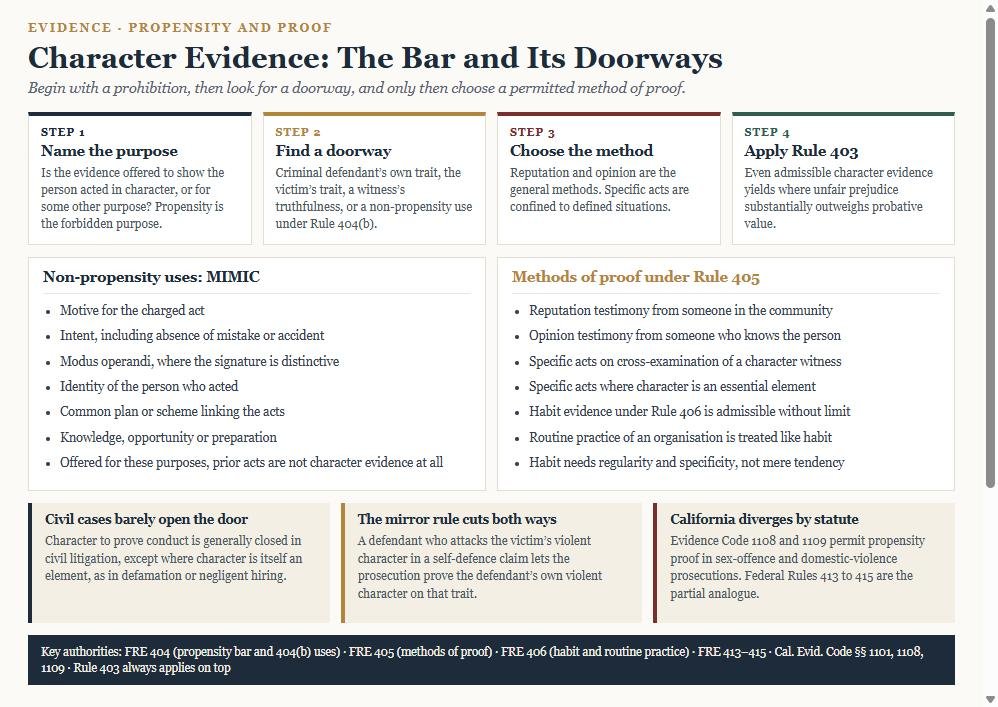
The propensity bar
Federal Rule of Evidence 404(a) states the prohibition: evidence of a person’s character or a character trait is not admissible to prove that on a particular occasion the person acted in accordance with that character. The concern is not that such evidence is worthless. It is that jurors overweight it, that it invites punishment for who someone is rather than for what they did, and that it turns a trial about one event into a trial about a whole life.
Because the bar is defined by purpose, the first question in every problem is what the proponent wants the jury to infer. If the chain of reasoning runs “this person is violent, therefore this person was violent that night,” the evidence is propensity evidence and it is out unless a specific rule lets it in.
The doorways in criminal cases
Three doorways open, and only in criminal prosecutions.
The defendant’s own character
A criminal defendant may offer evidence of a pertinent good character trait to show they acted in accordance with it. The trait must actually be pertinent to the charge: honesty in a fraud case, peacefulness in an assault case. The prosecution may not open this subject, but once the defendant does, the prosecution may rebut on the same trait.
The victim’s character
A defendant claiming self-defence may offer evidence of the victim’s violent character, and a defendant in a case where consent is at issue may address the victim’s relevant trait, subject to the special protections that apply in sexual assault cases. This is where the so-called mirror rule bites: attacking the victim’s character for violence permits the prosecution to prove the defendant’s own character for violence on that same trait.
A witness’s credibility
Character for truthfulness or untruthfulness is governed by the impeachment rules rather than the propensity bar. Any witness who testifies puts their credibility in issue, so this doorway is available in civil and criminal cases alike. Keep it separate in your answer: credibility character and conduct character are different arguments with different rules.
Non-propensity uses: the MIMIC purposes
Rule 404(b) permits evidence of other crimes, wrongs or acts when offered for a purpose other than propensity. The traditional mnemonic is MIMIC, and the list is illustrative rather than closed.
- Motive. A prior theft from the same victim explains why the defendant acted.
- Intent, and absence of mistake or accident. Three near-identical prior incidents make an innocent explanation implausible.
- Modus operandi. A distinctive method acts as a signature identifying the actor.
- Identity. A prior act ties the defendant to the crime through a unique feature.
- Common plan or scheme. A nearly identical earlier fraud shows a single overarching design rather than a disposition to defraud.
- Knowledge, opportunity and preparation. Familiarity with a security system, or possession of the tools used.
The critical framing point is that evidence offered for a MIMIC purpose is not character evidence at all. It happens to consist of bad acts, but the inference does not run through disposition. Say that expressly in an answer; graders look for it. Notice requirements and a limiting instruction usually follow, and Rule 403 still applies.
| Purpose offered | Admissible? | Rule |
|---|---|---|
| To show the person is the kind who would do this | No | 404(a) propensity bar |
| Criminal defendant’s pertinent good trait | Yes, defence first | 404(a)(2)(A) |
| Prosecution rebuttal on the same trait | Yes, after the door opens | 404(a)(2)(A) |
| Victim’s violent character in self-defence | Yes, then mirrored | 404(a)(2)(B) and (C) |
| Witness truthfulness | Yes, in any case | 607 to 609 |
| Motive, intent, plan, identity, knowledge | Yes, not propensity | 404(b) |
| Habit or routine practice | Yes, freely | 406 |
Exam tip: never write that character evidence is admissible or inadmissible. Write that it is inadmissible for one purpose and admissible for another, then identify which purpose the proponent has chosen. That single sentence is usually worth more than the whole list of exceptions.
Methods of proof under Rule 405
Even where character is a permitted subject, the form the proof may take is limited. Rule 405 allows reputation testimony and opinion testimony on direct examination. Specific instances of conduct are confined to two situations: cross-examination of a character witness, and cases where character is itself an essential element of a claim or defence, as in defamation or negligent entrustment.
Candidates lose points here in a predictable way, by assuming that specific acts can never be mentioned. They can, on cross. A defence witness who testifies that the defendant is peaceable may be asked whether they knew about a prior brawl, because the question tests the basis of the witness’s knowledge rather than proving the brawl happened.
Habit evidence stands outside the bar
Rule 406 admits evidence of a person’s habit or an organisation’s routine practice to prove that on a particular occasion the person or organisation acted in accordance with it, with no need for corroboration and no eyewitness requirement. The distinction from character is regularity and specificity: “careless driver” is character, while “always fastens the seatbelt before starting the engine” is habit.
Ask two questions. How often does the conduct occur, and how narrowly is the situation defined? A semi-automatic response to a specific recurring stimulus is habit. A general tendency, however well documented, is character.
Civil cases and the California variations
In civil litigation the propensity door is essentially closed. Character may be proved only where it forms an element of the claim, such as the plaintiff’s reputation in defamation or an employee’s violent disposition in negligent hiring. Otherwise the parties must argue about what happened, not about who the parties are.
California starts from the same prohibition in Evidence Code section 1101 but adds statutory carve-outs that do not track federal practice. Sections 1108 and 1109 admit propensity evidence in sexual-offence and domestic-violence prosecutions respectively. Federal Rules 413 to 415 provide a partial analogue for sexual assault and child molestation, but there is no federal counterpart to the domestic-violence provision, which makes it the cleaner distinction to draw in an answer.
Common mistakes that cost points
- Concluding that character evidence is inadmissible without asking what purpose it serves.
- Letting the prosecution open the character door before the defendant does.
- Forgetting the mirror rule after a defendant attacks the victim’s character.
- Treating 404(b) evidence as an exception to the propensity bar rather than as evidence outside it.
- Denying that specific acts may ever be raised, when cross-examination of a character witness permits exactly that.
- Confusing a general tendency with a habit under Rule 406.
- Applying the criminal doorways to a civil case where they are unavailable.
- Skipping Rule 403 after establishing that a rule permits the evidence.
Frequently asked questions
Does the prior act need to result in a conviction?
No. Rule 404(b) reaches crimes, wrongs and other acts whether or not charged or proven in another proceeding, provided there is sufficient evidence for the jury to find the act occurred. Convictions matter for impeachment under Rule 609, which is a separate analysis.
What is the difference between 404(b) and impeachment?
Rule 404(b) evidence is offered as substantive proof of an element such as intent or identity. Impeachment evidence is offered to suggest the witness should not be believed. The same prior conviction can be inadmissible for one purpose and admissible for the other, so name the purpose before applying a rule.
How specific must the trait be?
Pertinent to the charge. Honesty is pertinent to fraud but not to assault; peacefulness is pertinent to assault but not to embezzlement. A witness who vouches for the defendant’s general good character has usually strayed beyond what Rule 404(a)(2) allows.
Character evidence under the California Evidence Code, 2026
California does not use the Federal Rules of Evidence, and in this area the differences are substantial rather than cosmetic. Section 1101 of the California Evidence Code states the general prohibition on character evidence to prove conduct, while permitting evidence of other acts offered to prove a fact such as motive, intent or identity. Section 1102 allows a criminal defendant to offer evidence of their own good character, opening the door to prosecution rebuttal.
Two California provisions have no federal analogue in the same form and dominate practice in the Los Angeles Superior Court. Section 1108 permits the prosecution, in a case charging a sexual offence, to introduce evidence of the defendant’s other sexual offences to prove propensity. Section 1109 does the same in domestic violence cases, and it also reaches elder abuse and child abuse. Both are subject to the general discretion in section 352 to exclude evidence whose prejudicial effect substantially outweighs its probative value, and that balancing is where these motions are actually decided.
Other divergences to remember:
- Section 1103 has a two-way structure. A defendant may offer evidence of the victim’s violent character, but doing so permits the prosecution to offer evidence of the defendant’s violent character.
- Rape shield rules constrain victim sexual conduct evidence. Separate provisions restrict such evidence and impose a procedural gateway.
- Impeachment by conviction requires moral turpitude. California asks whether the prior offence involves moral turpitude rather than applying a felony or dishonesty test.
- Truth in Evidence expanded admissibility. The California Constitution bars exclusion of relevant evidence except as federal law requires, which is why California prosecutors have broader latitude than in many states.
- Habit and custom are admissible. Section 1105 permits evidence of habit or custom to prove conduct on a specific occasion.
- Civil cases restrict credibility character. Section 787 generally bars character for truthfulness in civil actions.
In 2026, cite the Evidence Code section rather than a federal rule number, and always frame a section 352 argument. Read with the hearsay rule, homicide and Miranda rights.
Next steps
Character evidence and hearsay are the two Evidence topics that reward a purpose-first habit of mind, so study them together. Work through the hearsay rule next and notice how both analyses begin by asking what the proponent is trying to prove rather than what the item of evidence is. If you are revising torts alongside evidence, the elements of negligence shows why habit evidence is so often decisive on the breach element.
For drilling, take one assault fact pattern and offer the same prior fight for five different purposes in turn. Then read the text of Rule 404 and the Federal Rules of Evidence to check your instinct against the language, and compare the California provision if you are sitting a state examination.
Related guides
 Congress’s Naturalization Power and Citizenship Limits
 Executive Agreements: The President’s Sole Foreign Power
 Ripeness and Mootness: Timing Rules in Federal Court
 The Appointment Power: Principal and Inferior Officers
 Campaign Finance and Anonymous Speech: The Core Rules
 Incorporation Doctrine: Which Rights Bind the States
 Piercing the Corporate Veil: A Two-Prong Alter Ego Test
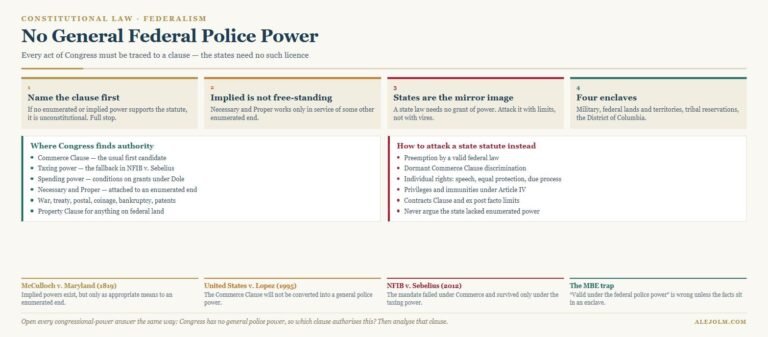 No Federal Police Power: Enumerated Powers and Enclaves
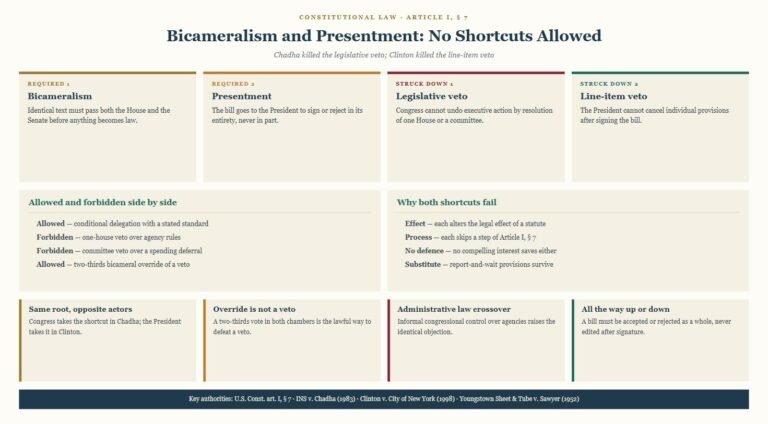 Bicameralism and Presentment: Two Vetoes Struck Down
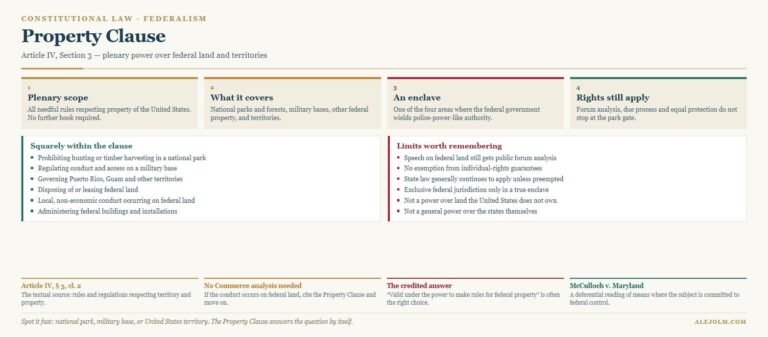 Property Clause: Congress and Federal Lands Explained
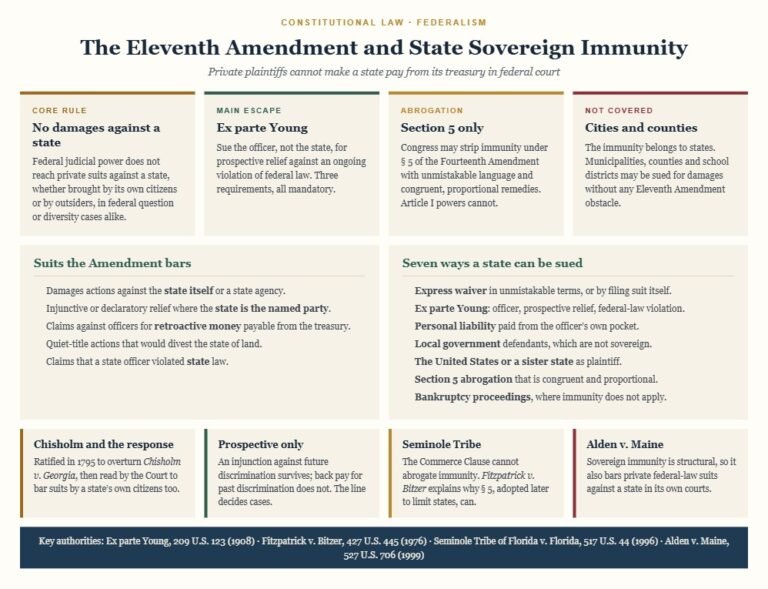 The Eleventh Amendment and State Sovereign Immunity
 Easements Explained: Creation, Scope and Termination