
Piercing the corporate veil is the equitable exception to the most valuable feature of incorporation. Shareholders of a properly formed corporation risk only what they invested; creditors who go unpaid must look to corporate assets. Veil piercing sets that bargain aside and reaches the owners personally when respecting the corporate form would work fraud or injustice.
This guide explains the two-prong alter ego test, the factors courts actually weigh, why tort creditors fare better than contract creditors, and the mistakes that make an otherwise strong answer collapse.
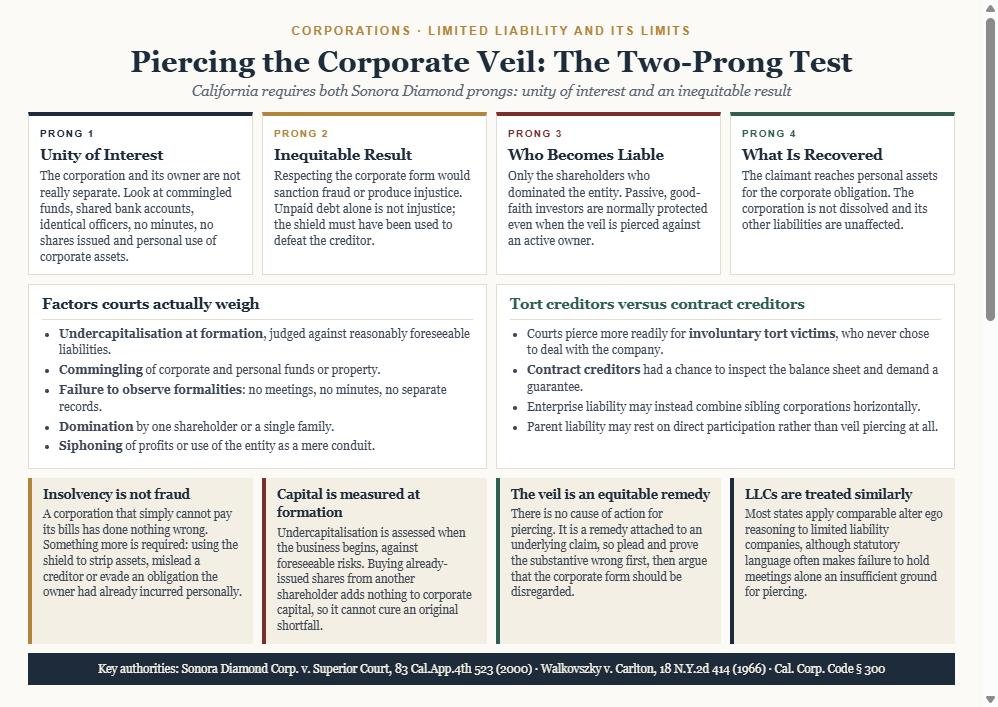
The bargain limited liability represents
Limited liability exists to encourage investment. Without it, nobody would buy shares in an enterprise whose failure could consume their house. The trade-off historically was double taxation: corporate income is taxed at the entity level and taxed again when distributed as dividends, which is why pass-through entities became so popular.
Courts guard the shield carefully. Disregarding the corporate form is described in the case law as extraordinary, reserved for the situation where the entity has no real separate existence and someone would be cheated if that fiction were honoured.
The two-prong test
California’s formulation, drawn from Sonora Diamond Corp. v. Superior Court, requires both prongs. Most jurisdictions use a functionally identical two-part inquiry even where the labels differ.
Prong one: unity of interest and ownership
The claimant must show that the corporation and the shareholder are not genuinely separate persons. This is a fact-heavy inquiry with no single controlling factor. Courts look for:
- Commingling of corporate and personal funds, or payment of personal expenses from corporate accounts.
- Failure to issue stock, hold meetings, keep minutes or maintain separate books.
- Identical officers, directors and offices between the shareholder and the entity.
- Use of corporate property as though it were personal property.
- Undercapitalisation relative to the risks the business was always going to create.
- Domination of the entity by a single shareholder or one family.
- Siphoning of profits or treating the corporation as a mere conduit for another business.
Prong two: an inequitable result
Even a badly run corporation is entitled to its shield unless honouring it would sanction fraud or produce injustice. This is where most claims fail. The creditor must show that the corporate form was used to defeat the very obligation now being enforced, not merely that the corporation turned out to be broke.
Classic examples include transferring assets out of the entity once litigation was foreseeable, inducing a creditor to extend credit while concealing that the company was an empty shell, and reincorporating to escape a judgment.
Exam tip: state that both prongs are required and analyse them separately. Answers that pile up alter ego factors and stop, without ever explaining what injustice would follow, lose half the available credit.
Undercapitalisation is measured at formation
The question is whether the business was funded adequately when it began, judged against reasonably foreseeable liabilities and expected income. A taxi company operating a fleet with the statutory minimum insurance is the textbook illustration, and Walkovszky v. Carlton famously refused to pierce on thin capitalisation alone.
Note a subtlety that examiners like. Buying already-issued shares from an existing shareholder transfers ownership but injects no new capital into the corporation. A later purchaser therefore cannot cure an original capitalisation defect by paying a large price for the stock.
Tort creditors versus contract creditors
| Creditor type | Bargaining position | Judicial attitude |
|---|---|---|
| Tort victim | Involuntary; never chose to deal with the entity | More willing to pierce, because the creditor had no chance to protect itself |
| Trade or contract creditor | Voluntary; could inspect finances or demand a guarantee | More reluctant; the creditor accepted the risk it now complains about |
| Employee or tax authority | Often protected by specific statutes | Statutory liability may attach without any veil piercing at all |
Related doctrines sometimes do the work instead. Enterprise liability treats several sibling corporations under common ownership as one pool of assets. Direct participant liability holds a parent responsible for its own conduct rather than its subsidiary’s. Successor liability follows assets into the hands of a purchaser who is really a continuation of the seller.
Who is exposed
Piercing is targeted, not collective. Liability falls on the shareholders who dominated and misused the entity. A passive investor who bought shares in good faith, took no part in management and knew nothing of the misuse is ordinarily protected even where the veil is pierced against the controlling owner.
Directors and officers face a different set of exposures altogether. Their personal risk usually runs through fiduciary duty rather than veil piercing, which is why the analysis in the Business Judgment Rule and Directors’ Fiduciary Duties is a separate inquiry with its own presumption in favour of the decision-maker.
Common mistakes that cost points
- Treating insolvency or an unpaid debt as sufficient evidence of injustice.
- Analysing only the alter ego factors and never reaching the second prong.
- Measuring capitalisation at the time of the lawsuit rather than at formation.
- Imposing liability on every shareholder instead of the ones who dominated the entity.
- Describing piercing as a cause of action rather than a remedy attached to an underlying claim.
- Forgetting that contract creditors face a harder road than tort victims.
- Overlooking statutory liabilities, such as unpaid payroll taxes, that attach directly to responsible persons.
- Assuming an LLC cannot be pierced, when most states apply comparable reasoning.
Frequently asked questions
Does failing to hold annual meetings automatically pierce the veil?
No. Neglecting formalities is evidence of unity of interest, but it is only one factor and it never satisfies the second prong on its own. Many LLC statutes go further and expressly say that failure to hold meetings is not a ground for imposing personal liability.
Can a corporation pierce its own veil?
Generally not. The doctrine protects outside claimants, so a shareholder cannot invoke it to obtain a benefit, such as reaching an insurance policy or avoiding a contract term. Courts call this reverse piercing and treat it with considerable suspicion.
Is a single-shareholder corporation inherently vulnerable?
One-person corporations are entirely lawful. Domination is a factor, not a violation. What creates exposure is the combination of domination with commingling, thin capital and conduct that leaves a creditor cheated.
Alter ego in California: piercing the veil in 2026
California calls this the alter ego doctrine and applies a two-part test that does not require proof of fraud. The claimant must show a unity of interest and ownership such that the separate personalities of the corporation and the individual no longer exist, and that treating the acts as those of the corporation alone would sanction a fraud or promote injustice. The formulation dates from Automotriz del Golfo de California v. Resnick (1957) and was restated in Sonora Diamond Corp. v. Superior Court (2000).
California procedure offers a remedy that surprises practitioners from other states. Rather than filing a new action, a judgment creditor may move under section 187 of the California Code of Civil Procedure to amend an existing judgment to add an alter ego as a judgment debtor, and Los Angeles County litigation has produced leading authority on the practice. The alter ego must have controlled the underlying litigation and been virtually represented in it, but where those conditions are met the creditor reaches the individual without retrying the merits.
The factors and the California specifics:
- Commingling and undercapitalisation are the strongest facts. Paying personal expenses from company accounts and starting business without adequate capital carry the most weight.
- Formalities matter evidentially. Absent minutes, unissued shares and no separate records support unity of interest.
- Reverse piercing is available against LLCs. California appellate authority has permitted an outside creditor to reach LLC assets to satisfy a member’s debt, an approach many states reject.
- LLC members are treated like shareholders. The California Corporations Code applies the same alter ego analysis to limited liability companies.
- Suspended corporations lose capacity. A corporation suspended for unpaid franchise tax cannot prosecute or defend an action, which often precipitates alter ego motions.
- Single enterprise liability reaches sister companies. Affiliated entities operating as one business may be held mutually liable.
For 2026, gather bank records and formalities evidence early, and consider the judgment amendment route. Read with partner liability, the business judgment rule and preclusion.
Next steps
Draft answers in two movements: first the separateness evidence, then the injustice. Then place the doctrine in context alongside the duties owed by management in Business Judgment Rule and Directors’ Fiduciary Duties, the liability rules for unincorporated firms in Partner Liability and Authority Under RUPA Explained, and the professional obligations that arise when a lawyer represents both the entity and its owner in Conflicts of Interest: A 6-Step Decision Tree for the Bar.
For primary sources, the California baseline that corporate business is managed by the board appears in Cal. Corp. Code § 300, the New York decision refusing to pierce for thin capitalisation is Walkovszky v. Carlton, and Cornell’s summary of piercing the corporate veil gives a compact multi-state overview.
Related guides
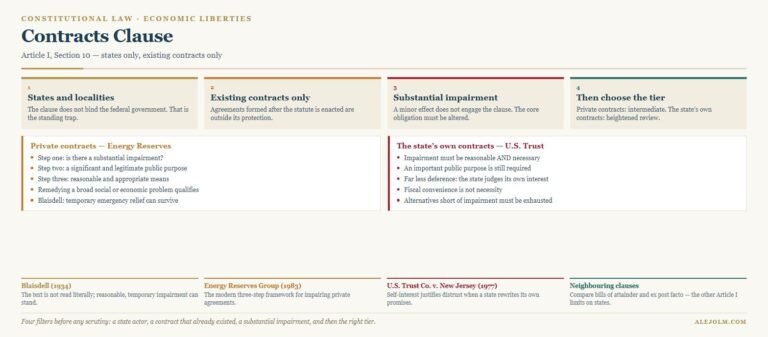 Contracts Clause: When States May Impair Agreements
 Second Amendment: The Bruen Text-and-History Standard
 Personal Jurisdiction: The 3-Step Bar Exam Framework
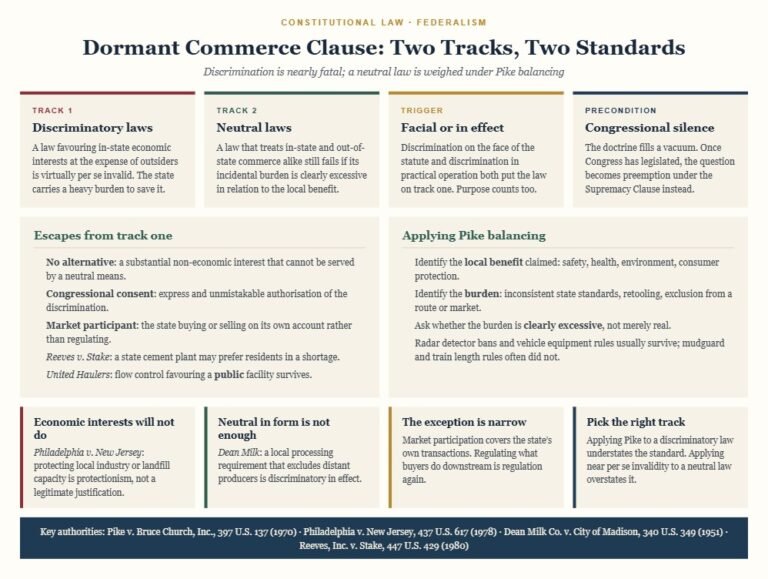 Dormant Commerce Clause: Discrimination vs Pike Balancing
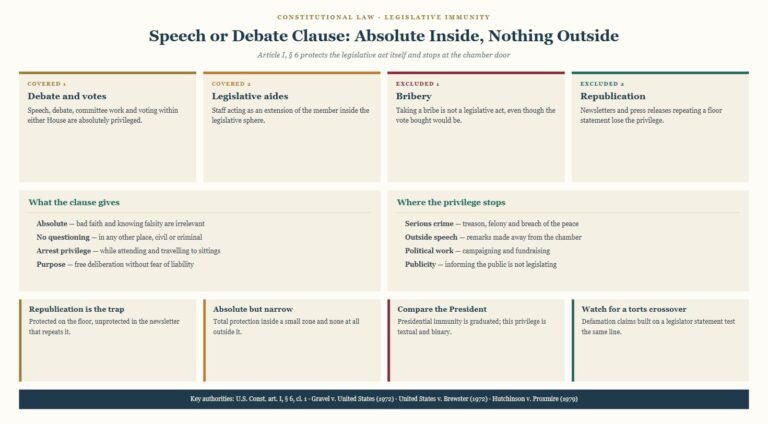 Speech or Debate Clause: Absolute but Narrow Immunity
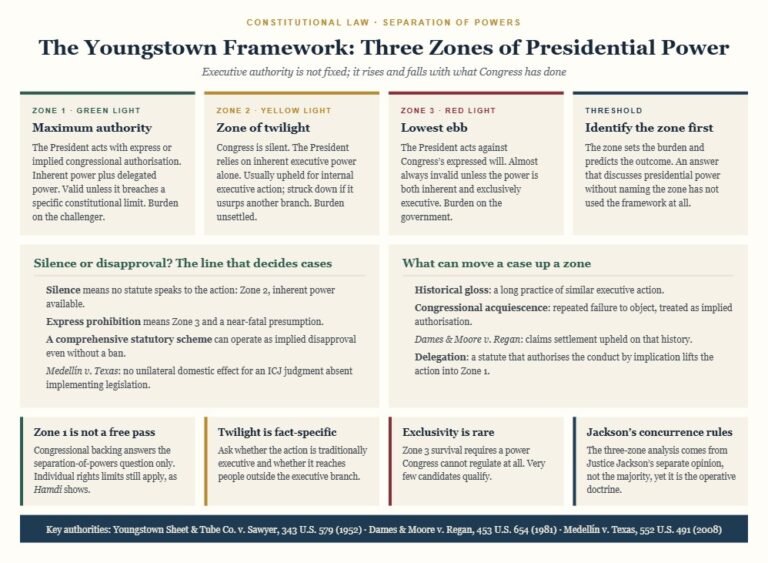 The Youngstown Framework: Presidential Power in 3 Zones
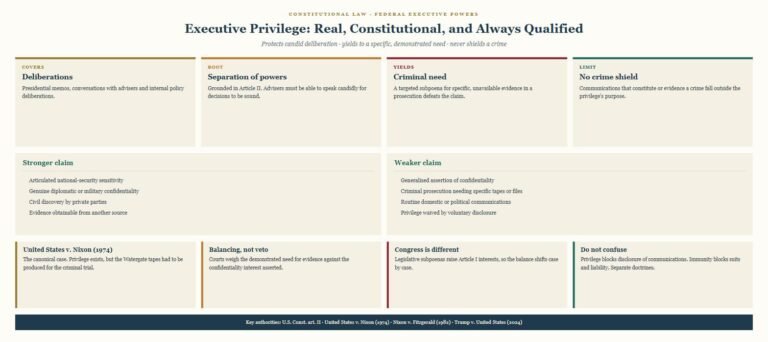 Executive Privilege: A Qualified Right That Must Yield
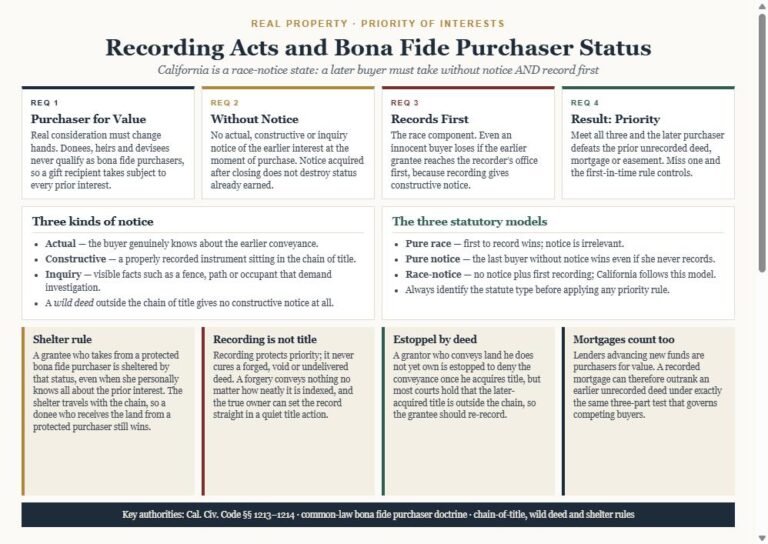 Recording Acts: Race, Notice and Race-Notice Explained
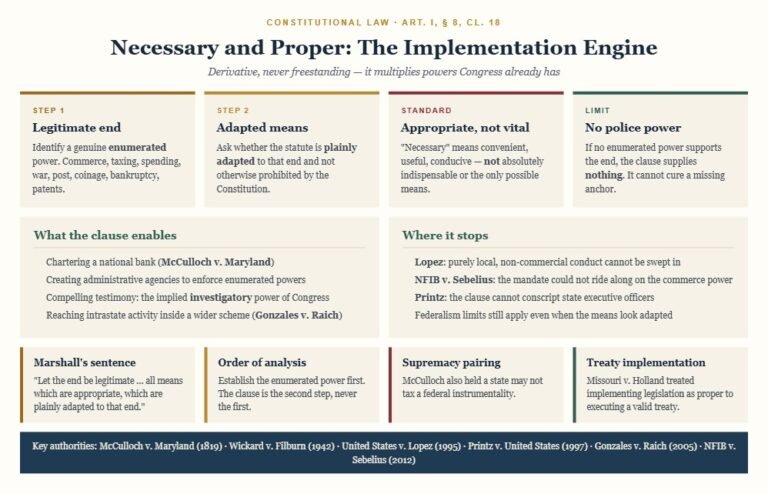 The Necessary and Proper Clause: Congress’s Multiplier
 The Rule Against Perpetuities Explained Step by Step
 Easements Explained: Creation, Scope and Termination
 Campaign Finance and Anonymous Speech: The Core Rules