
States need revenue, and interstate businesses are attractive targets. The Commerce Clause does not stop a state from taxing commerce that crosses its borders, but it does insist the tax be honest about what belongs to that state and what does not. The framework for testing that is the Complete Auto test.
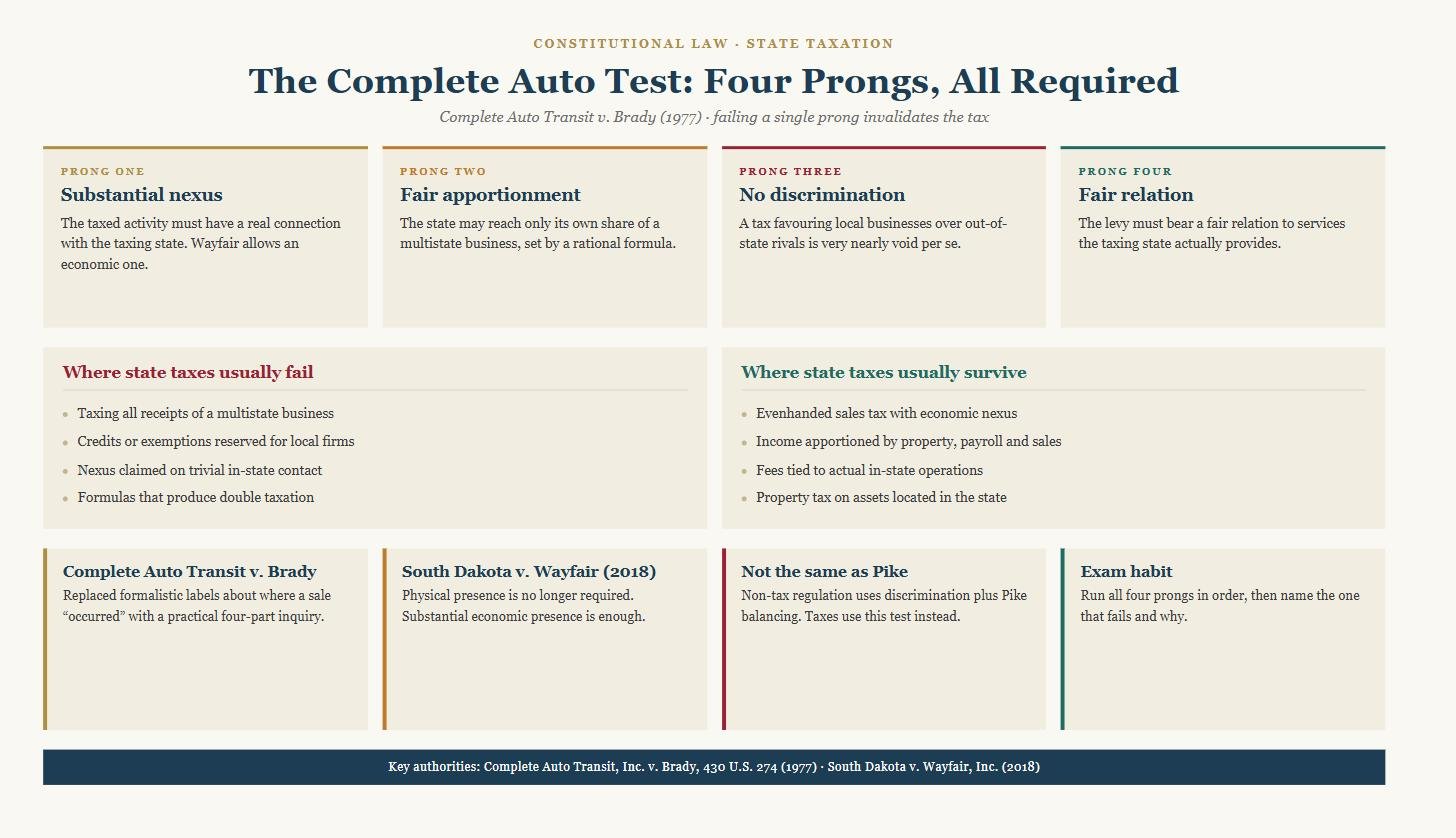
Complete Auto Transit, Inc. v. Brady (1977) swept away an older jurisprudence obsessed with labels — whether a sale formally “occurred” inside the state, whether the tax was on the privilege of doing interstate business — and replaced it with four practical questions. A state tax on interstate commerce survives only if it satisfies all four. Fail one and the tax falls, however comfortably it clears the other three.
Why taxes get their own test
Ordinary state regulation of commerce is analysed by asking whether it discriminates against interstate commerce and, if not, whether its burden clearly exceeds its local benefits under Pike balancing. Taxes are different, because the risk is not simply protectionism but arithmetic. Several states may each have a genuine claim on the same enterprise, and unless their claims are limited to their own share, the same dollar gets taxed twice or four times purely because the business crossed a line.
The four prongs address that risk directly. Nexus asks whether this state has any business taxing at all. Apportionment asks how much of the enterprise it may reach. Non-discrimination asks whether it is using the tax code as a tariff. Fair relation asks whether the levy corresponds to anything the state actually provides.
Prong one: substantial nexus
The taxed activity must have a substantial connection with the taxing state. Historically that meant physical presence — an office, employees, inventory. South Dakota v. Wayfair, Inc. (2018) abandoned the physical-presence rule for sales-tax collection duties and accepted substantial economic presence instead, so a remote seller with meaningful sales into a state can be required to collect its tax without ever setting foot there.
What nexus still excludes is trivial or incidental contact. A single delivery, an unsolicited order, a website accessible everywhere — none of these on its own gives a state a claim. The question is whether the enterprise has purposefully availed itself of the state’s market to a degree that makes taxation fair.
Prong two: fair apportionment
This is where most challenged taxes actually die. A state may tax only its own share of a multistate business, and the formula it uses must be both internally and externally consistent: if every state applied the same formula, no more than one hundred per cent of the enterprise would be taxed, and the share this state claims must reasonably reflect the activity within it.
The classic failure is a gross-receipts tax reaching all of a company’s revenue when only a fraction of its operations are local. Traditional three-factor formulas that weight property, payroll and sales are the safe harbour, precisely because they measure something real.
Exam tip: whenever a fact pattern gives you revenue figures broken down by state, apportionment is the prong being tested. Do the arithmetic; the answer is usually visible in the numbers.
Prongs three and four: discrimination and fair relation
Non-discrimination mirrors the general dormant Commerce Clause rule. A tax that imposes a higher rate on out-of-state goods, or grants a credit only to local producers, is a tariff in disguise and is virtually per se invalid. Facial neutrality is not a defence if the practical effect is to shelter local business from competition.
Fair relation is the least demanding prong and the one courts rarely use to strike a tax down. It requires only that the levy bear a fair relationship to the services the state provides — roads, policing, courts, a trained workforce. It does not require any close accounting between tax paid and benefit received, and a business that enjoys the general advantages of operating in a state cannot complain that it uses fewer of them than its neighbours.
| Tax measure | Prong most at risk |
|---|---|
| Gross-receipts tax on all revenue of a multistate seller | Fair apportionment |
| Collection duty imposed on a remote online seller | Substantial nexus |
| Tax credit available only to in-state producers | Non-discrimination — usually fatal |
| Higher rate on goods brought in from other states | Non-discrimination — fatal |
| Flat annual fee on every truck using state highways | Fair relation and apportionment |
| Income tax apportioned by property, payroll and sales | Generally valid on all four prongs |
Worked example
State R imposes a five per cent tax on the gross receipts of manufacturers operating within the state. A manufacturer with plants in four states earns two hundred million in total, of which fifty million arises from its State R operations. State R assesses the tax on the fifty million, producing a bill of two and a half million. The manufacturer challenges it.
The tax stands. It applies at the same rate to local and out-of-state manufacturers, so there is no discrimination. The company runs a plant in the state and earns fifty million there, which is substantial nexus by any measure. State R has confined the base to in-state receipts rather than reaching the whole two hundred million, so apportionment is satisfied. And the manufacturer uses State R’s roads, utilities, courts and workforce, which is all fair relation requires. Four prongs, four passes.
Change one fact. Suppose State R assessed five per cent of the full two hundred million because the company is “doing business” in the state. The tax now fails apportionment outright, and it would fail even if the company’s in-state presence were far larger, because the base bears no relation to the activity within the state.
Common mistakes that cost points
- Running Pike balancing on a tax. Taxes get the four-part test; non-tax regulation gets discrimination plus Pike.
- Stopping after the first prong that passes. All four are independent requirements.
- Still requiring physical presence for nexus. Wayfair changed that.
- Confusing apportionment with the tax rate. A modest rate on an unapportioned base is still unconstitutional.
- Treating fair relation as a cost-benefit audit. It asks for a fair relation, not a matching invoice.
- Forgetting that a tax on the federal government fails for an entirely different reason, under intergovernmental immunity, with no balancing at all.
Frequently asked questions
Can two states tax the same income?
Each may tax its own apportioned share, and the shares should add up to no more than the whole. What the Constitution forbids is a formula that, if generally applied, would expose the enterprise to tax on more than all of its activity.
Does Congress have a role here?
A considerable one. The limits come from the Commerce Clause, and Congress may consent to state taxation that courts would otherwise strike down, or forbid state taxation that would otherwise be permitted. Where a federal statute speaks, it controls.
Are user fees analysed the same way?
Broadly yes, though fair relation carries more weight. A charge presented as a fee for using state facilities must bear a reasonable relationship to the use, and a flat charge that ignores how much use is actually made is the standard vulnerability.
The Complete Auto test and California state taxation in 2026
The four-part test asks whether a state tax on interstate commerce rests on substantial nexus with the taxing state, is fairly apportioned, does not discriminate against interstate commerce, and is fairly related to services the state provides. California applies it constantly, because it taxes aggressively and its economy is heavily interstate.
Substantial nexus no longer requires physical presence. After South Dakota v. Wayfair (2018) California enacted economic nexus thresholds for sales and use tax collection, and remote sellers meeting them must register and collect, including the district taxes that push combined rates in parts of Los Angeles County above ten per cent. On the income side, California uses a single sales factor with market-based sourcing for most taxpayers, so revenue is assigned to California when the customer receives the benefit here.
Local layers that complicate the analysis:
- The City of Los Angeles taxes gross receipts. Businesses must apportion receipts to activity within the city, and disputes over apportionment methodology are common.
- District taxes vary within the county. Rates differ between incorporated cities and unincorporated areas, so the correct rate depends on the delivery address.
- Internal consistency tests discrimination. Ask what would happen if every state adopted the same rule; if the hypothetical produces double taxation, the tax is vulnerable.
- Fair relation is easily satisfied. Courts require only that the taxpayer receive the general benefits of state services, not a measured quid pro quo.
- Public Law 86-272 still shelters some sellers. Its protection for mere solicitation of orders for tangible goods has narrowed considerably as commerce moved online.
- Property tax follows Proposition 13. Interstate businesses holding California real property are assessed on acquisition value, which creates planning consequences on transfer.
For 2026, run the four prongs in order and treat apportionment as the prong most often winnable. Read with the dormant Commerce Clause, the taxing power and personal jurisdiction.
Next steps
Read this with the dormant Commerce Clause for the general framework this test specialises, the Commerce Clause for the source of the limit, intergovernmental immunity for the categorical bar that applies when the taxpayer is the federal government, and Article IV privileges and immunities for the parallel claim available to individual citizens.
For primary sources, read Complete Auto Transit, Inc. v. Brady on Justia, review the Commerce Clause on Cornell Legal Information Institute, and confirm current subject coverage with the State Bar of California.
Related guides
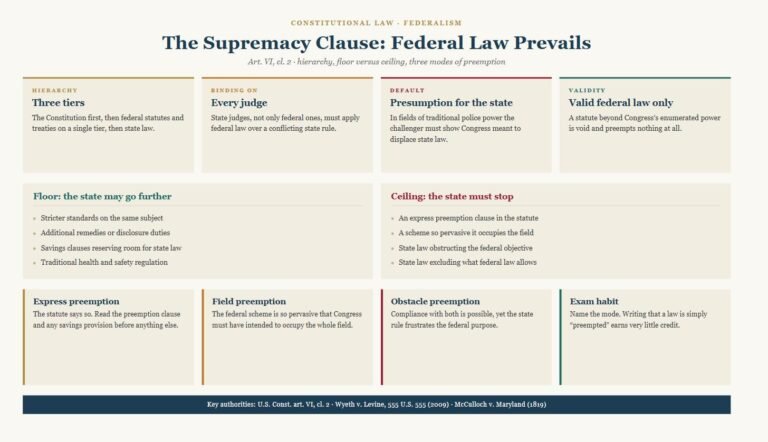 The Supremacy Clause: Floors, Ceilings and Preemption
 Personal Jurisdiction: The 3-Step Bar Exam Framework
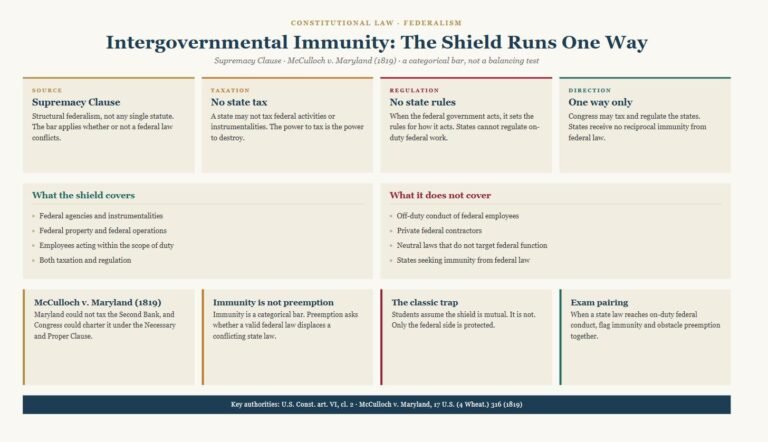 Intergovernmental Immunity: The Shield Runs One Way
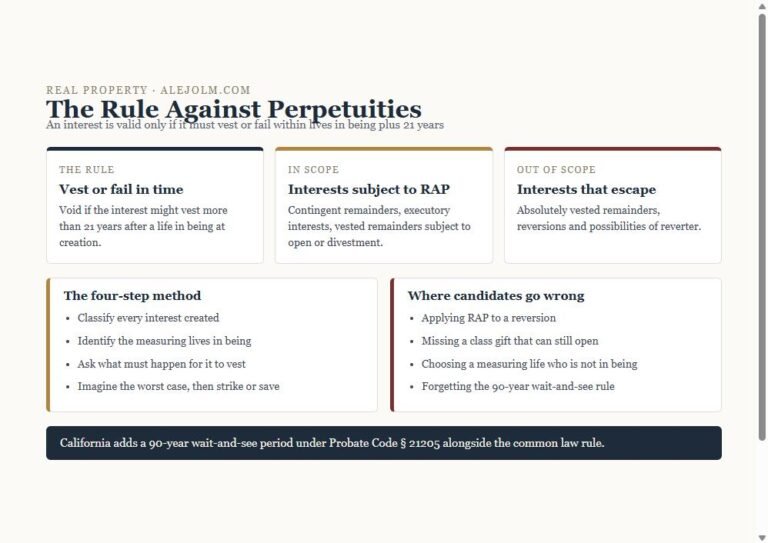 The Rule Against Perpetuities Explained Step by Step
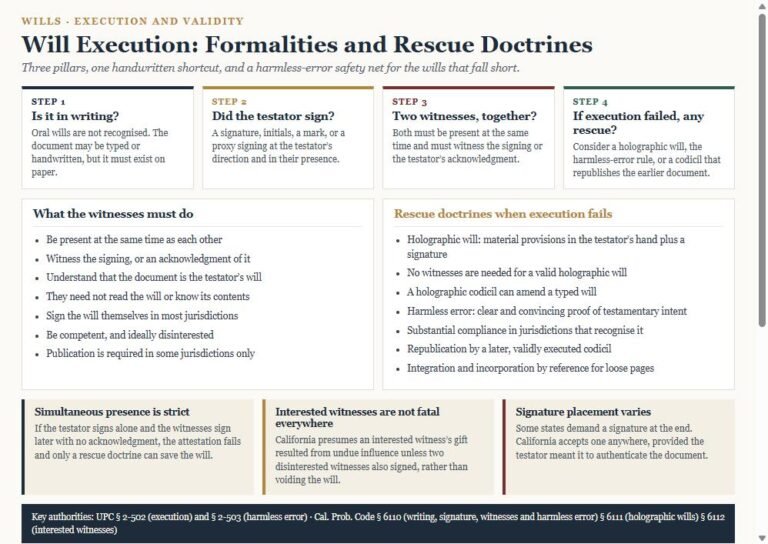 Will Execution Requirements: Formalities and Rescue
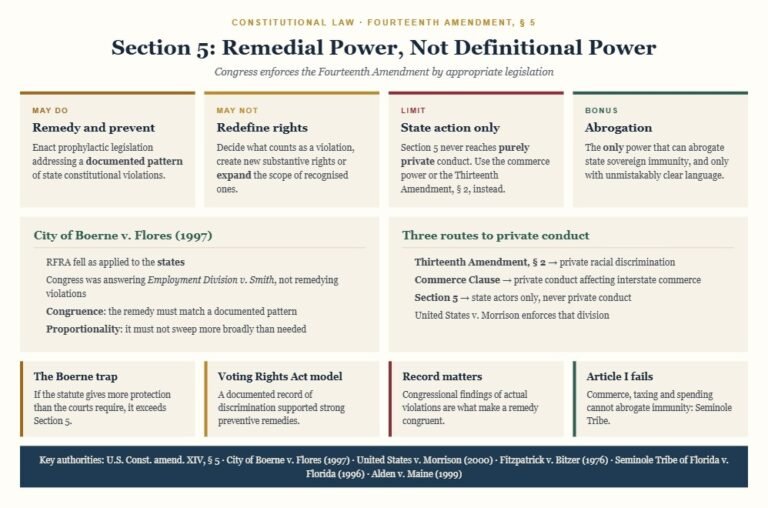 Section 5 Enforcement Power: Remedy, Do Not Redefine
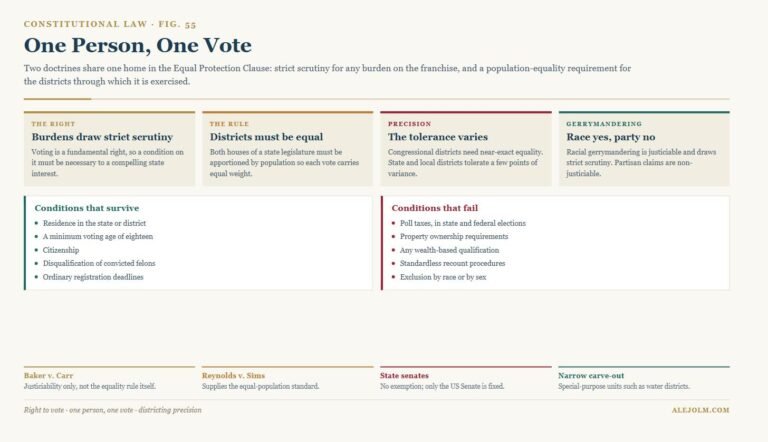 One Person, One Vote: Voting Rights Under Equal Protection
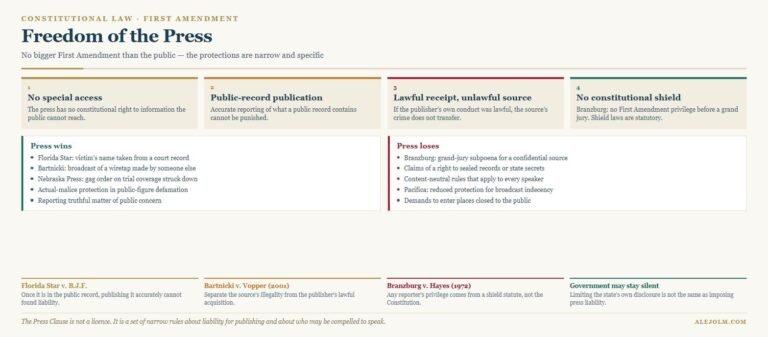 Freedom of the Press: Publication Liability and Limits
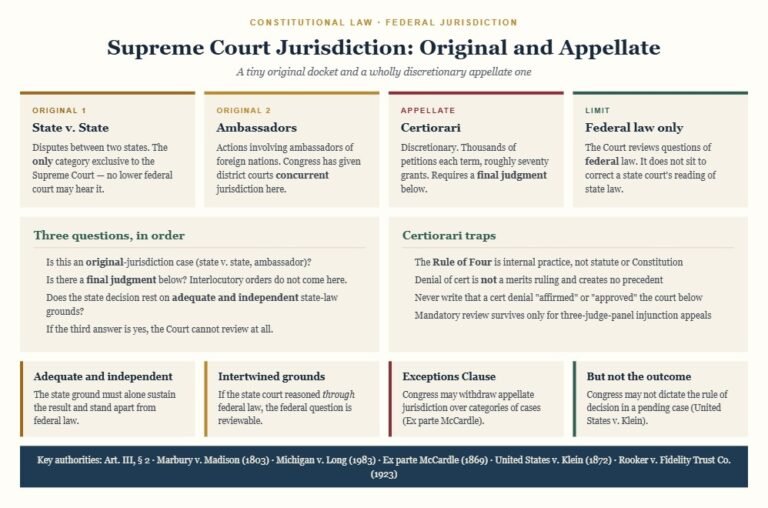 Supreme Court Jurisdiction: Original vs Appellate Power
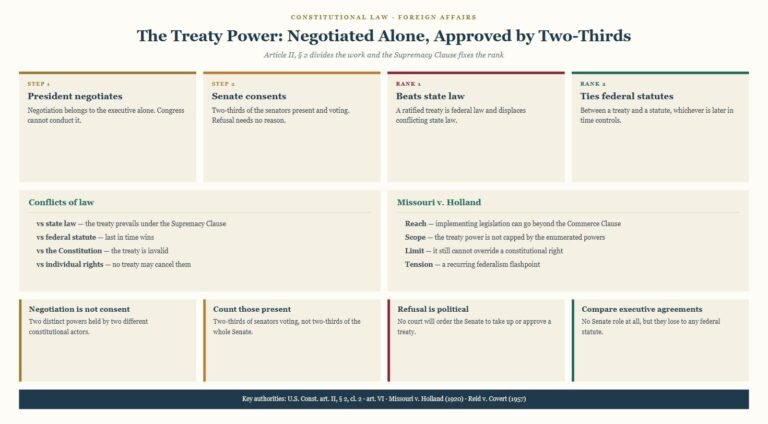 The Treaty Power: Senate Advice and Consent Explained
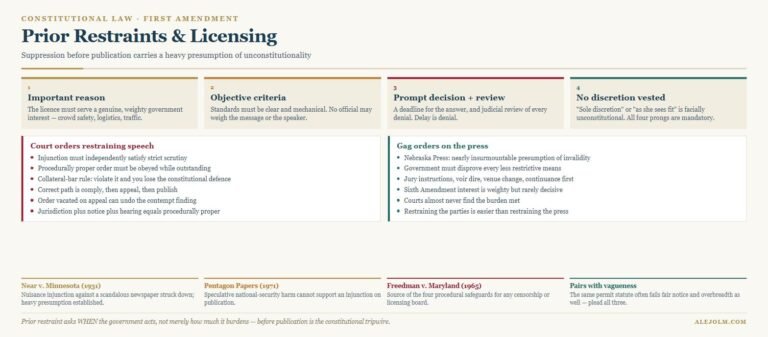 Prior Restraint and Licensing: The Freedman Safeguards
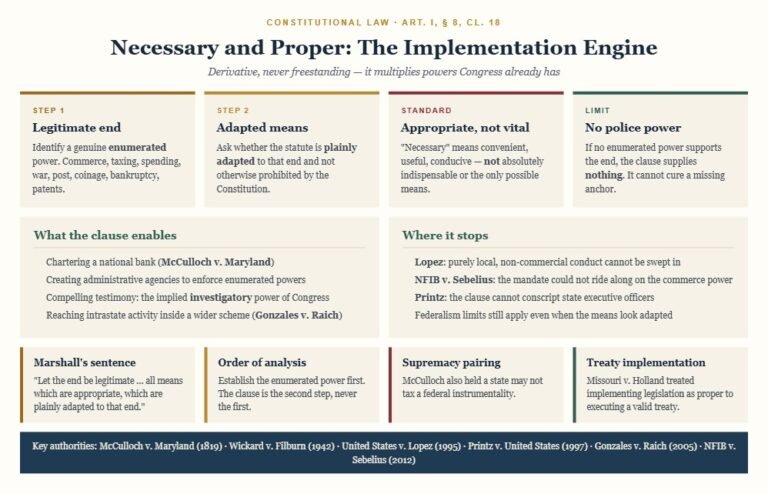 The Necessary and Proper Clause: Congress’s Multiplier