
Murder and manslaughter sit on a ladder, and the single most useful habit in a homicide question is to know which rung is the default. Common law murder is the unlawful killing of another human being with malice aforethought, and on the bar exam murder is presumed to be second degree unless the facts establish a first-degree trigger.
Work down from there. If mitigation applies, the killing drops to voluntary manslaughter. If there was never any malice at all, you are in involuntary manslaughter. This guide walks the ladder rung by rung, then unpacks felony murder, which examiners test almost entirely through its limitations.
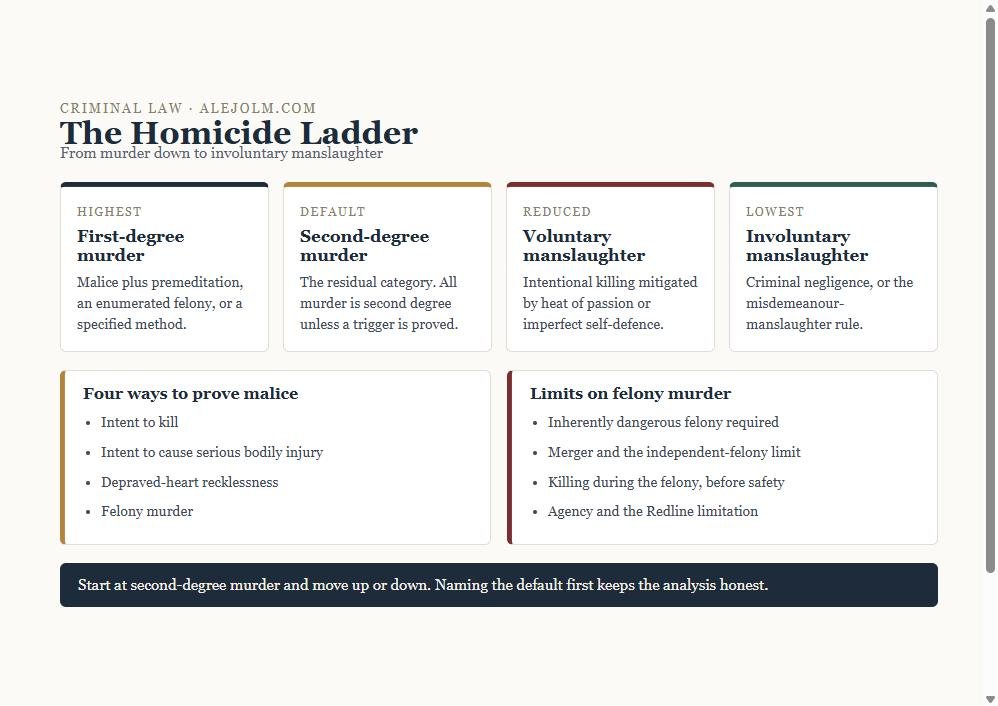
Malice aforethought: four routes, not one
Malice is a term of art and does not require ill will. It can be proved in four ways, and being able to list them quickly is what allows you to classify a killing under time pressure.
- Intent to kill — the clearest route.
- Intent to cause serious bodily injury — death need not have been intended.
- Depraved-heart recklessness — extreme, reckless disregard of an unjustifiably high risk to human life, often phrased as a wanton and reckless disregard for human life or an abandoned and malignant heart.
- Felony murder — the intent to commit an inherently dangerous felony supplies the malice.
Second-degree murder is the default
Second-degree murder is the residual category: any unlawful killing with malice aforethought that does not qualify as first degree. It covers intent-to-kill killings without premeditation, intent-to-cause-serious-injury killings, depraved-heart killings and felony murder arising from a non-enumerated felony.
State the default explicitly in your answer. Writing that all murder is second degree unless a first-degree trigger is proved shows the grader you have the architecture right before you argue the facts.
First-degree murder: three elevating triggers
Malice alone is never enough for first degree. One of three additional features must be present.
Premeditation and deliberation
The defendant must have reflected on the decision to kill. The time required can be momentary, which is precisely what makes this a fact-sensitive issue rather than a mechanical one. Look for planning activity, motive and the manner of killing.
An enumerated dangerous felony
Killings during the felonies commonly remembered by the mnemonic BARRK — burglary, arson, robbery, rape and kidnapping — are first-degree felony murder. Killings during other inherently dangerous felonies are second degree.
A statutorily specified method
Poisoning, lying in wait and torture are the classic examples. These are shortcuts written into the statute, so if the facts mention one of them the elevation is straightforward.
Voluntary manslaughter: four cumulative conditions
Voluntary manslaughter is an intentional killing that would otherwise be murder, reduced by heat of passion. The four conditions are cumulative, and failing any one of them leaves you at murder.
- Adequate provocation sufficient to inflame a reasonable, ordinary person.
- Actual heat of passion in the defendant.
- No reasonable opportunity to cool off between the provocation and the killing.
- The defendant in fact did not cool off.
Words alone are traditionally inadequate provocation, however insulting. Many jurisdictions also recognise imperfect self-defence, where the defendant honestly but unreasonably believed force was necessary, and diminished capacity, as independent routes to the same reduction.
Involuntary manslaughter: no malice at all
Involuntary manslaughter covers unintentional killings. There are two routes.
| Route | Standard | Note |
|---|---|---|
| Criminal negligence | A gross deviation from the standard of care | Objective; no subjective awareness of the risk is required |
| Misdemeanour-manslaughter | Death during an unlawful act that is not a qualifying felony | Foreseeability distinguishes it from felony murder |
The gradation matters. Criminal negligence is more culpable than ordinary civil negligence but less culpable than the conscious disregard needed for depraved-heart murder. Placing the defendant on that scale is usually the point of the question.
Felony murder and its six limitations
Felony murder treats a killing committed during an inherently dangerous felony as murder without independent proof of malice as to the death. Because the doctrine is so severe, the examinable content is almost entirely in the limits.
- Inherently dangerous felony — California asks whether the felony is dangerous in the abstract, not merely as committed.
- Merger and the independent-felony limit — the felony must be independent of the homicide. Assault, whose only purpose is to injure, merges and cannot support the charge.
- Timing — liability runs during the felony and continues until the defendant reaches a temporary place of safety.
- Foreseeability — where applied, the death must be a foreseeable result, though foreseeability is often presumed where a co-felon causes it.
- Agency and the Redline limitation — in most jurisdictions a felon is not liable when a co-felon is killed by the victim or police. An innocent bystander killed by a victim or officer does generally count, at least where a felon caused the confrontation.
- A valid defence to the underlying felony, such as self-defence, defeats the felony-murder charge built on it.
There is also a constitutional ceiling. Under Enmund v. Florida and Tison v. Arizona, the death penalty cannot be imposed on a defendant whose participation was minor and who lacked reckless indifference to human life.
Common mistakes that cost points
- Starting at first-degree murder instead of naming second degree as the default.
- Treating malice as requiring hatred or spite.
- Finding voluntary manslaughter when one of the four heat-of-passion conditions is missing.
- Using assault as the predicate for felony murder despite merger.
- Confusing depraved-heart recklessness with criminal negligence.
- Ignoring the temporary-place-of-safety cut-off on felony murder liability.
Frequently asked questions
How much time does premeditation require?
Very little. Courts accept that reflection can be momentary, so the analysis focuses on evidence of planning, motive and method rather than on a fixed interval.
Are words ever adequate provocation?
Traditionally not, no matter how offensive. Some jurisdictions allow words that convey information amounting to a provoking event, but the safe answer is that insults alone do not mitigate.
What is the difference between depraved heart and criminal negligence?
Depraved heart involves extreme recklessness amounting to malice, so it supports murder. Criminal negligence is a gross deviation from due care measured objectively, and supports involuntary manslaughter only.
Homicide in California after the felony murder reform, 2026
California homicide law changed fundamentally in 2019, and any analysis using the older framework will be wrong. Legislation amending sections 188 and 189 of the California Penal Code provided that malice may not be imputed based solely on participation in a crime, which abolished the natural and probable consequences theory of murder and confined felony murder to defendants who were the actual killer, who aided the killing with intent to kill, or who were major participants in specified felonies acting with reckless indifference to human life.
The reform was made retroactive through a petition procedure, and the Los Angeles Superior Court has processed a very large volume of resentencing petitions as a result, with the Los Angeles County District Attorney‘s office required to respond on the merits of each. A practitioner encountering an older conviction should always check whether the theory of liability survives the amendment.
The current structure:
- First degree requires deliberation or a listed circumstance. Premeditation, lying in wait, torture, poison or an enumerated felony under the narrowed rule.
- Implied malice covers dangerous driving. Following People v. Watson (1981), a defendant with prior awareness of the risks of drunk driving may be charged with murder rather than vehicular manslaughter.
- Heat of passion reduces to voluntary manslaughter. Adequate provocation judged by an objective standard, with no cooling-off period.
- Imperfect self-defence is a California doctrine. An honest but unreasonable belief in the need for defensive force negates malice and reduces the offence.
- Gross vehicular manslaughter is separate. The Penal Code creates graded vehicular offences with and without intoxication.
- Capital punishment is subject to a moratorium. Executions have been suspended by executive action while the death penalty remains on the books, so verify the current position before advising.
- Jury instructions come from CALCRIM. The CALCRIM jury instructions state the elements as they will be given.
In 2026, identify the theory of malice before anything else, and screen old convictions for retroactive relief. Read with habeas corpus, the Ex Post Facto Clause and Miranda rights.
Next steps
Homicide connects to causation, accomplice liability and the justification defences, and the same laddered reasoning pays off elsewhere on the syllabus. Compare our guides to the four elements of negligence, the hearsay rule and consideration in contract law.
For statutory text, the California Penal Code is published by the state legislature, and Cornell’s entry on the felony murder doctrine is a compact summary.
The most efficient drill is classification without analysis: read thirty short killings and write only the rung and the reason. Speed at classification frees time for the felony murder limits, where the marks are concentrated.
Related guides
- Advisory Opinions: Article III and Declaratory Relief
- Access to the Courts: When Filing Fees Are Unconstitutional
- Other Enumerated Powers: Postal, Bankruptcy, Admiralty
- Franchise Amendments: Congress and the Right to Vote
- Property Clause: Congress and Federal Lands Explained
- No Federal Police Power: Enumerated Powers and Enclaves
- Contracts Clause: When States May Impair Agreements
- Takings Clause: Lucas, Penn Central and Just Compensation
- Free Exercise Clause: Smith, Lukumi and Fulton Applied
- Establishment Clause: Church, State and the New Test
- Freedom of Association: Scrutiny, Dale and Disclosure
- Freedom of the Press: Publication Liability and Limits
- Campaign Finance and Anonymous Speech: The Core Rules
- Unconstitutional Conditions: Benefits and Rights Waivers
- Government Speech Doctrine: When the State Can Choose
- Vagueness and Overbreadth: Facial Challenges Explained
- Prior Restraint and Licensing: The Freedman Safeguards
- Symbolic Conduct and the O’Brien Test: The Pivot Question
- Government Employee Speech: Garcetti and Pickering Rules
- Commercial Speech and the Central Hudson Four-Part Test
- Actual Malice and the Three Tracks of Defamation Law
- Public Forum Doctrine and the Time, Place, Manner Test
- First Amendment: The Three-Question Speech Framework
- One Person, One Vote: Voting Rights Under Equal Protection
- Alienage Classifications: Strict Scrutiny and Its Pockets
- Equal Protection: The Three-Step Classification Test
- Second Amendment: The Bruen Text-and-History Standard
- Substantive Due Process After Dobbs: A Two-Step Test
- Procedural Due Process: Notice, Hearing and Mathews
- Incorporation Doctrine: Which Rights Bind the States
- Full Faith and Credit: Recognising Sister-State Judgments
- The Complete Auto Test: Taxing Interstate Commerce
- The Right to Travel: Durational Residency Explained
- Article IV Privileges and Immunities: The Comity Rule
- Federal Preemption: The Three-Step Ladder Explained
- The Supremacy Clause: Floors, Ceilings and Preemption
- Intergovernmental Immunity: The Shield Runs One Way
- The Presidential Pardon Power: Four Limits That Matter
- Executive Privilege: A Qualified Right That Must Yield
- Presidential Immunity: Criminal, Civil and Private Acts
- The Removal Power: At-Will Firing and Its Exceptions
- The Appointment Power: Principal and Inferior Officers
- Take Care Clause: Enforcement Discretion and Its Limits
- Commander-in-Chief Power: Deploy Without Declaring War
- Executive Agreements: The President’s Sole Foreign Power
- The Treaty Power: Senate Advice and Consent Explained
- The Presidential Veto Power, Override and Pocket Veto
- Bicameralism and Presentment: Two Vetoes Struck Down
- The Nondelegation Doctrine and the Intelligible Principle
- Speech or Debate Clause: Absolute but Narrow Immunity
- The Impeachment Power: House Majority, Senate Two-Thirds
- Congress’s Naturalization Power and Citizenship Limits
- Congressional War Powers: Declare, Fund and Command
- Anti-Commandeering Doctrine and the Tenth Amendment
- Section 5 Enforcement Power: Remedy, Do Not Redefine
- The Spending Power and the Five Dole Test Conditions
- Congress’s Taxing Power: When a Penalty Is Really a Tax
- The Necessary and Proper Clause: Congress’s Multiplier
- Ex Post Facto Clause: Retroactive Criminal Laws Barred
- Bills of Attainder: Legislative Punishment Explained
- The Writ of Habeas Corpus: Testing Unlawful Detention
- Supreme Court Jurisdiction: Original vs Appellate Power
- Abstention Doctrine: 4 Ways Federal Courts Step Aside
- Dormant Commerce Clause: Discrimination vs Pike Balancing
- The Commerce Clause: 3 Categories and 2 Hard Limits
- State Action Doctrine: The Government Conduct Threshold
- The Eleventh Amendment and State Sovereign Immunity
- Political Question Doctrine: What Courts Will Not Decide
- Ripeness and Mootness: Timing Rules in Federal Court
- Standing in Federal Court: The 3-Part Article III Test
- Marbury v. Madison and the Power of Judicial Review
- The Youngstown Framework: Presidential Power in 3 Zones
- The IRAC Method: How to Structure a Bar Exam Answer
- Piercing the Corporate Veil: A Two-Prong Alter Ego Test
- Defamation Elements, Fault Standards and Privileges
- The Parol Evidence Rule: Integration and Exceptions
- Recording Acts: Race, Notice and Race-Notice Explained
- Partner Liability and Authority Under RUPA Explained
- Trustee Duties: Care, Loyalty, Impartiality, Accounts
- Specific Performance: A Six-Element Bar Exam Framework
- Will Execution Requirements: Formalities and Rescue
- Community Property Presumptions in California Explained
- Easements Explained: Creation, Scope and Termination
- Products Liability: The Three Defect Theories Explained
- Miranda Rights: Custody, Interrogation and Invocation
- The Character Evidence Rules: Propensity Bar and Doorways
- Adverse Possession Elements: OCEAN and the Tax Rule
- Business Judgment Rule and Directors’ Fiduciary Duties
- The Statute of Frauds: MYLEGS and How to Satisfy It
- Res Judicata vs Collateral Estoppel: Bar Exam Guide
- The Erie Doctrine Explained: A 4-Step Bar Exam Guide
- Conflicts of Interest: A 6-Step Decision Tree for the Bar
- The Rule Against Perpetuities Explained Step by Step
- Consideration in Contract Law: Rules and Exceptions
- The Four Elements of Negligence: Bar Exam Breakdown
- The Hearsay Rule Explained: Exceptions and Exemptions
- Personal Jurisdiction: The 3-Step Bar Exam Framework
- 3 Levels of Scrutiny in Constitutional Law Explained
- The Citizenship Clause After Trump v. Barbara