
Because Congress has no general police power, every federal statute must be traced to a clause. Most of the time attention goes to the three heavyweights — commerce, taxing and spending — and the remaining grants in Article I, Section 8 are treated as decorative. That is a mistake. Each is an independent source of legislative authority, and on a question where commerce plainly fails, one of them is frequently the correct answer.
This guide works through the catalogue: borrowing, the postal power, coinage and standards, bankruptcy, patents and copyrights, and admiralty. Bankruptcy deserves the most attention, because it behaves unlike any other federal power — it operates concurrently with the states, and state sovereign immunity is no defence to it.
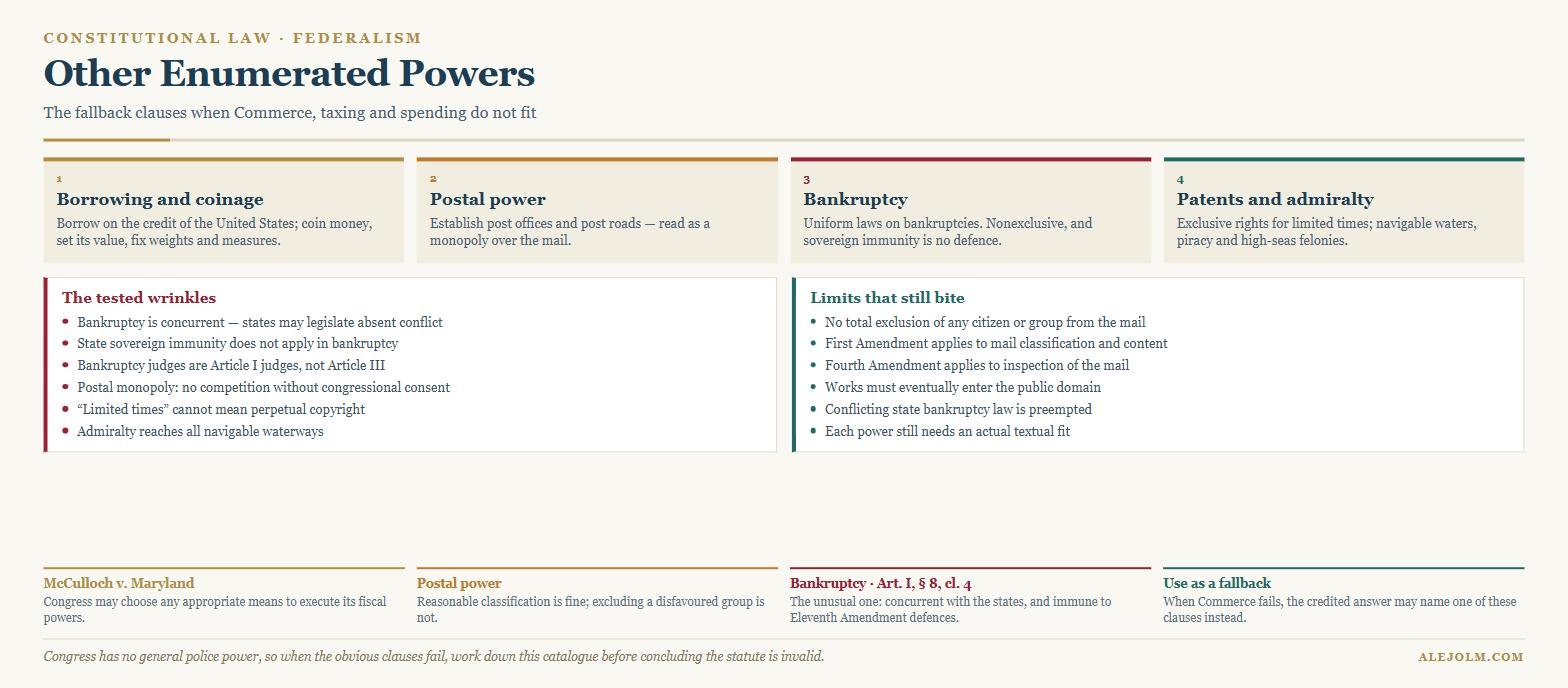
Borrowing, coinage and standards
Congress may borrow money on the credit of the United States, coin money and regulate its value, and fix the standard of weights and measures. These are among the least litigated grants precisely because they are uncontroversial, but they carry historical weight out of proportion to their modern caseload.
Their significance lies in McCulloch v. Maryland (1819). Nothing in the text authorises Congress to charter a bank, and the argument against the Second Bank of the United States was that no clause named it. The answer was that the fiscal powers — borrowing, coining, taxing — carry with them the choice of appropriate means, and a bank was a reasonably adapted instrument for executing them. That reasoning established the modern understanding of implied powers and is the reason these grants matter more than their case law suggests.
The postal power and its limits
Congress may establish post offices and post roads, and that grant has been read to confer a monopoly over the carriage of the mail: no competitor may operate without congressional consent. Within the system, Congress may classify mail into categories, set rates differentially, and impose reasonable restrictions on how the service is used.
Two limits are firmly established and both are examinable. Congress may not deprive any citizen or group of the general privilege of using the mail — total exclusion of a person or an organisation from the postal system is impermissible. And the postal power is fully subject to the Bill of Rights: the First Amendment governs restrictions based on the content or viewpoint of what is sent, and the Fourth Amendment governs inspection of the mail.
The fact pattern to expect combines the two. A statute excluding a disfavoured group’s publications from the mail engages the postal power’s internal limit on total exclusion and presents a straightforward viewpoint-discrimination problem under the First Amendment. Reasonable classification is one thing; using the monopoly to silence a category of speaker is quite another.
Bankruptcy: the unusual power
Article I, Section 8, Clause 4 empowers Congress to establish uniform laws on the subject of bankruptcies, and three features make it the most tested item in this catalogue.
First, the power is nonexclusive. Most federal powers displace state legislation in the field; bankruptcy does not. States may legislate concurrently on bankruptcy-related matters, and state debtor-creditor law continues to operate, so long as it does not conflict with the federal scheme. Where a conflict arises, the Supremacy Clause resolves it in favour of federal law, but absence of conflict means coexistence rather than displacement.
Second, state sovereign immunity does not apply in bankruptcy proceedings. This is one of the recognised routes around the Eleventh Amendment: a state cannot invoke immunity to escape the operation of federal bankruptcy procedure, and the explanation lies in the in rem character of the proceeding, which adjudicates the debtor’s estate rather than suing the state.
Third, bankruptcy judges are Article I judges. They are created by Congress under its legislative power rather than appointed under Article III, which means they lack life tenure and salary protection — and which is why the allocation of business between bankruptcy courts and Article III district courts has generated its own body of separation-of-powers litigation.
Exam tip: if a question involves bankruptcy, check two things immediately. Is the state asserting sovereign immunity? It fails. Is there concurrent state legislation? It survives unless it actually conflicts with the federal rules.
Patents, copyrights and admiralty
Congress may secure to authors and inventors, for limited times, the exclusive right to their writings and discoveries. Two points follow. Courts are highly deferential to Congress’s judgement about what counts as a limited time, so extensions of copyright terms have survived challenge. But the limitation is real rather than ornamental: protection cannot be perpetual, and the work must eventually enter the public domain. A statute conferring indefinite exclusivity would exceed the clause.
The admiralty power allows Congress to regulate navigable waterways and to define and punish piracies and felonies committed on the high seas. Its practical use is as a jurisdictional and regulatory hook where the subject is maritime: a regulation of navigation, vessel safety or conduct on navigable water may be sustained under admiralty without any need to show a commercial effect, which makes it another useful alternative when the commerce analysis looks strained.
| Subject of the statute | Clause to cite |
|---|---|
| Chartering a bank or fiscal institution | Borrowing and coinage plus Necessary and Proper |
| Excluding a competitor from carrying letters | Postal power |
| Barring a group’s publications from the mail | Postal power and First Amendment |
| Opening mail without a warrant | Fourth Amendment |
| Uniform rules for discharging debts | Bankruptcy |
| State resisting a bankruptcy proceeding | Bankruptcy |
| Extending a copyright term | Patent and copyright |
| Regulating navigation on inland waterways | Admiralty |
Worked example
Congress enacts a statute establishing uniform rules for the discharge of consumer debts. The rules conflict in several respects with a state’s debtor-creditor legislation, which offers debtors weaker relief. A state agency that is itself a creditor of a debtor in bankruptcy asserts sovereign immunity and declines to participate in the proceedings, and the state argues that its own legislation should govern.
Both arguments fail, and each fails for a distinct reason. On authority, the statute rests squarely on the power to establish uniform laws on the subject of bankruptcies, so no commerce analysis is needed. On the conflict, the bankruptcy power is nonexclusive, which means the state legislation was perfectly valid until it collided with the federal scheme — but once it does collide, the Supremacy Clause makes the federal rules preeminent, and the state provisions yield to the extent of the inconsistency. Note the precision here: the state law is not invalid across the board, only displaced where it conflicts. On immunity, the assertion is simply unavailable, because bankruptcy is one of the recognised exceptions to Eleventh Amendment protection; a state creditor is bound by the proceeding like any other. The statute stands and the state must participate.
Change one fact. Suppose the state’s legislation addressed exemptions from execution for household goods in circumstances the federal scheme left untouched. Now there is no conflict, and the nonexclusive character of the power becomes the point: the state provision continues to operate alongside the federal rules. This is what makes bankruptcy unusual — in most fields the existence of a comprehensive federal scheme is itself an argument for preemption, whereas here concurrent operation is the constitutional expectation.
Common mistakes that cost points
- Forgetting that bankruptcy is nonexclusive. Concurrent state legislation survives unless it actually conflicts.
- Allowing a state to assert sovereign immunity in bankruptcy. It is one of the recognised exceptions to Eleventh Amendment immunity.
- Treating the postal monopoly as permitting any restriction. Total exclusion of a person or group is impermissible, and the First and Fourth Amendments apply.
- Assuming copyright could be perpetual. “Limited times” is mandatory, however deferential the review of a particular term.
- Reaching for the Commerce Clause on maritime facts. Admiralty supplies a direct hook for navigable waters and high-seas offences.
- Overlooking these clauses entirely when commerce fails, and concluding the statute is unconstitutional.
- Treating bankruptcy judges as Article III judges. They are Article I judges without life tenure or salary protection.
- Using the Necessary and Proper Clause as a free-standing power rather than as a source of means towards one of these ends.
Frequently asked questions
Why is the bankruptcy power described as nonexclusive?
Because states may legislate concurrently in the field. Most federal powers, once exercised comprehensively, displace state law; bankruptcy expressly contemplates coexistence, with state debtor-creditor rules continuing to operate unless they conflict with the federal scheme, in which case the Supremacy Clause resolves the conflict.
Can Congress exclude someone from using the mail?
No. Congress may classify mail and impose reasonable conditions on the service, but it may not deprive a citizen or a group of the general privilege of using it. Any attempt to exclude a category of sender also faces a straightforward First Amendment problem if the ground of exclusion is the content or viewpoint of the material.
Could Congress make copyright protection permanent?
No. The clause authorises exclusive rights only for limited times, and although courts are deferential about what length qualifies, the requirement is substantive. Protection must eventually expire and the work must enter the public domain, so a statute conferring indefinite exclusivity would exceed the power.
Postal, bankruptcy and admiralty powers in Los Angeles, 2026
The lesser enumerated powers are easy to treat as historical curiosities, but in Los Angeles County they are the constitutional basis of enormous amounts of everyday practice. Three deserve particular attention.
Admiralty is the most visible. The San Pedro Bay port complex is among the busiest in the world, and maritime jurisdiction under article III supports federal cases in the Central District of California involving cargo damage, charter disputes, vessel liens, injuries to seamen and longshore workers’ compensation. Bankruptcy is the second: the Central District of California handles one of the heaviest consumer and business filing loads in the country, and because a discharge is a federal remedy, state collection and lien law yields to it. The copyright and patent power is the third, and in a county built around the entertainment industry it is unavoidable.
The interactions worth knowing:
- Municipal bankruptcy needs state permission. Chapter 9 is available to a California local agency only through the authorisation and mediation procedure in the California Government Code.
- Copyright preempts some state claims. Rights equivalent to copyright in fixed works are displaced, but California’s statutory and common law right of publicity protects name, voice and likeness alongside federal law.
- Maritime workers have distinct remedies. Seamen sue under federal maritime law while longshore workers proceed under the federal compensation statute rather than California workers’ compensation.
- The postal power supports federal fraud offences. Use of the mails is a common jurisdictional hook where no other federal nexus exists.
- Bankruptcy exemptions are state-flavoured. California provides its own exemption schemes, including a substantial homestead exemption that matters greatly given county property values.
- Uniformity has limits. Bankruptcy law must be uniform, yet incorporating state exemptions has been upheld.
In 2026, look for the enumerated power that supplies federal jurisdiction before assuming a dispute is purely local. Read with the Commerce Clause, the Necessary and Proper Clause and preemption.
Next steps
These clauses only make sense against the rule they satisfy, so start with the no general federal police power principle and then work through the primary alternatives: the Commerce Clause, the taxing power and the Necessary and Proper Clause, which extends each of these grants to its appropriate means. The bankruptcy wrinkle connects directly to the Eleventh Amendment and to federal preemption, and the companion Article IV grant over federal land is the Property Clause.
The text of Article I, Section 8 and annotated commentary are freely available through Justia’s Article I collection. Cornell’s Legal Information Institute keeps a concise entry with current citations, and candidates should confirm the tested scope against the outlines published by the State Bar of California.
Related guides
- Advisory Opinions: Article III and Declaratory Relief
- Access to the Courts: When Filing Fees Are Unconstitutional
- Franchise Amendments: Congress and the Right to Vote
- Property Clause: Congress and Federal Lands Explained
- No Federal Police Power: Enumerated Powers and Enclaves
- Contracts Clause: When States May Impair Agreements
- Takings Clause: Lucas, Penn Central and Just Compensation
- Free Exercise Clause: Smith, Lukumi and Fulton Applied
- Establishment Clause: Church, State and the New Test
- Freedom of Association: Scrutiny, Dale and Disclosure
- Freedom of the Press: Publication Liability and Limits
- Campaign Finance and Anonymous Speech: The Core Rules
- Unconstitutional Conditions: Benefits and Rights Waivers
- Government Speech Doctrine: When the State Can Choose
- Vagueness and Overbreadth: Facial Challenges Explained
- Prior Restraint and Licensing: The Freedman Safeguards
- Symbolic Conduct and the O’Brien Test: The Pivot Question
- Government Employee Speech: Garcetti and Pickering Rules
- Commercial Speech and the Central Hudson Four-Part Test
- Actual Malice and the Three Tracks of Defamation Law
- Public Forum Doctrine and the Time, Place, Manner Test
- First Amendment: The Three-Question Speech Framework
- One Person, One Vote: Voting Rights Under Equal Protection
- Alienage Classifications: Strict Scrutiny and Its Pockets
- Equal Protection: The Three-Step Classification Test
- Second Amendment: The Bruen Text-and-History Standard
- Substantive Due Process After Dobbs: A Two-Step Test
- Procedural Due Process: Notice, Hearing and Mathews
- Incorporation Doctrine: Which Rights Bind the States
- Full Faith and Credit: Recognising Sister-State Judgments
- The Complete Auto Test: Taxing Interstate Commerce
- The Right to Travel: Durational Residency Explained
- Article IV Privileges and Immunities: The Comity Rule
- Federal Preemption: The Three-Step Ladder Explained
- The Supremacy Clause: Floors, Ceilings and Preemption
- Intergovernmental Immunity: The Shield Runs One Way
- The Presidential Pardon Power: Four Limits That Matter
- Executive Privilege: A Qualified Right That Must Yield
- Presidential Immunity: Criminal, Civil and Private Acts
- The Removal Power: At-Will Firing and Its Exceptions
- The Appointment Power: Principal and Inferior Officers
- Take Care Clause: Enforcement Discretion and Its Limits
- Commander-in-Chief Power: Deploy Without Declaring War
- Executive Agreements: The President’s Sole Foreign Power
- The Treaty Power: Senate Advice and Consent Explained
- The Presidential Veto Power, Override and Pocket Veto
- Bicameralism and Presentment: Two Vetoes Struck Down
- The Nondelegation Doctrine and the Intelligible Principle
- Speech or Debate Clause: Absolute but Narrow Immunity
- The Impeachment Power: House Majority, Senate Two-Thirds
- Congress’s Naturalization Power and Citizenship Limits
- Congressional War Powers: Declare, Fund and Command
- Anti-Commandeering Doctrine and the Tenth Amendment
- Section 5 Enforcement Power: Remedy, Do Not Redefine
- The Spending Power and the Five Dole Test Conditions
- Congress’s Taxing Power: When a Penalty Is Really a Tax
- The Necessary and Proper Clause: Congress’s Multiplier
- Ex Post Facto Clause: Retroactive Criminal Laws Barred
- Bills of Attainder: Legislative Punishment Explained
- The Writ of Habeas Corpus: Testing Unlawful Detention
- Supreme Court Jurisdiction: Original vs Appellate Power
- Abstention Doctrine: 4 Ways Federal Courts Step Aside
- Dormant Commerce Clause: Discrimination vs Pike Balancing
- The Commerce Clause: 3 Categories and 2 Hard Limits
- State Action Doctrine: The Government Conduct Threshold
- The Eleventh Amendment and State Sovereign Immunity
- Political Question Doctrine: What Courts Will Not Decide
- Ripeness and Mootness: Timing Rules in Federal Court
- Standing in Federal Court: The 3-Part Article III Test
- Marbury v. Madison and the Power of Judicial Review
- The Youngstown Framework: Presidential Power in 3 Zones
- The IRAC Method: How to Structure a Bar Exam Answer
- Piercing the Corporate Veil: A Two-Prong Alter Ego Test
- Defamation Elements, Fault Standards and Privileges
- The Parol Evidence Rule: Integration and Exceptions
- Recording Acts: Race, Notice and Race-Notice Explained
- Partner Liability and Authority Under RUPA Explained
- Trustee Duties: Care, Loyalty, Impartiality, Accounts
- Specific Performance: A Six-Element Bar Exam Framework
- Will Execution Requirements: Formalities and Rescue
- Community Property Presumptions in California Explained
- Easements Explained: Creation, Scope and Termination
- Products Liability: The Three Defect Theories Explained
- Miranda Rights: Custody, Interrogation and Invocation
- The Character Evidence Rules: Propensity Bar and Doorways
- Adverse Possession Elements: OCEAN and the Tax Rule
- Business Judgment Rule and Directors’ Fiduciary Duties
- The Statute of Frauds: MYLEGS and How to Satisfy It
- Res Judicata vs Collateral Estoppel: Bar Exam Guide
- The Erie Doctrine Explained: A 4-Step Bar Exam Guide
- Conflicts of Interest: A 6-Step Decision Tree for the Bar
- The Rule Against Perpetuities Explained Step by Step
- Murder and Manslaughter: The Homicide Ladder Explained
- Consideration in Contract Law: Rules and Exceptions
- The Four Elements of Negligence: Bar Exam Breakdown
- The Hearsay Rule Explained: Exceptions and Exemptions
- Personal Jurisdiction: The 3-Step Bar Exam Framework
- 3 Levels of Scrutiny in Constitutional Law Explained
- The Citizenship Clause After Trump v. Barbara