
Article I, Section 10 provides that no state shall pass any law impairing the obligation of contracts. Read literally that would be an absolute bar, and for a period in the nineteenth century it functioned close to one. It has not been read literally for ninety years. The modern clause is a real but manageable constraint, and it is defined as much by what falls outside it as by the tests it imposes.
Two exclusions come first and dispose of a great many problems before any scrutiny is applied. The clause binds states and their subdivisions only — it does not reach the federal government. And it protects existing contracts only — agreements formed after the statute was enacted are outside it entirely. Beyond those filters, the analysis turns on whether the impairment is substantial and on whose contract the state is rewriting.
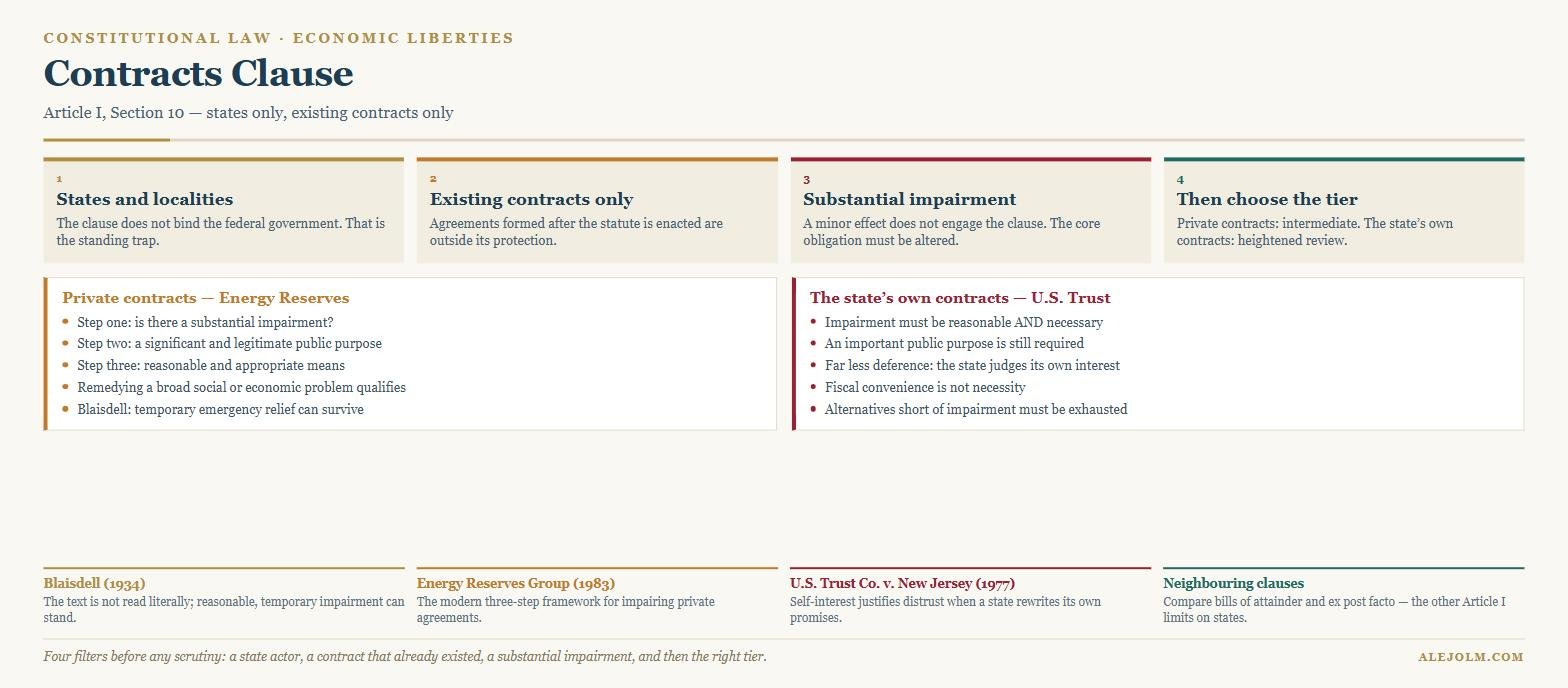
The two threshold filters
The first filter is the identity of the defendant. Article I, Section 10 is a list of prohibitions on the states, and this is one of them. Congress is not restrained by it, and federal legislation altering contractual obligations must be attacked on other grounds — due process, or takings if property rights are appropriated. This is among the most reliably examined traps in the area, precisely because the intuitive reading of a constitutional clause is that it constrains all government.
The second filter is timing. The clause protects the obligation of contracts already in existence when the legislature acts. A statute that changes the rules for agreements made in the future impairs nothing; parties contract against the legal background as they find it, and altering that background prospectively is ordinary regulation. So the first question on any set of facts is when the contract was formed relative to the enactment.
The third requirement, once both filters are passed, is that the impairment be substantial. Incidental effects on contractual arrangements do not engage the clause. The alteration must reach the core of what the parties bargained for — the obligation to pay, the amount, the timing, the security — rather than the periphery. Where a statute merely regulates an industry in ways that make performance somewhat less profitable, the threshold is usually not met.
Blaisdell: why the clause is not absolute
Home Building & Loan Association v. Blaisdell (1934) is the case that converted the clause from a near-absolute prohibition into a standard of reasonableness. Minnesota, in the depths of the Depression, extended the redemption period available to mortgagors facing foreclosure. That plainly impaired existing mortgage contracts, and on the literal text it should have failed.
It survived. The Court held that the clause is not read to bar every impairment, and that reasonable, temporary relief addressing a genuine economic emergency can stand — provided the impairment is of a character appropriate to the emergency and the conditions imposed remain reasonable. The qualifications matter as much as the holding: the relief was temporary, it was tied to identified conditions, and it did not extinguish the creditor’s entitlement but deferred it.
The enduring lesson is that emergency does not suspend the clause but does inform what counts as reasonable. A permanent cancellation of obligations would not have survived, and describing a difficulty as a crisis does not license whatever the legislature prefers.
Private contracts: the Energy Reserves framework
Where the state impairs contracts between private parties, the modern test comes from Energy Reserves Group v. Kansas Power & Light (1983) and runs in three steps.
- Is there a substantial impairment of a contractual relationship? If not, the inquiry ends and the statute stands.
- Does the law serve a significant and legitimate public purpose? Remedying a broad social or economic problem qualifies. Conferring an advantage on one party for its own sake does not.
- Are the means reasonable and appropriate to that purpose? The adjustment of the parties’ rights must be proportionate and tailored, not a wholesale reallocation dressed up as regulation.
In practice this operates as intermediate scrutiny: an important and legitimate purpose, with means reasonably and narrowly fitted to it. Courts are reasonably deferential at the second step, since legislatures are entitled to identify social and economic problems, and do the real work at the third. Two features tend to save a statute — that it addresses a general problem rather than a particular dispute, and that the relief is proportionate and, where appropriate, temporary. In Energy Reserves itself a Kansas price-regulation statute survived a challenge by a natural-gas producer on exactly this reasoning.
The state’s own contracts: heightened review under U.S. Trust
Everything changes when the state is rewriting its own promises. U.S. Trust Co. v. New Jersey (1977) requires that such an impairment be reasonable and necessary to serve an important public purpose — a materially harder standard than the private-contract test.
The justification is straightforward institutional distrust. When a state regulates contracts between other people, its judgement about the public interest is at least disinterested. When it relieves itself of its own obligations — revoking a covenant given to bondholders, reducing benefits it undertook to pay — it stands to gain directly from the conclusion it reaches, and deference would amount to letting a party decide its own case.
The word carrying the weight is necessary. Fiscal convenience is not necessity. A state that could raise revenue, reduce other spending, or achieve its objective without breaking its promise has not established necessity, and the availability of alternatives short of impairment is generally fatal. Complete self-exemption would otherwise be available to any legislature willing to describe its budget as a public purpose.
Exam tip: run the filters mechanically before any scrutiny. Federal actor? Clause does not apply. Contract formed after the statute? Not protected. Impairment merely incidental? Threshold not met. Only then ask whose contract it is.
Where the clause sits among neighbouring limits
Article I, Section 10 contains several prohibitions on the states, and the Contracts Clause is best learned with its neighbours because fact patterns often engage more than one. A statute singling out a named party for adverse treatment may be a bill of attainder; one imposing retroactive criminal liability may be an ex post facto law; one appropriating property outright raises a takings question. The Contracts Clause occupies the specific ground of retroactive interference with agreed obligations.
It is also worth remembering that a failed Contracts Clause claim is not the end of the matter. Substantive due process supplies a weaker but available route against arbitrary economic legislation, and where the state has effectively appropriated a contractual entitlement rather than merely modified it, a takings analysis may be the better framing. Against the federal government, those alternatives are the only routes available.
| Situation | Analysis |
|---|---|
| Federal statute altering existing contracts | Clause inapplicable |
| State statute affecting contracts formed later | Not an existing contract |
| Minor incidental effect on performance | No substantial impairment |
| Temporary emergency mortgage relief | Blaisdell |
| State price regulation burdening a supplier | Energy Reserves |
| Retroactive change to private payment terms | Intermediate scrutiny |
| State revoking a covenant to its bondholders | U.S. Trust |
| State reducing its own obligations for convenience | U.S. Trust |
Worked example
State M enacts a statute providing that all employment contracts currently in force between private employers and employees must be modified so that wages are paid weekly rather than monthly, and that any contractual provision permitting deferral of a portion of wages is void. The stated purpose is protecting workers from income insecurity. An employer with three-year fixed contracts containing deferral arrangements challenges the statute.
The filters are satisfied: the actor is a state, the contracts already existed, and the alteration is substantial because it changes the timing and structure of the core payment obligation rather than some peripheral term. These are private contracts, so the Energy Reserves framework governs. The second step is comfortably met — protecting employees from income insecurity is a significant and legitimate purpose addressing a broad social problem rather than resolving a private dispute in one party’s favour. Everything therefore turns on the third step. A requirement of weekly payment is a proportionate response to the identified problem and leaves the substance of the bargain intact; the total voiding of all deferral provisions is harder, since some may have been negotiated for the employee’s benefit. On balance a court would likely uphold the payment-frequency requirement and scrutinise the blanket invalidation of deferral clauses more closely.
Change one fact. Suppose the state were instead relieving itself of deferred-compensation obligations owed to its own employees, citing a budget shortfall. Now U.S. Trust applies and the analysis hardens considerably. The state must show the impairment is not merely reasonable but necessary, and a shortfall it could address through taxation, borrowing or reduced spending elsewhere will not establish necessity. The identical economic measure, applied to the state’s own promises rather than other people’s, very likely fails.
Common mistakes that cost points
- Applying the clause to federal legislation. Article I, Section 10 restrains states and localities only.
- Protecting contracts formed after the statute was enacted. Only pre-existing agreements are covered.
- Reading the text absolutely. Blaisdell settled that reasonable, temporary impairment serving an important purpose can survive.
- Skipping the substantial-impairment threshold and moving straight to scrutiny.
- Applying the private-contract test where the state is impairing its own obligations. That attracts the heightened U.S. Trust standard.
- Treating fiscal convenience as necessity. Available alternatives short of impairment defeat the state’s case.
- Forgetting the third Energy Reserves step. A legitimate purpose does not save disproportionate means.
- Overlooking the alternatives. Substantive due process and takings remain available where the clause does not apply.
Frequently asked questions
Does the Contracts Clause bind the federal government?
No. Article I, Section 10 is a list of prohibitions on the states, and this is one of them. Federal legislation altering contractual obligations must be challenged on other grounds, typically due process or, where a contractual entitlement has effectively been appropriated, the Takings Clause.
Why do state contracts get stricter review than private ones?
Because the state benefits directly from the impairment. When it modifies contracts between other parties its assessment of the public interest is at least disinterested; when it relieves itself of its own promises it is judging its own case. U.S. Trust therefore demands that the impairment be necessary as well as reasonable.
Can an economic emergency justify impairing contracts?
It can inform what is reasonable, but it does not suspend the clause. Blaisdell upheld Depression-era mortgage relief that was temporary, conditioned and deferred rather than extinguished the creditor’s rights. A permanent cancellation of obligations would not have survived, and labelling a difficulty an emergency does not by itself justify the measure.
The Contracts Clause in California: pensions and eviction rules, 2026
California has produced the most significant contemporary Contracts Clause litigation in the country, in two very different areas. The first is public pensions. Under a line of decisions beginning with cases such as Allen v. City of Long Beach (1955), what practitioners call the California Rule treats a public employee’s pension terms as contractual rights protected from disadvantageous modification unless comparable new advantages are provided. That doctrine directly affects the Los Angeles County Employees Retirement Association and every county bargaining unit.
The rule has been narrowed but not abandoned. In litigation over the state’s 2013 pension reform legislation, the California Supreme Court upheld the elimination of practices such as purchasing additional service credit and the curtailment of pension spiking, reasoning that employees have no contractual right to preserve a method of calculating benefits that the Legislature may reasonably close. The core promise of a pension remains protected; the mechanics do not.
The second area is housing regulation:
- Eviction moratoria survived challenge. The Ninth Circuit rejected a Contracts Clause attack on Los Angeles pandemic-era eviction restrictions, applying the deferential standard for reasonable and appropriate public purposes.
- Rent stabilisation is analysed the same way. County and city rent rules impair lease terms but are sustained as legitimate exercises of the police power.
- Public contracts get closer scrutiny. Where the state impairs its own obligations, deference is reduced because self-interest is involved.
- Substantial impairment comes first. If the change does not substantially impair a contractual relationship, the enquiry ends there, as Sveen v. Melin (2018) illustrates.
- Reasonableness is judged against the problem. A broad emergency justifies broader impairment, and courts examine whether the measure was tailored.
- Retroactivity is the trigger. The clause reaches only laws applied to existing contracts, not rules governing future agreements.
For 2026, ask whether a public or private contract is impaired, since that determines the level of deference. Read with the Takings Clause, substantive due process and procedural due process.
Next steps
This clause belongs with the other Article I limits on state power, so read it beside bills of attainder and the Ex Post Facto Clause, which police adjacent forms of retroactive legislation. Where a statute has appropriated a contractual entitlement rather than merely adjusted it, the Takings Clause is often the stronger framing, and substantive due process remains the fallback route against arbitrary economic regulation — including against the federal government, which this clause does not reach.
The opinions in Blaisdell and U.S. Trust are the two most useful to read in full and are freely available through Justia’s Article I collection. Cornell’s Legal Information Institute keeps a concise entry with current citations, and candidates should confirm the tested scope against the outlines published by the State Bar of California.
Related guides
 Recording Acts: Race, Notice and Race-Notice Explained
 Bicameralism and Presentment: Two Vetoes Struck Down
 The Spending Power and the Five Dole Test Conditions
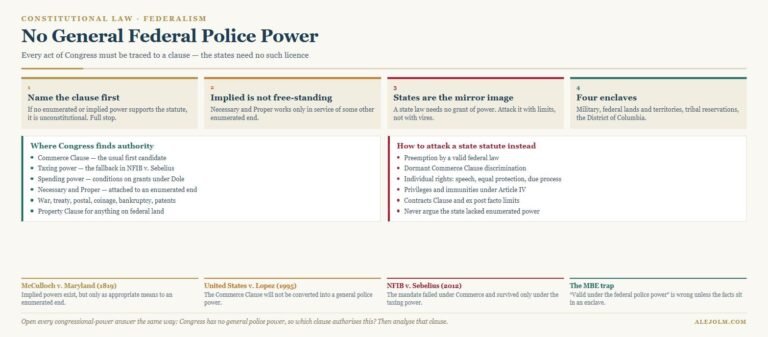 No Federal Police Power: Enumerated Powers and Enclaves
 3 Levels of Scrutiny in Constitutional Law Explained
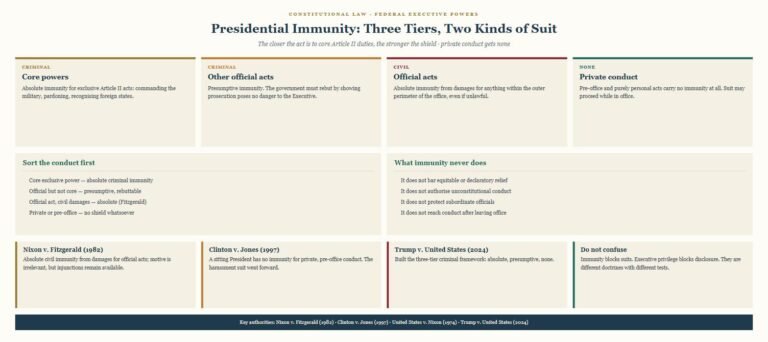 Presidential Immunity: Criminal, Civil and Private Acts
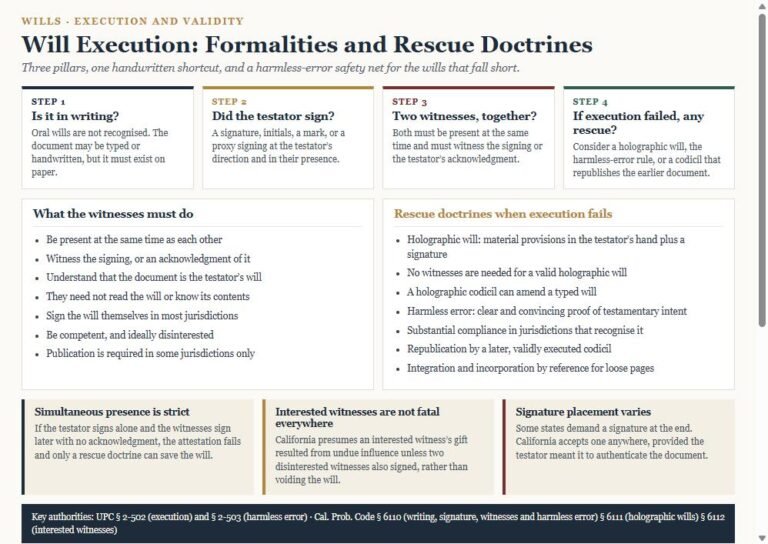 Will Execution Requirements: Formalities and Rescue
 Personal Jurisdiction: The 3-Step Bar Exam Framework
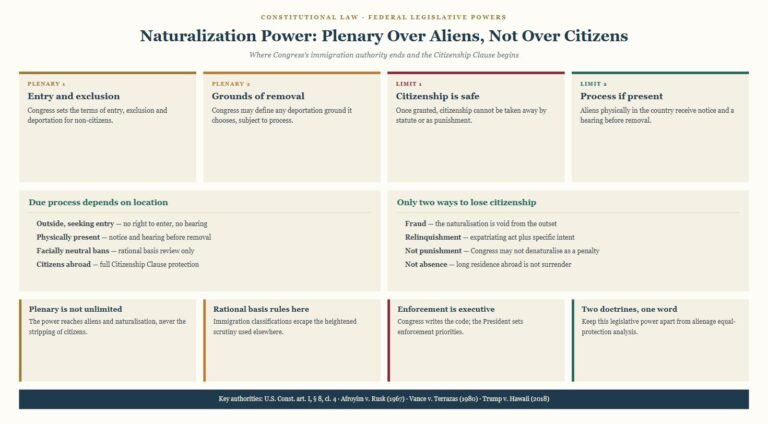 Congress’s Naturalization Power and Citizenship Limits
 The Appointment Power: Principal and Inferior Officers
 Political Question Doctrine: What Courts Will Not Decide
 The Eleventh Amendment and State Sovereign Immunity