
The Commerce Clause is the workhorse of federal power. Article I, § 8, cl. 3 lets Congress regulate commerce with foreign nations, among the several states and with the Indian tribes, and since the New Deal that language has carried most of the federal statute book. It also does a second job, because the same clause implies a limit on state regulation of interstate trade.
This guide explains the three categories Congress may regulate, why the economic character of the activity decides the hardest cases, how aggregation works, and the two situations in which the power runs out entirely.
Start by sorting, not by arguing
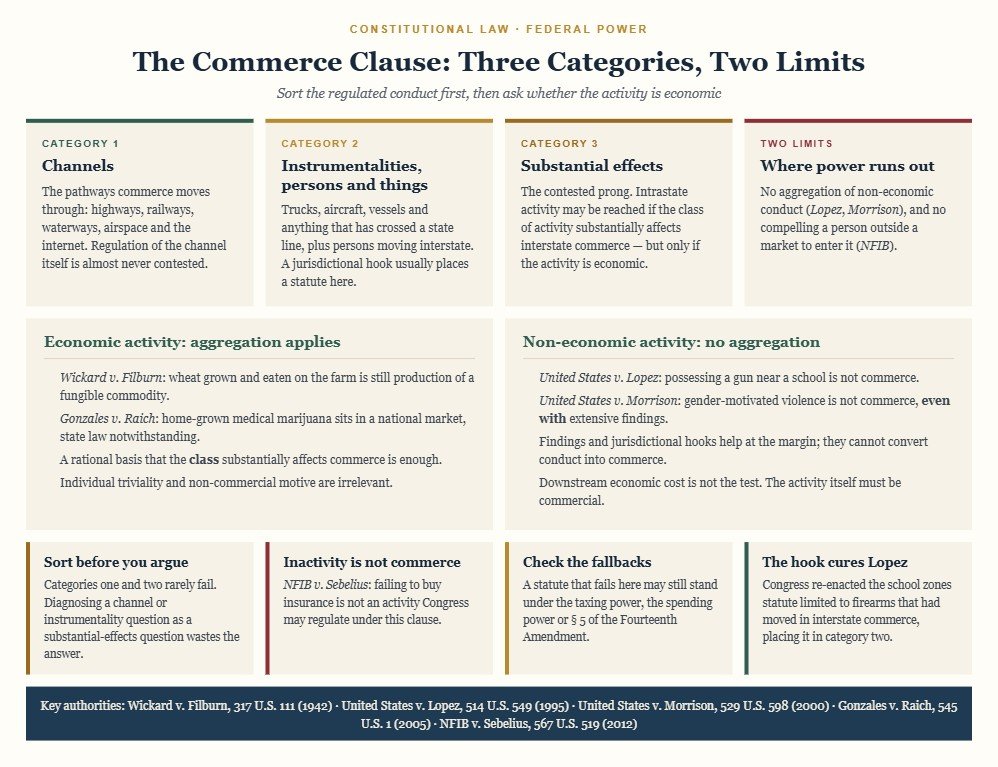
Modern analysis begins by placing the regulated conduct in one of three categories. Congress may regulate the channels of interstate commerce, meaning the pathways along which trade moves. It may regulate the instrumentalities of commerce and the persons and things moving in it. And it may regulate purely intrastate activity that substantially affects interstate commerce.
The first two categories are rarely contested. If a statute addresses highways, air traffic, shipping, the internet, or goods that have crossed a state line, the power exists almost automatically. Candidates who skip the sorting step and rush to the substantial effects analysis turn easy questions into hard ones.
Category three and the economic activity threshold
Everything difficult happens in the third category, and it turns on one question: is the regulated activity economic in nature? Economic means production, distribution, exchange or consumption of a commodity or service. If the answer is yes, Congress may aggregate the activity across everyone similarly situated and regulate the class where the aggregate substantially affects interstate commerce. If the answer is no, aggregation is unavailable and the statute fails.
Aggregation: Wickard and Raich
Wickard v. Filburn is the high-water mark of the principle. A farmer grew wheat in excess of his federal quota and consumed all of it on his own farm. Nothing was sold and nothing crossed a state line, yet the Court upheld the regulation because wheat is a fungible commodity traded nationally and the cumulative effect of all home-consumption growers on that market would be substantial.
Gonzales v. Raich applied the same reasoning to marijuana grown at home for medical use under state authorisation. The plants never entered commerce, but marijuana is a fungible commodity in a national market, so the conduct was economic, aggregable, and reachable as part of a comprehensive federal scheme notwithstanding contrary state law.
The limit: Lopez and Morrison
United States v. Lopez struck down the Gun-Free School Zones Act. Possessing a firearm near a school involves no purchase, sale or exchange; the statute contained no requirement that the particular gun have moved in commerce; and Congress had made no findings. Non-economic conduct cannot be aggregated, so the substantial effects prong was unavailable.
United States v. Morrison is the more instructive case, because Congress had done its homework. Extensive findings documented the cost of gender-motivated violence to the national economy, and the Court struck the civil remedy down anyway. Findings cannot convert conduct that is not commerce into commerce.
Exam tip: the most common error is treating an activity as economic because it has economic consequences. Lost productivity, higher medical costs and reduced consumer spending are effects, not commerce. Ask what the regulated conduct itself consists of.
| Regulated conduct | Economic? | Result |
|---|---|---|
| Growing a commodity for personal consumption | Yes | Aggregable; regulation valid (Wickard, Raich) |
| Possessing a weapon in a school zone | No | Not aggregable; statute invalid (Lopez) |
| Committing gender-motivated violence | No | Not aggregable even with findings (Morrison) |
| Operating a business serving interstate travellers | Yes | Valid; classic category two or three case |
| Declining to purchase insurance | Inactivity | Outside the clause (NFIB); sustained instead as a tax |
The second limit: Congress cannot compel market entry
NFIB v. Sebelius added a limit that applies even to plainly economic subject matter. The individual mandate in the Affordable Care Act required people to buy health insurance, and a majority concluded that regulating the failure to purchase is regulating inactivity rather than commerce. The clause lets Congress regulate people already in a market; it does not let Congress conscript people into one.
The mandate nonetheless survived, upheld as an exercise of the taxing power because the payment functioned as a tax on going uninsured. The lesson for an answer is procedural as much as doctrinal: when a Commerce Clause argument fails, check the taxing power, the spending power and § 5 of the Fourteenth Amendment before declaring the statute unconstitutional.
Jurisdictional hooks and congressional findings
Two drafting devices appear constantly in fact patterns. A jurisdictional hook limits the statute to conduct connected to interstate commerce, for example a firearm “that has moved in or otherwise affects interstate commerce”. That phrase moves the statute into category two and generally saves it, which is exactly how Congress re-enacted the school zones legislation after Lopez.
Congressional findings are weaker. They help at the margin, where the economic character of the conduct is genuinely arguable, and they are worth mentioning. They cannot rescue a statute aimed at conduct that is never commercial.
Two worked examples
First, Congress makes it a federal crime to carry a knife within a thousand feet of a school, with no jurisdictional element and no findings. Carrying a knife is not production, distribution or exchange, so aggregation is unavailable and the statute fails under Lopez. Add the hook, and the analysis changes completely.
Second, Congress caps the quantity of vegetables an individual may grow for personal consumption as part of a scheme regulating agricultural markets. A gardener who never sells anything is still producing a commodity traded nationally. Under Wickard and Raich the conduct is economic, aggregation applies, and the cap stands.
The dormant side of the clause
The same text that empowers Congress restricts the states. Where Congress has not acted, a state law that discriminates against out-of-state commerce, or that unduly burdens it, may be invalid under the dormant Commerce Clause. That is a distinct doctrine with its own tests, and an answer should never mix the affirmative power analysis with it.
Common mistakes that cost points
- Calling an activity economic because it produces economic effects rather than because it is commerce.
- Believing congressional findings can substitute for the economic activity requirement.
- Skipping the three-category sort and analysing a channels case as a substantial effects case.
- Treating Raich as inconsistent with Lopez; the difference is the commercial character of the conduct.
- Concluding a statute is unconstitutional without checking the taxing and spending powers.
- Confusing the NFIB Commerce Clause holding with its taxing power holding.
- Overlooking a jurisdictional hook that places the statute in category two.
- Analysing the affirmative power and the dormant limit as though they were one doctrine.
Frequently asked questions
Does the aggregation principle still survive after Lopez?
Yes, in full, for economic activity. Raich confirmed it a decade after Lopez. What Lopez and Morrison added was a gate in front of aggregation: the conduct must be commercial before the cumulative effect argument becomes available.
Can Congress regulate the internet under this clause?
Yes. The internet is treated as a channel and an instrumentality of interstate commerce, which places most regulation of online transactions in the first two categories and avoids the substantial effects analysis altogether.
What is a rational basis in this context?
For the substantial effects prong, courts ask whether Congress had a rational basis for concluding that the class of activity affects interstate commerce. It is deferential, but it operates only after the economic activity threshold is met, so it does not rescue a statute aimed at non-commercial conduct.
The Commerce Clause, California and Los Angeles County in 2026
The leading modern authority on the reach of federal commerce power began as a California dispute. Gonzales v. Raich (2005) concerned two California residents growing cannabis for personal medical use under the state’s Compassionate Use Act, and the Court held that Congress could reach even wholly local, non-commercial cultivation because it formed part of a class of activities substantially affecting the interstate market. Understanding that case is understanding why state legalisation does not displace federal authority.
The consequences remain live in Los Angeles County in 2026. Cannabis is lawful under state law following Proposition 64 and licensed through state and local regimes, and Los Angeles has its own commercial licensing framework. Yet the federal Controlled Substances Act still applies, which is why licensed operators face banking difficulties and why federal tax treatment differs so sharply from ordinary businesses. Nothing about state licensing alters the Raich analysis.
The framework and its local applications:
- Three categories, one aggregation rule. Channels, instrumentalities and substantial effects, with aggregation available only for economic activity after Lopez and Morrison.
- Non-economic local conduct is different. Gun possession near schools and gender-motivated violence fell outside the power precisely because they were not commercial.
- Inactivity cannot be compelled. NFIB v. Sebelius (2012) confirmed Congress may regulate commerce but not command people to enter it.
- The ports are the clearest federal nexus. The Los Angeles and Long Beach complex is an instrumentality of interstate and foreign commerce, so federal regulation there is essentially unquestioned.
- State law compliance is not a federal defence. A county licence does not immunise conduct the federal statute prohibits.
- Immigration and labour enforcement follow separately. Federal authority in those areas rests on other clauses, so do not fold everything into commerce.
In 2026, the exam habit worth building is to classify the regulated activity as economic or not before reaching for aggregation. See the dormant Commerce Clause for limits on the states, the Necessary and Proper Clause for the companion power, and preemption for the conflict rules.
Next steps
Drill the sorting step until it is automatic, then practise articulating why a given activity is or is not commercial without referring to its consequences. From there, connect federal power to the structural doctrines around it: the allocation questions in The Youngstown Framework: Presidential Power in 3 Zones, the limits on suing states in The Eleventh Amendment and State Sovereign Immunity, and the threshold in State Action Doctrine: The Government Conduct Threshold.
For primary sources, read Wickard v. Filburn, United States v. Lopez and Gonzales v. Raich. Cornell’s note on the Commerce Clause gives a short overview of the doctrinal arc.
Related guides
- Advisory Opinions: Article III and Declaratory Relief
- Access to the Courts: When Filing Fees Are Unconstitutional
- Other Enumerated Powers: Postal, Bankruptcy, Admiralty
- Franchise Amendments: Congress and the Right to Vote
- Property Clause: Congress and Federal Lands Explained
- No Federal Police Power: Enumerated Powers and Enclaves
- Contracts Clause: When States May Impair Agreements
- Takings Clause: Lucas, Penn Central and Just Compensation
- Free Exercise Clause: Smith, Lukumi and Fulton Applied
- Establishment Clause: Church, State and the New Test
- Freedom of Association: Scrutiny, Dale and Disclosure
- Freedom of the Press: Publication Liability and Limits
- Campaign Finance and Anonymous Speech: The Core Rules
- Unconstitutional Conditions: Benefits and Rights Waivers
- Government Speech Doctrine: When the State Can Choose
- Vagueness and Overbreadth: Facial Challenges Explained
- Prior Restraint and Licensing: The Freedman Safeguards
- Symbolic Conduct and the O’Brien Test: The Pivot Question
- Government Employee Speech: Garcetti and Pickering Rules
- Commercial Speech and the Central Hudson Four-Part Test
- Actual Malice and the Three Tracks of Defamation Law
- Public Forum Doctrine and the Time, Place, Manner Test
- First Amendment: The Three-Question Speech Framework
- One Person, One Vote: Voting Rights Under Equal Protection
- Alienage Classifications: Strict Scrutiny and Its Pockets
- Equal Protection: The Three-Step Classification Test
- Second Amendment: The Bruen Text-and-History Standard
- Substantive Due Process After Dobbs: A Two-Step Test
- Procedural Due Process: Notice, Hearing and Mathews
- Incorporation Doctrine: Which Rights Bind the States
- Full Faith and Credit: Recognising Sister-State Judgments
- The Complete Auto Test: Taxing Interstate Commerce
- The Right to Travel: Durational Residency Explained
- Article IV Privileges and Immunities: The Comity Rule
- Federal Preemption: The Three-Step Ladder Explained
- The Supremacy Clause: Floors, Ceilings and Preemption
- Intergovernmental Immunity: The Shield Runs One Way
- The Presidential Pardon Power: Four Limits That Matter
- Executive Privilege: A Qualified Right That Must Yield
- Presidential Immunity: Criminal, Civil and Private Acts
- The Removal Power: At-Will Firing and Its Exceptions
- The Appointment Power: Principal and Inferior Officers
- Take Care Clause: Enforcement Discretion and Its Limits
- Commander-in-Chief Power: Deploy Without Declaring War
- Executive Agreements: The President’s Sole Foreign Power
- The Treaty Power: Senate Advice and Consent Explained
- The Presidential Veto Power, Override and Pocket Veto
- Bicameralism and Presentment: Two Vetoes Struck Down
- The Nondelegation Doctrine and the Intelligible Principle
- Speech or Debate Clause: Absolute but Narrow Immunity
- The Impeachment Power: House Majority, Senate Two-Thirds
- Congress’s Naturalization Power and Citizenship Limits
- Congressional War Powers: Declare, Fund and Command
- Anti-Commandeering Doctrine and the Tenth Amendment
- Section 5 Enforcement Power: Remedy, Do Not Redefine
- The Spending Power and the Five Dole Test Conditions
- Congress’s Taxing Power: When a Penalty Is Really a Tax
- The Necessary and Proper Clause: Congress’s Multiplier
- Ex Post Facto Clause: Retroactive Criminal Laws Barred
- Bills of Attainder: Legislative Punishment Explained
- The Writ of Habeas Corpus: Testing Unlawful Detention
- Supreme Court Jurisdiction: Original vs Appellate Power
- Abstention Doctrine: 4 Ways Federal Courts Step Aside
- Dormant Commerce Clause: Discrimination vs Pike Balancing
- State Action Doctrine: The Government Conduct Threshold
- The Eleventh Amendment and State Sovereign Immunity
- Political Question Doctrine: What Courts Will Not Decide
- Ripeness and Mootness: Timing Rules in Federal Court
- Standing in Federal Court: The 3-Part Article III Test
- Marbury v. Madison and the Power of Judicial Review
- The Youngstown Framework: Presidential Power in 3 Zones
- The IRAC Method: How to Structure a Bar Exam Answer
- Piercing the Corporate Veil: A Two-Prong Alter Ego Test
- Defamation Elements, Fault Standards and Privileges
- The Parol Evidence Rule: Integration and Exceptions
- Recording Acts: Race, Notice and Race-Notice Explained
- Partner Liability and Authority Under RUPA Explained
- Trustee Duties: Care, Loyalty, Impartiality, Accounts
- Specific Performance: A Six-Element Bar Exam Framework
- Will Execution Requirements: Formalities and Rescue
- Community Property Presumptions in California Explained
- Easements Explained: Creation, Scope and Termination
- Products Liability: The Three Defect Theories Explained
- Miranda Rights: Custody, Interrogation and Invocation
- The Character Evidence Rules: Propensity Bar and Doorways
- Adverse Possession Elements: OCEAN and the Tax Rule
- Business Judgment Rule and Directors’ Fiduciary Duties
- The Statute of Frauds: MYLEGS and How to Satisfy It
- Res Judicata vs Collateral Estoppel: Bar Exam Guide
- The Erie Doctrine Explained: A 4-Step Bar Exam Guide
- Conflicts of Interest: A 6-Step Decision Tree for the Bar
- The Rule Against Perpetuities Explained Step by Step
- Murder and Manslaughter: The Homicide Ladder Explained
- Consideration in Contract Law: Rules and Exceptions
- The Four Elements of Negligence: Bar Exam Breakdown
- The Hearsay Rule Explained: Exceptions and Exemptions
- Personal Jurisdiction: The 3-Step Bar Exam Framework
- 3 Levels of Scrutiny in Constitutional Law Explained
- The Citizenship Clause After Trump v. Barbara