
A teacher is escorted out of a school two hours after receiving a letter. A family’s benefits stop without warning. A licence is revoked by the official who filed the complaint. None of those facts tells you whether the government was right. All of them raise the question procedural due process actually asks, which is whether the government went about it fairly.
The Fifth and Fourteenth Amendments forbid any deprivation of life, liberty or property without due process of law. Procedurally, that resolves into three questions asked in a fixed order: has a protected interest been taken, how much process was owed, and when was it owed. Get the order right and the doctrine becomes mechanical.
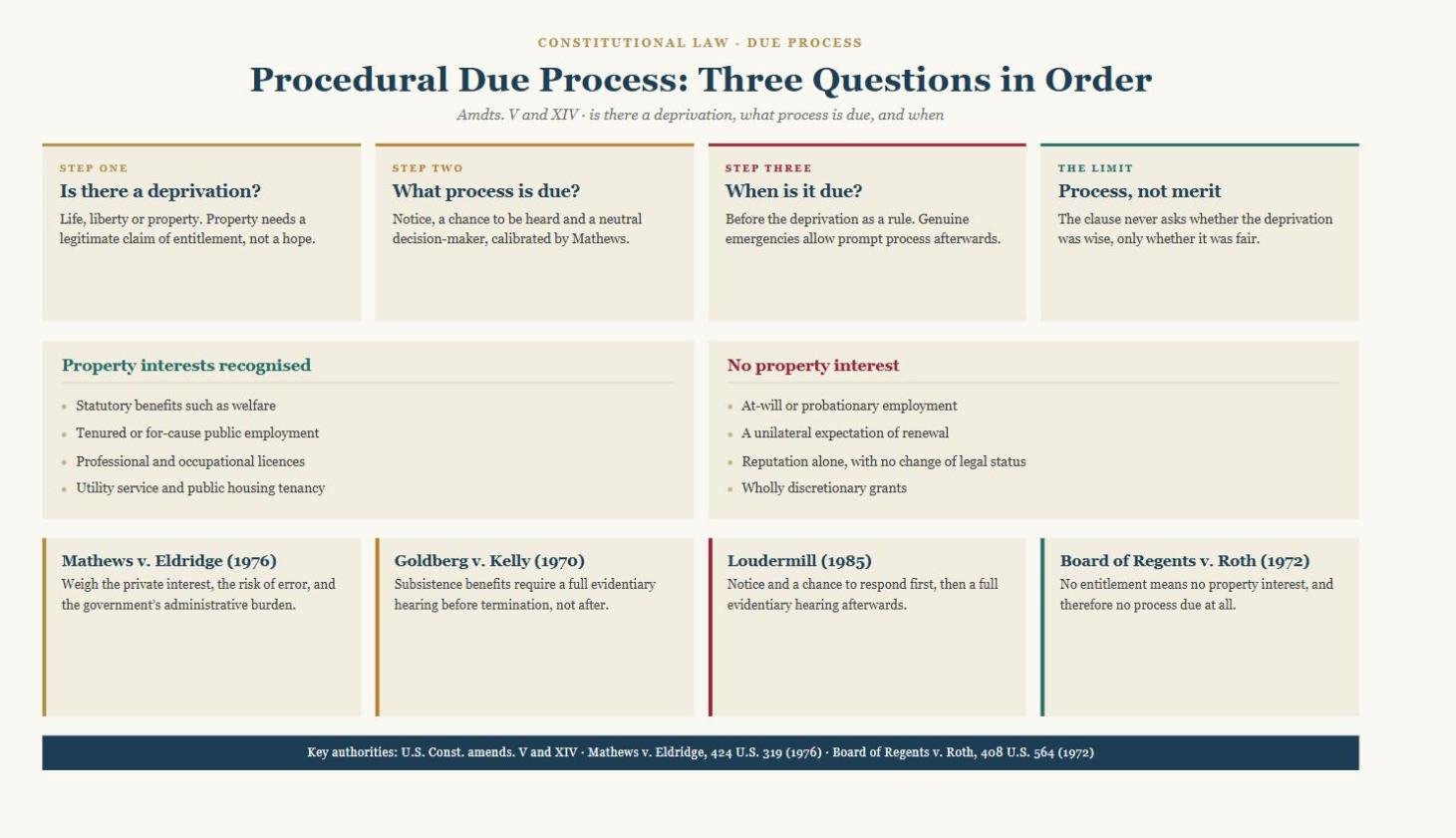
Step one: is a protected interest at stake?
Life and liberty rarely cause difficulty. Property does, because the constitutional meaning is far wider than land and goods and far narrower than everything a person would like to keep. Board of Regents v. Roth (1972) supplies the test: a property interest exists only where an independent source — a statute, a contract, an established understanding — creates a legitimate claim of entitlement. A unilateral expectation, however sincere, is not enough.
So a professor whose one-year appointment simply expired had no property interest in renewal, because nothing gave him a right to it. By contrast a tenured employee removable only for cause, a welfare recipient who meets statutory eligibility, a licensed professional and a public-housing tenant all hold entitlements, and the clause engages the moment the government moves against them.
Liberty has its own boundary. Paul v. Davis (1976) held that damage to reputation alone is not a deprivation of liberty; there must be some accompanying change in legal status. Being called a shoplifter by the police is not, by itself, a due process injury.
Step two: how much process, and the Mathews factors
There is no fixed procedural package. Mathews v. Eldridge (1976) directs courts to balance three things: the weight of the private interest, the risk of erroneous deprivation under the existing procedure together with the likely value of extra safeguards, and the government’s interest in avoiding the cost and administrative burden that those safeguards would impose.
The irreducible minimum is notice that a person of ordinary understanding can actually act on, an opportunity to be heard, and a decision-maker without a personal stake in the outcome. Everything above that minimum — live testimony, cross-examination, counsel, a written statement of reasons — is a function of the balance.
| Deprivation | Process the Constitution requires |
|---|---|
| Short suspension from a public school | Notice of the charge and a chance to explain — Goss v. Lopez |
| Termination of subsistence welfare benefits | Full evidentiary hearing before termination — Goldberg v. Kelly |
| Dismissal of a tenured public employee | Notice and chance to respond first, full hearing after — Loudermill |
| Termination of disability benefits | Paper review first, evidentiary hearing after — Mathews |
| Seizure of contaminated food or a dangerous weapon | Act at once, prompt hearing afterwards |
| Non-renewal of a fixed-term contract | None — no entitlement, no process — Roth |
The contrast between Goldberg and Mathews is the doctrine in miniature. Both involved benefits, and both turned on the same three factors. Welfare recipients could not survive a wait, and the eligibility questions were the kind lay testimony illuminates, so a full hearing had to come first. Disability determinations rested on medical records that written submissions capture well, and recipients had other resources, so a paper process followed by a hearing sufficed.
Exam tip: never assert that a full hearing is required. Name the interest, name the risk of error, name the government’s burden, and let the required procedure fall out of the comparison.
Step three: timing, and the emergency exception
The default is process before the deprivation. That is what makes Loudermill useful: the pre-termination stage need not be elaborate, but there must be something, because a chance to respond after dismissal is a chance to argue about a decision already made.
Genuine emergencies displace the default. Health inspectors may destroy contaminated food and police may seize a weapon from someone believed dangerous without a prior hearing, because the harm the government is preventing cannot wait. The price is a prompt post-deprivation hearing, and the promptness is enforced.
What procedural due process does not do
It does not ask whether the government had a good reason. A state may terminate a benefit for reasons a court considers unwise, and if notice, a hearing and a neutral decision-maker were provided, procedural due process is satisfied. The complaint that the decision itself was arbitrary belongs to substantive due process, which asks whether the government may do this at all rather than how it must go about it.
Nor does the clause reach private conduct. A private employer who fires someone without a hearing has not violated the Fourteenth Amendment, because there is no state action. That threshold comes before everything discussed here.
Worked example
A tenured teacher is accused by a parent of mishandling a pupil. The district hands her a letter setting out the reasons and escorts her from the building two hours later. She is told a hearing will follow within thirty days if she asks for one. She sues.
She wins on the timing. Tenure creates an entitlement, so a property interest exists. Employment is a weighty private interest, the risk of error on a single untested complaint is real, and letting an employee say a few words costs the district almost nothing — so the Mathews balance requires some opportunity to respond before removal, exactly as Loudermill holds. Written notice alone does not supply it. The thirty-day hearing satisfies the post-termination requirement but cannot cure the missing pre-termination step.
Change one fact. Suppose she is a probationary teacher in her first year, dismissable at will. Now there is no entitlement, no property interest and no process due, and the case ends at step one without any need to weigh anything.
Common mistakes that cost points
- Arguing about whether the deprivation was justified. That is substantive due process.
- Finding a property interest in a hope of renewal. Roth requires an entitlement from an independent source.
- Treating reputational harm as a liberty deprivation without any change in legal status.
- Demanding a full evidentiary hearing in every case instead of running the Mathews balance.
- Forgetting that the pre-deprivation stage may be brief so long as it exists.
- Overlooking state action, without which the clause does not apply at all.
Frequently asked questions
Is there a right to counsel in a due process hearing?
Sometimes, and it depends on the balance. Counsel is required where liberty is at stake in a criminal or quasi-criminal proceeding, and it may be required in exceptionally complex civil proceedings, but there is no general entitlement to a lawyer at an administrative hearing.
What makes a decision-maker insufficiently neutral?
A personal or financial stake in the outcome, or prior involvement as accuser or investigator in the same matter. General familiarity with the case or with the policy at issue does not disqualify anyone; institutional interest is tolerated, personal interest is not.
Does due process require the notice to be in the recipient’s language?
It requires notice reasonably calculated to inform, which is the Mullane standard. Where the government knows a recipient cannot read the notice as drafted, formal delivery of an incomprehensible document will not satisfy the requirement.
Procedural due process and Skelly rights in Los Angeles County, 2026
California has its own vocabulary for this doctrine, and a practitioner who knows only Mathews v. Eldridge will be lost in a county disciplinary hearing. In Skelly v. State Personnel Board (1975) the California Supreme Court held that a permanent public employee with a property interest in continued employment is entitled, before discipline takes effect, to notice of the proposed action, the reasons, a copy of the materials relied on and an opportunity to respond. Those are universally called Skelly rights, and Los Angeles County departments build their disciplinary procedures around them.
The review mechanism is equally distinctive. Administrative mandamus under section 1094.5 of the California Code of Civil Procedure is the vehicle for challenging a county decision made after a required hearing, and it defines the record, the standard of review and whether the court weighs the evidence independently or merely checks for substantial evidence. Petitions go to the writ department of the Los Angeles Superior Court.
Applying the framework locally:
- Find the property or liberty interest first. Civil service tenure, occupational licences and continued receipt of statutory benefits qualify; at-will employment does not.
- Post-termination hearings must follow. Skelly requires pre-action process plus a full evidentiary hearing afterwards, usually before the county civil service commission.
- Fundamental vested rights change the standard. Where such a right is affected, the court reviews the evidence independently rather than deferring.
- Exhaustion is mandatory. Failing to pursue the administrative remedy generally bars judicial review altogether.
- Benefit terminations require advance notice. County social services decisions follow state hearing procedures with continuing aid pending appeal in many cases.
- Peace officers have added protections. The Public Safety Officers Procedural Bill of Rights in the California Government Code supplements Skelly for Sheriff’s Department discipline.
For 2026, ask what interest is at stake, what process was given and whether the statutory writ deadline has run. Read with substantive due process, access to the courts and government employee speech.
Next steps
Read this with the state action doctrine, the threshold that comes first, then the incorporation doctrine for how the guarantee reaches state government, full faith and credit for what happens when notice fails and a judgment is challenged elsewhere, and Miranda rights for procedural protection in the criminal setting.
For primary sources, read Mathews v. Eldridge on Justia and Goldberg v. Kelly also on Justia, review the Fourteenth Amendment on Cornell Legal Information Institute, and confirm current subject coverage with the State Bar of California.
Related guides
- Advisory Opinions: Article III and Declaratory Relief
- Access to the Courts: When Filing Fees Are Unconstitutional
- Other Enumerated Powers: Postal, Bankruptcy, Admiralty
- Franchise Amendments: Congress and the Right to Vote
- Property Clause: Congress and Federal Lands Explained
- No Federal Police Power: Enumerated Powers and Enclaves
- Contracts Clause: When States May Impair Agreements
- Takings Clause: Lucas, Penn Central and Just Compensation
- Free Exercise Clause: Smith, Lukumi and Fulton Applied
- Establishment Clause: Church, State and the New Test
- Freedom of Association: Scrutiny, Dale and Disclosure
- Freedom of the Press: Publication Liability and Limits
- Campaign Finance and Anonymous Speech: The Core Rules
- Unconstitutional Conditions: Benefits and Rights Waivers
- Government Speech Doctrine: When the State Can Choose
- Vagueness and Overbreadth: Facial Challenges Explained
- Prior Restraint and Licensing: The Freedman Safeguards
- Symbolic Conduct and the O’Brien Test: The Pivot Question
- Government Employee Speech: Garcetti and Pickering Rules
- Commercial Speech and the Central Hudson Four-Part Test
- Actual Malice and the Three Tracks of Defamation Law
- Public Forum Doctrine and the Time, Place, Manner Test
- First Amendment: The Three-Question Speech Framework
- One Person, One Vote: Voting Rights Under Equal Protection
- Alienage Classifications: Strict Scrutiny and Its Pockets
- Equal Protection: The Three-Step Classification Test
- Second Amendment: The Bruen Text-and-History Standard
- Substantive Due Process After Dobbs: A Two-Step Test
- Incorporation Doctrine: Which Rights Bind the States
- Full Faith and Credit: Recognising Sister-State Judgments
- The Complete Auto Test: Taxing Interstate Commerce
- The Right to Travel: Durational Residency Explained
- Article IV Privileges and Immunities: The Comity Rule
- Federal Preemption: The Three-Step Ladder Explained
- The Supremacy Clause: Floors, Ceilings and Preemption
- Intergovernmental Immunity: The Shield Runs One Way
- The Presidential Pardon Power: Four Limits That Matter
- Executive Privilege: A Qualified Right That Must Yield
- Presidential Immunity: Criminal, Civil and Private Acts
- The Removal Power: At-Will Firing and Its Exceptions
- The Appointment Power: Principal and Inferior Officers
- Take Care Clause: Enforcement Discretion and Its Limits
- Commander-in-Chief Power: Deploy Without Declaring War
- Executive Agreements: The President’s Sole Foreign Power
- The Treaty Power: Senate Advice and Consent Explained
- The Presidential Veto Power, Override and Pocket Veto
- Bicameralism and Presentment: Two Vetoes Struck Down
- The Nondelegation Doctrine and the Intelligible Principle
- Speech or Debate Clause: Absolute but Narrow Immunity
- The Impeachment Power: House Majority, Senate Two-Thirds
- Congress’s Naturalization Power and Citizenship Limits
- Congressional War Powers: Declare, Fund and Command
- Anti-Commandeering Doctrine and the Tenth Amendment
- Section 5 Enforcement Power: Remedy, Do Not Redefine
- The Spending Power and the Five Dole Test Conditions
- Congress’s Taxing Power: When a Penalty Is Really a Tax
- The Necessary and Proper Clause: Congress’s Multiplier
- Ex Post Facto Clause: Retroactive Criminal Laws Barred
- Bills of Attainder: Legislative Punishment Explained
- The Writ of Habeas Corpus: Testing Unlawful Detention
- Supreme Court Jurisdiction: Original vs Appellate Power
- Abstention Doctrine: 4 Ways Federal Courts Step Aside
- Dormant Commerce Clause: Discrimination vs Pike Balancing
- The Commerce Clause: 3 Categories and 2 Hard Limits
- State Action Doctrine: The Government Conduct Threshold
- The Eleventh Amendment and State Sovereign Immunity
- Political Question Doctrine: What Courts Will Not Decide
- Ripeness and Mootness: Timing Rules in Federal Court
- Standing in Federal Court: The 3-Part Article III Test
- Marbury v. Madison and the Power of Judicial Review
- The Youngstown Framework: Presidential Power in 3 Zones
- The IRAC Method: How to Structure a Bar Exam Answer
- Piercing the Corporate Veil: A Two-Prong Alter Ego Test
- Defamation Elements, Fault Standards and Privileges
- The Parol Evidence Rule: Integration and Exceptions
- Recording Acts: Race, Notice and Race-Notice Explained
- Partner Liability and Authority Under RUPA Explained
- Trustee Duties: Care, Loyalty, Impartiality, Accounts
- Specific Performance: A Six-Element Bar Exam Framework
- Will Execution Requirements: Formalities and Rescue
- Community Property Presumptions in California Explained
- Easements Explained: Creation, Scope and Termination
- Products Liability: The Three Defect Theories Explained
- Miranda Rights: Custody, Interrogation and Invocation
- The Character Evidence Rules: Propensity Bar and Doorways
- Adverse Possession Elements: OCEAN and the Tax Rule
- Business Judgment Rule and Directors’ Fiduciary Duties
- The Statute of Frauds: MYLEGS and How to Satisfy It
- Res Judicata vs Collateral Estoppel: Bar Exam Guide
- The Erie Doctrine Explained: A 4-Step Bar Exam Guide
- Conflicts of Interest: A 6-Step Decision Tree for the Bar
- The Rule Against Perpetuities Explained Step by Step
- Murder and Manslaughter: The Homicide Ladder Explained
- Consideration in Contract Law: Rules and Exceptions
- The Four Elements of Negligence: Bar Exam Breakdown
- The Hearsay Rule Explained: Exceptions and Exemptions
- Personal Jurisdiction: The 3-Step Bar Exam Framework
- 3 Levels of Scrutiny in Constitutional Law Explained
- The Citizenship Clause After Trump v. Barbara