
Two doctrines do most of the demolition work in free-speech litigation, and they are constantly confused with one another. Vagueness asks whether an ordinary person can tell what the statute forbids. Overbreadth asks whether the statute, however clearly written, reaches substantially more protected expression than the Constitution permits. One is a due-process complaint about fair notice; the other is a First Amendment complaint about scope.
The confusion is understandable, because the same badly drafted ordinance usually fails both. But an answer that runs them together loses marks and, in practice, loses arguments — the tests are different, the remedies differ in reach, and only one of them lets a litigant sue on behalf of strangers. This guide separates them cleanly, sets out Grayned and Broadrick, explains the third-party standing exception, and works a hypothetical from arrest to judgment.
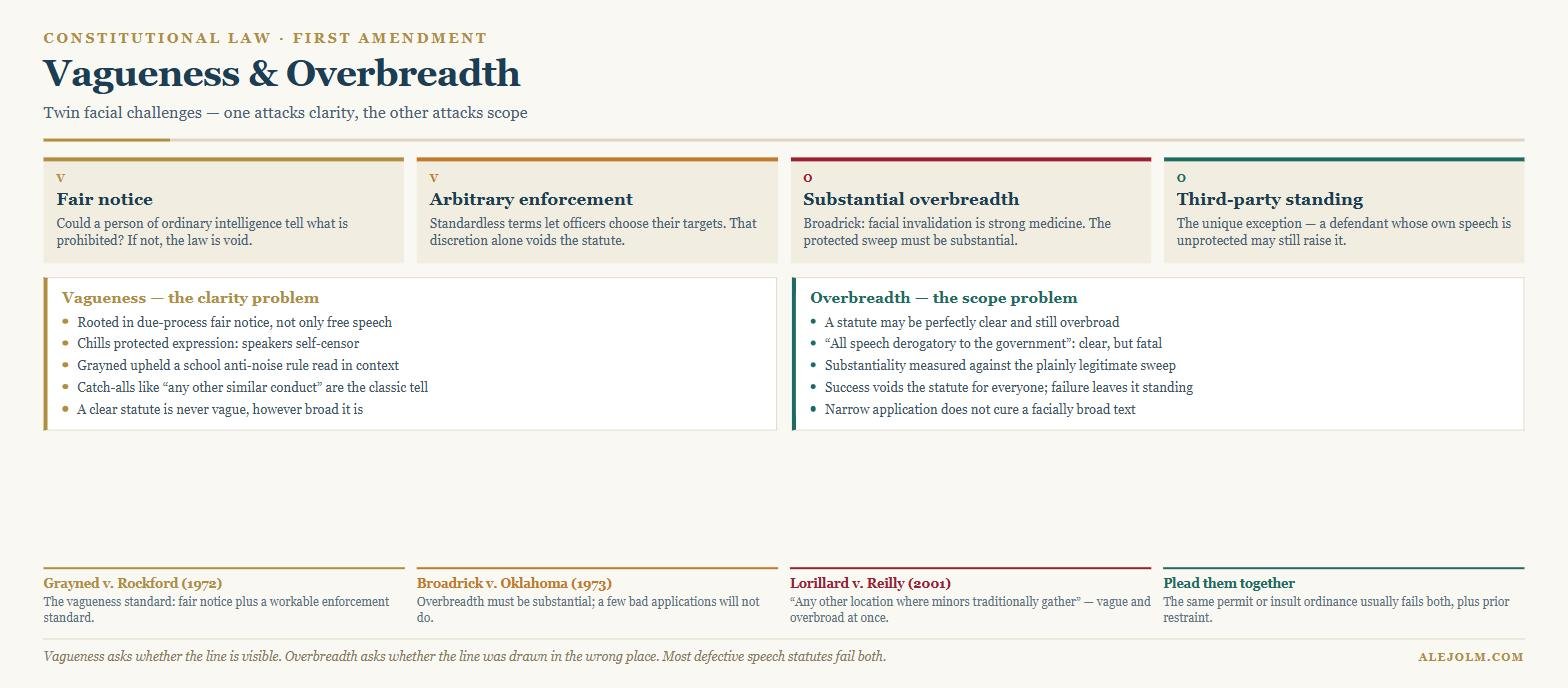
Two different defects in the same statute
Start with a concrete pair. An ordinance banning “all speech derogatory to the government” is perfectly clear. Nobody reading it is confused about what it covers. It is nevertheless flagrantly unconstitutional, because criticising the government is core protected political expression — that is an overbreadth defect, not a vagueness defect. Now take an ordinance banning “suspicious behaviour”. Nobody can tell what that means, so it fails fair notice, and it also happens to sweep in vast amounts of innocent conduct. That one is vague and overbroad.
The lesson is that clarity and breadth are independent variables. A statute can be clear and too broad, unclear and narrow, or both defective at once. Because both are facial challenges, neither depends on whether the particular claimant’s own speech was protected. The claimant is not arguing that the law was misapplied to them; the argument is that the text itself cannot stand.
That facial character explains the stakes. If a claimant wins, the statute cannot be enforced against anyone — it is struck down wholesale, or the offending clause is severed if the rest survives on its own. If the claimant loses, the statute remains fully operative and the prosecution proceeds. There is no middle outcome in which the law survives but shrinks, which is precisely why courts treat facial invalidation as an unusual remedy rather than a routine one.
Vagueness: the fair-notice problem
Grayned v. City of Rockford (1972) supplies the working test. A law is void for vagueness if it either fails to give a person of ordinary intelligence fair notice of what conduct is prohibited, or is so standardless that it authorises and encourages arbitrary and discriminatory enforcement. Those are two separate failure modes, and either one is sufficient.
The first prong protects the speaker. If the boundary is invisible, cautious people stay well clear of it, and the statute suppresses protected expression that it never actually reached — the classic chilling effect. The second prong protects against selective enforcement. An officer armed with an indeterminate standard can wave through the sympathetic demonstrator and arrest the unpopular one, and the record will never show why.
It is worth noting what Grayned actually held on its facts, because students often misremember it as a striking-down case. The Court upheld an anti-noise ordinance directed at the area around schools, prohibiting noise or diversion that disturbs or tends to disturb the good order of the school session. Read in context — a specific place, a specific time, a specific identifiable harm — the terms gave adequate guidance. Vagueness is therefore not a complaint about imprecise words in the abstract. It is a complaint that the statute supplies no workable standard for the situation it governs.
Exam tip: vagueness has two independent limbs. Argue fair notice and arbitrary enforcement separately — many statutes give tolerable notice yet still hand officials an unreviewable standard, and that alone is fatal.
Overbreadth: the substantiality problem
Overbreadth is a First Amendment doctrine about reach. A statute is facially invalid if it prohibits substantially more speech than the Constitution allows, capturing protected expression alongside whatever unprotected category the legislature was actually aiming at. The word doing the work is substantially.
Broadrick v. Oklahoma (1973) described facial invalidation for overbreadth as “strong medicine”, to be administered sparingly and only as a last resort. The measurement is comparative: the amount of protected speech the statute reaches, judged in relation to the statute’s plainly legitimate sweep. A law with a large legitimate core that also catches a handful of protected applications is not substantially overbroad, and the proper vehicle is an as-applied challenge rather than facial invalidation.
This substantiality requirement is what keeps the doctrine from swallowing every imperfect statute. It also explains a pattern that surprises people: the categories of unprotected speech are so narrowly defined that legislatures almost never manage to legislate them accurately. Fighting-words statutes are the standing example. Every fighting-words ordinance that has reached the courts has been held overbroad or vague, because drafters reach for words like “abusive”, “insulting” or “opprobrious” that inevitably capture protected rudeness. The same is true of provisions aimed at incitement or true threats that describe the target in ordinary rather than doctrinal language.
Third-party standing, the doctrine’s unique feature
Overbreadth carries an exception to ordinary standing rules that exists nowhere else in constitutional litigation. A defendant may attack a statute as overbroad even though their own conduct was constitutionally punishable and could have been prosecuted under a properly drawn law. In effect, the defendant litigates on behalf of absent third parties whose protected speech the statute also reaches.
The justification is practical. The people most chilled by an overbroad statute are precisely the ones who never speak and therefore never get prosecuted, so they never generate a case. If only defendants with protected speech could raise the challenge, the statute would sit on the books indefinitely, suppressing expression that never reaches a courtroom. Allowing the unsympathetic defendant to raise it is the only reliable way to clear the chill.
Two consequences follow. First, never dismiss an overbreadth argument on the ground that the client’s own words were clearly unprotected — that is irrelevant to the challenge. Second, do not extend the exception. Third-party standing belongs to overbreadth specifically, not to vagueness and not to free-speech litigation generally, and an answer that generalises it is wrong.
Catch-all clauses, and where challenges actually succeed
In practice the defect usually sits in a residual clause. Legislators enumerate three or four specific items and then add “and any other similar conduct”, “any person who…”, or “any other location where minors traditionally gather”. That last phrase, from the Massachusetts tobacco-advertising rules considered in Lorillard Tobacco Co. v. Reilly, is the paradigm case: nobody can say whether cinemas, shopping centres or public parks qualify, which is vagueness, and the phrase reaches an enormous quantity of lawful advertising directed at adults, which is overbreadth.
So the drafting tells are learnable. Undefined evaluative adjectives — offensive, insulting, derogatory, disrespectful, inappropriate. Open-ended residual clauses. Purpose language that turns on the listener’s reaction rather than the speaker’s conduct. Grants of discretion to an official to decide what serves the public interest. Any of these should trigger a full run through both doctrines, and usually through prior restraint as well if the statute operates by permit.
| Question | Vagueness |
|---|---|
| Constitutional source | Due process — fair notice |
| Defect identified | The prohibited line cannot be located |
| Governing case | Grayned v. City of Rockford (1972) |
| Threshold | No fair notice, or standardless enforcement |
| Third-party standing | No — ordinary standing rules apply |
| Effect of winning | Statute or clause void for everyone |
| Can a clear statute fail? | No — clarity defeats the claim |
Worked example
State M enacts a “Respect for Officials” ordinance forbidding “insulting, offensive, or derogatory speech targeting government officials or their families for the purpose of causing offence or undermining their authority”. Nothing in the text defines any of the three adjectives; the assessment is left to the arresting officer. An activist describes the Governor’s tax policy as “a betrayal of working families”, implying corruption, and is arrested. She challenges the ordinance as vague and overbroad.
Take vagueness first. “Insulting”, “offensive” and “derogatory” are evaluative terms with no statutory content, so an ordinary speaker cannot predict whether sharp political criticism crosses the line — fair notice fails. The second limb fails more decisively: with no definitions at all, the officer’s own sensibilities supply the standard, which is exactly the arbitrary and discriminatory enforcement Grayned forbids. Now overbreadth. The ordinance reaches speech aimed at “undermining” official authority, which describes essentially all political criticism of government. Criticism of officials sits at the absolute centre of protected expression, so the protected sweep is not merely substantial relative to any legitimate core — there is barely a legitimate core to weigh it against. The ordinance is facially invalid on both grounds and the prosecution cannot proceed.
Change one fact. Suppose the ordinance instead forbade “face-to-face utterances directed at a specific person that are likely to provoke an immediate violent response”, and the activist had screamed abuse at the Governor from a metre away. Now the text tracks the fighting-words definition rather than paraphrasing it, so notice is adequate and the legitimate sweep is real. The activist could no longer win facially; her route would be an as-applied argument that political criticism at volume is not a fighting word. That is a much harder case — and it shows that the defect in the original ordinance was drafting, not the subject matter.
Common mistakes that cost points
- Merging the two doctrines into a single “vague and overbroad” conclusion. Run each test separately and say which prong fails and why.
- Assuming an overbreadth claimant needs protected speech of their own. Third-party standing means the client’s conduct can be squarely unprotected.
- Extending third-party standing to vagueness or to free-speech claims generally. The exception is confined to overbreadth.
- Forgetting the substantiality threshold. Broadrick calls facial invalidation strong medicine; a few stray protected applications are not enough.
- Believing a narrowly enforced statute is saved. Overbreadth is measured on the text, not on prosecutorial restraint.
- Treating vagueness as purely a due-process point. Applied to speech it independently offends the First Amendment because it chills expression.
- Remembering Grayned as a striking-down case. It upheld the school anti-noise ordinance; the terms were clear enough read in context.
- Overlooking residual catch-all clauses, which are where the defect almost always hides.
Frequently asked questions
Can a statute be overbroad without being vague?
Yes, and the example is worth memorising. A ban on “all speech derogatory to the government” is entirely clear — no reader is in doubt about its meaning — yet it reaches core protected political criticism and is therefore overbroad. Clarity is simply not a defence to a scope problem.
What is the substantiality requirement in overbreadth?
Under Broadrick v. Oklahoma, a statute is not facially invalidated merely because some applications would be unconstitutional. The protected speech it reaches must be substantial when measured against the statute’s plainly legitimate sweep. Where it is not, the challenger must proceed as-applied instead.
Who can bring an overbreadth challenge?
Anyone the statute reaches, including a defendant whose own expression was constitutionally punishable. This third-party standing is a deliberate exception to ordinary standing doctrine, justified because the speakers most chilled by an overbroad law are the ones who stay silent and never generate a case.
Vagueness and overbreadth in California enforcement, 2026
California has supplied a canonical vagueness case. In Kolender v. Lawson (1983) the Supreme Court invalidated a California statute requiring people who loiter or wander on the streets to identify themselves and account for their presence, holding it unconstitutionally vague because it gave police effectively unlimited discretion to decide who had provided credible identification. The decision is the standard authority on vagueness as a delegation problem rather than merely a notice problem.
That framing matters in Los Angeles County, where enforcement discretion over public space is a persistent source of litigation. Ordinances regulating sitting, lying and sleeping on public property, vending in parks and on beaches, and encampment locations have been challenged repeatedly on vagueness and overbreadth grounds, and the successful challenges have generally focused on the absence of ascertainable standards rather than the underlying policy aim.
The doctrinal points that decide these cases:
- Vagueness has two limbs. Inadequate notice to the ordinary person, and inadequate constraint on the officer or official applying the rule.
- Overbreadth is a First Amendment device. It lets a litigant challenge a law on behalf of others whose protected speech it would reach, and requires substantial overbreadth.
- Gang injunctions were upheld in California. The California Supreme Court sustained a nuisance-based injunction in People ex rel. Gallo v. Acuna (1997), while federal decisions struck vaguer loitering provisions elsewhere.
- Scienter requirements rescue statutes. Adding a knowledge or intent element frequently cures an otherwise vague prohibition.
- Narrowing constructions are the usual fix. California appellate courts often read a provision narrowly rather than strike it, so check whether a limiting interpretation already exists.
- Facial and as-applied challenges differ. Plead both, because a statute may be clear as applied to your client yet indefensible generally.
In 2026, ask who is being given discretion and whether anything meaningfully limits it. Read with the First Amendment framework, symbolic conduct and procedural due process.
Next steps
These doctrines are tools rather than freestanding topics, so they make most sense read alongside the framework they attack. Work through the First Amendment analysis to see where a facial challenge slots in, then read prior restraint and licensing, because a permit statute that vests discretion almost always fails all three doctrines at once. The fair-notice rationale behind vagueness comes from procedural due process, and because most challenged ordinances regulate streets and parks it is worth pairing this with public forum doctrine before reaching the merits.
For primary material, the opinions in Grayned and Broadrick repay a full reading and are freely available via Justia’s First Amendment collection. Cornell’s Legal Information Institute maintains short doctrinal entries with current citations, and candidates should confirm the tested scope against the outlines published by the State Bar of California.
Related guides
- Advisory Opinions: Article III and Declaratory Relief
- Access to the Courts: When Filing Fees Are Unconstitutional
- Other Enumerated Powers: Postal, Bankruptcy, Admiralty
- Franchise Amendments: Congress and the Right to Vote
- Property Clause: Congress and Federal Lands Explained
- No Federal Police Power: Enumerated Powers and Enclaves
- Contracts Clause: When States May Impair Agreements
- Takings Clause: Lucas, Penn Central and Just Compensation
- Free Exercise Clause: Smith, Lukumi and Fulton Applied
- Establishment Clause: Church, State and the New Test
- Freedom of Association: Scrutiny, Dale and Disclosure
- Freedom of the Press: Publication Liability and Limits
- Campaign Finance and Anonymous Speech: The Core Rules
- Unconstitutional Conditions: Benefits and Rights Waivers
- Government Speech Doctrine: When the State Can Choose
- Prior Restraint and Licensing: The Freedman Safeguards
- Symbolic Conduct and the O’Brien Test: The Pivot Question
- Government Employee Speech: Garcetti and Pickering Rules
- Commercial Speech and the Central Hudson Four-Part Test
- Actual Malice and the Three Tracks of Defamation Law
- Public Forum Doctrine and the Time, Place, Manner Test
- First Amendment: The Three-Question Speech Framework
- One Person, One Vote: Voting Rights Under Equal Protection
- Alienage Classifications: Strict Scrutiny and Its Pockets
- Equal Protection: The Three-Step Classification Test
- Second Amendment: The Bruen Text-and-History Standard
- Substantive Due Process After Dobbs: A Two-Step Test
- Procedural Due Process: Notice, Hearing and Mathews
- Incorporation Doctrine: Which Rights Bind the States
- Full Faith and Credit: Recognising Sister-State Judgments
- The Complete Auto Test: Taxing Interstate Commerce
- The Right to Travel: Durational Residency Explained
- Article IV Privileges and Immunities: The Comity Rule
- Federal Preemption: The Three-Step Ladder Explained
- The Supremacy Clause: Floors, Ceilings and Preemption
- Intergovernmental Immunity: The Shield Runs One Way
- The Presidential Pardon Power: Four Limits That Matter
- Executive Privilege: A Qualified Right That Must Yield
- Presidential Immunity: Criminal, Civil and Private Acts
- The Removal Power: At-Will Firing and Its Exceptions
- The Appointment Power: Principal and Inferior Officers
- Take Care Clause: Enforcement Discretion and Its Limits
- Commander-in-Chief Power: Deploy Without Declaring War
- Executive Agreements: The President’s Sole Foreign Power
- The Treaty Power: Senate Advice and Consent Explained
- The Presidential Veto Power, Override and Pocket Veto
- Bicameralism and Presentment: Two Vetoes Struck Down
- The Nondelegation Doctrine and the Intelligible Principle
- Speech or Debate Clause: Absolute but Narrow Immunity
- The Impeachment Power: House Majority, Senate Two-Thirds
- Congress’s Naturalization Power and Citizenship Limits
- Congressional War Powers: Declare, Fund and Command
- Anti-Commandeering Doctrine and the Tenth Amendment
- Section 5 Enforcement Power: Remedy, Do Not Redefine
- The Spending Power and the Five Dole Test Conditions
- Congress’s Taxing Power: When a Penalty Is Really a Tax
- The Necessary and Proper Clause: Congress’s Multiplier
- Ex Post Facto Clause: Retroactive Criminal Laws Barred
- Bills of Attainder: Legislative Punishment Explained
- The Writ of Habeas Corpus: Testing Unlawful Detention
- Supreme Court Jurisdiction: Original vs Appellate Power
- Abstention Doctrine: 4 Ways Federal Courts Step Aside
- Dormant Commerce Clause: Discrimination vs Pike Balancing
- The Commerce Clause: 3 Categories and 2 Hard Limits
- State Action Doctrine: The Government Conduct Threshold
- The Eleventh Amendment and State Sovereign Immunity
- Political Question Doctrine: What Courts Will Not Decide
- Ripeness and Mootness: Timing Rules in Federal Court
- Standing in Federal Court: The 3-Part Article III Test
- Marbury v. Madison and the Power of Judicial Review
- The Youngstown Framework: Presidential Power in 3 Zones
- The IRAC Method: How to Structure a Bar Exam Answer
- Piercing the Corporate Veil: A Two-Prong Alter Ego Test
- Defamation Elements, Fault Standards and Privileges
- The Parol Evidence Rule: Integration and Exceptions
- Recording Acts: Race, Notice and Race-Notice Explained
- Partner Liability and Authority Under RUPA Explained
- Trustee Duties: Care, Loyalty, Impartiality, Accounts
- Specific Performance: A Six-Element Bar Exam Framework
- Will Execution Requirements: Formalities and Rescue
- Community Property Presumptions in California Explained
- Easements Explained: Creation, Scope and Termination
- Products Liability: The Three Defect Theories Explained
- Miranda Rights: Custody, Interrogation and Invocation
- The Character Evidence Rules: Propensity Bar and Doorways
- Adverse Possession Elements: OCEAN and the Tax Rule
- Business Judgment Rule and Directors’ Fiduciary Duties
- The Statute of Frauds: MYLEGS and How to Satisfy It
- Res Judicata vs Collateral Estoppel: Bar Exam Guide
- The Erie Doctrine Explained: A 4-Step Bar Exam Guide
- Conflicts of Interest: A 6-Step Decision Tree for the Bar
- The Rule Against Perpetuities Explained Step by Step
- Murder and Manslaughter: The Homicide Ladder Explained
- Consideration in Contract Law: Rules and Exceptions
- The Four Elements of Negligence: Bar Exam Breakdown
- The Hearsay Rule Explained: Exceptions and Exemptions
- Personal Jurisdiction: The 3-Step Bar Exam Framework
- 3 Levels of Scrutiny in Constitutional Law Explained
- The Citizenship Clause After Trump v. Barbara