
Speech is rarely a solitary act. People organise, join, subscribe, donate and campaign together, and a right to speak that did not protect combining with others would be largely ornamental. Freedom of association is the doctrine that fills that gap: a right derived from free speech to associate for expressive purposes, and to keep those associations private.
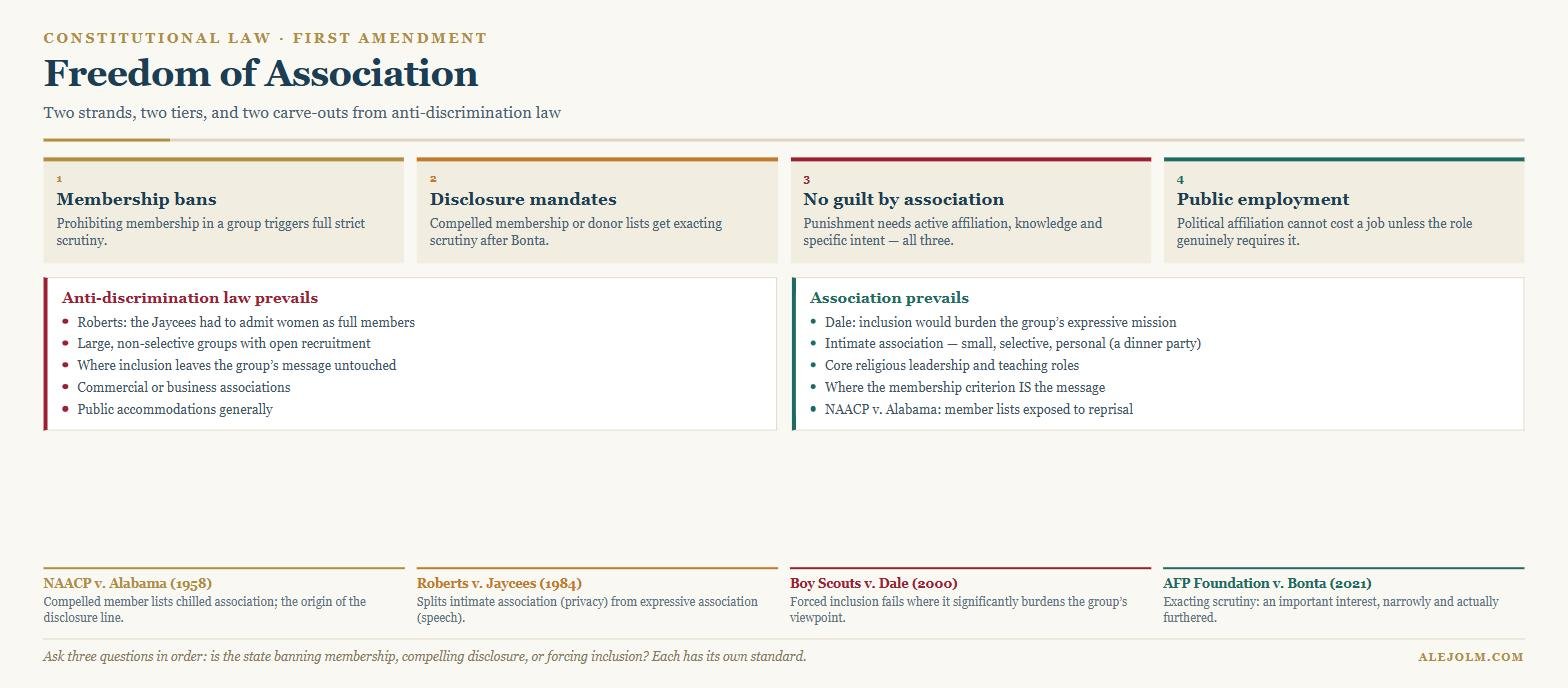
The doctrine is genuinely difficult because it operates at three different pressure points, each with its own standard. Banning membership in a group attracts strict scrutiny. Compelling disclosure of who belongs or who donates attracts exacting scrutiny. Forcing a group to accept a member it wishes to exclude is analysed differently again, under the two carve-outs from anti-discrimination law recognised in Roberts and Dale. Answers that apply one tier to all three go wrong immediately.
Membership bans and the guilt-by-association guardrail
A law prohibiting membership in an organisation strikes at the heart of the right and receives full strict scrutiny: a compelling interest, narrowly served. Preventing violent criminal activity can be compelling, but a blanket membership prohibition is rarely narrow, because organisations contain people who joined for entirely lawful reasons.
That concern produces the doctrine’s most protective feature. Membership alone can never found liability. To punish an individual for belonging to a group engaged in unlawful activity, the government must prove three things, and all three are required: that the person was actively affiliated with the group; that the person had knowledge of its illegal aims or activities; and that the person held the specific intent to further those illegal aims.
Each element does distinct work. Active affiliation excludes the nominal or lapsed member and the sympathiser who never joined. Knowledge excludes the member who genuinely did not know what a faction of the organisation was doing. Specific intent excludes the member who knew and disapproved but stayed for the group’s lawful work. Together they dismantle guilt by association — and an answer that recites only membership and knowledge has missed the element that usually decides the case.
Compelled disclosure: from NAACP v. Alabama to Bonta
The second pressure point is anonymity. NAACP v. Alabama ex rel. Patterson (1958) is the foundation, and its facts explain the doctrine’s force. Alabama demanded the organisation’s membership lists during the civil-rights era. Disclosure would have exposed members to economic reprisal, harassment and violence, with the entirely predictable result that people would stop joining. The compelled disclosure was unconstitutional because it burdened the right to associate as effectively as a direct ban.
The modern standard comes from Americans for Prosperity Foundation v. Bonta (2021), which applied exacting scrutiny to a requirement that charities report their major donors to the state. Exacting scrutiny demands a sufficiently important government interest — more than merely legitimate — and narrow tailoring, with the disclosure regime actually and directly furthering that interest. Administrative convenience, or an untested suspicion that some organisations might misbehave, is not enough.
The tier distinction is a favourite examination point, so it is worth stating flatly: membership prohibitions get strict scrutiny; disclosure mandates get exacting scrutiny. The lower standard reflects that disclosure does not forbid association outright, but the burden is nonetheless real, because the members most easily deterred are those with most to fear. Narrow reporting rules tied to identified electioneering or a demonstrated fraud problem can survive; broad prophylactic collection generally cannot.
Exam tip: identify which of the three questions the facts actually raise before choosing a standard. Ban on membership means strict scrutiny. Compelled lists means exacting scrutiny. Forced inclusion means Roberts and Dale, not a tier at all.
Anti-discrimination law and the two carve-outs
The third pressure point is the most contested. Public-accommodations and anti-discrimination statutes routinely require organisations to admit people they would prefer to exclude, and as a general matter those statutes are valid — associational freedom does not license open discrimination. Two carve-outs exist, and they rest on quite different foundations.
The first is intimate association, protected on privacy grounds. Small, selective, personal relationships — family, close friendship, a dinner party — are simply not the state’s business, and anti-discrimination law does not reach them. The relevant markers are size, selectivity in admission, seclusion from outsiders, and the personal character of the relationship. As a group grows large and recruits openly it moves out of this category.
The second is expressive integrity. Forced inclusion is unconstitutional where admitting the unwanted member would significantly affect the group’s ability to express its viewpoints. This is not a general licence to exclude; the group must have an identifiable expressive purpose, and the inclusion must genuinely impair its capacity to convey its message. Where the membership criterion is itself part of the message, the carve-out applies.
Roberts and Dale: the same test, opposite results
Roberts v. United States Jaycees (1984) both drew the intimate/expressive distinction and applied it. Minnesota required the Jaycees to admit women as full members. The organisation was large, recruited essentially anyone eligible, and pursued business and civic aims. Admitting women would not impair its ability to advocate anything it advocated, so the anti-discrimination statute applied and the challenge failed.
Boy Scouts of America v. Dale (2000) reached the opposite conclusion on the same framework. The Court accepted that the organisation had an expressive purpose concerning values and moral conduct, and that requiring it to retain a scoutmaster whose presence contradicted the message it sought to convey would significantly burden that expression. The anti-discrimination law, valid in general, could not be applied to compel the inclusion.
Reading the two together shows what the test actually asks. It is not whether the group dislikes the person, nor whether the exclusion is defensible on the merits, nor whether the group is sympathetic. The question is functional: would forced inclusion measurably impair the group’s capacity to communicate its viewpoint? Size, selectivity, and whether the group has a genuine expressive mission are the facts that answer it. This is also why core religious leadership and teaching roles fall comfortably within the carve-out — there the shared belief is not incidental to the message but constitutive of it.
Public employment and political affiliation
The right also protects public employees. A government employee may not be dismissed or refused promotion because of political views or affiliations, unless the affiliation is genuinely required for effective performance of the job. A teacher penalised for registering as an independent, or a clerk passed over for backing the wrong party, has a strong associational claim.
The exception tracks the same relatedness logic that governs conditions on benefits generally. For a genuine policymaking or confidential post — an adviser charged with advancing an elected administration’s programme, or campaign staff — political alignment is part of the role, and considering it is permissible. The exception depends on actual function rather than job title, and it is narrow: recategorising ordinary posts as policymaking will not survive scrutiny.
| Government action | Standard or test |
|---|---|
| Prohibiting membership in a group | Strict scrutiny |
| Punishing an individual member | Affiliation + knowledge + specific intent |
| Compelling member or donor lists | Exacting scrutiny (Bonta) |
| Requiring a large open group to admit members | Roberts |
| Requiring inclusion that burdens the message | Dale |
| Reaching a small, selective personal group | Intimate association |
| Dismissing an employee for party affiliation | Rutan line |
| Requiring alignment for a policymaking post | Function-based exception |
Worked example
City X enacts an ordinance providing that no organisation receiving city funding may discriminate in membership on grounds of religion or ideology. A religious organisation that receives a city grant wishes to restrict those who lead worship and teach theology to adherents of its faith. It challenges the ordinance as applied.
The general proposition favours the city: anti-discrimination laws are valid and associational freedom does not authorise discrimination at large. So the question is whether either carve-out applies. Intimate association does not — a funded organisation with congregational membership is neither small nor selective in the relevant sense. Expressive integrity is a different matter. This organisation plainly has an expressive purpose, and the roles at issue are the ones through which it articulates that purpose: leading worship and teaching doctrine. Compelling it to install leaders who do not hold the beliefs they are appointed to convey would not merely inconvenience the organisation but would directly undermine its ability to communicate its message. Unlike the Jaycees in Roberts, where admitting women left the group’s advocacy untouched, here the shared belief is constitutive of the message. Under Dale the ordinance cannot be applied to these roles.
Change one fact. Suppose the organisation instead wished to refuse membership on religious grounds to applicants for its paid administrative and maintenance posts. Those roles convey no message and require no shared belief, so forced inclusion would not measurably impair the organisation’s expression. The carve-out would not reach them and the ordinance would apply. The lesson is that expressive integrity is assessed role by role, not organisation by organisation.
Common mistakes that cost points
- Applying one standard throughout. Membership bans get strict scrutiny; disclosure mandates get exacting scrutiny; forced inclusion is governed by Roberts and Dale.
- Proving only membership and knowledge. Specific intent to further the illegal aims is the third, indispensable element.
- Assuming anti-discrimination statutes always prevail. Intimate association and expressive integrity are genuine carve-outs.
- Confusing the two carve-outs. Intimate association rests on privacy and turns on size and selectivity; expressive integrity rests on speech and turns on the message.
- Treating Dale as a general licence to exclude. The group must show forced inclusion would significantly impair its expression.
- Assessing expressive integrity organisation-wide rather than role by role. Core expressive posts and ancillary posts may come out differently.
- Assuming political affiliation may be required for any public job. It may be considered only where the role genuinely requires it.
- Merging associational privacy with expressive association. They are related strands, and they attract different treatment.
Frequently asked questions
Can someone be punished simply for belonging to an organisation?
No. The government must establish active affiliation, knowledge of the group’s unlawful aims, and specific intent to further them. All three are necessary, which is what prevents the doctrine collapsing into guilt by association. A member who knew of the unlawful activity but did not intend to advance it cannot be punished.
Why do disclosure requirements get exacting rather than strict scrutiny?
Because disclosure does not prohibit association outright; it makes it public. The burden is nonetheless serious, since exposure deters exactly those members with most to fear, so Bonta requires a sufficiently important interest that the regime actually and narrowly furthers — a demanding standard that broad collection schemes routinely fail.
How do Roberts and Dale fit together?
They apply the same question and reach different answers on their facts. Ask whether forced inclusion would significantly impair the group’s ability to express its viewpoint. For the large, open, business-oriented Jaycees the answer was no. For an organisation whose message concerned the values the excluded member’s presence contradicted, the answer was yes.
Freedom of association in California and Los Angeles County, 2026
Two strands matter here, and California is central to both. Expressive association allows a group to exclude those whose presence would undermine its message, as in Boy Scouts of America v. Dale (2000), while associational privacy protects members and donors from compelled disclosure, the ground on which Americans for Prosperity Foundation v. Bonta (2021) struck down a California charitable reporting requirement.
California complicates the first strand because its antidiscrimination law reaches private organisations directly. The Unruh Civil Rights Act in the California Civil Code applies to all business establishments, and California courts have had to decide when an organisation is a business establishment subject to the statute and when it is a genuinely expressive association entitled to exclude. The answer turns on the group’s purpose, selectivity and commercial character rather than on its label.
The public sector dimension is the most consequential in Los Angeles County:
- Compulsory union fees are unconstitutional. Janus v. AFSCME (2018) held that public employees cannot be required to subsidise a union, so county employees must affirmatively consent to deductions.
- California legislated around the margins. State law preserves union access to new employees and channels membership disputes to the union, without reviving compulsory fees.
- Exclusive representation survives. A union may still bargain for all employees in a unit; only the payment obligation was invalidated.
- Unruh reaches many private clubs. Selectivity and non-commercial purpose are what distinguish a protected association from a covered business establishment.
- Disclosure must be tailored to a real interest. Election-related reporting is generally upheld, while broad membership lists are not.
- Intimate association is a separate right. Family and close personal relationships are protected under due process rather than the First Amendment.
For 2026, identify which strand you are arguing and whether a California statute independently applies. Read with campaign finance, equal protection and the state action doctrine.
Next steps
Association is best read as one specialisation of a larger framework, so work outward from the First Amendment analysis and revisit the levels of scrutiny, since the whole doctrine is organised around which tier a given interference attracts. The disclosure strand overlaps directly with campaign finance and anonymous speech, where Bonta also governs, and the employment strand is developed in government employee speech and in the unconstitutional conditions doctrine.
The opinions in NAACP v. Alabama and Dale are short and repay a full reading, and both are freely available through Justia’s First Amendment collection. Cornell’s Legal Information Institute keeps a concise entry with current citations, and candidates should confirm the tested scope against the outlines published by the State Bar of California.
Related guides
- Advisory Opinions: Article III and Declaratory Relief
- Access to the Courts: When Filing Fees Are Unconstitutional
- Other Enumerated Powers: Postal, Bankruptcy, Admiralty
- Franchise Amendments: Congress and the Right to Vote
- Property Clause: Congress and Federal Lands Explained
- No Federal Police Power: Enumerated Powers and Enclaves
- Contracts Clause: When States May Impair Agreements
- Takings Clause: Lucas, Penn Central and Just Compensation
- Free Exercise Clause: Smith, Lukumi and Fulton Applied
- Establishment Clause: Church, State and the New Test
- Freedom of the Press: Publication Liability and Limits
- Campaign Finance and Anonymous Speech: The Core Rules
- Unconstitutional Conditions: Benefits and Rights Waivers
- Government Speech Doctrine: When the State Can Choose
- Vagueness and Overbreadth: Facial Challenges Explained
- Prior Restraint and Licensing: The Freedman Safeguards
- Symbolic Conduct and the O’Brien Test: The Pivot Question
- Government Employee Speech: Garcetti and Pickering Rules
- Commercial Speech and the Central Hudson Four-Part Test
- Actual Malice and the Three Tracks of Defamation Law
- Public Forum Doctrine and the Time, Place, Manner Test
- First Amendment: The Three-Question Speech Framework
- One Person, One Vote: Voting Rights Under Equal Protection
- Alienage Classifications: Strict Scrutiny and Its Pockets
- Equal Protection: The Three-Step Classification Test
- Second Amendment: The Bruen Text-and-History Standard
- Substantive Due Process After Dobbs: A Two-Step Test
- Procedural Due Process: Notice, Hearing and Mathews
- Incorporation Doctrine: Which Rights Bind the States
- Full Faith and Credit: Recognising Sister-State Judgments
- The Complete Auto Test: Taxing Interstate Commerce
- The Right to Travel: Durational Residency Explained
- Article IV Privileges and Immunities: The Comity Rule
- Federal Preemption: The Three-Step Ladder Explained
- The Supremacy Clause: Floors, Ceilings and Preemption
- Intergovernmental Immunity: The Shield Runs One Way
- The Presidential Pardon Power: Four Limits That Matter
- Executive Privilege: A Qualified Right That Must Yield
- Presidential Immunity: Criminal, Civil and Private Acts
- The Removal Power: At-Will Firing and Its Exceptions
- The Appointment Power: Principal and Inferior Officers
- Take Care Clause: Enforcement Discretion and Its Limits
- Commander-in-Chief Power: Deploy Without Declaring War
- Executive Agreements: The President’s Sole Foreign Power
- The Treaty Power: Senate Advice and Consent Explained
- The Presidential Veto Power, Override and Pocket Veto
- Bicameralism and Presentment: Two Vetoes Struck Down
- The Nondelegation Doctrine and the Intelligible Principle
- Speech or Debate Clause: Absolute but Narrow Immunity
- The Impeachment Power: House Majority, Senate Two-Thirds
- Congress’s Naturalization Power and Citizenship Limits
- Congressional War Powers: Declare, Fund and Command
- Anti-Commandeering Doctrine and the Tenth Amendment
- Section 5 Enforcement Power: Remedy, Do Not Redefine
- The Spending Power and the Five Dole Test Conditions
- Congress’s Taxing Power: When a Penalty Is Really a Tax
- The Necessary and Proper Clause: Congress’s Multiplier
- Ex Post Facto Clause: Retroactive Criminal Laws Barred
- Bills of Attainder: Legislative Punishment Explained
- The Writ of Habeas Corpus: Testing Unlawful Detention
- Supreme Court Jurisdiction: Original vs Appellate Power
- Abstention Doctrine: 4 Ways Federal Courts Step Aside
- Dormant Commerce Clause: Discrimination vs Pike Balancing
- The Commerce Clause: 3 Categories and 2 Hard Limits
- State Action Doctrine: The Government Conduct Threshold
- The Eleventh Amendment and State Sovereign Immunity
- Political Question Doctrine: What Courts Will Not Decide
- Ripeness and Mootness: Timing Rules in Federal Court
- Standing in Federal Court: The 3-Part Article III Test
- Marbury v. Madison and the Power of Judicial Review
- The Youngstown Framework: Presidential Power in 3 Zones
- The IRAC Method: How to Structure a Bar Exam Answer
- Piercing the Corporate Veil: A Two-Prong Alter Ego Test
- Defamation Elements, Fault Standards and Privileges
- The Parol Evidence Rule: Integration and Exceptions
- Recording Acts: Race, Notice and Race-Notice Explained
- Partner Liability and Authority Under RUPA Explained
- Trustee Duties: Care, Loyalty, Impartiality, Accounts
- Specific Performance: A Six-Element Bar Exam Framework
- Will Execution Requirements: Formalities and Rescue
- Community Property Presumptions in California Explained
- Easements Explained: Creation, Scope and Termination
- Products Liability: The Three Defect Theories Explained
- Miranda Rights: Custody, Interrogation and Invocation
- The Character Evidence Rules: Propensity Bar and Doorways
- Adverse Possession Elements: OCEAN and the Tax Rule
- Business Judgment Rule and Directors’ Fiduciary Duties
- The Statute of Frauds: MYLEGS and How to Satisfy It
- Res Judicata vs Collateral Estoppel: Bar Exam Guide
- The Erie Doctrine Explained: A 4-Step Bar Exam Guide
- Conflicts of Interest: A 6-Step Decision Tree for the Bar
- The Rule Against Perpetuities Explained Step by Step
- Murder and Manslaughter: The Homicide Ladder Explained
- Consideration in Contract Law: Rules and Exceptions
- The Four Elements of Negligence: Bar Exam Breakdown
- The Hearsay Rule Explained: Exceptions and Exemptions
- Personal Jurisdiction: The 3-Step Bar Exam Framework
- 3 Levels of Scrutiny in Constitutional Law Explained
- The Citizenship Clause After Trump v. Barbara