
The original Constitution said remarkably little about who may vote, leaving qualifications largely to the states. Four amendments changed that by removing specific grounds from the states’ reach, and each carries an enforcement clause allowing Congress to legislate against discrimination in state as well as federal elections. Together they form the textual floor of voting rights.
Learning them is a matter of matching a ground of exclusion to the right amendment, and the exercise is more precise than it first appears — because one of the four is narrower than people assume, and a great deal of voting doctrine sits outside all four and is handled by equal protection instead. This guide sets out each amendment, the enforcement power that gives them teeth, and the boundary with the fundamental-rights analysis.
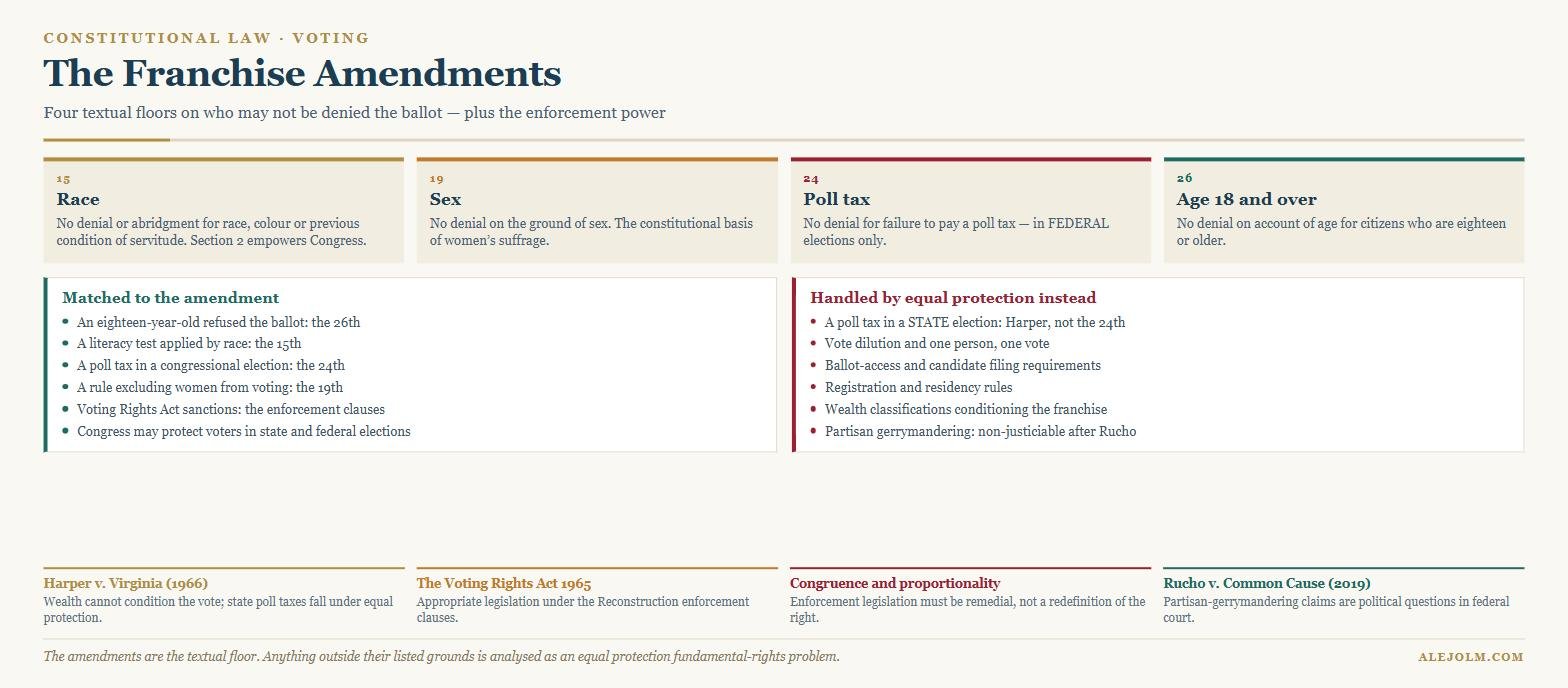
The four amendments
Each amendment removes one ground from the permissible reasons for denying or abridging the vote, and each is worth stating in its own terms rather than paraphrased loosely.
- Fifteenth Amendment. The right to vote may not be denied or abridged on account of race, colour, or previous condition of servitude. Section 2 gives Congress power to enforce it by appropriate legislation, and it is the constitutional foundation of federal voting-rights legislation.
- Nineteenth Amendment. The right to vote may not be denied or abridged on account of sex — the constitutional basis of women’s suffrage.
- Twenty-fourth Amendment. The right to vote may not be denied or abridged for failure to pay a poll tax or any other tax — in federal elections. That textual limitation is the source of the area’s best-known trap.
- Twenty-sixth Amendment. The right to vote may not be denied or abridged on account of age for citizens who are eighteen years of age or older.
A compact way to hold them: fifteenth is race, nineteenth is sex, twenty-fourth is poll tax in federal elections, twenty-sixth is age eighteen and above. Note the shared verb across all four — denied or abridged. The amendments prohibit exclusion on the listed grounds; they are not general charters for regulating the machinery of elections, and a rule that burdens voting without discriminating on a listed ground must be attacked elsewhere.
The poll tax trap
The Twenty-fourth Amendment reaches federal elections only — elections for President, Vice President, senators and representatives. It says nothing about state and local elections, and a candidate who cites it against a state poll tax has cited the wrong provision.
State poll taxes are nonetheless unconstitutional, and the authority is Harper v. Virginia Board of Elections (1966), decided under the Equal Protection Clause. The reasoning is that the right to vote is fundamental and wealth is not a permissible basis for allocating it, so conditioning the franchise on payment is subject to strict scrutiny and cannot be justified. The result is the same, the route is different, and the distinction is examined constantly.
So the discipline on any poll-tax fact pattern is to read which election is involved before choosing the authority. Federal election, cite the Twenty-fourth Amendment. State or local election, cite Harper and equal protection. A complete answer mentions both and explains why the amendment does not reach the state case by its own terms.
Exam tip: check the type of election before naming the provision. The Twenty-fourth Amendment is textually limited to federal elections; a state poll tax falls under Harper and equal protection.
The enforcement power and the Voting Rights Act
The amendments would be of limited practical value without machinery, and the enforcement clauses supply it. Congress may enact appropriate legislation to enforce them, and it has — most importantly the Voting Rights Act of 1965, which provides sanctions and remedies for voter discrimination and reaches state as well as federal elections.
There is a constitutional limit on that power, and it is worth knowing because it is where enforcement legislation is actually litigated. Congress’s authority is remedial: it may enact measures that are congruent and proportional to the constitutional violations it seeks to remedy, but it may not redefine the substance of the right itself. Legislation supported by a record of documented discrimination and tailored to it stands on solid ground; a sweeping prophylactic regime with no such record is vulnerable.
The Reconstruction amendments are also the reason federal voting legislation can reach purely state elections. Ordinarily Congress would need to establish an enumerated power, and its authority over the conduct of state elections is limited. The enforcement clauses supply a direct and independent grant for the specific purpose of preventing discrimination in the franchise.
What the amendments do not cover
The great majority of modern voting litigation concerns grounds the amendments do not list, and that material belongs to the fundamental-rights branch of equal protection rather than to any amendment’s text.
Districting and vote dilution are the largest category. The one person, one vote principle requires substantial population equality between districts, and it derives from equal protection rather than from the franchise amendments. Ballot-access requirements, candidate filing fees, registration deadlines, residency rules and durational requirements are all assessed by weighing the burden imposed against the state’s justification. Wealth-based conditions fall under Harper. In each case the franchise amendments function as the textual floor — worth citing to establish that voting is constitutionally protected — with the analysis then proceeding under equal protection.
One boundary is jurisdictional rather than substantive. Claims that district lines were drawn to entrench a political party — partisan gerrymandering — were held non-justiciable in federal court in Rucho v. Common Cause (2019), on the ground that no manageable standard exists for deciding how much partisanship is too much. Racial gerrymandering claims remain fully justiciable, which makes the characterisation of the claim decisive.
| Facts | Provision |
|---|---|
| Literacy test administered by race | Fifteenth Amendment |
| Women excluded from the ballot | Nineteenth Amendment |
| Poll tax in a congressional election | Twenty-fourth Amendment |
| Poll tax in a state election | Equal protection (Harper) |
| Eighteen-year-old refused the vote | Twenty-sixth Amendment |
| Unequal district populations | Equal protection |
| Federal legislation on state elections | Enforcement clauses |
| Partisan gerrymandering claim | Political question (Rucho) |
| Racial gerrymandering claim | Equal protection |
Worked example
State N enacts a statute requiring every voter to pay a two-dollar registration fee before voting in any state or local election. Federal elections are unaffected. A resident who cannot afford the fee challenges the statute, relying on the Twenty-fourth Amendment.
The claimant is right about the outcome and wrong about the provision, and a good answer says both. The Twenty-fourth Amendment prohibits conditioning the vote on payment of a tax, but only in federal elections, and this statute is expressly confined to state and local contests. So the amendment does not apply by its own terms, and a challenge resting on it alone would fail. Equal protection supplies the correct route. The right to vote is fundamental, and a classification that allocates it by ability to pay is reviewed under strict scrutiny following Harper v. Virginia Board of Elections. The state’s likely justifications — defraying administrative cost, or discouraging casual registration — are not compelling, and cost recovery could be achieved from general revenue without excluding anyone. The fee is unconstitutional, and its modest size is irrelevant: Harper turns on the impermissibility of the criterion, not the magnitude of the sum.
Change one fact. Suppose the statute instead required voters to present a document establishing residence in the precinct, with free documents available on request. Now there is no listed ground and no wealth classification, so neither the amendments nor Harper disposes of the case. The analysis becomes a weighing exercise: the burden imposed on voters against the state’s legitimate interest in confirming eligibility — and a genuinely free and accessible document would very likely survive.
Common mistakes that cost points
- Citing the Twenty-fourth Amendment against a state poll tax. It reaches federal elections only; use Harper and equal protection.
- Forgetting that the Twenty-sixth Amendment protects citizens aged eighteen and above, not any age classification whatever.
- Treating the amendments as general charters over election machinery. They prohibit denial on listed grounds and nothing more.
- Analysing districting under the franchise amendments. One person, one vote comes from equal protection.
- Overlooking the enforcement clauses when a federal statute regulates state elections. That is where the authority comes from.
- Ignoring the congruence-and-proportionality limit. Enforcement legislation must be remedial, not a redefinition of the right.
- Pursuing a partisan-gerrymandering claim in federal court after Rucho. Racial gerrymandering claims remain available.
- Assuming a small fee is acceptable. Harper condemns the criterion, not the amount.
Frequently asked questions
Are poll taxes in state elections unconstitutional?
Yes, but not because of the Twenty-fourth Amendment, which is limited to federal elections. Harper v. Virginia Board of Elections held that conditioning the franchise on wealth violates the Equal Protection Clause, since voting is fundamental and ability to pay is not a permissible basis for allocating it.
Can Congress regulate state elections?
For the purpose of preventing discrimination in the franchise, yes. The enforcement clauses of the Reconstruction and franchise amendments authorise appropriate legislation reaching state as well as federal elections, which is how the Voting Rights Act operates. The power is remedial and must be congruent and proportional to documented violations.
Where does one person, one vote come from?
From the Equal Protection Clause, not from any franchise amendment. The amendments prohibit exclusion on specified grounds; the requirement that districts contain roughly equal populations, and the doctrine on vote dilution, belong to the fundamental-rights branch of equal protection.
Voting rights in California and Los Angeles County in 2026
The franchise amendments set a federal floor: race, sex, poll taxes and age above eighteen may not be used to deny the vote. California has built well above that floor, and Los Angeles County administers the largest local election system in the United States through the Los Angeles County Registrar-Recorder/County Clerk.
Two California choices matter most. Every registered voter receives a mail ballot automatically, a practice made permanent after the 2020 cycle, and voters may register or correct their registration through election day using conditional registration. Los Angeles County also replaced traditional precincts with a network of multi-day vote centres using ballot marking devices developed by the county itself, a system designed in part to deliver ballots in a large number of languages as federal law requires.
The specifics that decide cases and exam questions:
- Parole no longer disqualifies. Proposition 17, approved in 2020, restored voting rights to people on state parole, so in California only current incarceration for a felony suspends the franchise.
- Poll taxes and their equivalents are barred. Any charge that operates as a precondition to voting is invalid, which is why identification and documentation requirements are examined closely.
- California has no strict photo identification requirement. Signature comparison is the principal verification method for mail ballots, with a statutory cure process.
- Pre-registration begins at sixteen. Registration becomes effective automatically at eighteen.
- Language assistance is federally mandated here. The county’s multilingual materials reflect obligations under federal voting rights legislation, not merely local preference.
- Burdens are weighed, not banned. Neutral regulations are assessed by balancing the burden against the state’s interests rather than by strict scrutiny.
For 2026, confirm current deadlines and vote centre locations with the county registrar before relying on any date. Read with one person, one vote, Section 5 enforcement power and equal protection.
Next steps
These amendments are the textual floor, so read them with the doctrine that does most of the analytical work: the right to vote and one person, one vote covers districting and dilution, and equal protection supplies the scrutiny for every classification the amendments do not name. On the congressional side, the Section 5 enforcement power explains the congruence-and-proportionality limit, and the political question doctrine accounts for why partisan-gerrymandering claims fail in federal court.
The texts of the amendments and annotated commentary are freely available through Justia’s constitutional collection. Cornell’s Legal Information Institute keeps a concise entry with current citations, and candidates should confirm the tested scope against the outlines published by the State Bar of California.
Related guides
- Advisory Opinions: Article III and Declaratory Relief
- Access to the Courts: When Filing Fees Are Unconstitutional
- Other Enumerated Powers: Postal, Bankruptcy, Admiralty
- Property Clause: Congress and Federal Lands Explained
- No Federal Police Power: Enumerated Powers and Enclaves
- Contracts Clause: When States May Impair Agreements
- Takings Clause: Lucas, Penn Central and Just Compensation
- Free Exercise Clause: Smith, Lukumi and Fulton Applied
- Establishment Clause: Church, State and the New Test
- Freedom of Association: Scrutiny, Dale and Disclosure
- Freedom of the Press: Publication Liability and Limits
- Campaign Finance and Anonymous Speech: The Core Rules
- Unconstitutional Conditions: Benefits and Rights Waivers
- Government Speech Doctrine: When the State Can Choose
- Vagueness and Overbreadth: Facial Challenges Explained
- Prior Restraint and Licensing: The Freedman Safeguards
- Symbolic Conduct and the O’Brien Test: The Pivot Question
- Government Employee Speech: Garcetti and Pickering Rules
- Commercial Speech and the Central Hudson Four-Part Test
- Actual Malice and the Three Tracks of Defamation Law
- Public Forum Doctrine and the Time, Place, Manner Test
- First Amendment: The Three-Question Speech Framework
- One Person, One Vote: Voting Rights Under Equal Protection
- Alienage Classifications: Strict Scrutiny and Its Pockets
- Equal Protection: The Three-Step Classification Test
- Second Amendment: The Bruen Text-and-History Standard
- Substantive Due Process After Dobbs: A Two-Step Test
- Procedural Due Process: Notice, Hearing and Mathews
- Incorporation Doctrine: Which Rights Bind the States
- Full Faith and Credit: Recognising Sister-State Judgments
- The Complete Auto Test: Taxing Interstate Commerce
- The Right to Travel: Durational Residency Explained
- Article IV Privileges and Immunities: The Comity Rule
- Federal Preemption: The Three-Step Ladder Explained
- The Supremacy Clause: Floors, Ceilings and Preemption
- Intergovernmental Immunity: The Shield Runs One Way
- The Presidential Pardon Power: Four Limits That Matter
- Executive Privilege: A Qualified Right That Must Yield
- Presidential Immunity: Criminal, Civil and Private Acts
- The Removal Power: At-Will Firing and Its Exceptions
- The Appointment Power: Principal and Inferior Officers
- Take Care Clause: Enforcement Discretion and Its Limits
- Commander-in-Chief Power: Deploy Without Declaring War
- Executive Agreements: The President’s Sole Foreign Power
- The Treaty Power: Senate Advice and Consent Explained
- The Presidential Veto Power, Override and Pocket Veto
- Bicameralism and Presentment: Two Vetoes Struck Down
- The Nondelegation Doctrine and the Intelligible Principle
- Speech or Debate Clause: Absolute but Narrow Immunity
- The Impeachment Power: House Majority, Senate Two-Thirds
- Congress’s Naturalization Power and Citizenship Limits
- Congressional War Powers: Declare, Fund and Command
- Anti-Commandeering Doctrine and the Tenth Amendment
- Section 5 Enforcement Power: Remedy, Do Not Redefine
- The Spending Power and the Five Dole Test Conditions
- Congress’s Taxing Power: When a Penalty Is Really a Tax
- The Necessary and Proper Clause: Congress’s Multiplier
- Ex Post Facto Clause: Retroactive Criminal Laws Barred
- Bills of Attainder: Legislative Punishment Explained
- The Writ of Habeas Corpus: Testing Unlawful Detention
- Supreme Court Jurisdiction: Original vs Appellate Power
- Abstention Doctrine: 4 Ways Federal Courts Step Aside
- Dormant Commerce Clause: Discrimination vs Pike Balancing
- The Commerce Clause: 3 Categories and 2 Hard Limits
- State Action Doctrine: The Government Conduct Threshold
- The Eleventh Amendment and State Sovereign Immunity
- Political Question Doctrine: What Courts Will Not Decide
- Ripeness and Mootness: Timing Rules in Federal Court
- Standing in Federal Court: The 3-Part Article III Test
- Marbury v. Madison and the Power of Judicial Review
- The Youngstown Framework: Presidential Power in 3 Zones
- The IRAC Method: How to Structure a Bar Exam Answer
- Piercing the Corporate Veil: A Two-Prong Alter Ego Test
- Defamation Elements, Fault Standards and Privileges
- The Parol Evidence Rule: Integration and Exceptions
- Recording Acts: Race, Notice and Race-Notice Explained
- Partner Liability and Authority Under RUPA Explained
- Trustee Duties: Care, Loyalty, Impartiality, Accounts
- Specific Performance: A Six-Element Bar Exam Framework
- Will Execution Requirements: Formalities and Rescue
- Community Property Presumptions in California Explained
- Easements Explained: Creation, Scope and Termination
- Products Liability: The Three Defect Theories Explained
- Miranda Rights: Custody, Interrogation and Invocation
- The Character Evidence Rules: Propensity Bar and Doorways
- Adverse Possession Elements: OCEAN and the Tax Rule
- Business Judgment Rule and Directors’ Fiduciary Duties
- The Statute of Frauds: MYLEGS and How to Satisfy It
- Res Judicata vs Collateral Estoppel: Bar Exam Guide
- The Erie Doctrine Explained: A 4-Step Bar Exam Guide
- Conflicts of Interest: A 6-Step Decision Tree for the Bar
- The Rule Against Perpetuities Explained Step by Step
- Murder and Manslaughter: The Homicide Ladder Explained
- Consideration in Contract Law: Rules and Exceptions
- The Four Elements of Negligence: Bar Exam Breakdown
- The Hearsay Rule Explained: Exceptions and Exemptions
- Personal Jurisdiction: The 3-Step Bar Exam Framework
- 3 Levels of Scrutiny in Constitutional Law Explained
- The Citizenship Clause After Trump v. Barbara