
Equal protection questions look open-ended and are not. Almost every one of them is decided in the first few seconds, at the moment you decide whether the statute sorts people into groups and, if it does, which tier of review that sorting attracts. Everything after that is bookkeeping.
The clause itself is short: no state shall deny to any person within its jurisdiction the equal protection of the laws. What has grown around it is a three-step routine, a fixed table of tier assignments, and one evidentiary rule about facially neutral statutes that trips up more candidates than any other part of the doctrine.
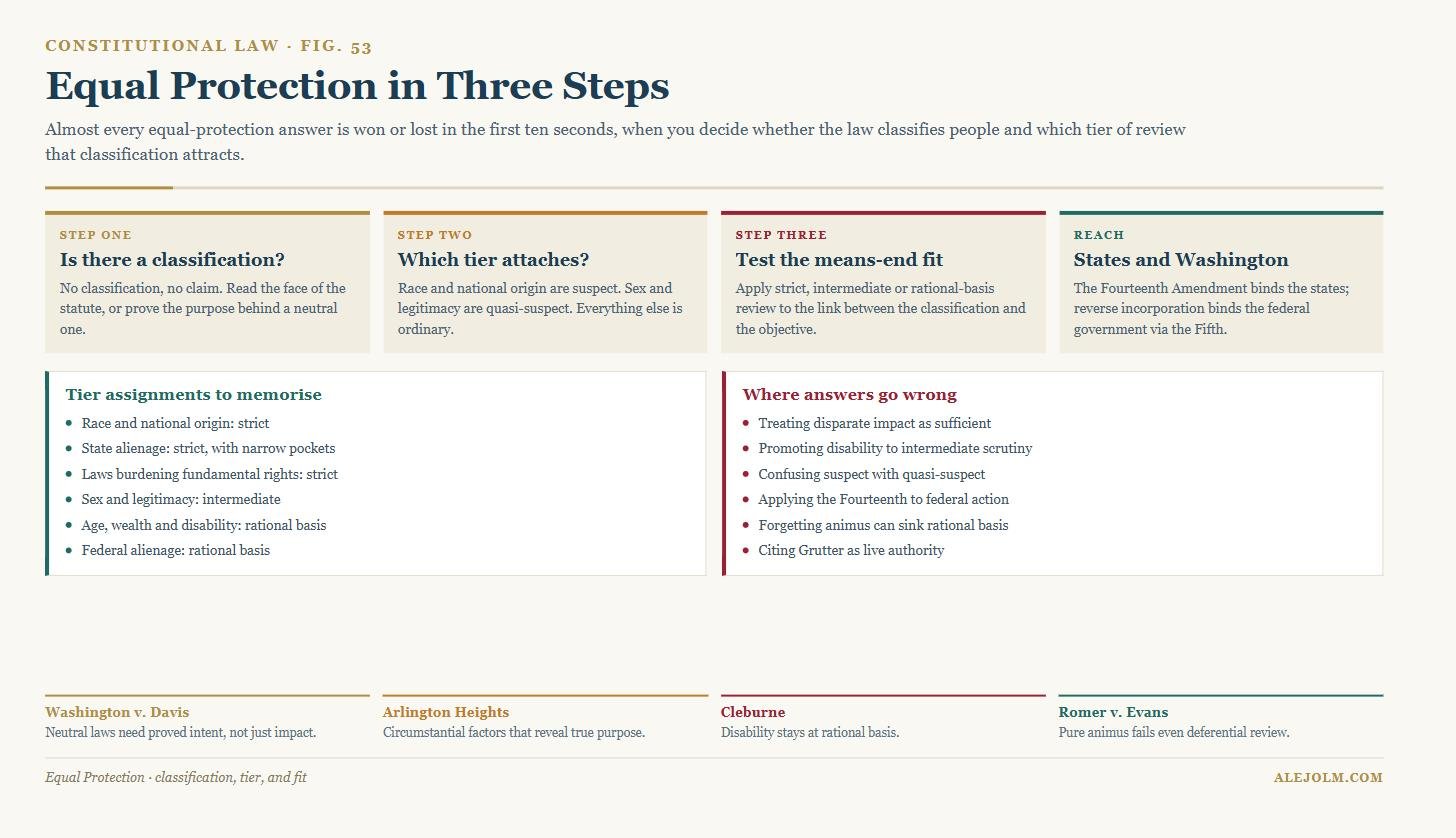
Step one: does the law classify?
If a statute treats everyone alike, there is no equal protection claim, however unwelcome its effects. So the first task is to locate the classification. It can appear in one of two places.
A facially discriminatory law names the characteristic outright — a rule barring non-citizens from a licence, or excluding women from a post. Here the classification is on the page, intent is presumed from the terms, and you move straight to the tier. A facially neutral law names nothing, and this is where the real work lies: the challenger must show that the legislature acted with a discriminatory purpose, not merely that the statute lands harder on one group.
That distinction is the single most productive thing to get right. A hypothetical describing a civil-service examination that screens out one racial group at a higher rate is not an automatic strict-scrutiny problem. It is a purpose problem, and the government wins unless intent is proved.
Proving purpose behind a neutral statute
Disparate impact alone does not raise the level of review. The Court settled that in 1976, and the practical consequence is that constitutional equal protection prohibits intentional discrimination rather than requiring equal outcomes. Note the contrast with some statutory regimes, where impact alone can establish liability; do not import that logic into a constitutional answer.
Purpose is proved circumstantially, and there is a recognised checklist for it: the historical background of the decision, the sequence of events leading up to it, departures from the normal procedural or substantive criteria the body would ordinarily follow, and the legislative or administrative record, including what decision-makers said at the time. A stark statistical disparity is evidence within that framework, but it is one factor rather than a substitute for the inquiry.
Exam tip: name the classification before you name a tier. If the statute is facially neutral, spend a sentence on discriminatory purpose and the circumstantial factors before you touch scrutiny at all — an answer that jumps straight to strict scrutiny has skipped the step being tested.
Step two: assigning the tier
The tier table is finite and worth learning cold, because the marks are in the assignment rather than in the application.
| Classification | Standard |
|---|---|
| Race, national origin | Strict scrutiny |
| State alienage | Strict scrutiny, with narrow exceptions |
| Federal alienage | Rational basis |
| Sex, legitimacy | Intermediate scrutiny |
| Burdens on fundamental rights | Strict scrutiny |
| Age, wealth, disability, economic regulation | Rational basis |
Two rows cause most of the damage. Disability is rational basis, not intermediate, despite the intuitive analogy to sex; the leading case declined to treat it as suspect or quasi-suspect and still struck the ordinance before it, which is a useful reminder that rational basis is not always toothless. And alienage splits by sovereign: a state classification presumptively draws strict scrutiny, while an equivalent federal classification draws only rational basis, because Congress holds plenary authority over immigration.
Sex classifications carry a further gloss. The government needs an exceedingly persuasive justification, and generalisations about how men or women tend to be will not supply it. Evidence about the actual fit between the classification and the objective is required, which is why categorical exclusions built on stereotype fail even though the underlying interest is legitimate.
The fundamental-rights branch
Equal protection also bites when a classification burdens a fundamental right even though the classification itself is unremarkable. Voting, interstate travel and access to the courts all operate this way: a wealth-based restriction is not suspect on its own terms, but attach it to the franchise and strict scrutiny follows. This is where equal protection and substantive due process overlap, and a strong answer runs both theories rather than choosing between them.
The limits matter too. Education is not a fundamental right for these purposes and wealth is not a suspect class, so unequal school funding is reviewed deferentially. Ordinary civil filing fees survive, while a fee that forecloses the only available route to a legal remedy does not.
Reverse incorporation: reaching federal action
The Fourteenth Amendment speaks only to the states, so a federal programme cannot violate its Equal Protection Clause. The result is reached instead through the Due Process Clause of the Fifth Amendment, which has been read to carry an equal protection component of the same content. The analysis and the tiers are identical; only the textual hook changes. Naming the right clause for the right defendant is a cheap mark and an easy one to drop.
Worked example
State J bars women from serving as probation officers. Its stated justification is public safety: officers supervise high-risk offenders, and the legislature asserts that women are less able to handle physically dangerous encounters. A rejected applicant sues.
The statute names sex on its face, so the classification is established and intermediate scrutiny attaches without any inquiry into purpose. The state must show an important objective and a substantial relation to it. Public safety in offender supervision is plainly important, so the case turns on fit. The asserted link rests on a generalisation about physical capacity rather than evidence, and it is both over- and under-inclusive: it excludes capable women while admitting men who are not capable. A less crude instrument — an individualised fitness standard, or a training requirement applied to all applicants — would serve the same objective more precisely. The blanket exclusion therefore fails.
Change one fact. Suppose the statute imposed no sex-based bar but instead required every applicant to pass a physical assessment, and suppose women failed it at a markedly higher rate. There is now no facial classification, so the applicant must prove that the assessment was adopted for a discriminatory purpose. Absent that showing — an unusual procedural history, contemporaneous statements, an abandoned prior standard — the requirement stands under rational basis, and the higher failure rate alone will not carry the claim.
Common mistakes that cost points
- Treating disparate impact as a substitute for discriminatory purpose in a facially neutral case.
- Promoting disability or age to intermediate scrutiny by analogy to sex; both remain at rational basis.
- Blurring suspect and quasi-suspect, and so applying strict scrutiny to a sex classification.
- Applying the Fourteenth Amendment to a federal defendant instead of the Fifth Amendment equal protection component.
- Giving the same treatment to state and federal alienage classifications when they sit in different tiers.
- Assuming rational basis is unlosable; a classification resting on bare animus fails it.
- Missing the fundamental-rights branch, and reviewing a voting or court-access restriction deferentially.
- Failing to identify any classification at all before launching into tiers.
Frequently asked questions
Does a law with a racially disproportionate effect violate equal protection?
Not by itself. If the statute is neutral on its face, the challenger must prove the legislature acted with discriminatory purpose, established through the historical background, the sequence of events, procedural irregularities and the legislative record. Impact is evidence within that inquiry, not a shortcut around it.
Which classifications actually receive heightened scrutiny?
Race and national origin receive strict scrutiny, as do state alienage classifications and laws burdening fundamental rights. Sex and legitimacy receive intermediate scrutiny. Age, wealth, disability and ordinary economic regulation receive rational basis.
How can the federal government be bound if the clause names only states?
Through reverse incorporation. The Fifth Amendment Due Process Clause has been construed to include an equal protection guarantee of the same substance, so federal classifications are analysed under the identical tiers with a different textual basis.
Equal protection in California: Proposition 209 and Los Angeles County, 2026
California reached the destination of Students for Fair Admissions v. Harvard (2023) nearly three decades early, and by a different route. Article I, section 31 of the California Constitution, adopted as Proposition 209 in 1996, prohibits the state and its subdivisions from granting preferential treatment on the basis of race, sex, colour, ethnicity or national origin in public employment, public education and public contracting. Voters declined to repeal it in 2020.
The practical effect is that a Los Angeles County programme cannot be defended merely by satisfying federal strict scrutiny; it must also clear a state constitutional prohibition that operates as a flat rule rather than a balancing test. County contracting policy reflects this. Preference programmes are structured around race-neutral criteria such as business size, local presence and social or economic disadvantage defined without reference to race, and outreach is permitted where selection is not.
How the two layers interact:
- Tiers still govern the federal claim. Race and national origin draw strict scrutiny, sex draws intermediate scrutiny, and most other classifications draw rational basis review.
- Proposition 209 is narrower but harder. It reaches only the listed categories and only public sector activity, but within that space it admits almost no justification.
- Remedial programmes need a court order or federal mandate. Those are the recognised routes around the state prohibition, not a general diversity interest.
- Data collection is not preference. Studying disparities in county contracting is lawful; using race to award the contract is not.
- California protects more in other respects. The state constitution has been read to give heightened protection to classifications federal law treats more leniently.
- Disparate impact is statutory. Equal protection requires intent, so unintentional disparities are litigated under statutes instead.
For 2026, answer the federal tier question and then ask the separate state question. Read with the levels of scrutiny, alienage classifications and Section 5 enforcement power.
Next steps
This topic sits on top of the scrutiny framework, so it repays reading the levels of scrutiny first and then returning here. From there, substantive due process covers the doctrine that overlaps on fundamental rights, the incorporation doctrine explains how these guarantees reach the states at all, and the state action doctrine answers the threshold question of whether a private actor can be reached in the first place.
For primary material, the leading opinions are collected at Justia, an annotated treatment of the clause is maintained by the Cornell Legal Information Institute, and current examination scope is published by the State Bar of California.
Related guides
- Advisory Opinions: Article III and Declaratory Relief
- Access to the Courts: When Filing Fees Are Unconstitutional
- Other Enumerated Powers: Postal, Bankruptcy, Admiralty
- Franchise Amendments: Congress and the Right to Vote
- Property Clause: Congress and Federal Lands Explained
- No Federal Police Power: Enumerated Powers and Enclaves
- Contracts Clause: When States May Impair Agreements
- Takings Clause: Lucas, Penn Central and Just Compensation
- Free Exercise Clause: Smith, Lukumi and Fulton Applied
- Establishment Clause: Church, State and the New Test
- Freedom of Association: Scrutiny, Dale and Disclosure
- Freedom of the Press: Publication Liability and Limits
- Campaign Finance and Anonymous Speech: The Core Rules
- Unconstitutional Conditions: Benefits and Rights Waivers
- Government Speech Doctrine: When the State Can Choose
- Vagueness and Overbreadth: Facial Challenges Explained
- Prior Restraint and Licensing: The Freedman Safeguards
- Symbolic Conduct and the O’Brien Test: The Pivot Question
- Government Employee Speech: Garcetti and Pickering Rules
- Commercial Speech and the Central Hudson Four-Part Test
- Actual Malice and the Three Tracks of Defamation Law
- Public Forum Doctrine and the Time, Place, Manner Test
- First Amendment: The Three-Question Speech Framework
- One Person, One Vote: Voting Rights Under Equal Protection
- Alienage Classifications: Strict Scrutiny and Its Pockets
- Second Amendment: The Bruen Text-and-History Standard
- Substantive Due Process After Dobbs: A Two-Step Test
- Procedural Due Process: Notice, Hearing and Mathews
- Incorporation Doctrine: Which Rights Bind the States
- Full Faith and Credit: Recognising Sister-State Judgments
- The Complete Auto Test: Taxing Interstate Commerce
- The Right to Travel: Durational Residency Explained
- Article IV Privileges and Immunities: The Comity Rule
- Federal Preemption: The Three-Step Ladder Explained
- The Supremacy Clause: Floors, Ceilings and Preemption
- Intergovernmental Immunity: The Shield Runs One Way
- The Presidential Pardon Power: Four Limits That Matter
- Executive Privilege: A Qualified Right That Must Yield
- Presidential Immunity: Criminal, Civil and Private Acts
- The Removal Power: At-Will Firing and Its Exceptions
- The Appointment Power: Principal and Inferior Officers
- Take Care Clause: Enforcement Discretion and Its Limits
- Commander-in-Chief Power: Deploy Without Declaring War
- Executive Agreements: The President’s Sole Foreign Power
- The Treaty Power: Senate Advice and Consent Explained
- The Presidential Veto Power, Override and Pocket Veto
- Bicameralism and Presentment: Two Vetoes Struck Down
- The Nondelegation Doctrine and the Intelligible Principle
- Speech or Debate Clause: Absolute but Narrow Immunity
- The Impeachment Power: House Majority, Senate Two-Thirds
- Congress’s Naturalization Power and Citizenship Limits
- Congressional War Powers: Declare, Fund and Command
- Anti-Commandeering Doctrine and the Tenth Amendment
- Section 5 Enforcement Power: Remedy, Do Not Redefine
- The Spending Power and the Five Dole Test Conditions
- Congress’s Taxing Power: When a Penalty Is Really a Tax
- The Necessary and Proper Clause: Congress’s Multiplier
- Ex Post Facto Clause: Retroactive Criminal Laws Barred
- Bills of Attainder: Legislative Punishment Explained
- The Writ of Habeas Corpus: Testing Unlawful Detention
- Supreme Court Jurisdiction: Original vs Appellate Power
- Abstention Doctrine: 4 Ways Federal Courts Step Aside
- Dormant Commerce Clause: Discrimination vs Pike Balancing
- The Commerce Clause: 3 Categories and 2 Hard Limits
- State Action Doctrine: The Government Conduct Threshold
- The Eleventh Amendment and State Sovereign Immunity
- Political Question Doctrine: What Courts Will Not Decide
- Ripeness and Mootness: Timing Rules in Federal Court
- Standing in Federal Court: The 3-Part Article III Test
- Marbury v. Madison and the Power of Judicial Review
- The Youngstown Framework: Presidential Power in 3 Zones
- The IRAC Method: How to Structure a Bar Exam Answer
- Piercing the Corporate Veil: A Two-Prong Alter Ego Test
- Defamation Elements, Fault Standards and Privileges
- The Parol Evidence Rule: Integration and Exceptions
- Recording Acts: Race, Notice and Race-Notice Explained
- Partner Liability and Authority Under RUPA Explained
- Trustee Duties: Care, Loyalty, Impartiality, Accounts
- Specific Performance: A Six-Element Bar Exam Framework
- Will Execution Requirements: Formalities and Rescue
- Community Property Presumptions in California Explained
- Easements Explained: Creation, Scope and Termination
- Products Liability: The Three Defect Theories Explained
- Miranda Rights: Custody, Interrogation and Invocation
- The Character Evidence Rules: Propensity Bar and Doorways
- Adverse Possession Elements: OCEAN and the Tax Rule
- Business Judgment Rule and Directors’ Fiduciary Duties
- The Statute of Frauds: MYLEGS and How to Satisfy It
- Res Judicata vs Collateral Estoppel: Bar Exam Guide
- The Erie Doctrine Explained: A 4-Step Bar Exam Guide
- Conflicts of Interest: A 6-Step Decision Tree for the Bar
- The Rule Against Perpetuities Explained Step by Step
- Murder and Manslaughter: The Homicide Ladder Explained
- Consideration in Contract Law: Rules and Exceptions
- The Four Elements of Negligence: Bar Exam Breakdown
- The Hearsay Rule Explained: Exceptions and Exemptions
- Personal Jurisdiction: The 3-Step Bar Exam Framework
- 3 Levels of Scrutiny in Constitutional Law Explained
- The Citizenship Clause After Trump v. Barbara