
The elements of negligence are duty, breach, causation and damages. The plaintiff must prove all four by a preponderance of the evidence, and if a single element fails the claim fails with it. That structure is also the safest skeleton for an exam answer, because it forces you to address each stage in the order a court would.
What separates a competent answer from a strong one is knowing which element the fact pattern is really testing. Most negligence questions are quietly about breach or about proximate cause. This guide works through the four elements, the shortcuts and the traps.
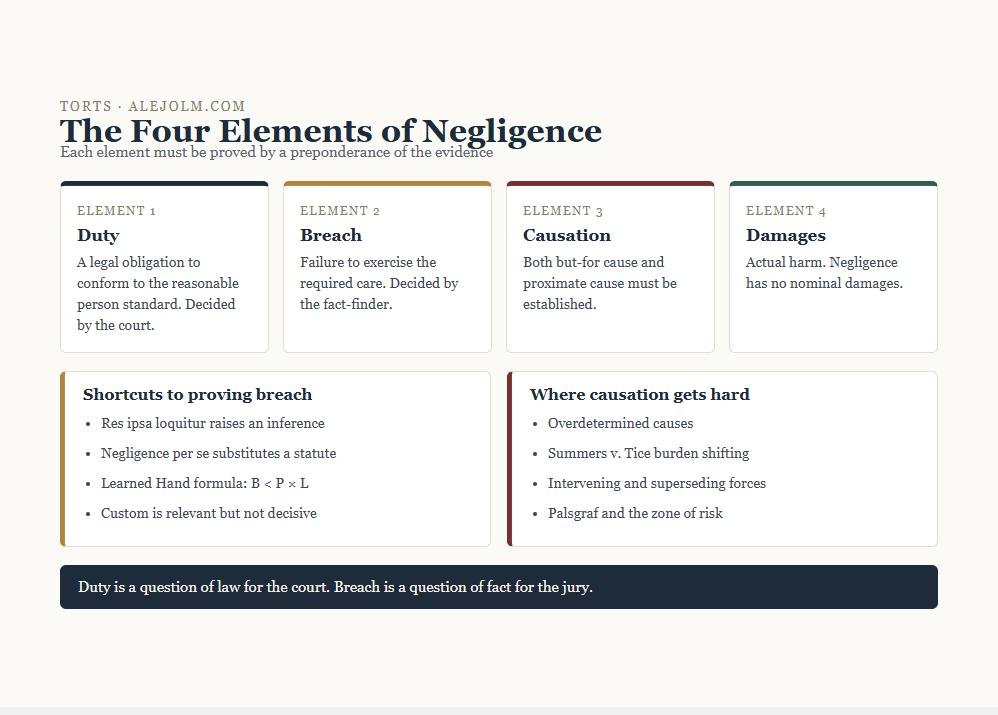
Element 1: duty of care
Duty is a legal obligation to conform your conduct to the reasonable person standard. Critically, duty is a question of law decided by the court, not the jury. There is no absolute liability for every injury a defendant causes; a defendant is not an insurer.
To whom is duty owed?
Palsgraf v. Long Island Railroad (1928) supplies the classic answer. Cardozo’s majority limits duty to foreseeable plaintiffs within the zone of danger. Andrews’s dissent would extend duty to anyone in fact harmed. Both views are worth naming when the plaintiff is unexpected.
One category is always foreseeable: rescuers. Wagner v. International Railway (1921) crystallised the idea that danger invites rescue, so a negligent defendant owes a duty to the person who comes to help.
Affirmative duties to act
There is generally no duty to rescue a stranger. Duties arise from special relationships, from voluntarily undertaking a rescue, and from creating the peril. Tarasoff v. Regents (1976) added a further situation: a therapist who learns a patient poses a serious threat to an identifiable victim owes a duty to protect that person.
Element 2: breach
Breach is the failure to exercise the required degree of care, and unlike duty it is a question of fact for the jury. The test is whether a reasonable person in the defendant’s position would have foreseen the risk and taken precautions.
The Learned Hand formula
United States v. Carroll Towing (1947) frames breach as a cost-benefit comparison: liability attaches where the burden of precaution is less than the probability of harm multiplied by the gravity of the loss. Cited as B < P × L, it is a useful way to argue breach explicitly rather than asserting it.
Custom and industry practice
Compliance with industry custom is relevant evidence but is not dispositive. An entire industry can be negligent, and a defendant who followed custom may still have fallen below the reasonable standard.
Two shortcuts worth knowing precisely
- Res ipsa loquitur — where the accident is of a kind that ordinarily does not happen absent negligence, the instrumentality was in the defendant’s exclusive control and the plaintiff did not contribute, a permissible inference of negligence arises. It shifts the burden of producing evidence; it does not conclusively establish breach.
- Negligence per se — an unexcused violation of a statute designed to protect this class of persons against this type of harm establishes duty and breach as a matter of law. Excuse is available where compliance would have been more dangerous, the point of Tedla v. Ellman.
Precision matters here. Saying res ipsa “proves” negligence, or that negligence per se merely creates an inference, inverts both doctrines.
Element 3: causation
Causation splits into two independent enquiries, and an answer that collapses them into one loses marks.
Actual cause
The but-for test asks whether the harm would have occurred without the defendant’s conduct. If it would have happened anyway, there is no actual cause. Two situations displace the test.
- Overdetermined causation — where multiple forces were each independently sufficient, courts use a substantial factor test rather than but-for.
- Alternative liability — in Summers v. Tice (1948) two negligent defendants fired and only one shot struck the plaintiff. Because the source could not be identified, the burden shifted to each defendant to disprove causation, and absent proof both were jointly and severally liable.
Proximate cause
Proximate cause is a legal limit, not a factual one. It confines liability to foreseeable consequences: was the harm within a foreseeable category of risk, and was the plaintiff a foreseeable victim?
| Intervening force | Usual treatment |
|---|---|
| Ordinary negligent medical treatment of the injury | Foreseeable, so liability continues |
| Rescue attempts and their consequences | Foreseeable, so liability continues |
| Ordinary negligence of a third party | Generally foreseeable |
| Extraordinary or criminal acts of a third party | Often superseding, cutting off liability |
| Unforeseeable acts of nature | Generally superseding |
The eggshell plaintiff rule sits alongside this. Once liability is established, the defendant takes the plaintiff as found and is responsible for the full extent of the harm even where the plaintiff’s fragility was unforeseeable.
Element 4: damages
Negligence requires actual harm. There are no nominal damages, which distinguishes it sharply from the intentional torts. Where the only injury is emotional, you are no longer in ordinary negligence but in negligent infliction of emotional distress, which has its own rules.
Direct-victim recovery generally requires the plaintiff to have been within the zone of physical danger. Bystander recovery in California follows the Dillon v. Legg factors: a close relationship with the injured party, contemporaneous perception of the injury-causing event, and physical proximity to the scene.
Defences that reduce or bar recovery
Contributory negligence, a complete bar, has been abolished in most jurisdictions. California applies pure comparative negligence: the plaintiff recovers even at ninety-nine per cent fault, with damages reduced by the assigned percentage. Modified comparative jurisdictions cut off recovery at fifty or fifty-one per cent.
Comparative negligence must be pleaded affirmatively by the defendant, and the apportionment is for the jury. Assumption of risk, express or implied, is the other main route to reducing or defeating the claim.
Common mistakes that cost points
- Treating duty as a jury question or breach as a question of law.
- Merging actual and proximate cause into a single paragraph.
- Asserting breach without articulating the standard or weighing precautions.
- Overstating res ipsa loquitur as proof rather than inference.
- Applying negligence per se without checking the protected class and type of harm.
- Forgetting that negligence needs actual damages.
Frequently asked questions
Is there ever a duty to rescue a stranger?
Not as a general rule. A duty arises from a special relationship, from having created the danger, or from having begun a rescue and then abandoned it, leaving the victim worse off.
How is res ipsa loquitur different from negligence per se?
Res ipsa is circumstantial and permits an inference of breach. Negligence per se borrows a statutory standard and establishes duty and breach as a matter of law unless an excuse applies.
Does the eggshell plaintiff rule extend the duty?
No. It expands the extent of recoverable damages once liability exists. It does not create a duty to an unforeseeable plaintiff.
Negligence in California: Rowland, comparative fault and county claims, 2026
California negligence law has a statutory foundation and a distinctive judicial overlay. Section 1714 of the California Civil Code states the general duty to exercise ordinary care, and in Rowland v. Christian (1968) the California Supreme Court abolished the common law categories of invitee, licensee and trespasser in favour of a multi-factor enquiry into foreseeability, certainty of injury, closeness of connection, moral blame, policy of preventing harm, burden on the defendant and availability of insurance. Duty in California is therefore argued from those factors rather than from the entrant’s status.
Apportionment is equally distinctive. Li v. Yellow Cab Co. (1975) replaced contributory negligence with pure comparative fault, so a plaintiff ninety per cent responsible still recovers ten per cent of their damages. Proposition 51 then made liability for non-economic damages several rather than joint, so each defendant pays only its proportionate share of pain and suffering while remaining jointly liable for economic loss.
Suing a public entity in Los Angeles County adds requirements:
- Present a claim first. The Government Claims Act in the California Government Code requires presentation to the county, generally within six months for personal injury, before any suit.
- Public entity liability is statutory. There is no common law negligence claim against the county; you must identify a statute such as the dangerous condition of public property provision.
- Design immunity is a real defence. An approved design for a county road or facility can immunise the entity even where the design causes harm.
- Two years for personal injury. Section 335.1 of the California Code of Civil Procedure sets the period, with shorter deadlines effectively imposed by the claims statute.
- Medical negligence has its own regime. California caps non-economic damages in professional negligence actions, and the cap has been on a scheduled series of annual increases, so confirm the figure applicable to the year of injury.
- Jury instructions come from CACI. The CACI civil jury instructions set out the elements the Los Angeles Superior Court will actually read to the jury.
For 2026, plead duty through the Rowland factors and calendar the claims deadline immediately. Read with products liability, public entity immunity and res judicata.
Next steps
Negligence supplies the analytical pattern for much of the Torts syllabus, including products liability and vicarious liability. The same element-by-element discipline appears in our guides to the hearsay rule, personal jurisdiction and the levels of scrutiny.
For case text and doctrinal summaries, Cornell’s Legal Information Institute entry on negligence is a reliable starting point.
The best drill is targeted: for twenty fact patterns, write one sentence per element and then one paragraph only on the element the facts actually contest. That is where the marks live.
Related guides
- Advisory Opinions: Article III and Declaratory Relief
- Access to the Courts: When Filing Fees Are Unconstitutional
- Other Enumerated Powers: Postal, Bankruptcy, Admiralty
- Franchise Amendments: Congress and the Right to Vote
- Property Clause: Congress and Federal Lands Explained
- No Federal Police Power: Enumerated Powers and Enclaves
- Contracts Clause: When States May Impair Agreements
- Takings Clause: Lucas, Penn Central and Just Compensation
- Free Exercise Clause: Smith, Lukumi and Fulton Applied
- Establishment Clause: Church, State and the New Test
- Freedom of Association: Scrutiny, Dale and Disclosure
- Freedom of the Press: Publication Liability and Limits
- Campaign Finance and Anonymous Speech: The Core Rules
- Unconstitutional Conditions: Benefits and Rights Waivers
- Government Speech Doctrine: When the State Can Choose
- Vagueness and Overbreadth: Facial Challenges Explained
- Prior Restraint and Licensing: The Freedman Safeguards
- Symbolic Conduct and the O’Brien Test: The Pivot Question
- Government Employee Speech: Garcetti and Pickering Rules
- Commercial Speech and the Central Hudson Four-Part Test
- Actual Malice and the Three Tracks of Defamation Law
- Public Forum Doctrine and the Time, Place, Manner Test
- First Amendment: The Three-Question Speech Framework
- One Person, One Vote: Voting Rights Under Equal Protection
- Alienage Classifications: Strict Scrutiny and Its Pockets
- Equal Protection: The Three-Step Classification Test
- Second Amendment: The Bruen Text-and-History Standard
- Substantive Due Process After Dobbs: A Two-Step Test
- Procedural Due Process: Notice, Hearing and Mathews
- Incorporation Doctrine: Which Rights Bind the States
- Full Faith and Credit: Recognising Sister-State Judgments
- The Complete Auto Test: Taxing Interstate Commerce
- The Right to Travel: Durational Residency Explained
- Article IV Privileges and Immunities: The Comity Rule
- Federal Preemption: The Three-Step Ladder Explained
- The Supremacy Clause: Floors, Ceilings and Preemption
- Intergovernmental Immunity: The Shield Runs One Way
- The Presidential Pardon Power: Four Limits That Matter
- Executive Privilege: A Qualified Right That Must Yield
- Presidential Immunity: Criminal, Civil and Private Acts
- The Removal Power: At-Will Firing and Its Exceptions
- The Appointment Power: Principal and Inferior Officers
- Take Care Clause: Enforcement Discretion and Its Limits
- Commander-in-Chief Power: Deploy Without Declaring War
- Executive Agreements: The President’s Sole Foreign Power
- The Treaty Power: Senate Advice and Consent Explained
- The Presidential Veto Power, Override and Pocket Veto
- Bicameralism and Presentment: Two Vetoes Struck Down
- The Nondelegation Doctrine and the Intelligible Principle
- Speech or Debate Clause: Absolute but Narrow Immunity
- The Impeachment Power: House Majority, Senate Two-Thirds
- Congress’s Naturalization Power and Citizenship Limits
- Congressional War Powers: Declare, Fund and Command
- Anti-Commandeering Doctrine and the Tenth Amendment
- Section 5 Enforcement Power: Remedy, Do Not Redefine
- The Spending Power and the Five Dole Test Conditions
- Congress’s Taxing Power: When a Penalty Is Really a Tax
- The Necessary and Proper Clause: Congress’s Multiplier
- Ex Post Facto Clause: Retroactive Criminal Laws Barred
- Bills of Attainder: Legislative Punishment Explained
- The Writ of Habeas Corpus: Testing Unlawful Detention
- Supreme Court Jurisdiction: Original vs Appellate Power
- Abstention Doctrine: 4 Ways Federal Courts Step Aside
- Dormant Commerce Clause: Discrimination vs Pike Balancing
- The Commerce Clause: 3 Categories and 2 Hard Limits
- State Action Doctrine: The Government Conduct Threshold
- The Eleventh Amendment and State Sovereign Immunity
- Political Question Doctrine: What Courts Will Not Decide
- Ripeness and Mootness: Timing Rules in Federal Court
- Standing in Federal Court: The 3-Part Article III Test
- Marbury v. Madison and the Power of Judicial Review
- The Youngstown Framework: Presidential Power in 3 Zones
- The IRAC Method: How to Structure a Bar Exam Answer
- Piercing the Corporate Veil: A Two-Prong Alter Ego Test
- Defamation Elements, Fault Standards and Privileges
- The Parol Evidence Rule: Integration and Exceptions
- Recording Acts: Race, Notice and Race-Notice Explained
- Partner Liability and Authority Under RUPA Explained
- Trustee Duties: Care, Loyalty, Impartiality, Accounts
- Specific Performance: A Six-Element Bar Exam Framework
- Will Execution Requirements: Formalities and Rescue
- Community Property Presumptions in California Explained
- Easements Explained: Creation, Scope and Termination
- Products Liability: The Three Defect Theories Explained
- Miranda Rights: Custody, Interrogation and Invocation
- The Character Evidence Rules: Propensity Bar and Doorways
- Adverse Possession Elements: OCEAN and the Tax Rule
- Business Judgment Rule and Directors’ Fiduciary Duties
- The Statute of Frauds: MYLEGS and How to Satisfy It
- Res Judicata vs Collateral Estoppel: Bar Exam Guide
- The Erie Doctrine Explained: A 4-Step Bar Exam Guide
- Conflicts of Interest: A 6-Step Decision Tree for the Bar
- The Rule Against Perpetuities Explained Step by Step
- Murder and Manslaughter: The Homicide Ladder Explained
- Consideration in Contract Law: Rules and Exceptions
- The Hearsay Rule Explained: Exceptions and Exemptions
- Personal Jurisdiction: The 3-Step Bar Exam Framework
- 3 Levels of Scrutiny in Constitutional Law Explained
- The Citizenship Clause After Trump v. Barbara