
Preemption is the most practical doctrine in the federalism syllabus and the one most often argued badly. The mistake is rarely the conclusion. It is the failure to say which kind of preemption is at work, and to say it in the right order.
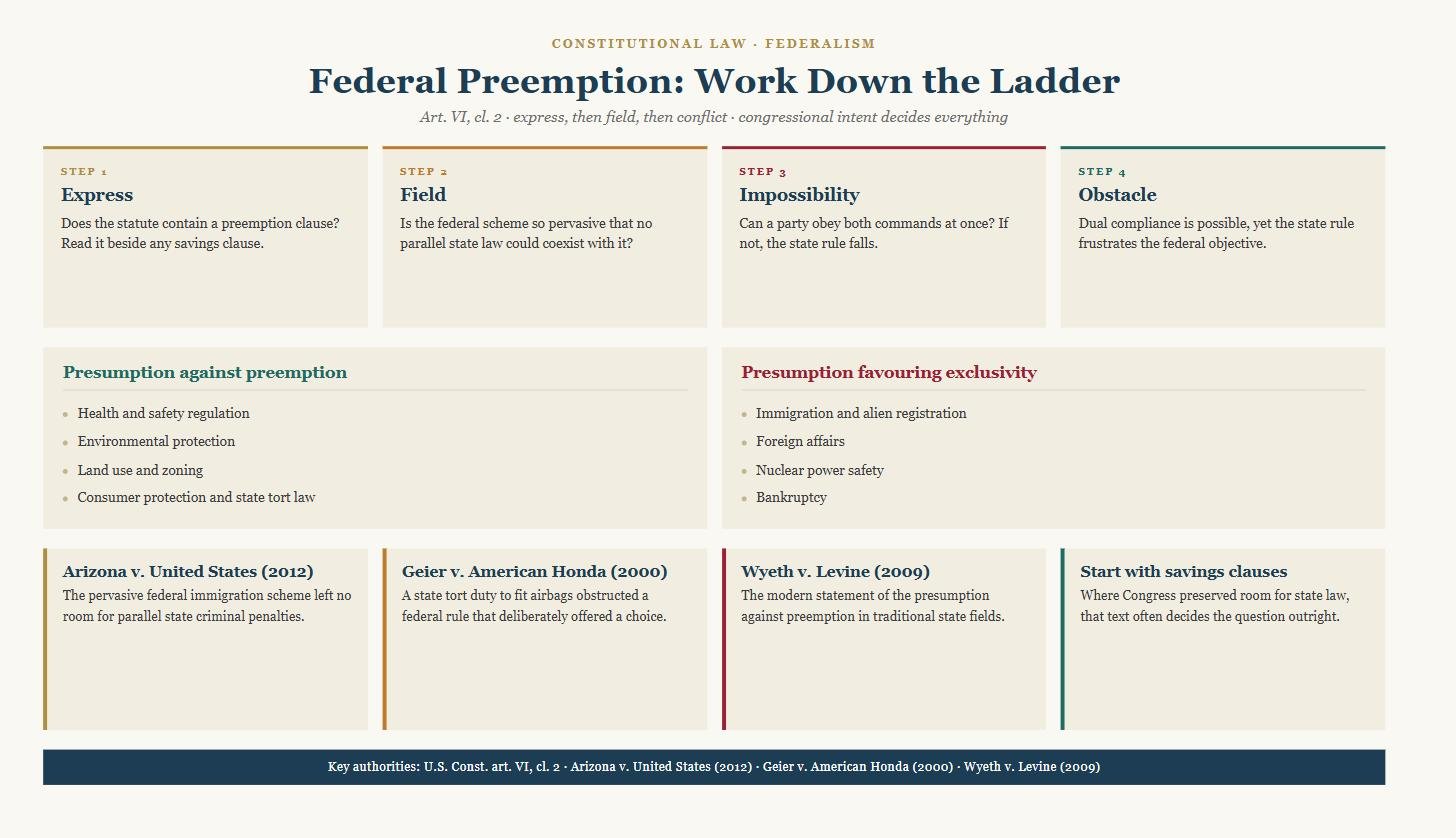
Federal preemption is the displacement of state law by valid federal law. It has one constitutional source, Article VI, and three recognised forms: express, field and conflict, with conflict splitting into impossibility and obstacle. Work down the ladder in that sequence and most fact patterns resolve themselves. Jump to the bottom rung and you will argue about congressional purpose when the statute already answered the question in its own text.
Why the order matters
Every rung asks a different question and demands a different kind of evidence. Express preemption is a reading exercise. Field preemption is an inference from the architecture of a regulatory scheme. Impossibility is a factual test about dual compliance. Obstacle preemption is an argument about legislative purpose, and it is the vaguest and most contested of the four, which is precisely why it should be reached last.
There is also a filter before the first rung. Preemption presupposes valid federal law. If the federal statute exceeds Congress’s enumerated powers, there is nothing to preempt with, and the analysis ends before it starts.
Express preemption: read the clause, then read the savings clause
Some statutes announce their own preemptive scope. When they do, that text governs, and the work is interpretive rather than structural: how far does the clause reach, and what does it leave alone?
The trap is stopping at the preemption clause. Federal statutes frequently pair a preemption clause with a savings clause that preserves state authority in defined respects, and the two must be read together. A preemption clause covering state “standards” may leave common-law damages claims untouched; a savings clause protecting state remedies may nonetheless yield where a particular remedy would obstruct the federal scheme. Lorillard Tobacco Co. v. Reilly (2001) is the standard illustration of an express clause doing real work: the federal cigarette-labelling statute displaced state rules on cigarette advertising.
Field preemption: the hardest rung to see
Congress can occupy a field without saying so. The inference comes from pervasiveness: a scheme so detailed, so comprehensively enforced and so dependent on national uniformity that parallel state regulation of the same subject would necessarily disturb it. The traditional examples are immigration and alien registration, foreign affairs, nuclear power safety and bankruptcy.
Arizona v. United States (2012) is the modern anchor. Arizona had enacted a statute layering state criminal penalties onto conduct already governed by the federal immigration code. Several provisions fell to field preemption because the federal scheme left no room for a concurrent state regime, and one fell as an obstacle to federal enforcement discretion. The lesson for exams is that field preemption is not about conflict at all: a state law can mirror federal law word for word and still be preempted, because duplication in an occupied field is itself the problem.
Students over-apply this rung. Most federal regulatory schemes are not exclusive. If the subject is health, safety, land use or consumer protection, field preemption is almost never the answer.
Conflict preemption: impossibility and obstacle
Impossibility is the narrow form. A party subject to both commands cannot obey one without violating the other. It is rare, because clever regulatory design usually leaves some way to comply with both, and because higher cost or extra steps are not the same as impossibility.
Obstacle preemption is where the litigation lives. Dual compliance is possible, yet the state rule stands in the way of what Congress was trying to achieve. Geier v. American Honda Motor Co. (2000) shows how it works. A federal safety standard deliberately gave manufacturers a choice among passive-restraint systems in order to encourage a mix of technologies. A state tort claim asserting that any car without an airbag was defective would have destroyed that choice. Compliance with both was literally possible — fit airbags everywhere — but the state duty defeated the federal design.
Exam tip: obstacle preemption always requires you to identify the federal objective first, in one sentence. If you cannot state the objective, you cannot show that the state rule obstructs it.
The presumption, and who carries the burden
The challenger to the state law bears the burden, and in fields where states have traditionally regulated, courts start from a presumption against preemption and demand reasonably clear evidence of congressional intent. Wyeth v. Levine (2009) is the modern statement. In fields structurally committed to the national government, the presumption runs the other way.
| Field | Which way the presumption runs, and why |
|---|---|
| Health and safety regulation | Against preemption — core state police power |
| Environmental standards | Against preemption — savings clauses usually set floors, not ceilings |
| Consumer protection and state tort claims | Against preemption — Wyeth v. Levine |
| Land use and zoning | Against preemption — historically local |
| Immigration and alien registration | Toward exclusivity — Arizona v. United States |
| Foreign affairs | Toward exclusivity — structurally a federal monopoly |
| Nuclear power safety and bankruptcy | Toward exclusivity — pervasive federal schemes |
Worked example
Congress enacts a produce-safety statute setting federal standards for processing and traceability. It contains no preemption clause. State Y then requires two processing steps beyond the federal minimum and adds a state-specific label. Processors sue.
Work the ladder. Express preemption is out: there is no clause. Field preemption is out: food safety is a classic state police-power subject, and a standards statute with no exclusivity signal does not occupy the field. Impossibility is out: a processor that performs the extra steps has satisfied the federal minimum as well. That leaves obstacle preemption, which requires naming the federal objective. The objective here is safer produce with traceable supply chains, and stricter state processing plus additional labelling advances that objective rather than frustrating it. The state law survives.
Change one fact. Suppose the federal statute exists to create a single national label so that processors need print only one version for the whole market. Now State Y’s extra label defeats the very purpose of the federal rule, and the labelling requirement is obstacle-preempted even though the processing rules still stand.
Common mistakes that cost points
- Reaching for obstacle preemption first. It is the last rung, not the first.
- Over-applying field preemption. Most federal schemes are concurrent, not exclusive.
- Reading a preemption clause without its savings clause, or the reverse.
- Treating extra cost or extra steps as impossibility. Impossibility means genuinely irreconcilable commands.
- Forgetting the presumption against preemption in traditional state fields, and who bears the burden.
- Skipping the validity question. An ultra vires federal statute preempts nothing.
- Arguing obstacle preemption without first stating the federal objective in plain words.
Frequently asked questions
Can a federal regulation preempt state law, or only a statute?
A validly issued regulation can carry preemptive force, because it operates under delegated statutory authority. The analysis is the same, but it adds a prior question: was the agency acting within the power Congress actually gave it?
Does a state common-law damages claim count as state law for preemption purposes?
Yes. A tort duty enforced through a jury verdict regulates conduct just as a statute does, which is exactly why Geier came out as it did.
If federal law bans something, must a state ban it too?
No, and this is where preemption meets anti-commandeering. Federal law may be supreme without obliging a state to enact or enforce a parallel prohibition. A state that simply declines to criminalise conduct is not passing a conflicting law; it is passing no law at all.
Federal preemption of California law in 2026
California legislates aggressively in fields the federal government also occupies, so preemption is not an academic doctrine here but a routine litigation defence. The categories remain express, field and conflict preemption, with conflict subdividing into impossibility and obstacle preemption, but the interesting work is in how they apply to specific California statutes.
Two recent examples show the range. California’s worker classification statute, commonly known as AB 5, was challenged by motor carriers on the ground that federal transport legislation preempts state rules affecting prices, routes and services; the Ninth Circuit held it was not preempted because a generally applicable classification test does not target carrier services. By contrast, parts of the City of Los Angeles Clean Truck Program were struck down in American Trucking Associations v. City of Los Angeles (2013) because the concession contract requirements operated with the force of law in a preempted field.
Recurring preemption questions in Los Angeles County:
- Immigration cooperation limits largely survived. Federal challenges to California’s sanctuary legislation mostly failed, because a state may decline to assist federal enforcement even though it may not obstruct it.
- Vehicle emissions turn on the waiver. The Clean Air Act preempts state standards unless California obtains a waiver, so the doctrine’s application changes with federal administrative decisions.
- Employee benefit plans are heavily preempted. ERISA displaces most state regulation of plan administration, which limits county and city health mandates.
- Local ordinances face state preemption too. A Los Angeles County ordinance can be preempted by California law as well as federal law, and the Los Angeles County Counsel analyses both layers.
- Savings clauses matter enormously. Read the federal statute for an express preservation of state remedies before conceding the point.
- Agency views are persuasive, not conclusive. A federal regulator’s assertion of preemptive intent does not settle the question.
For 2026, identify the precise federal text first and the category second, because obstacle preemption arguments untethered to statutory language rarely succeed. Read with the Supremacy Clause, the anti-commandeering doctrine and the dormant Commerce Clause.
Next steps
Read this with the Supremacy Clause, which supplies the constitutional source, then intergovernmental immunity for the categorical bar that needs no conflict at all, the anti-commandeering doctrine for the limit on compelling state action, and the dormant Commerce Clause for what governs when Congress has said nothing.
For primary sources, read Arizona v. United States on Justia and Geier v. American Honda Motor Co. also on Justia, review Article VI on Cornell Legal Information Institute, and confirm current subject coverage with the State Bar of California.
Related guides
- Advisory Opinions: Article III and Declaratory Relief
- Access to the Courts: When Filing Fees Are Unconstitutional
- Other Enumerated Powers: Postal, Bankruptcy, Admiralty
- Franchise Amendments: Congress and the Right to Vote
- Property Clause: Congress and Federal Lands Explained
- No Federal Police Power: Enumerated Powers and Enclaves
- Contracts Clause: When States May Impair Agreements
- Takings Clause: Lucas, Penn Central and Just Compensation
- Free Exercise Clause: Smith, Lukumi and Fulton Applied
- Establishment Clause: Church, State and the New Test
- Freedom of Association: Scrutiny, Dale and Disclosure
- Freedom of the Press: Publication Liability and Limits
- Campaign Finance and Anonymous Speech: The Core Rules
- Unconstitutional Conditions: Benefits and Rights Waivers
- Government Speech Doctrine: When the State Can Choose
- Vagueness and Overbreadth: Facial Challenges Explained
- Prior Restraint and Licensing: The Freedman Safeguards
- Symbolic Conduct and the O’Brien Test: The Pivot Question
- Government Employee Speech: Garcetti and Pickering Rules
- Commercial Speech and the Central Hudson Four-Part Test
- Actual Malice and the Three Tracks of Defamation Law
- Public Forum Doctrine and the Time, Place, Manner Test
- First Amendment: The Three-Question Speech Framework
- One Person, One Vote: Voting Rights Under Equal Protection
- Alienage Classifications: Strict Scrutiny and Its Pockets
- Equal Protection: The Three-Step Classification Test
- Second Amendment: The Bruen Text-and-History Standard
- Substantive Due Process After Dobbs: A Two-Step Test
- Procedural Due Process: Notice, Hearing and Mathews
- Incorporation Doctrine: Which Rights Bind the States
- Full Faith and Credit: Recognising Sister-State Judgments
- The Complete Auto Test: Taxing Interstate Commerce
- The Right to Travel: Durational Residency Explained
- Article IV Privileges and Immunities: The Comity Rule
- The Supremacy Clause: Floors, Ceilings and Preemption
- Intergovernmental Immunity: The Shield Runs One Way
- The Presidential Pardon Power: Four Limits That Matter
- Executive Privilege: A Qualified Right That Must Yield
- Presidential Immunity: Criminal, Civil and Private Acts
- The Removal Power: At-Will Firing and Its Exceptions
- The Appointment Power: Principal and Inferior Officers
- Take Care Clause: Enforcement Discretion and Its Limits
- Commander-in-Chief Power: Deploy Without Declaring War
- Executive Agreements: The President’s Sole Foreign Power
- The Treaty Power: Senate Advice and Consent Explained
- The Presidential Veto Power, Override and Pocket Veto
- Bicameralism and Presentment: Two Vetoes Struck Down
- The Nondelegation Doctrine and the Intelligible Principle
- Speech or Debate Clause: Absolute but Narrow Immunity
- The Impeachment Power: House Majority, Senate Two-Thirds
- Congress’s Naturalization Power and Citizenship Limits
- Congressional War Powers: Declare, Fund and Command
- Anti-Commandeering Doctrine and the Tenth Amendment
- Section 5 Enforcement Power: Remedy, Do Not Redefine
- The Spending Power and the Five Dole Test Conditions
- Congress’s Taxing Power: When a Penalty Is Really a Tax
- The Necessary and Proper Clause: Congress’s Multiplier
- Ex Post Facto Clause: Retroactive Criminal Laws Barred
- Bills of Attainder: Legislative Punishment Explained
- The Writ of Habeas Corpus: Testing Unlawful Detention
- Supreme Court Jurisdiction: Original vs Appellate Power
- Abstention Doctrine: 4 Ways Federal Courts Step Aside
- Dormant Commerce Clause: Discrimination vs Pike Balancing
- The Commerce Clause: 3 Categories and 2 Hard Limits
- State Action Doctrine: The Government Conduct Threshold
- The Eleventh Amendment and State Sovereign Immunity
- Political Question Doctrine: What Courts Will Not Decide
- Ripeness and Mootness: Timing Rules in Federal Court
- Standing in Federal Court: The 3-Part Article III Test
- Marbury v. Madison and the Power of Judicial Review
- The Youngstown Framework: Presidential Power in 3 Zones
- The IRAC Method: How to Structure a Bar Exam Answer
- Piercing the Corporate Veil: A Two-Prong Alter Ego Test
- Defamation Elements, Fault Standards and Privileges
- The Parol Evidence Rule: Integration and Exceptions
- Recording Acts: Race, Notice and Race-Notice Explained
- Partner Liability and Authority Under RUPA Explained
- Trustee Duties: Care, Loyalty, Impartiality, Accounts
- Specific Performance: A Six-Element Bar Exam Framework
- Will Execution Requirements: Formalities and Rescue
- Community Property Presumptions in California Explained
- Easements Explained: Creation, Scope and Termination
- Products Liability: The Three Defect Theories Explained
- Miranda Rights: Custody, Interrogation and Invocation
- The Character Evidence Rules: Propensity Bar and Doorways
- Adverse Possession Elements: OCEAN and the Tax Rule
- Business Judgment Rule and Directors’ Fiduciary Duties
- The Statute of Frauds: MYLEGS and How to Satisfy It
- Res Judicata vs Collateral Estoppel: Bar Exam Guide
- The Erie Doctrine Explained: A 4-Step Bar Exam Guide
- Conflicts of Interest: A 6-Step Decision Tree for the Bar
- The Rule Against Perpetuities Explained Step by Step
- Murder and Manslaughter: The Homicide Ladder Explained
- Consideration in Contract Law: Rules and Exceptions
- The Four Elements of Negligence: Bar Exam Breakdown
- The Hearsay Rule Explained: Exceptions and Exemptions
- Personal Jurisdiction: The 3-Step Bar Exam Framework
- 3 Levels of Scrutiny in Constitutional Law Explained
- The Citizenship Clause After Trump v. Barbara