
Article II, Section 3 directs the President to take care that the laws be faithfully executed. Students often file the Take Care Clause under limitations and move on. That is a mistake, because the clause does two opposite jobs at once: it is the constitutional source of the President’s authority to run the entire federal enforcement apparatus, and it is the constraint that stops the President from erasing statutes he dislikes.
Every question built on this clause reduces to one line: is the President prioritising, or is the President nullifying? Prioritising is faithful execution. Nullifying is a suspension of the law, and no President has that power.
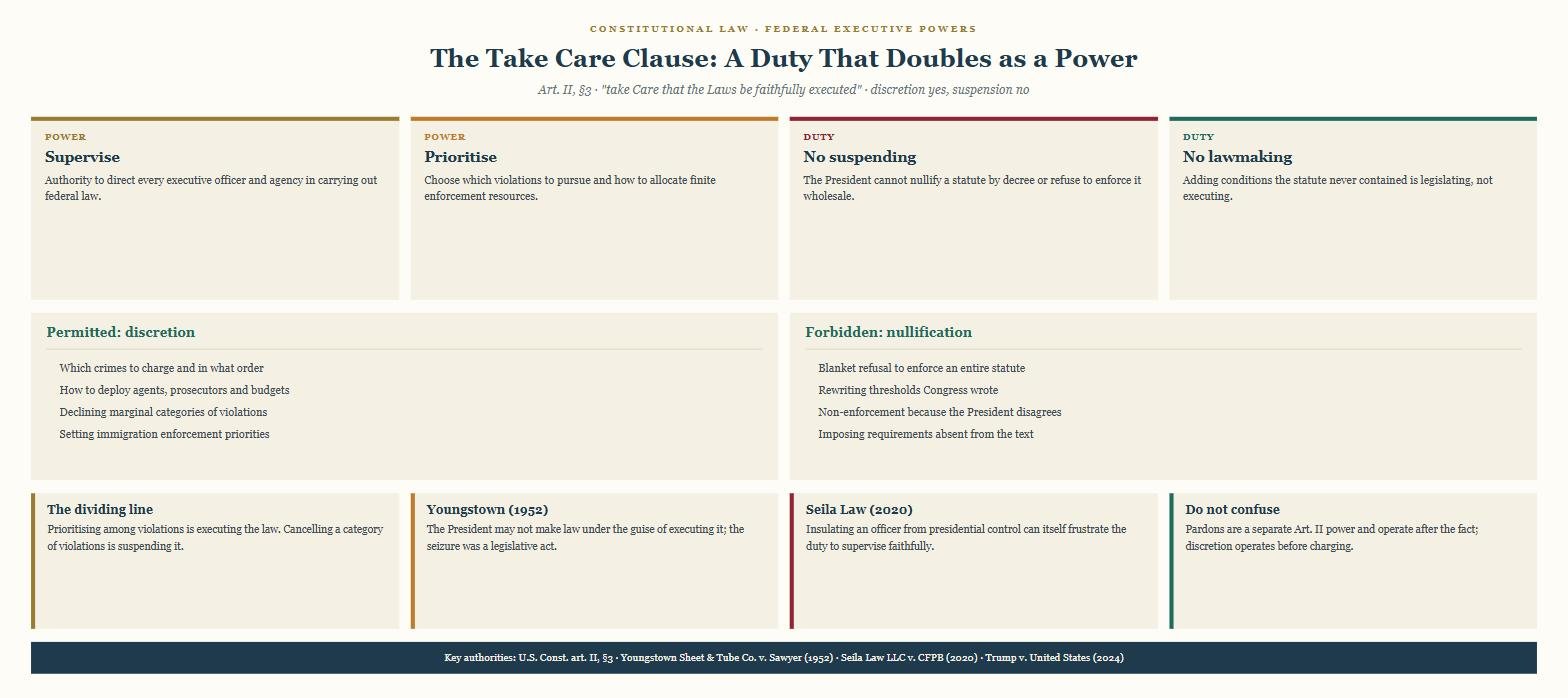
A duty and a power in one clause
As a power, the clause authorises the President to supervise all federal law enforcement and to direct the executive agencies. Officers who execute federal law answer to the President, and that chain of command is constitutional rather than merely administrative.
As a duty, the clause bars the President from suspending enforcement or nullifying a statute by executive decree. The President is not a legislator. There is no inherent Article II authority to declare that a validly enacted law will simply not operate.
- Direct and supervise every executive-branch official carrying out federal law.
- Exercise prosecutorial discretion over which violations to pursue and when.
- Allocate finite investigative and prosecutorial resources across priorities.
- Never suspend a statute, and never rewrite it through an enforcement policy.
Prosecutorial discretion: how far it goes
Discretion is real and it is broad. No administration can prosecute every violation of federal law, so choices are inevitable and courts defer heavily to executive judgment about resource allocation. Charging trafficking rather than simple possession, violent felonies rather than misdemeanours, or prioritising deportable aliens with criminal records are all classic, permissible choices.
The limit appears when the choice stops looking like triage and starts looking like repeal. A policy amounting to categorical non-enforcement of an entire statute crosses into unconstitutional suspension. So does a directive that quietly amends the statute — for example, instructing prosecutors to charge an offence only above a quantity threshold Congress never wrote.
Exam tip: ask what the President is adding or subtracting. Choosing among violations Congress made criminal is discretion. Inventing an element, a threshold or an exemption is legislating, and that violates the Take Care Clause.
| Executive action | Characterisation | Constitutional? |
|---|---|---|
| Prosecute trafficking before simple possession | Resource prioritisation | Yes |
| Focus immigration removals on criminal aliens | Enforcement priority | Yes, within wide margins |
| Decline marginal cases for lack of resources | Discretion | Yes |
| Announce a statute will not be enforced at all | Suspension of the law | No |
| Charge only above a quantity Congress never set | Rewriting the statute | No |
| Add a permit condition absent from the text | Legislating | No |
How the clause interacts with separation of powers
Youngstown Sheet & Tube Co. v. Sawyer supplies the governing intuition: the President may not make law under the guise of executing it. The steel seizure was a legislative act dressed as an executive one, and the Take Care Clause could not launder it. The same reasoning defeats an enforcement policy that functions as an amendment.
The clause also cuts in the President’s favour on questions of control over subordinates. Seila Law LLC v. Consumer Financial Protection Bureau reasoned that insulating a single agency head from presidential removal frustrates the President’s constitutional obligation to supervise those who execute federal law. And Trump v. United States confirms that core Article II acts carry substantial protection from second-guessing, which reinforces how much room the executive has inside its own sphere.
Worked example
A federal statute mandates prosecution for a specific drug offence. The President directs prosecutors to charge the offence only when it involves trafficking of more than one hundred pounds. Is the directive constitutional?
Start with the rule. Article II, Section 3 requires faithful execution, and prosecutorial discretion is permitted but cannot amount to nullification. Then characterise the directive. The President has not merely ranked cases; he has grafted a weight threshold onto a statute that contains none, and every violation below that threshold is now immune by executive fiat. That is an amendment, not a priority. Conclusion: the directive exceeds presidential authority and violates the Take Care Clause.
Change one fact. Suppose the directive instead says that, given limited staffing, offices should devote first attention to large-quantity trafficking cases while retaining authority to charge any violation. Now nothing has been carved out of the statute; resources have simply been ranked. That version survives, because prioritisation is exactly what faithful execution of a finite budget looks like.
Common mistakes that cost points
- Treating prosecutorial discretion as unlimited. The President may prioritise, but a blanket refusal to enforce violates the clause.
- Reading the clause as a pure limitation. It is also the source of the President’s supervisory authority over the executive branch.
- Confusing clemency with discretion. A pardon is a distinct Article II power that operates after the fact; discretion operates before charging.
- Ignoring the difference between ranking cases and exempting a category of conduct.
- Assuming disagreement with a statute justifies non-enforcement. Policy disagreement is not a constitutional objection.
- Forgetting the deference courts extend to resource-allocation judgments, and overclaiming a violation on thin facts.
- Missing the Youngstown link: an enforcement policy that legislates is void for the same reason the seizure was.
- Overlooking that the clause reaches agency officials, not just prosecutors.
Frequently asked questions
Can the President refuse to enforce a law he believes is unconstitutional?
That is the narrow and contested exception. A President who concludes a statute is unconstitutional may decline to enforce it while seeking judicial resolution, but mere policy disagreement never suffices, and the safer exam answer treats blanket non-enforcement as forbidden.
Does the Take Care Clause let the President control independent agencies?
It supplies the argument. Seila Law used the duty of faithful execution to explain why insulating a single agency head from removal is constitutionally problematic, though multimember commissions retain more protection.
How often is this clause tested?
Rarely on its own, and usually as one issue inside a larger separation-of-powers or removal question. Knowing the discretion-versus-nullification line covers nearly every appearance.
The duty to enforce the law: the Gascón litigation, 2026
The federal Take Care Clause obliges the President to see that the laws are faithfully executed, and article V of the California Constitution places the same duty on the Governor of California. The most instructive recent application in Los Angeles County concerned neither official, but the District Attorney, and it produced a rare judicial ruling on the boundary between discretion and duty.
In Association of Deputy District Attorneys v. Gascón (2022) the Court of Appeal considered special directives instructing deputy prosecutors not to plead sentencing enhancements and to seek dismissal of enhancements already pleaded. The court held that while charging discretion is broad, it does not extend to directing subordinates to disregard mandatory statutory duties, and it upheld an injunction as to those elements. Prosecutorial discretion, in other words, permits deciding whether to charge but not refusing to comply with a statute that requires particular action once charges exist.
Where the duty to execute bites locally:
- Charging discretion remains wide. A district attorney may decline to prosecute categories of conduct, and courts will not compel prosecution.
- Mandatory statutory duties are enforceable by mandamus. Section 1085 of the California Code of Civil Procedure is the vehicle, and standing is generous in public duty cases.
- The Attorney General has supervisory power. The California Attorney General may direct local prosecutors and take over cases where necessary to secure uniform enforcement.
- County officers have ministerial duties. The Assessor, Registrar and Sheriff must perform functions the law specifies, and refusal invites a writ.
- Policy directives are not legislation. Internal guidance cannot displace a statute, which is the core lesson of the litigation.
- Resource limits are a defence to timing, not to duty. Courts accept prioritisation but not abdication.
For 2026, separate discretionary from ministerial functions before assessing whether a duty is enforceable. Read with the Youngstown framework, the removal power and official immunity.
Next steps
Continue with the structural cases that surround this clause: read the Commander-in-Chief power for the Youngstown framework in action, then bicameralism and presentment for what counts as lawmaking, and the presidential veto power for the President’s legitimate role in legislation.
For primary sources, read Youngstown Sheet & Tube Co. v. Sawyer on Justia, review the text of Article II on Cornell Legal Information Institute, and confirm current subject coverage with the State Bar of California.
Related guides
- Advisory Opinions: Article III and Declaratory Relief
- Access to the Courts: When Filing Fees Are Unconstitutional
- Other Enumerated Powers: Postal, Bankruptcy, Admiralty
- Franchise Amendments: Congress and the Right to Vote
- Property Clause: Congress and Federal Lands Explained
- No Federal Police Power: Enumerated Powers and Enclaves
- Contracts Clause: When States May Impair Agreements
- Takings Clause: Lucas, Penn Central and Just Compensation
- Free Exercise Clause: Smith, Lukumi and Fulton Applied
- Establishment Clause: Church, State and the New Test
- Freedom of Association: Scrutiny, Dale and Disclosure
- Freedom of the Press: Publication Liability and Limits
- Campaign Finance and Anonymous Speech: The Core Rules
- Unconstitutional Conditions: Benefits and Rights Waivers
- Government Speech Doctrine: When the State Can Choose
- Vagueness and Overbreadth: Facial Challenges Explained
- Prior Restraint and Licensing: The Freedman Safeguards
- Symbolic Conduct and the O’Brien Test: The Pivot Question
- Government Employee Speech: Garcetti and Pickering Rules
- Commercial Speech and the Central Hudson Four-Part Test
- Actual Malice and the Three Tracks of Defamation Law
- Public Forum Doctrine and the Time, Place, Manner Test
- First Amendment: The Three-Question Speech Framework
- One Person, One Vote: Voting Rights Under Equal Protection
- Alienage Classifications: Strict Scrutiny and Its Pockets
- Equal Protection: The Three-Step Classification Test
- Second Amendment: The Bruen Text-and-History Standard
- Substantive Due Process After Dobbs: A Two-Step Test
- Procedural Due Process: Notice, Hearing and Mathews
- Incorporation Doctrine: Which Rights Bind the States
- Full Faith and Credit: Recognising Sister-State Judgments
- The Complete Auto Test: Taxing Interstate Commerce
- The Right to Travel: Durational Residency Explained
- Article IV Privileges and Immunities: The Comity Rule
- Federal Preemption: The Three-Step Ladder Explained
- The Supremacy Clause: Floors, Ceilings and Preemption
- Intergovernmental Immunity: The Shield Runs One Way
- The Presidential Pardon Power: Four Limits That Matter
- Executive Privilege: A Qualified Right That Must Yield
- Presidential Immunity: Criminal, Civil and Private Acts
- The Removal Power: At-Will Firing and Its Exceptions
- The Appointment Power: Principal and Inferior Officers
- Commander-in-Chief Power: Deploy Without Declaring War
- Executive Agreements: The President’s Sole Foreign Power
- The Treaty Power: Senate Advice and Consent Explained
- The Presidential Veto Power, Override and Pocket Veto
- Bicameralism and Presentment: Two Vetoes Struck Down
- The Nondelegation Doctrine and the Intelligible Principle
- Speech or Debate Clause: Absolute but Narrow Immunity
- The Impeachment Power: House Majority, Senate Two-Thirds
- Congress’s Naturalization Power and Citizenship Limits
- Congressional War Powers: Declare, Fund and Command
- Anti-Commandeering Doctrine and the Tenth Amendment
- Section 5 Enforcement Power: Remedy, Do Not Redefine
- The Spending Power and the Five Dole Test Conditions
- Congress’s Taxing Power: When a Penalty Is Really a Tax
- The Necessary and Proper Clause: Congress’s Multiplier
- Ex Post Facto Clause: Retroactive Criminal Laws Barred
- Bills of Attainder: Legislative Punishment Explained
- The Writ of Habeas Corpus: Testing Unlawful Detention
- Supreme Court Jurisdiction: Original vs Appellate Power
- Abstention Doctrine: 4 Ways Federal Courts Step Aside
- Dormant Commerce Clause: Discrimination vs Pike Balancing
- The Commerce Clause: 3 Categories and 2 Hard Limits
- State Action Doctrine: The Government Conduct Threshold
- The Eleventh Amendment and State Sovereign Immunity
- Political Question Doctrine: What Courts Will Not Decide
- Ripeness and Mootness: Timing Rules in Federal Court
- Standing in Federal Court: The 3-Part Article III Test
- Marbury v. Madison and the Power of Judicial Review
- The Youngstown Framework: Presidential Power in 3 Zones
- The IRAC Method: How to Structure a Bar Exam Answer
- Piercing the Corporate Veil: A Two-Prong Alter Ego Test
- Defamation Elements, Fault Standards and Privileges
- The Parol Evidence Rule: Integration and Exceptions
- Recording Acts: Race, Notice and Race-Notice Explained
- Partner Liability and Authority Under RUPA Explained
- Trustee Duties: Care, Loyalty, Impartiality, Accounts
- Specific Performance: A Six-Element Bar Exam Framework
- Will Execution Requirements: Formalities and Rescue
- Community Property Presumptions in California Explained
- Easements Explained: Creation, Scope and Termination
- Products Liability: The Three Defect Theories Explained
- Miranda Rights: Custody, Interrogation and Invocation
- The Character Evidence Rules: Propensity Bar and Doorways
- Adverse Possession Elements: OCEAN and the Tax Rule
- Business Judgment Rule and Directors’ Fiduciary Duties
- The Statute of Frauds: MYLEGS and How to Satisfy It
- Res Judicata vs Collateral Estoppel: Bar Exam Guide
- The Erie Doctrine Explained: A 4-Step Bar Exam Guide
- Conflicts of Interest: A 6-Step Decision Tree for the Bar
- The Rule Against Perpetuities Explained Step by Step
- Murder and Manslaughter: The Homicide Ladder Explained
- Consideration in Contract Law: Rules and Exceptions
- The Four Elements of Negligence: Bar Exam Breakdown
- The Hearsay Rule Explained: Exceptions and Exemptions
- Personal Jurisdiction: The 3-Step Bar Exam Framework
- 3 Levels of Scrutiny in Constitutional Law Explained
- The Citizenship Clause After Trump v. Barbara