
The business judgment rule is the reason most challenges to board decisions fail before they begin. It is a presumption, not an immunity, and the entire skill of answering a corporations question lies in knowing what facts destroy it and what happens next when they do.
This guide sets out the presumption, the duties of care and loyalty that sit behind it, the interested-director safe harbours, and the corporate opportunity doctrine that produces more wrong answers than any other loyalty topic.
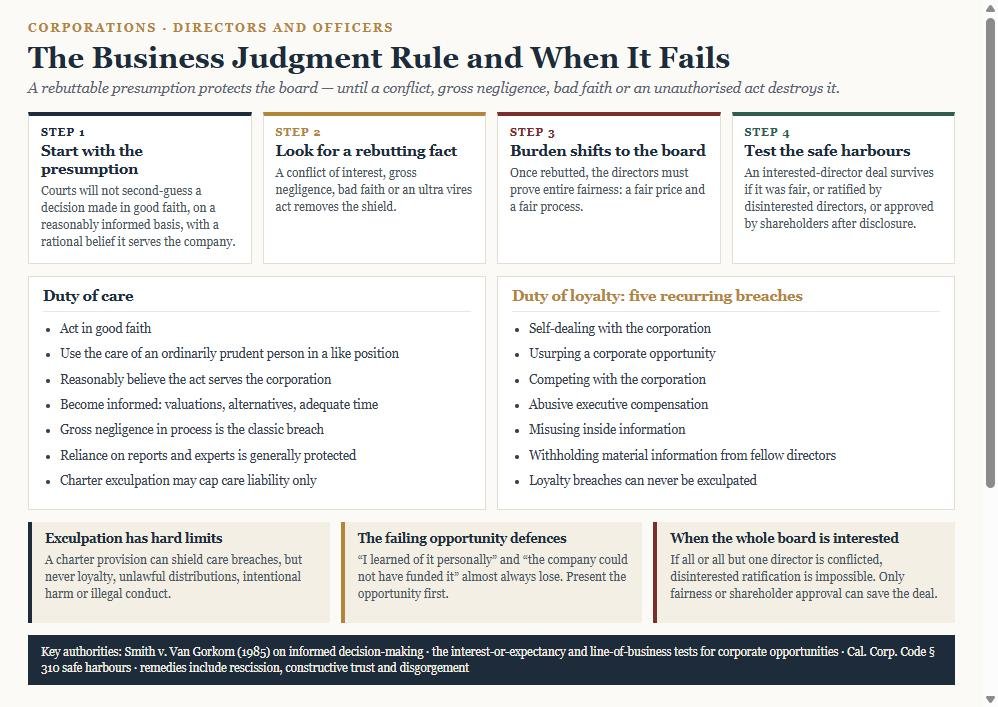
What the presumption actually protects
Directors and officers owe identical fiduciary duties: they must act at all times in the corporation’s best interest. The business judgment rule tells courts not to second-guess a decision that was made in good faith, on a reasonably informed basis, and with a rational belief that it served the company. Bad outcomes alone are not actionable, because shareholders bought a business, not a guarantee.
Notice what the presumption is about. It protects the process by which the board decided, not the wisdom of the result. That is why the successful challenges in the case law almost always attack how the board informed itself rather than what it ultimately chose.
The duty of care
A director must act in good faith, with the care an ordinarily prudent person would use in a like position, and in a manner they reasonably believe serves the corporation. In practice the duty is a duty to become informed before voting.
Smith v. Van Gorkom is the standard illustration. A board that approved a merger without obtaining a valuation, studying alternatives or taking reasonable time to deliberate was held grossly negligent, and the presumption fell away even though no director had a personal conflict. Directors are, however, generally entitled to rely on reports, financial statements and opinions prepared by officers or outside experts they reasonably believe competent.
Exculpation and its limits
Many charters contain a provision limiting or eliminating personal liability for duty-of-care breaches. Such clauses are effective for care, and only for care. They cannot shield a breach of loyalty, an unlawful distribution, intentional misconduct or an illegal act. Candidates who apply an exculpation clause to a self-dealing problem lose the point immediately.
The duty of loyalty
Loyalty prohibits a director from taking an improper personal benefit at the corporation’s expense unless all material facts are disclosed and independent ratification is obtained. Five patterns recur.
- Self-dealing. Contracting with the corporation personally, through a family member, or through an affiliated entity.
- Usurping a corporate opportunity. Taking for yourself a business prospect that belonged to the company.
- Competing with the corporation. Running or backing a rival venture while serving on the board.
- Abusive compensation. Approving pay that no disinterested board could rationally consider reasonable.
- Misusing inside information. Trading on, or exploiting, information acquired through the office.
A sixth, quieter breach deserves mention: the duty to disclose. Withholding material corporate information from fellow directors, so that they cannot decide on a full record, is itself a loyalty violation rather than a mere lapse of care.
When the presumption is rebutted
The rule evaporates in the face of a conflict of interest, gross negligence in the decision process, bad faith, or action beyond the corporation’s powers. Once any of those is shown, the burden flips: the directors must prove the transaction’s entire fairness, which means both a fair price and fair dealing in how the deal was negotiated, timed, structured and disclosed.
| Situation | Who bears the burden | Standard applied |
|---|---|---|
| Ordinary informed decision | Challenger | Business judgment rule |
| Gross negligence in the process | Directors, once shown | Entire fairness |
| Director on both sides of the deal | Directors | Entire fairness, unless a safe harbour applies |
| Bad faith or knowing illegality | Directors | No protection; exculpation unavailable |
| Act beyond corporate powers | Directors | No protection |
| Reliance on a competent expert report | Challenger | Business judgment rule preserved |
Interested-director transactions and the three safe harbours
A deal between the corporation and a director, a director’s family member, or an entity in which the director has a material interest is not automatically void. It survives if any one of three conditions is met.
- Fairness. The transaction was fair to the corporation at the time it was authorised.
- Disinterested director approval. A majority of disinterested directors approved it after full disclosure of all material facts. At least two disinterested directors are needed to constitute a quorum for that purpose.
- Shareholder approval. The shareholders ratified it after full disclosure.
Absent every safe harbour, the transaction is voidable at the corporation’s option. And note the structural trap: if all the directors, or all but one, are interested, disinterested ratification is arithmetically impossible, so only fairness or a shareholder vote can rescue the deal. California codifies this framework at Corporations Code section 310, and other jurisdictions follow substantially the same architecture.
Exam tip: state the presumption in one sentence, then hunt for the fact that rebuts it. Ninety per cent of the available points sit in the rebuttal and in the safe harbour analysis, not in reciting the rule.
The corporate opportunity doctrine
A director who learns of a business opportunity must present it to the corporation first, and may pursue it personally only after the disinterested directors decline. Two tests determine whether an opportunity belonged to the company.
- Interest or expectancy. Did the corporation have an existing interest or a reasonable expectancy in the opportunity, for example a property it was already negotiating to buy?
- Line of business. Does the opportunity fall within the corporation’s current or reasonably foreseeable scope of business?
Two defences appear constantly in fact patterns and almost always fail. “I learned about it in my personal capacity” does not matter if the opportunity is in the company’s line of business, and “the corporation could not have afforded it” is not the director’s decision to make. The remedy is restitutionary rather than compensatory: a constructive trust over the opportunity itself, or disgorgement of the profits earned from it.
Liability, contribution and indemnification
Directors who vote for or assent to an unlawful distribution are personally liable for the excess, with a right of contribution from other liable directors and recoupment from shareholders who knowingly accepted it. Statutory limitations periods for these actions are short, so timing facts in a question are rarely decorative. Indemnification and advancement of expenses are permitted within statutory bounds, but a director held liable for a loyalty breach or bad-faith conduct cannot be indemnified out of the corporate treasury.
Common mistakes that cost points
- Treating the business judgment rule as immunity rather than a rebuttable presumption.
- Attacking the wisdom of the decision instead of the adequacy of the process.
- Applying a charter exculpation clause to a loyalty breach, an illegal distribution or intentional misconduct.
- Forgetting that the burden shifts to entire fairness once the presumption is rebutted.
- Overlooking that disinterested ratification is impossible when the whole board is conflicted.
- Accepting “I could not have financed it” or “I learned of it privately” as corporate opportunity defences.
- Analysing damages rather than constructive trust and disgorgement for a usurped opportunity.
Frequently asked questions
Do officers get the same protection as directors?
Officers owe the same duties of care and loyalty. Courts extend business judgment deference to officers acting within their discretionary authority, though an officer executing a board decision is judged on performance rather than on a discretionary business choice.
Is a bad business decision ever enough on its own?
Almost never. Without a conflict, bad faith, gross negligence in process, or an unauthorised act, a loss-making decision made on an informed basis is protected. This is why plaintiffs plead process failures and demand board minutes.
What does entire fairness require in practice?
Two things together: fair dealing, covering how the transaction was initiated, negotiated, timed and disclosed, and fair price, covering the economic substance. A defensible price cannot cure a tainted process, and a clean process cannot justify an unfair price.
The business judgment rule in California: section 309 and HOAs, 2026
California codifies this doctrine rather than leaving it to case law. Section 309 of the California Corporations Code requires a director to perform their duties in good faith, in a manner the director believes to be in the best interests of the corporation and its shareholders, and with such care, including reasonable inquiry, as an ordinarily prudent person in a like position would use. A director who meets that standard, including by reasonable reliance on officers, counsel and experts, has no liability for an unsuccessful decision.
California also departs from Delaware in a way that matters for companies operating in Los Angeles County. Section 2115 of the California Corporations Code applies specified California governance provisions to certain foreign corporations whose business and shareholder contacts are predominantly Californian, notwithstanding the internal affairs doctrine. A company incorporated elsewhere but effectively headquartered here may therefore be subject to California rules on matters such as cumulative voting and distributions.
A third California feature reaches far more people than corporate law does:
- Community association boards get judicial deference. Following Lamden v. La Jolla Shores Clubdominium Homeowners Association (1999), courts defer to a board’s discretionary maintenance decisions made in good faith after reasonable investigation, which governs countless county condominium disputes.
- Reasonable inquiry is part of the standard. Unlike a pure deference rule, section 309 makes the adequacy of the process itself an element.
- Reliance must be justified. Deference to an expert requires that the director reasonably believed the matter was within that person’s competence.
- Conflicted transactions leave the rule. Section 310 governs interested director contracts, and the rule does not protect self-dealing.
- Derivative suits have California prerequisites. The California Corporations Code imposes its own pleading and security requirements, distinct from Delaware practice.
- Nonprofit directors have a parallel provision. Similar protection applies to nonprofit boards, which matters given the number of county service providers.
For 2026, examine the decision-making process before the decision itself, since that is what section 309 tests. Read with alter ego liability, fiduciary duties and conflicts of interest.
Next steps
Fiduciary analysis is the same shape wherever it appears, so this framework transfers. Compare it with the conflicts of interest decision tree in professional responsibility, where disclosure and informed consent play the role that ratification plays here. If you are working through business associations in order, pair this guide with your notes on shareholder voting and derivative suits, since a derivative claim is the procedural vehicle that brings these duties into court.
For practice, take one interested-director fact pattern and run it three times, satisfying a different safe harbour each time. Then read the business judgment rule overview at Cornell’s Legal Information Institute and the California Corporations Code to see how the statute frames what the case law describes.
Related guides
- Advisory Opinions: Article III and Declaratory Relief
- Access to the Courts: When Filing Fees Are Unconstitutional
- Other Enumerated Powers: Postal, Bankruptcy, Admiralty
- Franchise Amendments: Congress and the Right to Vote
- Property Clause: Congress and Federal Lands Explained
- No Federal Police Power: Enumerated Powers and Enclaves
- Contracts Clause: When States May Impair Agreements
- Takings Clause: Lucas, Penn Central and Just Compensation
- Free Exercise Clause: Smith, Lukumi and Fulton Applied
- Establishment Clause: Church, State and the New Test
- Freedom of Association: Scrutiny, Dale and Disclosure
- Freedom of the Press: Publication Liability and Limits
- Campaign Finance and Anonymous Speech: The Core Rules
- Unconstitutional Conditions: Benefits and Rights Waivers
- Government Speech Doctrine: When the State Can Choose
- Vagueness and Overbreadth: Facial Challenges Explained
- Prior Restraint and Licensing: The Freedman Safeguards
- Symbolic Conduct and the O’Brien Test: The Pivot Question
- Government Employee Speech: Garcetti and Pickering Rules
- Commercial Speech and the Central Hudson Four-Part Test
- Actual Malice and the Three Tracks of Defamation Law
- Public Forum Doctrine and the Time, Place, Manner Test
- First Amendment: The Three-Question Speech Framework
- One Person, One Vote: Voting Rights Under Equal Protection
- Alienage Classifications: Strict Scrutiny and Its Pockets
- Equal Protection: The Three-Step Classification Test
- Second Amendment: The Bruen Text-and-History Standard
- Substantive Due Process After Dobbs: A Two-Step Test
- Procedural Due Process: Notice, Hearing and Mathews
- Incorporation Doctrine: Which Rights Bind the States
- Full Faith and Credit: Recognising Sister-State Judgments
- The Complete Auto Test: Taxing Interstate Commerce
- The Right to Travel: Durational Residency Explained
- Article IV Privileges and Immunities: The Comity Rule
- Federal Preemption: The Three-Step Ladder Explained
- The Supremacy Clause: Floors, Ceilings and Preemption
- Intergovernmental Immunity: The Shield Runs One Way
- The Presidential Pardon Power: Four Limits That Matter
- Executive Privilege: A Qualified Right That Must Yield
- Presidential Immunity: Criminal, Civil and Private Acts
- The Removal Power: At-Will Firing and Its Exceptions
- The Appointment Power: Principal and Inferior Officers
- Take Care Clause: Enforcement Discretion and Its Limits
- Commander-in-Chief Power: Deploy Without Declaring War
- Executive Agreements: The President’s Sole Foreign Power
- The Treaty Power: Senate Advice and Consent Explained
- The Presidential Veto Power, Override and Pocket Veto
- Bicameralism and Presentment: Two Vetoes Struck Down
- The Nondelegation Doctrine and the Intelligible Principle
- Speech or Debate Clause: Absolute but Narrow Immunity
- The Impeachment Power: House Majority, Senate Two-Thirds
- Congress’s Naturalization Power and Citizenship Limits
- Congressional War Powers: Declare, Fund and Command
- Anti-Commandeering Doctrine and the Tenth Amendment
- Section 5 Enforcement Power: Remedy, Do Not Redefine
- The Spending Power and the Five Dole Test Conditions
- Congress’s Taxing Power: When a Penalty Is Really a Tax
- The Necessary and Proper Clause: Congress’s Multiplier
- Ex Post Facto Clause: Retroactive Criminal Laws Barred
- Bills of Attainder: Legislative Punishment Explained
- The Writ of Habeas Corpus: Testing Unlawful Detention
- Supreme Court Jurisdiction: Original vs Appellate Power
- Abstention Doctrine: 4 Ways Federal Courts Step Aside
- Dormant Commerce Clause: Discrimination vs Pike Balancing
- The Commerce Clause: 3 Categories and 2 Hard Limits
- State Action Doctrine: The Government Conduct Threshold
- The Eleventh Amendment and State Sovereign Immunity
- Political Question Doctrine: What Courts Will Not Decide
- Ripeness and Mootness: Timing Rules in Federal Court
- Standing in Federal Court: The 3-Part Article III Test
- Marbury v. Madison and the Power of Judicial Review
- The Youngstown Framework: Presidential Power in 3 Zones
- The IRAC Method: How to Structure a Bar Exam Answer
- Piercing the Corporate Veil: A Two-Prong Alter Ego Test
- Defamation Elements, Fault Standards and Privileges
- The Parol Evidence Rule: Integration and Exceptions
- Recording Acts: Race, Notice and Race-Notice Explained
- Partner Liability and Authority Under RUPA Explained
- Trustee Duties: Care, Loyalty, Impartiality, Accounts
- Specific Performance: A Six-Element Bar Exam Framework
- Will Execution Requirements: Formalities and Rescue
- Community Property Presumptions in California Explained
- Easements Explained: Creation, Scope and Termination
- Products Liability: The Three Defect Theories Explained
- Miranda Rights: Custody, Interrogation and Invocation
- The Character Evidence Rules: Propensity Bar and Doorways
- Adverse Possession Elements: OCEAN and the Tax Rule
- The Statute of Frauds: MYLEGS and How to Satisfy It
- Res Judicata vs Collateral Estoppel: Bar Exam Guide
- The Erie Doctrine Explained: A 4-Step Bar Exam Guide
- Conflicts of Interest: A 6-Step Decision Tree for the Bar
- The Rule Against Perpetuities Explained Step by Step
- Murder and Manslaughter: The Homicide Ladder Explained
- Consideration in Contract Law: Rules and Exceptions
- The Four Elements of Negligence: Bar Exam Breakdown
- The Hearsay Rule Explained: Exceptions and Exemptions
- Personal Jurisdiction: The 3-Step Bar Exam Framework
- 3 Levels of Scrutiny in Constitutional Law Explained
- The Citizenship Clause After Trump v. Barbara