
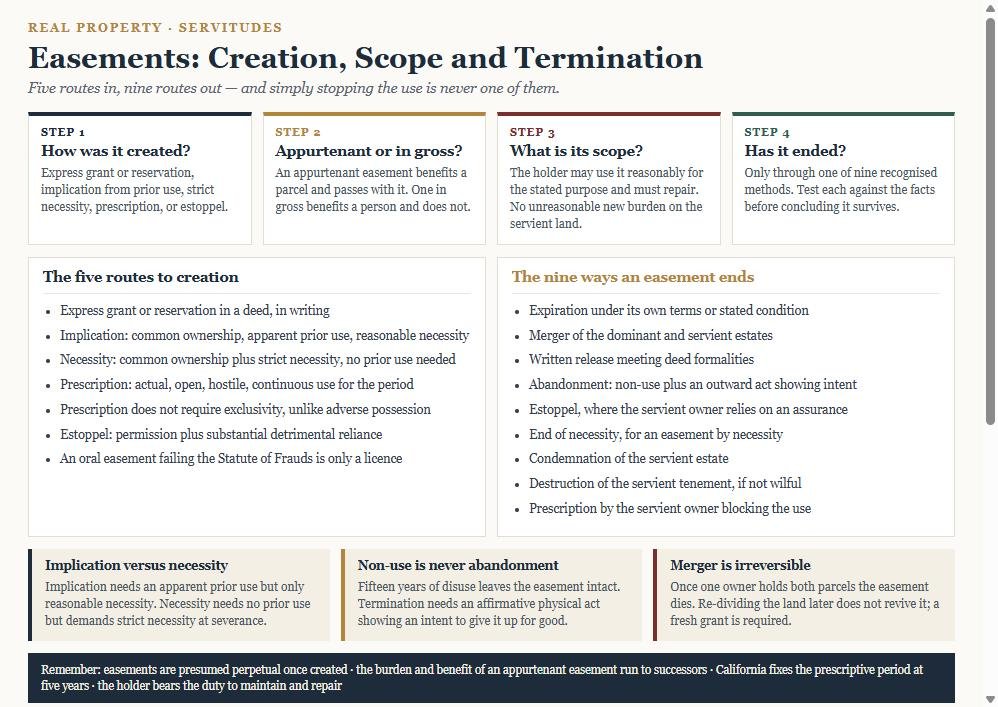
Easements reward a candidate who works in a fixed order. There are five ways an easement comes into existence, a scope question that decides how it may be used, and nine ways it can end. Because easements are presumed perpetual, the burden falls on whoever claims the right has disappeared, and the most tempting answer is usually the wrong one.
This guide covers the creation routes with the distinction between implication and necessity that examiners rely on, the difference between appurtenant easements and easements in gross, the scope and repair rules, and the nine termination methods with the three traps built into them.
What an easement is
An easement is a non-possessory right to use another person’s land for a defined purpose. The parcel that benefits is the dominant tenement; the parcel that bears the burden is the servient tenement. An affirmative easement allows the holder to do something on the servient land, such as cross it; a negative easement restrains the servient owner, though most such restraints are handled today through covenants instead.
Distinguish an easement from a licence. A licence is revocable permission and creates no interest in land, which matters because an oral arrangement that fails the writing requirement is treated as a licence rather than an easement. That single sentence resolves a surprising number of fact patterns.
Appurtenant or in gross?
An appurtenant easement benefits a particular parcel, so both the benefit and the burden pass automatically to successors when either parcel changes hands. An easement in gross benefits a person or a company independently of any land they own, the classic examples being utility lines and billboard rights, a category the Legal Information Institute treats separately, and it does not run with a dominant estate because there is none.
Courts prefer to find an easement appurtenant where the instrument is ambiguous, since a right tied to land is generally more useful and more predictable than a personal one.
The five routes to creation
Express grant or reservation
The straightforward route. A deed grants an easement to a neighbour, or a seller reserves one for themselves when conveying part of a parcel. Because an easement is an interest in land, the instrument must satisfy the statute of frauds writing requirement, which is where a great many informal arrangements fail.
Implication from prior use
Four conditions must hold. The dominant and servient parcels were once a single tract in common ownership; there was an apparent and continuous use of what became the servient part before severance; the use is reasonably necessary to the enjoyment of the dominant part; and the circumstances show the parties intended the use to continue after division. The classic scenario is a driveway that already served the house when the back lot was sold off.
Necessity
This route also requires previous common ownership, but the necessity must be strict rather than merely reasonable, and no prior use is needed at all. It exists to rescue a parcel left without access to a public road, and the easement is implied only over the part of the original tract that blocks that access.
The distinction between the two implied routes is the single most tested point in this area. Implication trades a lower standard of necessity for a requirement of visible prior use. Necessity dispenses with prior use entirely but demands that the dominant parcel be genuinely landlocked at the moment of severance.
Prescription
The easement analogue of adverse possession: actual, open and notorious, hostile and continuous use for the statutory period. One difference is decisive. Exclusivity is not required, so a path used simultaneously by the claimant, the servient owner and assorted neighbours can still ripen into a prescriptive easement. California sets the period at five years, matching its adverse possession period.
Estoppel
Where an owner gives permission and the user then invests substantially in reliance on it, revocation may be barred. This is sometimes described as an irrevocable licence, and it is the doctrine to reach for when the facts show significant expenditure following an oral assurance.
| Route | Prior common ownership? | Prior use required? | Necessity required? | Writing? |
|---|---|---|---|---|
| Express grant or reservation | No | No | No | Yes |
| Implication | Yes | Yes, apparent and continuous | Reasonable | No |
| Necessity | Yes | No | Strict | No |
| Prescription | No | The adverse use itself | No | No |
| Estoppel | No | Permitted use plus reliance | No | No |
Exam tip: before you decide whether an implied easement exists, find the severance. Both implication and necessity depend on a single tract having been divided, so if the parcels were never in common ownership, neither doctrine is available and you should say so immediately.
Scope, maintenance and overuse
The holder may use the easement reasonably for its stated purpose, including uses that develop naturally over time, but may not impose an unreasonable new burden on the servient land. A right of way granted for farm access does not automatically become a service road for a subdivision, and courts describe that kind of expansion as a surcharge, an idea the law of servitudes develops more fully.
Maintenance falls on the holder, who has both the right and the duty to make repairs necessary to the use. The servient owner may not obstruct the easement but otherwise retains full use of the land, including the right to relocate the way in some jurisdictions where relocation does not impair the holder’s enjoyment.
The nine ways an easement ends
- Expiration. By the easement’s own terms or on a stated condition.
- Merger. One person acquires both tenements, since nobody can hold an easement over their own land.
- Written release from the holder to the servient owner, satisfying deed formalities.
- Abandonment. Non-use together with an outward physical act showing an intent to give up the right permanently.
- Estoppel. The servient owner relies materially and detrimentally on the holder’s assurance that the easement is over.
- End of necessity. An easement by necessity ends automatically when the necessity does, unless an express grant accompanied it.
- Condemnation of the servient estate through eminent domain.
- Destruction of the servient tenement, unless the servient owner caused it wilfully.
- Prescription by the servient owner, who blocks the use openly and continuously for the statutory period.
Two traps inside the list
First, non-use alone never terminates an easement, however long it lasts. A holder who abandons a right of way in favour of a more convenient route for fifteen years still owns it, because courts protect the investment easements represent and require affirmative conduct rather than mere passivity. Building a permanent wall across the path, on the other hand, supplies the outward act that abandonment needs.
Second, merger is irreversible. If one owner acquires both parcels, the easement is extinguished at that moment. Selling the two parcels to different buyers years later does not revive it; a fresh easement must be expressly created. Fact patterns that walk you through a purchase and a later re-division are testing exactly this.
Common mistakes that cost points
- Confusing implication with necessity, or applying strict necessity to a prior-use case.
- Requiring exclusivity for a prescriptive easement, which is an adverse possession element rather than an easement one.
- Treating an oral arrangement as an easement instead of a licence.
- Concluding that long disuse terminated the easement.
- Reviving an easement after merger when the parcels are re-divided.
- Allowing an appurtenant easement to be severed from the dominant parcel, or an easement in gross to run with land.
- Ignoring the scope question and assuming any use of the way is permitted.
- Placing the repair burden on the servient owner.
Frequently asked questions
Does an easement have to be recorded to bind a buyer?
Recording protects the holder against a subsequent purchaser without notice, but a buyer with actual, inquiry or constructive notice takes subject to the easement anyway. A visible, well-worn path is often enough to give inquiry notice, which is why implied easements survive transfers more often than students expect.
Can an easement be created for a period of years?
Yes. Easements are presumed perpetual, but the parties may limit duration expressly or make the right conditional. Where they have done so, expiration is the first termination method to consider.
What is the difference between an easement and a profit?
A profit allows the holder to remove something from the land, such as timber, minerals or game, whereas an easement only permits use. The rules on creation, scope and termination are substantially the same, so the analysis transfers.
Easements in Los Angeles County: hillsides and equitable relief, 2026
Easement disputes in Los Angeles County have a distinctive geography. Hillside subdivisions in the Santa Monica Mountains, the Hollywood Hills and the San Gabriel foothills produce narrow shared driveways, retaining walls built across boundaries and decades-old encroachments, and California has developed a remedy for exactly that situation.
The doctrine is the equitable easement, sometimes called relative hardship. Where an encroachment was innocent rather than wilful, where removal would cause the encroacher hardship greatly disproportionate to the harm suffered by the landowner, and where the landowner would suffer only slight irreparable injury, a court may decline to order removal and instead grant the encroacher an easement on payment of compensation. California appellate decisions have emphasised that all three elements must be established and that the doctrine is applied sparingly, but it resolves a substantial share of county boundary litigation.
The California rules that shape these cases:
- Prescriptive easements need five years. Use must be open, notorious, continuous and hostile for the statutory period under the California Code of Civil Procedure.
- Exclusive prescriptive easements are not available over residential land. California courts refuse to allow prescription to function as adverse possession without the tax payment requirement.
- Recorded consent defeats prescription. Section 813 of the California Civil Code allows an owner to record a notice of consent to public use, preventing the ripening of rights.
- There is no right to a view. California recognises no implied view easement, so protection must come from a recorded covenant or a local ordinance.
- Coastal access dedications are common. Permit conditions along the county shoreline have created public easements, subject to the nexus requirements of Nollan.
- Implied and necessity easements need unity of ownership. Look for a prior common owner and an apparent, continuous use at severance.
For 2026, order a title search and survey before advising on any encroachment. Read with adverse possession, the recording acts and the Takings Clause.
Next steps
Easements share their machinery with the other possession-based doctrines, so revise them together. The adverse possession elements covers the same open, hostile and continuous requirements with the crucial addition of exclusivity, and comparing the two makes both easier to remember. Because an express easement is an interest in land, the statute of frauds and MYLEGS determines when an informal arrangement drops to the level of a licence.
For practice, take one severed-parcel fact pattern and vary the facts so that implication, necessity, prescription and estoppel each become the strongest route in turn. Then read the easement overview at Cornell’s Legal Information Institute and check the termination list against your own notes, since that is where most marks are lost.
Related guides
- Advisory Opinions: Article III and Declaratory Relief
- Access to the Courts: When Filing Fees Are Unconstitutional
- Other Enumerated Powers: Postal, Bankruptcy, Admiralty
- Franchise Amendments: Congress and the Right to Vote
- Property Clause: Congress and Federal Lands Explained
- No Federal Police Power: Enumerated Powers and Enclaves
- Contracts Clause: When States May Impair Agreements
- Takings Clause: Lucas, Penn Central and Just Compensation
- Free Exercise Clause: Smith, Lukumi and Fulton Applied
- Establishment Clause: Church, State and the New Test
- Freedom of Association: Scrutiny, Dale and Disclosure
- Freedom of the Press: Publication Liability and Limits
- Campaign Finance and Anonymous Speech: The Core Rules
- Unconstitutional Conditions: Benefits and Rights Waivers
- Government Speech Doctrine: When the State Can Choose
- Vagueness and Overbreadth: Facial Challenges Explained
- Prior Restraint and Licensing: The Freedman Safeguards
- Symbolic Conduct and the O’Brien Test: The Pivot Question
- Government Employee Speech: Garcetti and Pickering Rules
- Commercial Speech and the Central Hudson Four-Part Test
- Actual Malice and the Three Tracks of Defamation Law
- Public Forum Doctrine and the Time, Place, Manner Test
- First Amendment: The Three-Question Speech Framework
- One Person, One Vote: Voting Rights Under Equal Protection
- Alienage Classifications: Strict Scrutiny and Its Pockets
- Equal Protection: The Three-Step Classification Test
- Second Amendment: The Bruen Text-and-History Standard
- Substantive Due Process After Dobbs: A Two-Step Test
- Procedural Due Process: Notice, Hearing and Mathews
- Incorporation Doctrine: Which Rights Bind the States
- Full Faith and Credit: Recognising Sister-State Judgments
- The Complete Auto Test: Taxing Interstate Commerce
- The Right to Travel: Durational Residency Explained
- Article IV Privileges and Immunities: The Comity Rule
- Federal Preemption: The Three-Step Ladder Explained
- The Supremacy Clause: Floors, Ceilings and Preemption
- Intergovernmental Immunity: The Shield Runs One Way
- The Presidential Pardon Power: Four Limits That Matter
- Executive Privilege: A Qualified Right That Must Yield
- Presidential Immunity: Criminal, Civil and Private Acts
- The Removal Power: At-Will Firing and Its Exceptions
- The Appointment Power: Principal and Inferior Officers
- Take Care Clause: Enforcement Discretion and Its Limits
- Commander-in-Chief Power: Deploy Without Declaring War
- Executive Agreements: The President’s Sole Foreign Power
- The Treaty Power: Senate Advice and Consent Explained
- The Presidential Veto Power, Override and Pocket Veto
- Bicameralism and Presentment: Two Vetoes Struck Down
- The Nondelegation Doctrine and the Intelligible Principle
- Speech or Debate Clause: Absolute but Narrow Immunity
- The Impeachment Power: House Majority, Senate Two-Thirds
- Congress’s Naturalization Power and Citizenship Limits
- Congressional War Powers: Declare, Fund and Command
- Anti-Commandeering Doctrine and the Tenth Amendment
- Section 5 Enforcement Power: Remedy, Do Not Redefine
- The Spending Power and the Five Dole Test Conditions
- Congress’s Taxing Power: When a Penalty Is Really a Tax
- The Necessary and Proper Clause: Congress’s Multiplier
- Ex Post Facto Clause: Retroactive Criminal Laws Barred
- Bills of Attainder: Legislative Punishment Explained
- The Writ of Habeas Corpus: Testing Unlawful Detention
- Supreme Court Jurisdiction: Original vs Appellate Power
- Abstention Doctrine: 4 Ways Federal Courts Step Aside
- Dormant Commerce Clause: Discrimination vs Pike Balancing
- The Commerce Clause: 3 Categories and 2 Hard Limits
- State Action Doctrine: The Government Conduct Threshold
- The Eleventh Amendment and State Sovereign Immunity
- Political Question Doctrine: What Courts Will Not Decide
- Ripeness and Mootness: Timing Rules in Federal Court
- Standing in Federal Court: The 3-Part Article III Test
- Marbury v. Madison and the Power of Judicial Review
- The Youngstown Framework: Presidential Power in 3 Zones
- The IRAC Method: How to Structure a Bar Exam Answer
- Piercing the Corporate Veil: A Two-Prong Alter Ego Test
- Defamation Elements, Fault Standards and Privileges
- The Parol Evidence Rule: Integration and Exceptions
- Recording Acts: Race, Notice and Race-Notice Explained
- Partner Liability and Authority Under RUPA Explained
- Trustee Duties: Care, Loyalty, Impartiality, Accounts
- Specific Performance: A Six-Element Bar Exam Framework
- Will Execution Requirements: Formalities and Rescue
- Community Property Presumptions in California Explained
- Products Liability: The Three Defect Theories Explained
- Miranda Rights: Custody, Interrogation and Invocation
- The Character Evidence Rules: Propensity Bar and Doorways
- Adverse Possession Elements: OCEAN and the Tax Rule
- Business Judgment Rule and Directors’ Fiduciary Duties
- The Statute of Frauds: MYLEGS and How to Satisfy It
- Res Judicata vs Collateral Estoppel: Bar Exam Guide
- The Erie Doctrine Explained: A 4-Step Bar Exam Guide
- Conflicts of Interest: A 6-Step Decision Tree for the Bar
- The Rule Against Perpetuities Explained Step by Step
- Murder and Manslaughter: The Homicide Ladder Explained
- Consideration in Contract Law: Rules and Exceptions
- The Four Elements of Negligence: Bar Exam Breakdown
- The Hearsay Rule Explained: Exceptions and Exemptions
- Personal Jurisdiction: The 3-Step Bar Exam Framework
- 3 Levels of Scrutiny in Constitutional Law Explained
- The Citizenship Clause After Trump v. Barbara