
Ripeness and mootness are the timing halves of justiciability. Article III does not merely require an injured plaintiff; it requires a dispute that is ripe enough to decide and still alive when the court decides it. A case filed too early is dismissed as unripe, a case overtaken by events is dismissed as moot, and a question with no genuine adversary was never a case at all.
This guide explains the two-part ripeness test, the four routes by which a case escapes mootness, and the line between a forbidden advisory opinion and a perfectly proper declaratory judgment.
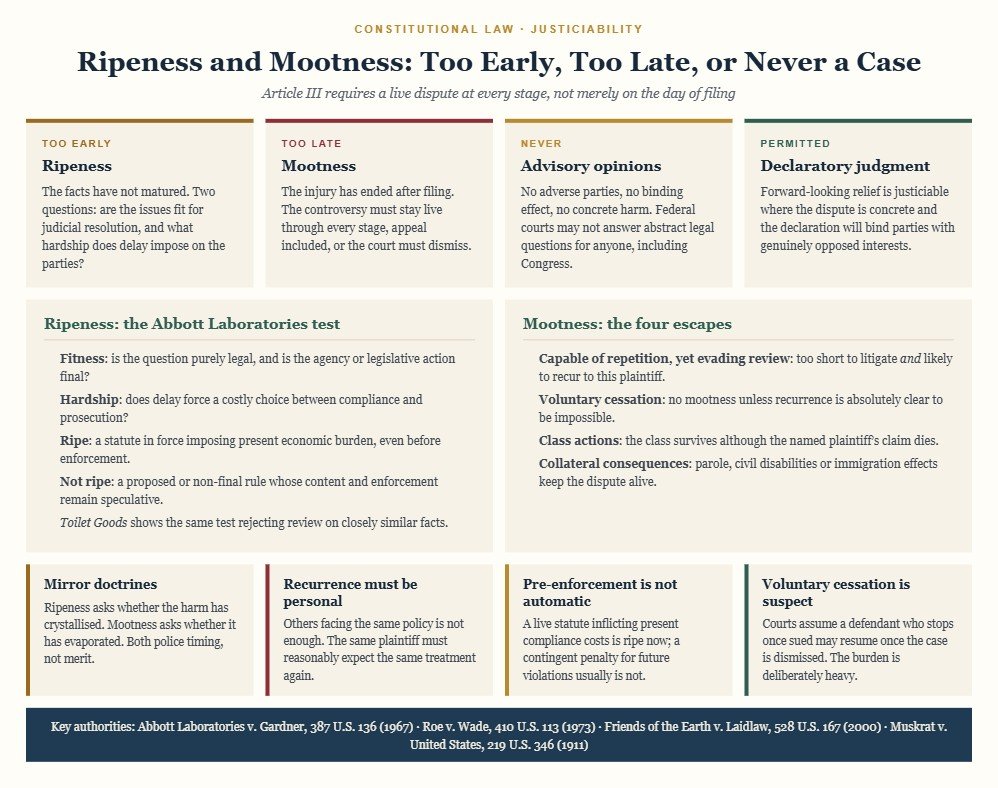
One requirement, three failure modes
All three doctrines enforce the same constitutional text. Federal courts may resolve cases and controversies, which means disputes between parties with genuinely opposed interests that a judgment will actually settle. Ripeness asks whether the facts have matured enough to make that judgment meaningful. Mootness asks whether the dispute still exists. The bar on advisory opinions asks whether there was ever a real adversary in the first place.
They are separate inquiries and should be analysed separately, in the same way that Standing in Federal Court: The 3-Part Article III Test is analysed separately from the merits.
Ripeness: has the harm crystallised?
The governing test comes from Abbott Laboratories v. Gardner and has two prongs. Fitness asks whether the issue is fit for judicial resolution: is the legal question essentially final and self-contained, or would the court be ruling on a moving target? Hardship asks what withholding review costs the parties: does delay force the plaintiff to choose between expensive compliance and the risk of prosecution?
In Abbott Laboratories itself, drug manufacturers faced a final labelling regulation that required immediate and costly changes. Pre-enforcement review was allowed because the burden was present and the legal question was ready. Its companion case, Toilet Goods Association v. Gardner, refused review of a different regulation on the same day, because enforcement depended on future inspections that might never occur. The same test cut both ways on facts that look superficially similar.
Pre-enforcement challenges are not automatically unripe
This is the most common error. Ripeness does not depend on whether the government has yet acted against the plaintiff; it depends on whether the burden is present and concrete. A statute in force that requires a business to register, pay, retool or stop trading inflicts economic harm from day one and is ripe immediately. A statute that threatens penalties only if the plaintiff someday chooses to violate it usually is not.
| Situation | Ripe? | Reason |
|---|---|---|
| Statute in force; plaintiff must comply now at real cost | Yes | Present economic burden, final legal question |
| Final agency rule requiring immediate relabelling | Yes | The Abbott Laboratories pattern |
| Rule whose application depends on future discretionary inspections | No | Hardship prong fails; enforcement is contingent |
| Bill still being amended in the legislature | No | No final text to review; the court would guess |
Exam tip: for any pre-enforcement fact pattern, hunt for a present cost. Compliance spending, lost sales, a licence surrendered or a business line closed are all evidence that the hardship prong is met.
Mootness: is the dispute still alive?
The injury must persist through every stage of litigation, including appeal. A student who challenges her school’s dress code and then graduates has lost the stake that made the case justiciable, and a ruling about the code would no longer affect her. The court must dismiss even if the merits are strong.
Capable of repetition, yet evading review
The most heavily tested exception has two independent requirements. The challenged action must be too short-lived for litigation to run its course, and there must be a reasonable expectation that the same plaintiff will face the same action again. Both prongs are essential.
The recurrence must be personal. A prisoner who challenges cell conditions and is then released cannot rely on the fact that other prisoners still suffer them; that satisfies neither prong as the doctrine is framed. A class action would survive in that scenario, but an individual claim would not.
Voluntary cessation
A defendant who stops the challenged conduct after being sued does not thereby moot the case. Friends of the Earth v. Laidlaw places a heavy burden on the party asserting mootness: it must be absolutely clear that the conduct cannot reasonably be expected to recur. Courts are openly sceptical, for the obvious reason that a defendant free to resume after dismissal has every incentive to pause during litigation.
Class actions and collateral consequences
In a certified class action, the death of the named representative’s claim does not end the case while any class member retains a live injury. Separately, a case survives where residual legal consequences outlast the primary injury: a sentence served but parole continuing, civil disabilities, loss of voting rights, employment bars or immigration exposure all keep the controversy alive.
Advisory opinions and the declaratory judgment line
Federal courts cannot answer abstract legal questions, even on request from a coordinate branch. Muskrat v. United States dismissed a test suit that Congress had authorised precisely so the validity of a statute could be examined, because the parties were not genuinely adverse and the government was funding both sides. Congress cannot manufacture jurisdiction by legislating a friendly lawsuit.
What matters is concreteness, not timing. Aetna Life Insurance Co. v. Haworth confirmed that a declaratory judgment is not an advisory opinion where it resolves a real, immediate controversy between parties with adverse legal interests, and the Declaratory Judgment Act codifies that position. A company that wants to launch a product it believes a regulation unlawfully prohibits may sue before any enforcement action, because the declaration will bind both sides and determine whether it proceeds.
| Request | Justiciable? | Why |
|---|---|---|
| Legislature asks a court whether a bill it may pass would be valid | No | No adverse parties, no enforceable effect |
| Congressionally authorised test suit funded on both sides | No | The Muskrat problem: adversity is fictional |
| Firm seeks a declaration that a live regulation is invalid before enforcement | Yes | Concrete dispute, binding result, real opposed interests |
| Firm seeks a general ruling on regulation of its whole industry, no specific plan | No | Abstract; nothing the judgment would resolve |
Common mistakes that cost points
- Treating every pre-enforcement challenge as unripe, and missing a present economic burden.
- Analysing ripeness as though it were standing, or the reverse.
- Applying the capable-of-repetition exception where only third parties will face the conduct again.
- Forgetting that voluntary cessation places the burden on the defendant, and a heavy one.
- Overlooking collateral consequences that keep a criminal or immigration case alive.
- Calling a declaratory judgment an advisory opinion because the relief looks prospective.
- Assuming a class action dies with the named plaintiff’s claim.
- Failing to state that mootness is assessed continuously, not only at filing.
Frequently asked questions
Can a state court issue an advisory opinion?
Some can. The bar derives from Article III and binds federal courts; a handful of state constitutions expressly authorise their highest court to advise the legislature or governor. On a bar exam the question is almost always about federal power, so say so explicitly before concluding.
Who raises mootness?
Anyone, at any time, and the court on its own motion. Because it is jurisdictional, mootness cannot be waived or conceded, and an appellate court must address it even if both parties would prefer a ruling on the merits.
Is a case unripe if damages have not yet been quantified?
Not usually. Ripeness concerns the maturity of the legal controversy, not the precision of the remedy. If liability is presently in dispute and the burden is real, the case can proceed while the amount is worked out.
Ripeness and mootness in California and Los Angeles County, 2026
Federal courts must dismiss a moot case because Article III leaves them no choice. California courts operate differently: mootness here is a matter of judicial discretion rather than jurisdictional compulsion, so a state judge who thinks an issue matters may decide it even though the immediate dispute has evaporated. That difference converts a fatal federal defect into an argument worth making in the Los Angeles Superior Court.
California recognises a broad public interest exception. Where a question is of continuing public importance and likely to recur, appellate courts routinely reach the merits, and the Second Appellate District, which hears appeals from Los Angeles County, has done so in disputes over county ordinances, public health orders and election administration. The federal exceptions still exist alongside it, so a litigant can argue voluntary cessation, collateral consequences and inherently short duration as well.
What this means on the ground:
- Discretion cuts both ways. Because the exception is discretionary, you must brief why the issue recurs and why guidance is needed. Simply asserting public importance rarely works.
- Election timelines are the classic trap. Disputes handled by the Los Angeles County Registrar-Recorder/County Clerk often outlive the election, and courts use the recurrence rationale to reach them.
- Ripeness is softened by declaratory relief. Section 1060 of the California Code of Civil Procedure permits declaratory judgments on actual controversies before breach, which is more forgiving than federal pre-enforcement doctrine.
- Land use claims must be final. A challenge to a Los Angeles County Regional Planning decision generally requires a final determination and exhausted administrative remedies, so premature filings fail on ripeness grounds.
- Exhaustion is jurisdictional in California. Unlike ripeness, failure to exhaust an available administrative remedy is usually a hard bar rather than a prudential one.
- Removal changes the answer. A discretionarily preserved state case becomes vulnerable the moment it reaches federal court.
The 2026 drill is to ask whether the case is dead as a matter of jurisdiction or merely dead as a matter of convenience, because in California those produce different outcomes. Compare standing, which California also relaxes, and advisory opinions, which mark the outer limit of what any court will decide.
Next steps
Practise by dating the facts. Write out when the statute took effect, when the plaintiff was affected, when the suit was filed and what changed afterwards, then test each doctrine against that timeline. From there, connect the timing rules to the party requirement in Standing in Federal Court: The 3-Part Article III Test, the source of judicial power in Marbury v. Madison and the Power of Judicial Review, and the finality rules that decide when a decision binds in Res Judicata vs Collateral Estoppel: Bar Exam Guide.
For primary sources, read Abbott Laboratories v. Gardner on ripeness, Friends of the Earth v. Laidlaw on voluntary cessation, and Aetna Life Insurance Co. v. Haworth on declaratory judgments. Cornell’s notes on ripeness and mootness are useful quick references.
Related guides
- Advisory Opinions: Article III and Declaratory Relief
- Access to the Courts: When Filing Fees Are Unconstitutional
- Other Enumerated Powers: Postal, Bankruptcy, Admiralty
- Franchise Amendments: Congress and the Right to Vote
- Property Clause: Congress and Federal Lands Explained
- No Federal Police Power: Enumerated Powers and Enclaves
- Contracts Clause: When States May Impair Agreements
- Takings Clause: Lucas, Penn Central and Just Compensation
- Free Exercise Clause: Smith, Lukumi and Fulton Applied
- Establishment Clause: Church, State and the New Test
- Freedom of Association: Scrutiny, Dale and Disclosure
- Freedom of the Press: Publication Liability and Limits
- Campaign Finance and Anonymous Speech: The Core Rules
- Unconstitutional Conditions: Benefits and Rights Waivers
- Government Speech Doctrine: When the State Can Choose
- Vagueness and Overbreadth: Facial Challenges Explained
- Prior Restraint and Licensing: The Freedman Safeguards
- Symbolic Conduct and the O’Brien Test: The Pivot Question
- Government Employee Speech: Garcetti and Pickering Rules
- Commercial Speech and the Central Hudson Four-Part Test
- Actual Malice and the Three Tracks of Defamation Law
- Public Forum Doctrine and the Time, Place, Manner Test
- First Amendment: The Three-Question Speech Framework
- One Person, One Vote: Voting Rights Under Equal Protection
- Alienage Classifications: Strict Scrutiny and Its Pockets
- Equal Protection: The Three-Step Classification Test
- Second Amendment: The Bruen Text-and-History Standard
- Substantive Due Process After Dobbs: A Two-Step Test
- Procedural Due Process: Notice, Hearing and Mathews
- Incorporation Doctrine: Which Rights Bind the States
- Full Faith and Credit: Recognising Sister-State Judgments
- The Complete Auto Test: Taxing Interstate Commerce
- The Right to Travel: Durational Residency Explained
- Article IV Privileges and Immunities: The Comity Rule
- Federal Preemption: The Three-Step Ladder Explained
- The Supremacy Clause: Floors, Ceilings and Preemption
- Intergovernmental Immunity: The Shield Runs One Way
- The Presidential Pardon Power: Four Limits That Matter
- Executive Privilege: A Qualified Right That Must Yield
- Presidential Immunity: Criminal, Civil and Private Acts
- The Removal Power: At-Will Firing and Its Exceptions
- The Appointment Power: Principal and Inferior Officers
- Take Care Clause: Enforcement Discretion and Its Limits
- Commander-in-Chief Power: Deploy Without Declaring War
- Executive Agreements: The President’s Sole Foreign Power
- The Treaty Power: Senate Advice and Consent Explained
- The Presidential Veto Power, Override and Pocket Veto
- Bicameralism and Presentment: Two Vetoes Struck Down
- The Nondelegation Doctrine and the Intelligible Principle
- Speech or Debate Clause: Absolute but Narrow Immunity
- The Impeachment Power: House Majority, Senate Two-Thirds
- Congress’s Naturalization Power and Citizenship Limits
- Congressional War Powers: Declare, Fund and Command
- Anti-Commandeering Doctrine and the Tenth Amendment
- Section 5 Enforcement Power: Remedy, Do Not Redefine
- The Spending Power and the Five Dole Test Conditions
- Congress’s Taxing Power: When a Penalty Is Really a Tax
- The Necessary and Proper Clause: Congress’s Multiplier
- Ex Post Facto Clause: Retroactive Criminal Laws Barred
- Bills of Attainder: Legislative Punishment Explained
- The Writ of Habeas Corpus: Testing Unlawful Detention
- Supreme Court Jurisdiction: Original vs Appellate Power
- Abstention Doctrine: 4 Ways Federal Courts Step Aside
- Dormant Commerce Clause: Discrimination vs Pike Balancing
- The Commerce Clause: 3 Categories and 2 Hard Limits
- State Action Doctrine: The Government Conduct Threshold
- The Eleventh Amendment and State Sovereign Immunity
- Political Question Doctrine: What Courts Will Not Decide
- Standing in Federal Court: The 3-Part Article III Test
- Marbury v. Madison and the Power of Judicial Review
- The Youngstown Framework: Presidential Power in 3 Zones
- The IRAC Method: How to Structure a Bar Exam Answer
- Piercing the Corporate Veil: A Two-Prong Alter Ego Test
- Defamation Elements, Fault Standards and Privileges
- The Parol Evidence Rule: Integration and Exceptions
- Recording Acts: Race, Notice and Race-Notice Explained
- Partner Liability and Authority Under RUPA Explained
- Trustee Duties: Care, Loyalty, Impartiality, Accounts
- Specific Performance: A Six-Element Bar Exam Framework
- Will Execution Requirements: Formalities and Rescue
- Community Property Presumptions in California Explained
- Easements Explained: Creation, Scope and Termination
- Products Liability: The Three Defect Theories Explained
- Miranda Rights: Custody, Interrogation and Invocation
- The Character Evidence Rules: Propensity Bar and Doorways
- Adverse Possession Elements: OCEAN and the Tax Rule
- Business Judgment Rule and Directors’ Fiduciary Duties
- The Statute of Frauds: MYLEGS and How to Satisfy It
- Res Judicata vs Collateral Estoppel: Bar Exam Guide
- The Erie Doctrine Explained: A 4-Step Bar Exam Guide
- Conflicts of Interest: A 6-Step Decision Tree for the Bar
- The Rule Against Perpetuities Explained Step by Step
- Murder and Manslaughter: The Homicide Ladder Explained
- Consideration in Contract Law: Rules and Exceptions
- The Four Elements of Negligence: Bar Exam Breakdown
- The Hearsay Rule Explained: Exceptions and Exemptions
- Personal Jurisdiction: The 3-Step Bar Exam Framework
- 3 Levels of Scrutiny in Constitutional Law Explained
- The Citizenship Clause After Trump v. Barbara