
Bills of attainder are legislative acts that inflict punishment on specifically identified individuals, or on easily identifiable members of a group, without the benefit of a judicial trial. Article I, § 9 forbids them to Congress and Article I, § 10 forbids them to the states, in the same words and with the same force.
This guide explains the two hallmarks of an attainder, why punishment is read broadly enough to include the loss of a job, how to separate targeted punishment from ordinary legislation affecting a class, and why the clause fills a gap that procedural due process leaves open.
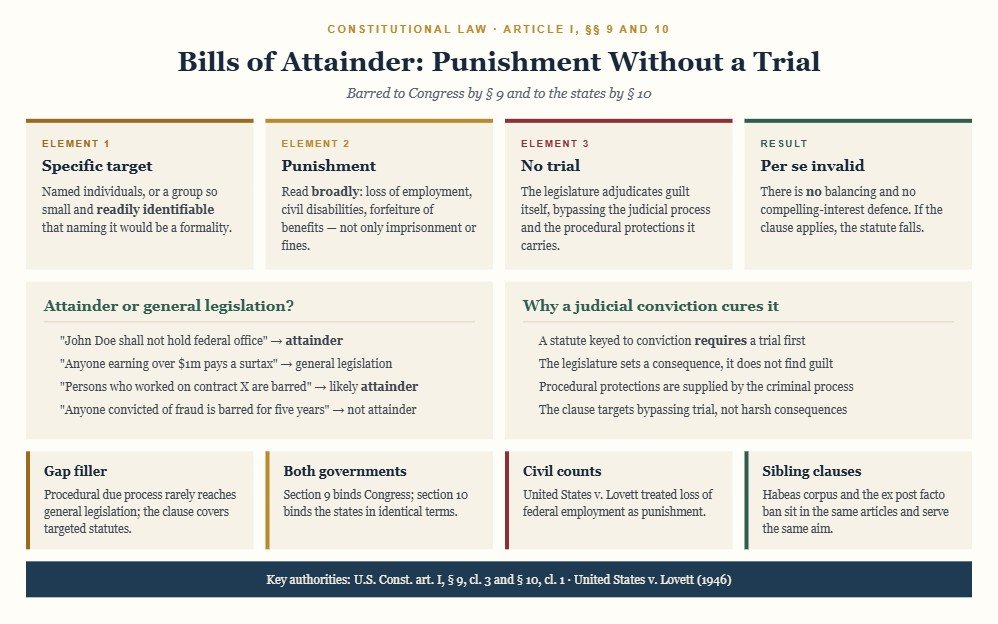
The structural objection
The clause is about who decides, not about how severe the consequence is. When a legislature identifies particular people and imposes a penalty on them by statute, it acts as prosecutor, jury and judge at once. The judicial process, with its notice, its evidence rules and its individualised findings, is skipped entirely.
Because the vice is structural, the remedy is absolute. There are no exceptions to the clause and no interest weighty enough to justify an attainder. Once the elements are present, the statute is unconstitutional.
Exam tip: when a statute names people, or describes a group so narrowly that the names are obvious, stop and run the attainder analysis before reaching due process.
Punishment is read broadly
Punishment is not confined to imprisonment or criminal fines. United States v. Lovett involved an appropriations rider that cut off the salaries of three named federal employees and barred them from federal employment. The Court treated that job loss as punishment, which established that civil disabilities count.
Later analysis has treated deprivation of benefits, professional disqualification and permanent exclusion from a field of work in the same way. If the statute’s practical effect is to inflict a penalty on identified persons, the label attached to it is not decisive.
Specificity: the dividing line
The hard work in most problems is deciding whether the statute targets people or regulates a class. A statute raising tax rates on high earners affects many people and may burden them heavily, but membership in the class is open-ended and the statute states a general policy. That is legislation, not attainder.
By contrast, a statute directed at the participants in a particular event, at the officers of a particular company, or at former holders of a particular office describes a closed and readily identifiable group. The narrower and more backward-looking the description, the more likely the statute is an attainder.
Why conviction-based statutes survive
A statute providing that anyone convicted of fraud may not receive federal contracts for five years is not an attainder. The class is open, and the penalty attaches only after a judicial conviction. The legislature has set a consequence of a trial rather than substituted itself for one.
| Statute | Attainder? | Reason |
|---|---|---|
| Bars three named employees from federal jobs | Yes | Named individuals, punishment, no trial (Lovett) |
| Bars a named contractor and its contract staff from all federal contracts | Likely yes | Closed, readily identifiable group punished by statute |
| Bars anyone convicted of fraud for five years | No | Open class, penalty follows a judicial conviction |
| Raises tax rates on all incomes above a threshold | No | General policy, open-ended class |
| Makes participants in a specific past riot ineligible for state office | Yes | Backward-looking, identifiable group, no adjudication |
Worked example: the disqualified contractor
After a defence contractor is found to have overbilled, Congress enacts a statute providing that the company, its officers and every employee who worked on government contracts are permanently barred from federal contracting. The group is closed and easy to identify from existing records. The bar is a penalty. No court determined who did what, or whether the penalty is proportionate. The statute bears every hallmark of an attainder and should fall.
Change one word. The statute now provides that any contractor convicted of fraud is barred for five years. The class is open to anyone who commits fraud in the future, and the bar operates only after a trial. The legislature has regulated rather than punished, and the clause is not engaged.
How the clause relates to due process
Procedural due process protects against individualised adjudication without fair procedure. It generally does not attach to general legislation, because legislating is not adjudicating. That leaves a gap: a legislature could impose a penalty on named persons by statute and argue that no adjudication occurred. The attainder clause closes the gap by making the targeted statute itself unconstitutional.
Read the clause as narrower than due process but sharper. It requires specificity and punishment, and where it applies it decides the case outright rather than inviting a balancing exercise.
Common mistakes that cost points
- Treating attainder as a criminal law doctrine. Civil penalties such as loss of employment count as punishment.
- Assuming the clause binds only Congress. Article I, § 10 imposes the identical ban on the states.
- Confusing burdensome general legislation with targeted punishment. Only the latter is attainder.
- Missing that a statute keyed to a judicial conviction requires a trial and so is not attainder.
- Looking for an exception or a compelling-interest defence. Attainders are invalid per se.
- Overlooking the gap-filling role and analysing only procedural due process.
- Ignoring the closed-group cases, where no names appear but the group is obvious from the description.
- Forgetting the family resemblance to the habeas and ex post facto clauses, which also keep punishment inside the courts.
Frequently asked questions
Must the statute name people expressly?
No. A description that identifies a small, closed group as effectively as a list of names is enough. The question is identifiability, not drafting technique.
Can a legislature ever impose a penalty directly?
It can impose consequences on open classes and prospective conduct, and it can attach consequences to judicial convictions. What it cannot do is adjudicate guilt and punish identified persons itself.
Does the clause apply to local governments?
Yes, in substance. A city or county acts under state authority, so state-level restrictions on attainder reach its enactments.
Bills of attainder and California loyalty oaths, 2026
The prohibition on legislative punishment without trial is one of the few constitutional provisions that binds both Congress and the states directly, and California has generated important authority on it. In Vogel v. County of Los Angeles (1967) the California Supreme Court struck down a loyalty oath requirement imposed on Los Angeles County employees, and in Speiser v. Randall (1958) the United States Supreme Court invalidated California’s oath condition on a veterans’ property tax exemption.
The modern test asks whether legislation specifies affected persons, imposes punishment, and does so without judicial trial. Specification need not be by name; a description so narrow that it identifies particular individuals or an easily ascertainable group can suffice, as the analysis in Nixon v. Administrator of General Services (1977) showed even while upholding the statute at issue.
Where the argument surfaces in county practice:
- Contractor debarment must be individualised. Excluding a named firm by board action invites the objection, which is why the County of Los Angeles uses ordinances with hearing procedures rather than targeted resolutions.
- Employment disqualification needs a hearing. Legislation barring identified persons from public employment is the classic attainder, as the oath cases demonstrate.
- Regulatory burdens are not punishment. Licensing conditions and prospective disqualifications based on conduct categories are generally sustained.
- Look for a non-punitive purpose. Courts examine historical forms of punishment, the severity of the burden and the legislative record for punitive intent.
- The California Constitution adds a parallel bar. Article I, section 9 prohibits bills of attainder, so plead both provisions.
- Oaths of office remain valid. A prospective affirmation to support the constitutions is permissible; a retrospective disavowal of past association is not.
For 2026, ask whether the measure identifies people rather than conduct, and whether the burden is punitive in character. Read with the Ex Post Facto Clause, procedural due process and unconstitutional conditions.
Next steps
Bills of attainder are best learned with the other Article I limits. Read Ex Post Facto Clause: Retroactive Criminal Laws Barred and The Writ of Habeas Corpus: Testing Unlawful Detention, and see Levels of Scrutiny in Constitutional Law for how the balancing tests differ from a per se ban.
For primary sources, read United States v. Lovett at Justia, the entry on bills of attainder and the annotation to Article I, § 9, cl. 3 at Cornell LII, and the examination scope published by the State Bar of California.
Related guides
- Advisory Opinions: Article III and Declaratory Relief
- Access to the Courts: When Filing Fees Are Unconstitutional
- Other Enumerated Powers: Postal, Bankruptcy, Admiralty
- Franchise Amendments: Congress and the Right to Vote
- Property Clause: Congress and Federal Lands Explained
- No Federal Police Power: Enumerated Powers and Enclaves
- Contracts Clause: When States May Impair Agreements
- Takings Clause: Lucas, Penn Central and Just Compensation
- Free Exercise Clause: Smith, Lukumi and Fulton Applied
- Establishment Clause: Church, State and the New Test
- Freedom of Association: Scrutiny, Dale and Disclosure
- Freedom of the Press: Publication Liability and Limits
- Campaign Finance and Anonymous Speech: The Core Rules
- Unconstitutional Conditions: Benefits and Rights Waivers
- Government Speech Doctrine: When the State Can Choose
- Vagueness and Overbreadth: Facial Challenges Explained
- Prior Restraint and Licensing: The Freedman Safeguards
- Symbolic Conduct and the O’Brien Test: The Pivot Question
- Government Employee Speech: Garcetti and Pickering Rules
- Commercial Speech and the Central Hudson Four-Part Test
- Actual Malice and the Three Tracks of Defamation Law
- Public Forum Doctrine and the Time, Place, Manner Test
- First Amendment: The Three-Question Speech Framework
- One Person, One Vote: Voting Rights Under Equal Protection
- Alienage Classifications: Strict Scrutiny and Its Pockets
- Equal Protection: The Three-Step Classification Test
- Second Amendment: The Bruen Text-and-History Standard
- Substantive Due Process After Dobbs: A Two-Step Test
- Procedural Due Process: Notice, Hearing and Mathews
- Incorporation Doctrine: Which Rights Bind the States
- Full Faith and Credit: Recognising Sister-State Judgments
- The Complete Auto Test: Taxing Interstate Commerce
- The Right to Travel: Durational Residency Explained
- Article IV Privileges and Immunities: The Comity Rule
- Federal Preemption: The Three-Step Ladder Explained
- The Supremacy Clause: Floors, Ceilings and Preemption
- Intergovernmental Immunity: The Shield Runs One Way
- The Presidential Pardon Power: Four Limits That Matter
- Executive Privilege: A Qualified Right That Must Yield
- Presidential Immunity: Criminal, Civil and Private Acts
- The Removal Power: At-Will Firing and Its Exceptions
- The Appointment Power: Principal and Inferior Officers
- Take Care Clause: Enforcement Discretion and Its Limits
- Commander-in-Chief Power: Deploy Without Declaring War
- Executive Agreements: The President’s Sole Foreign Power
- The Treaty Power: Senate Advice and Consent Explained
- The Presidential Veto Power, Override and Pocket Veto
- Bicameralism and Presentment: Two Vetoes Struck Down
- The Nondelegation Doctrine and the Intelligible Principle
- Speech or Debate Clause: Absolute but Narrow Immunity
- The Impeachment Power: House Majority, Senate Two-Thirds
- Congress’s Naturalization Power and Citizenship Limits
- Congressional War Powers: Declare, Fund and Command
- Anti-Commandeering Doctrine and the Tenth Amendment
- Section 5 Enforcement Power: Remedy, Do Not Redefine
- The Spending Power and the Five Dole Test Conditions
- Congress’s Taxing Power: When a Penalty Is Really a Tax
- The Necessary and Proper Clause: Congress’s Multiplier
- Ex Post Facto Clause: Retroactive Criminal Laws Barred
- The Writ of Habeas Corpus: Testing Unlawful Detention
- Supreme Court Jurisdiction: Original vs Appellate Power
- Abstention Doctrine: 4 Ways Federal Courts Step Aside
- Dormant Commerce Clause: Discrimination vs Pike Balancing
- The Commerce Clause: 3 Categories and 2 Hard Limits
- State Action Doctrine: The Government Conduct Threshold
- The Eleventh Amendment and State Sovereign Immunity
- Political Question Doctrine: What Courts Will Not Decide
- Ripeness and Mootness: Timing Rules in Federal Court
- Standing in Federal Court: The 3-Part Article III Test
- Marbury v. Madison and the Power of Judicial Review
- The Youngstown Framework: Presidential Power in 3 Zones
- The IRAC Method: How to Structure a Bar Exam Answer
- Piercing the Corporate Veil: A Two-Prong Alter Ego Test
- Defamation Elements, Fault Standards and Privileges
- The Parol Evidence Rule: Integration and Exceptions
- Recording Acts: Race, Notice and Race-Notice Explained
- Partner Liability and Authority Under RUPA Explained
- Trustee Duties: Care, Loyalty, Impartiality, Accounts
- Specific Performance: A Six-Element Bar Exam Framework
- Will Execution Requirements: Formalities and Rescue
- Community Property Presumptions in California Explained
- Easements Explained: Creation, Scope and Termination
- Products Liability: The Three Defect Theories Explained
- Miranda Rights: Custody, Interrogation and Invocation
- The Character Evidence Rules: Propensity Bar and Doorways
- Adverse Possession Elements: OCEAN and the Tax Rule
- Business Judgment Rule and Directors’ Fiduciary Duties
- The Statute of Frauds: MYLEGS and How to Satisfy It
- Res Judicata vs Collateral Estoppel: Bar Exam Guide
- The Erie Doctrine Explained: A 4-Step Bar Exam Guide
- Conflicts of Interest: A 6-Step Decision Tree for the Bar
- The Rule Against Perpetuities Explained Step by Step
- Murder and Manslaughter: The Homicide Ladder Explained
- Consideration in Contract Law: Rules and Exceptions
- The Four Elements of Negligence: Bar Exam Breakdown
- The Hearsay Rule Explained: Exceptions and Exemptions
- Personal Jurisdiction: The 3-Step Bar Exam Framework
- 3 Levels of Scrutiny in Constitutional Law Explained
- The Citizenship Clause After Trump v. Barbara