
The parol evidence rule answers one of the most practical questions in contract litigation: when the parties have signed a document, how much of what they said before signing still counts? It is not a rule about honesty or about which side is more sympathetic. It is an evidentiary filter built on the assumption that a final writing is the most reliable record of a bargain.
This guide walks through the trigger test, the difference between total and partial integration, the exceptions that always survive, and the more relaxed treatment of sales contracts under the Uniform Commercial Code.
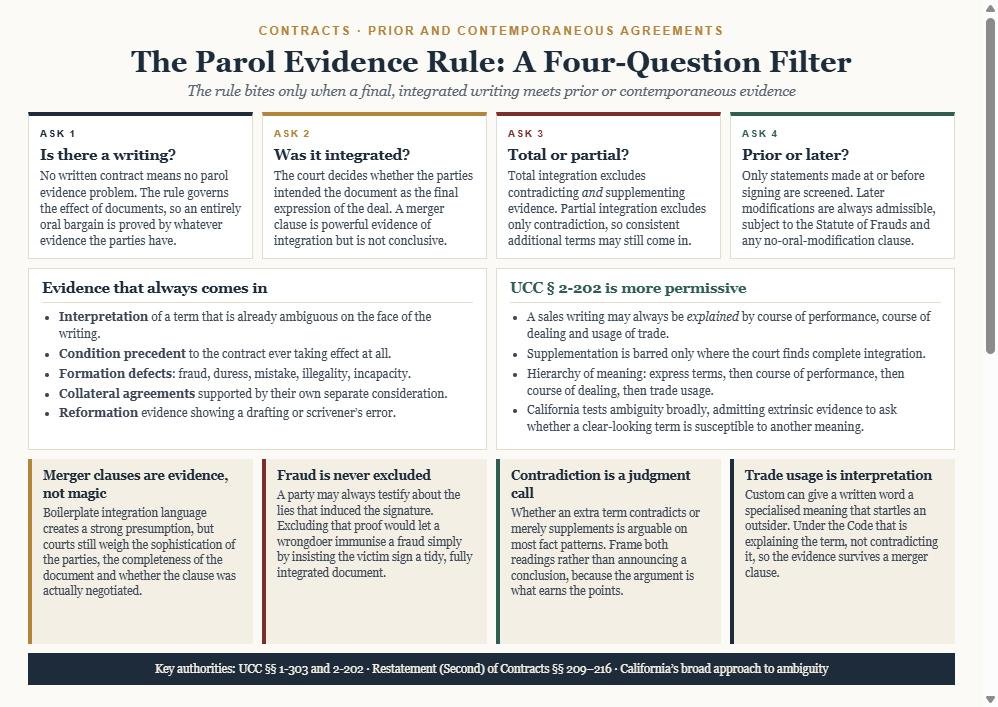
The trigger test: three conditions
The rule never applies automatically. Three conditions must all be present before a court will exclude anything:
- There is a written contract. Without a document there is nothing to be final about.
- The court finds that the writing was intended as the final expression of the agreement, which lawyers call integration.
- The evidence offered consists of statements, oral or written, made at or before the moment of signing.
The third condition does an enormous amount of work. Anything the parties agreed after signing is a modification, and modifications are always admissible. The parol evidence rule looks backwards, never forwards.
Integration: total or partial
Integration is a question for the judge, decided before the jury hears the disputed testimony. The judge asks whether these parties, drafting this document, meant it to supersede their earlier negotiations. Length, detail, sophistication of the parties and the presence of an integration clause all feed into the answer.
Complete integration
If the writing is completely integrated, extrinsic evidence cannot contradict it and cannot add to it. The document is treated as the whole deal. A buyer who claims the seller separately promised to leave the appliances behind is out of luck if the contract is complete on its face and says nothing about appliances.
Partial integration
If the writing is only partially integrated, the analysis splits. Evidence that contradicts an express term is still excluded, because the parties clearly settled that point. Evidence of additional consistent terms is admissible, because the parties simply never wrote those terms down.
Deciding whether a proposed term contradicts or merely supplements is often the whole case. Strong answers argue both characterisations rather than asserting one.
Merger clauses
A merger or integration clause states that the writing contains the entire agreement and that no other promises were made. Courts treat it as strong evidence of complete integration, but not as an irrebuttable declaration. Where the clause is buried in boilerplate, the parties had very unequal bargaining power, or the document is plainly incomplete, judges routinely look behind it.
Exam tip: never write “the contract has a merger clause, therefore the evidence is inadmissible.” Say that the clause creates a strong presumption of complete integration, then test that presumption against the facts you were given.
Evidence that always comes in
Several categories of proof sit entirely outside the rule, because they are not offered to change the terms of the deal:
- Interpretation of an ambiguous term. Explaining what an existing word means is not adding or contradicting a term. California courts are especially willing to hear extrinsic evidence on whether a seemingly plain term is reasonably susceptible to a second meaning.
- Condition precedent to effectiveness. Evidence that the whole contract was never to take effect unless some event occurred goes to the existence of the obligation, not its content.
- Defects in formation. Fraud, duress, undue influence, mistake, illegality and incapacity may always be proved. Otherwise a party could immunise a lie by insisting the victim sign a complete-looking document.
- Collateral agreements. A genuinely separate deal, supported by its own consideration, is a different contract and the writing does not speak to it.
- Reformation for scrivener’s error. Where the document fails to record what both sides actually agreed, equity will correct it.
- Subsequent modifications. Not an exception so much as a boundary: the rule simply does not reach them.
Sales of goods: UCC § 2-202
Article 2 deliberately loosens the common law. Under the Code, a written sales contract may always be explained or supplemented by course of performance, course of dealing and usage of trade, whatever the parties wrote. Supplementation by consistent additional terms is barred only if the court concludes the writing was intended as a complete and exclusive statement.
| Issue | Common law | UCC Article 2 |
|---|---|---|
| Trade custom and prior dealings | Admissible mainly to resolve ambiguity | Always admissible to explain or supplement |
| Consistent additional terms | Excluded if writing is completely integrated | Excluded only if writing is complete and exclusive |
| Contradicting express terms | Excluded | Excluded; express terms sit at the top of the hierarchy |
| Later modifications | Admissible, may need writing or consideration | Admissible; no consideration required under § 2-209 |
When sources of meaning conflict, the Code sets a hierarchy: express terms control everything, course of performance under this contract outranks course of dealing in earlier contracts between the same parties, and course of dealing outranks general usage of trade.
Common mistakes that cost points
- Applying the rule to a subsequent oral modification. The rule only screens prior and contemporaneous statements.
- Skipping the integration question and jumping straight to admissibility.
- Treating a merger clause as conclusive proof of complete integration.
- Forgetting that fraud, duress and mistake evidence is never excluded.
- Confusing interpretation with contradiction when the disputed word is genuinely ambiguous.
- Using the common-law rule on a goods transaction instead of § 2-202.
- Ignoring the collateral agreement doctrine when the extra promise has separate consideration.
- Assuming the rule keeps evidence from the jury permanently; a judge may admit it for a limited purpose.
Frequently asked questions
Is the parol evidence rule really a rule of evidence?
It is usually classified as substantive contract law rather than evidence law, because it defines what the agreement is rather than how facts are proved. That classification matters for choice-of-law questions and for whether a federal court applies state doctrine.
Does the rule apply to oral contracts?
No. There must be a writing that the parties intended as final. A purely oral agreement is proved by whatever testimony the parties can offer, subject only to the ordinary rules about credibility and to the Statute of Frauds where it applies.
What if the writing is silent on the disputed point?
Silence is the classic partial integration scenario. If the document does not address the term at all, the term cannot contradict anything, so it is admissible as a consistent addition unless the court finds the writing complete and exclusive.
The parol evidence rule in California: Traynor’s legacy, 2026
California is markedly more receptive to extrinsic evidence than the traditional model, and the reason is a pair of 1968 decisions by Chief Justice Traynor. In Masterson v. Sine the California Supreme Court held that whether a writing is integrated is itself a question to be decided with the aid of extrinsic evidence, and that a collateral agreement may be proved unless the parties would ordinarily have included it in the writing. In Pacific Gas & Electric Co. v. G. W. Thomas Drayage & Rigging Co. the court rejected the plain meaning rule, holding that extrinsic evidence is admissible to expose a latent ambiguity even where the language seems clear on its face.
The rule is codified in section 1856 of the California Code of Civil Procedure, which bars evidence of terms contradicting an integrated writing while expressly permitting evidence of consistent additional terms where the writing is only partially integrated, and evidence relevant to interpretation, mistake, illegality or fraud in all cases.
Points that matter in Los Angeles County practice:
- The fraud exception is now unrestricted. In Riverisland Cold Storage v. Fresno-Madera Production Credit Association (2013) the California Supreme Court overruled earlier authority and allowed promissory fraud to be proved even where the alleged promise contradicts the written terms.
- Integration clauses are strong but not conclusive. A merger clause is powerful evidence of complete integration, yet it does not bar interpretation evidence or a fraud claim.
- Course of dealing and trade usage are admissible. Both help establish meaning, and industry custom carries real weight in entertainment and construction disputes.
- Interpretation is decided by the judge first. The court determines admissibility and whether an ambiguity exists before any question reaches a jury.
- Condition precedent evidence is allowed. Proof that a written agreement was never to take effect is not barred.
- Reformation remains available. Mutual mistake in expressing the bargain is corrected rather than excluded.
For 2026, argue integration and interpretation as separate questions, since California treats them differently. Read with the statute of frauds, consideration and specific performance.
Next steps
Work the rule in the order the questions appear on the diagram, and write the integration finding explicitly before you exclude anything. Then connect it to the other formation doctrines: the writing requirement in The Statute of Frauds: MYLEGS and How to Satisfy It, the bargain requirement in Consideration in Contract Law: Rules and Exceptions, and the remedy analysis in Specific Performance: A Six-Element Bar Exam Framework.
The statutory text is short and worth reading directly: UCC § 2-202 on final written expression and UCC § 1-303 on course of performance, course of dealing and usage of trade. Cornell’s overview of the parol evidence rule gives a compact doctrinal summary. For a different set of admissibility filters, compare the analysis in The Hearsay Rule Explained: Exceptions and Exemptions and The Character Evidence Rules: Propensity Bar and Doorways.
Related guides
- Advisory Opinions: Article III and Declaratory Relief
- Access to the Courts: When Filing Fees Are Unconstitutional
- Other Enumerated Powers: Postal, Bankruptcy, Admiralty
- Franchise Amendments: Congress and the Right to Vote
- Property Clause: Congress and Federal Lands Explained
- No Federal Police Power: Enumerated Powers and Enclaves
- Contracts Clause: When States May Impair Agreements
- Takings Clause: Lucas, Penn Central and Just Compensation
- Free Exercise Clause: Smith, Lukumi and Fulton Applied
- Establishment Clause: Church, State and the New Test
- Freedom of Association: Scrutiny, Dale and Disclosure
- Freedom of the Press: Publication Liability and Limits
- Campaign Finance and Anonymous Speech: The Core Rules
- Unconstitutional Conditions: Benefits and Rights Waivers
- Government Speech Doctrine: When the State Can Choose
- Vagueness and Overbreadth: Facial Challenges Explained
- Prior Restraint and Licensing: The Freedman Safeguards
- Symbolic Conduct and the O’Brien Test: The Pivot Question
- Government Employee Speech: Garcetti and Pickering Rules
- Commercial Speech and the Central Hudson Four-Part Test
- Actual Malice and the Three Tracks of Defamation Law
- Public Forum Doctrine and the Time, Place, Manner Test
- First Amendment: The Three-Question Speech Framework
- One Person, One Vote: Voting Rights Under Equal Protection
- Alienage Classifications: Strict Scrutiny and Its Pockets
- Equal Protection: The Three-Step Classification Test
- Second Amendment: The Bruen Text-and-History Standard
- Substantive Due Process After Dobbs: A Two-Step Test
- Procedural Due Process: Notice, Hearing and Mathews
- Incorporation Doctrine: Which Rights Bind the States
- Full Faith and Credit: Recognising Sister-State Judgments
- The Complete Auto Test: Taxing Interstate Commerce
- The Right to Travel: Durational Residency Explained
- Article IV Privileges and Immunities: The Comity Rule
- Federal Preemption: The Three-Step Ladder Explained
- The Supremacy Clause: Floors, Ceilings and Preemption
- Intergovernmental Immunity: The Shield Runs One Way
- The Presidential Pardon Power: Four Limits That Matter
- Executive Privilege: A Qualified Right That Must Yield
- Presidential Immunity: Criminal, Civil and Private Acts
- The Removal Power: At-Will Firing and Its Exceptions
- The Appointment Power: Principal and Inferior Officers
- Take Care Clause: Enforcement Discretion and Its Limits
- Commander-in-Chief Power: Deploy Without Declaring War
- Executive Agreements: The President’s Sole Foreign Power
- The Treaty Power: Senate Advice and Consent Explained
- The Presidential Veto Power, Override and Pocket Veto
- Bicameralism and Presentment: Two Vetoes Struck Down
- The Nondelegation Doctrine and the Intelligible Principle
- Speech or Debate Clause: Absolute but Narrow Immunity
- The Impeachment Power: House Majority, Senate Two-Thirds
- Congress’s Naturalization Power and Citizenship Limits
- Congressional War Powers: Declare, Fund and Command
- Anti-Commandeering Doctrine and the Tenth Amendment
- Section 5 Enforcement Power: Remedy, Do Not Redefine
- The Spending Power and the Five Dole Test Conditions
- Congress’s Taxing Power: When a Penalty Is Really a Tax
- The Necessary and Proper Clause: Congress’s Multiplier
- Ex Post Facto Clause: Retroactive Criminal Laws Barred
- Bills of Attainder: Legislative Punishment Explained
- The Writ of Habeas Corpus: Testing Unlawful Detention
- Supreme Court Jurisdiction: Original vs Appellate Power
- Abstention Doctrine: 4 Ways Federal Courts Step Aside
- Dormant Commerce Clause: Discrimination vs Pike Balancing
- The Commerce Clause: 3 Categories and 2 Hard Limits
- State Action Doctrine: The Government Conduct Threshold
- The Eleventh Amendment and State Sovereign Immunity
- Political Question Doctrine: What Courts Will Not Decide
- Ripeness and Mootness: Timing Rules in Federal Court
- Standing in Federal Court: The 3-Part Article III Test
- Marbury v. Madison and the Power of Judicial Review
- The Youngstown Framework: Presidential Power in 3 Zones
- The IRAC Method: How to Structure a Bar Exam Answer
- Piercing the Corporate Veil: A Two-Prong Alter Ego Test
- Defamation Elements, Fault Standards and Privileges
- Recording Acts: Race, Notice and Race-Notice Explained
- Partner Liability and Authority Under RUPA Explained
- Trustee Duties: Care, Loyalty, Impartiality, Accounts
- Specific Performance: A Six-Element Bar Exam Framework
- Will Execution Requirements: Formalities and Rescue
- Community Property Presumptions in California Explained
- Easements Explained: Creation, Scope and Termination
- Products Liability: The Three Defect Theories Explained
- Miranda Rights: Custody, Interrogation and Invocation
- The Character Evidence Rules: Propensity Bar and Doorways
- Adverse Possession Elements: OCEAN and the Tax Rule
- Business Judgment Rule and Directors’ Fiduciary Duties
- The Statute of Frauds: MYLEGS and How to Satisfy It
- Res Judicata vs Collateral Estoppel: Bar Exam Guide
- The Erie Doctrine Explained: A 4-Step Bar Exam Guide
- Conflicts of Interest: A 6-Step Decision Tree for the Bar
- The Rule Against Perpetuities Explained Step by Step
- Murder and Manslaughter: The Homicide Ladder Explained
- Consideration in Contract Law: Rules and Exceptions
- The Four Elements of Negligence: Bar Exam Breakdown
- The Hearsay Rule Explained: Exceptions and Exemptions
- Personal Jurisdiction: The 3-Step Bar Exam Framework
- 3 Levels of Scrutiny in Constitutional Law Explained
- The Citizenship Clause After Trump v. Barbara