
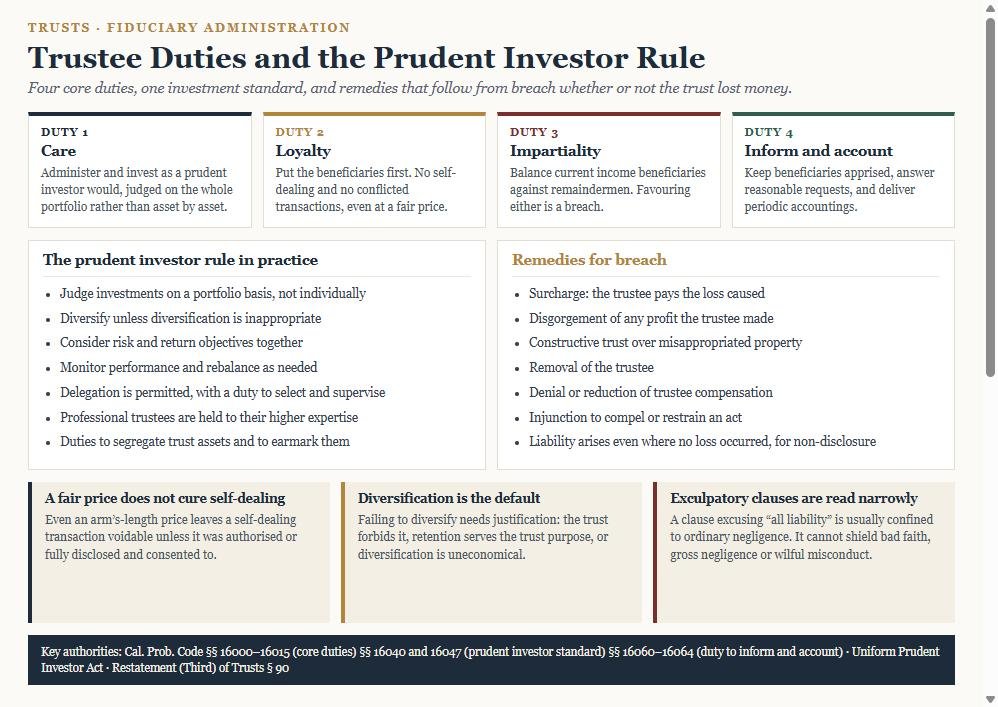
Trustee duties are the engine of the trusts syllabus. Creation questions are usually short; administration questions are where the marks are, because a trustee can breach without stealing anything, without losing money, and sometimes without doing anything at all. Four duties do most of the work, and each has its own remedy.
This guide sets out care, loyalty, impartiality and the duty to inform and account, explains the prudent investor rule that gives the duty of care its content, and covers the remedies for breach and the narrow effect of an exculpatory clause.
The trustee’s position
A trustee holds legal title to property for someone else’s benefit and must administer it in the beneficiaries’ interest. That is a stricter posture than the one a director occupies, because a trustee has no shareholders to answer to and no business judgment presumption to hide behind. Where a director gets deference for an informed decision, a trustee is measured against an objective standard of prudence.
Duty of care: the prudent investor rule
The modern standard asks what a prudent investor would do, and the prudent investor rule as expressed in the Uniform Prudent Investor Act and the Restatement (Third) of Trusts changed the enquiry in an important way. Investments are judged on a portfolio basis rather than individually, so a single speculative holding is not a breach if the overall allocation is sound.
- Diversify, unless diversification is inappropriate for this trust.
- Consider risk and return objectives together, in light of the trust’s purposes and the beneficiaries’ circumstances.
- Monitor performance continuously and rebalance where necessary.
- Delegate where prudent, with a continuing duty to select the agent carefully, define the scope of the delegation, and supervise.
- Meet the higher standard that applies to a professional trustee, a bank or an adviser with special skills.
- Keep trust property segregated from personal assets and properly earmarked as trust property.
Failure to diversify is the most commonly examined care breach, and the exceptions are narrow. The trust instrument may forbid it, retention of a particular asset may serve the trust’s purpose, such as keeping a family business intact, or diversification may be uneconomical. Each of those needs a clear justification on the facts, not an assumption.
Duty of loyalty: no self-dealing
The trustee must put the beneficiaries’ interests above every other interest, including their own. Self-dealing covers buying trust property, selling personal property to the trust, borrowing trust funds, and any transaction in which the trustee’s personal advantage diverges from the beneficiaries’.
The critical point is that fairness is not a defence. Even a transaction at a demonstrably fair price is generally voidable unless the trust instrument authorised it, the beneficiaries consented after full disclosure, or a court approved it in advance. Candidates who argue that the price was reasonable and stop there have missed what the duty prohibits.
Related loyalty problems
Two variations recur. Competing with the trust, for example by acquiring for oneself an investment opportunity the trust was pursuing, is a loyalty breach on the same footing as self-dealing. And a trustee who holds a position in a company whose shares form part of the trust must be careful that decisions serve the trust rather than the other role.
Duty of impartiality
Where a trust has current income beneficiaries and remaindermen, the trustee must balance their competing interests. Distributing generously to income beneficiaries erodes what the remaindermen will receive; hoarding principal starves the income beneficiaries. Neither is neutral, and the duty requires a defensible balance rather than a preference.
Impartiality also affects investment choices, since high-yield assets favour income beneficiaries while growth assets favour remaindermen. A trustee whose portfolio quietly tilts toward one class is exposed even if the overall return is respectable.
Duty to inform and account
The trustee must keep beneficiaries apprised of trust affairs, respond to reasonable requests for information, disclose material facts affecting their interests, and deliver periodic accountings showing receipts, disbursements and current value. Annual accounting is the modern default unless the instrument provides otherwise.
This duty produces liability without loss, which surprises candidates. A trustee who invests impeccably but conceals a conflict, or who simply never accounts, has breached even though the trust is worth more than when it started. Say so explicitly when the facts show silence.
| Duty | Typical breach | Usual remedy |
|---|---|---|
| Care | Failure to diversify or to monitor | Surcharge for the loss caused |
| Loyalty | Self-dealing, even at a fair price | Transaction voided; profits disgorged |
| Loyalty | Taking a trust opportunity | Constructive trust over the asset |
| Impartiality | Favouring income over remainder | Adjustment between the interests; surcharge |
| Inform and account | Non-disclosure or no accounting | Compelled accounting; removal; costs |
| Segregate and earmark | Commingling with personal funds | Strict liability for losses to that property |
Exam tip: name the duty before describing the conduct. “This is a loyalty breach, not a care breach” changes the entire remedy discussion, because loyalty breaches attract disgorgement and constructive trusts while care breaches attract surcharge for actual loss.
Remedies for breach
- Surcharge. The trustee personally pays the loss the breach caused.
- Disgorgement. Any profit the trustee made is stripped, whether or not the trust lost anything.
- Constructive trust. Misappropriated property, or property bought with trust funds, is held for the beneficiaries.
- Removal. Available where the breach or the hostility it created makes continued administration untenable.
- Denial of compensation. Fees may be reduced or refused.
- Injunction. To compel an act the trustee is refusing or restrain one that is threatened.
Beneficiaries may also trace trust property into the hands of a recipient, subject to the protection given to a purchaser who took for value and without notice. Where several beneficiaries have different interests, the remedy must respect the impartiality principle rather than simply compensating whoever sued.
Exculpatory clauses
Trust instruments often try to limit trustee liability. Courts construe such clauses strictly and view them with suspicion, particularly where the trustee drafted the instrument or influenced its terms. A clause may excuse ordinary negligence, but it cannot shield wilful misconduct, gross negligence or bad faith, and a provision purporting to exclude “all liability” is usually read down to the narrower meaning.
Common mistakes that cost points
- Judging each investment in isolation instead of on a portfolio basis.
- Treating a fair price as a defence to self-dealing.
- Assuming diversification is optional, or that a general power to retain assets excuses it.
- Overlooking impartiality where the trust has both income and remainder beneficiaries.
- Treating disclosure as discretionary, or requiring financial loss before finding a breach.
- Giving an exculpatory clause its literal breadth.
- Applying the business judgment rule, which belongs to corporate directors rather than trustees.
- Awarding surcharge where the appropriate remedy is disgorgement or a constructive trust.
Frequently asked questions
Can a trustee delegate investment decisions?
Yes, under the modern rule, and doing so is often prudent. The trustee retains duties to select the agent with care, to set the terms of the delegation sensibly, and to review the agent’s performance. Delegation transfers the task, not the responsibility.
Do co-trustees have to act unanimously?
Modern statutes generally allow a majority of co-trustees to act, with a dissenting trustee protected if the dissent is recorded and the trustee does not participate in the breach. A co-trustee who acquiesces in another’s breach, or who fails to take reasonable steps to prevent it, is exposed.
What if the beneficiaries consented to the transaction?
Informed consent by a competent adult beneficiary can bar that beneficiary’s claim, provided the trustee disclosed all material facts and did not exert improper influence. Consent by one beneficiary does not bind the others, and it cannot validate conduct that harms a class that could not consent.
Trustee duties under the California Probate Code, 2026
California codifies trustee obligations in detail, so a Los Angeles County dispute is argued from statutory text rather than from general fiduciary principles. Sections 16000 and following of the California Probate Code set out the duty to administer the trust according to its terms, the duty of loyalty in section 16002, the obligation to deal impartially among beneficiaries in section 16003 and the prohibition on conflicting transactions in section 16004.
Investment conduct is governed by California’s version of the prudent investor rule, which judges decisions by reference to the portfolio as a whole and the trust’s purposes rather than by the outcome of any single holding. The duty may be expanded, restricted or eliminated by the trust instrument in specified respects, so the first step in any analysis is reading what the settlor actually provided.
The provisions that generate litigation here:
- The 120-day notice is decisive. Section 16061.7 requires notification when a revocable trust becomes irrevocable, and it starts the period within which a contest must be brought.
- Accounting duties are enforceable by petition. A beneficiary may compel an account in the probate division of the Los Angeles Superior Court, and failure to account is a common ground for removal.
- Self-dealing is presumptively improper. Transactions between trustee and trust are voidable regardless of fairness unless authorised.
- Co-trustees must act together. Unless the instrument provides otherwise, joint action is required and a dissenting co-trustee should document objection.
- Real property duties are heavy in this county. Managing, insuring and deciding whether to sell high-value residential property is where impartiality disputes concentrate.
- Removal and surcharge are the remedies. Section 15642 lists removal grounds, and damages may include lost profits and interest.
For 2026, read the instrument, then the statute, then the notice dates. Read with will execution requirements, conflicts of interest and the business judgment rule.
Next steps
Fiduciary reasoning repeats across subjects, so compare frameworks deliberately. The business judgment rule and fiduciary duties covers the corporate version and shows how much more protection directors receive than trustees do, while the conflicts of interest decision tree sets out the professional-responsibility version built on disclosure and informed consent. If the trust was created by will, the will execution requirements determines whether the instrument that created it is valid at all.
For practice, take one portfolio and change a single fact each time: concentrate it in one stock, have the trustee buy a parcel from the trust at market value, favour the income beneficiary, then have the trustee stop sending accountings. Reading the trusts overview at Cornell’s Legal Information Institute alongside your notes will keep the duties and their remedies paired correctly.
Related guides
- Advisory Opinions: Article III and Declaratory Relief
- Access to the Courts: When Filing Fees Are Unconstitutional
- Other Enumerated Powers: Postal, Bankruptcy, Admiralty
- Franchise Amendments: Congress and the Right to Vote
- Property Clause: Congress and Federal Lands Explained
- No Federal Police Power: Enumerated Powers and Enclaves
- Contracts Clause: When States May Impair Agreements
- Takings Clause: Lucas, Penn Central and Just Compensation
- Free Exercise Clause: Smith, Lukumi and Fulton Applied
- Establishment Clause: Church, State and the New Test
- Freedom of Association: Scrutiny, Dale and Disclosure
- Freedom of the Press: Publication Liability and Limits
- Campaign Finance and Anonymous Speech: The Core Rules
- Unconstitutional Conditions: Benefits and Rights Waivers
- Government Speech Doctrine: When the State Can Choose
- Vagueness and Overbreadth: Facial Challenges Explained
- Prior Restraint and Licensing: The Freedman Safeguards
- Symbolic Conduct and the O’Brien Test: The Pivot Question
- Government Employee Speech: Garcetti and Pickering Rules
- Commercial Speech and the Central Hudson Four-Part Test
- Actual Malice and the Three Tracks of Defamation Law
- Public Forum Doctrine and the Time, Place, Manner Test
- First Amendment: The Three-Question Speech Framework
- One Person, One Vote: Voting Rights Under Equal Protection
- Alienage Classifications: Strict Scrutiny and Its Pockets
- Equal Protection: The Three-Step Classification Test
- Second Amendment: The Bruen Text-and-History Standard
- Substantive Due Process After Dobbs: A Two-Step Test
- Procedural Due Process: Notice, Hearing and Mathews
- Incorporation Doctrine: Which Rights Bind the States
- Full Faith and Credit: Recognising Sister-State Judgments
- The Complete Auto Test: Taxing Interstate Commerce
- The Right to Travel: Durational Residency Explained
- Article IV Privileges and Immunities: The Comity Rule
- Federal Preemption: The Three-Step Ladder Explained
- The Supremacy Clause: Floors, Ceilings and Preemption
- Intergovernmental Immunity: The Shield Runs One Way
- The Presidential Pardon Power: Four Limits That Matter
- Executive Privilege: A Qualified Right That Must Yield
- Presidential Immunity: Criminal, Civil and Private Acts
- The Removal Power: At-Will Firing and Its Exceptions
- The Appointment Power: Principal and Inferior Officers
- Take Care Clause: Enforcement Discretion and Its Limits
- Commander-in-Chief Power: Deploy Without Declaring War
- Executive Agreements: The President’s Sole Foreign Power
- The Treaty Power: Senate Advice and Consent Explained
- The Presidential Veto Power, Override and Pocket Veto
- Bicameralism and Presentment: Two Vetoes Struck Down
- The Nondelegation Doctrine and the Intelligible Principle
- Speech or Debate Clause: Absolute but Narrow Immunity
- The Impeachment Power: House Majority, Senate Two-Thirds
- Congress’s Naturalization Power and Citizenship Limits
- Congressional War Powers: Declare, Fund and Command
- Anti-Commandeering Doctrine and the Tenth Amendment
- Section 5 Enforcement Power: Remedy, Do Not Redefine
- The Spending Power and the Five Dole Test Conditions
- Congress’s Taxing Power: When a Penalty Is Really a Tax
- The Necessary and Proper Clause: Congress’s Multiplier
- Ex Post Facto Clause: Retroactive Criminal Laws Barred
- Bills of Attainder: Legislative Punishment Explained
- The Writ of Habeas Corpus: Testing Unlawful Detention
- Supreme Court Jurisdiction: Original vs Appellate Power
- Abstention Doctrine: 4 Ways Federal Courts Step Aside
- Dormant Commerce Clause: Discrimination vs Pike Balancing
- The Commerce Clause: 3 Categories and 2 Hard Limits
- State Action Doctrine: The Government Conduct Threshold
- The Eleventh Amendment and State Sovereign Immunity
- Political Question Doctrine: What Courts Will Not Decide
- Ripeness and Mootness: Timing Rules in Federal Court
- Standing in Federal Court: The 3-Part Article III Test
- Marbury v. Madison and the Power of Judicial Review
- The Youngstown Framework: Presidential Power in 3 Zones
- The IRAC Method: How to Structure a Bar Exam Answer
- Piercing the Corporate Veil: A Two-Prong Alter Ego Test
- Defamation Elements, Fault Standards and Privileges
- The Parol Evidence Rule: Integration and Exceptions
- Recording Acts: Race, Notice and Race-Notice Explained
- Partner Liability and Authority Under RUPA Explained
- Specific Performance: A Six-Element Bar Exam Framework
- Will Execution Requirements: Formalities and Rescue
- Community Property Presumptions in California Explained
- Easements Explained: Creation, Scope and Termination
- Products Liability: The Three Defect Theories Explained
- Miranda Rights: Custody, Interrogation and Invocation
- The Character Evidence Rules: Propensity Bar and Doorways
- Adverse Possession Elements: OCEAN and the Tax Rule
- Business Judgment Rule and Directors’ Fiduciary Duties
- The Statute of Frauds: MYLEGS and How to Satisfy It
- Res Judicata vs Collateral Estoppel: Bar Exam Guide
- The Erie Doctrine Explained: A 4-Step Bar Exam Guide
- Conflicts of Interest: A 6-Step Decision Tree for the Bar
- The Rule Against Perpetuities Explained Step by Step
- Murder and Manslaughter: The Homicide Ladder Explained
- Consideration in Contract Law: Rules and Exceptions
- The Four Elements of Negligence: Bar Exam Breakdown
- The Hearsay Rule Explained: Exceptions and Exemptions
- Personal Jurisdiction: The 3-Step Bar Exam Framework
- 3 Levels of Scrutiny in Constitutional Law Explained
- The Citizenship Clause After Trump v. Barbara