
The Erie doctrine is the rule that decides a deceptively simple question: when a federal court hears a state-law claim, whose law actually governs? Examiners love it because the answer is never “federal court, therefore federal law.” A judge sitting in diversity borrows the state’s substantive rules while keeping the federal procedural machinery, and the hard work lies in drawing the line between the two.
This guide turns that line-drawing exercise into a four-step routine you can run under time pressure. You will see where the doctrine came from, which categories fall on each side of the divide, how the Klaxon choice-of-law step fits in, and which traps cost the most points on essays and multiple-choice questions alike.
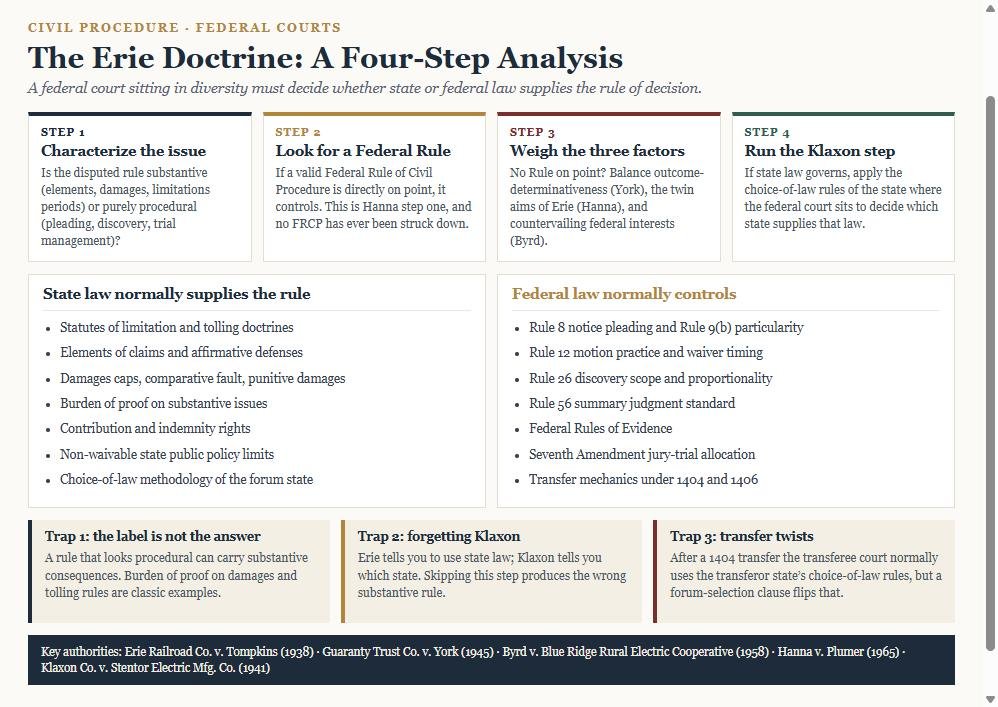
Where the Erie doctrine came from
For most of the nineteenth century, Swift v. Tyson let federal courts develop their own general common law in diversity cases. The result was two bodies of law for the same dispute and an obvious incentive to shop for the friendlier courthouse. In Erie Railroad Co. v. Tompkins (1938) the Supreme Court ended that practice: a federal court exercising diversity jurisdiction must apply the substantive law of the relevant state and has no authority to invent general federal common law in its place.
The doctrine therefore serves a structural goal rather than a technical one. Federal and state courthouses across the street from each other should reach the same outcome on the same state-law claim. Keep that purpose in mind, because every close call in the analysis is resolved by asking whether a different answer would let one party manufacture an advantage simply by choosing a forum.
Step 1: characterise the issue
Begin by naming the disputed rule precisely. Substantive rules define what a party must prove and what they can recover; procedural rules govern how the case moves through the courthouse. The categories below are settled enough that you can assign them on sight.
- Almost always substantive: elements of a claim or defence, statutes of limitation and tolling, damages caps, comparative fault, punitive damages standards, contribution and indemnity rights.
- Almost always procedural: pleading standards under Rule 8 and Rule 9(b), motion practice under Rule 12, discovery scope under Rule 26, and the summary judgment standard of Rule 56.
- Genuinely contested: burden of proof allocation, presumptions, expert-qualification rules, and doctrines such as claim preclusion that sit on the seam between the two.
Notice that “procedural” is not a label you can apply by intuition. A rule about who bears the burden of proving damages looks like courtroom mechanics but changes who wins, and that is exactly what makes it substantive for Erie purposes.
Step 2: is a Federal Rule directly on point?
Hanna v. Plumer (1965) supplies the shortcut. If a Federal Rule of Civil Procedure speaks directly to the question and is valid under the Rules Enabling Act, the Rule applies and the analysis stops. No Federal Rule has ever been invalidated on this ground, so in practice a Rule that genuinely covers the issue wins.
Two words carry the weight here: directly and on point. A Rule that merely touches the same subject does not displace state law. If the Federal Rule and the state rule can both operate without contradiction, there is no collision and you move on to step three rather than declaring a winner.
A worked example of the collision test
Suppose state law requires service on a corporate defendant personally on an officer, while Rule 4 permits service on a designated agent. Rule 4 answers the same question in a different way, so the collision is real and the federal Rule governs. Contrast a state rule that conditions recovery on a pre-suit notice letter: nothing in the Federal Rules addresses that condition, so the state requirement survives.
Step 3: no Rule on point? Weigh three factors
When no Federal Rule occupies the field, courts balance three considerations that have accumulated across the case law.
- Outcome determination. Guaranty Trust Co. v. York (1945) asks whether ignoring the state rule would significantly affect the result. A limitations period that bars the claim entirely is the paradigm case.
- The twin aims of Erie. Hanna asks whether applying federal law would encourage forum shopping or produce inequitable administration of the law, so that similarly situated litigants are treated differently depending on which door they walked through.
- Countervailing federal interests. Byrd v. Blue Ridge Rural Electric Cooperative (1958) allows a strong federal policy, such as the Seventh Amendment allocation of issues to a jury, to outweigh a state practice.
The factors are not a checklist to be totalled. They are a way of testing the same intuition from three angles: would a litigant rationally prefer federal court because of this rule alone? If the honest answer is yes, and no serious federal interest points the other way, apply state law.
Step 4: the Klaxon step nobody remembers
Erie tells you to apply state law. It does not tell you which state. Klaxon Co. v. Stentor Electric Manufacturing Co. (1941) fills the gap: the federal court applies the choice-of-law rules of the state in which it sits, then follows those rules to the governing substantive law.
So a suit filed in a California federal court over a New York contract runs California choice-of-law principles first. Those principles may well select New York law, but the route matters, and an answer that jumps straight to New York without the intermediate step is incomplete. California’s methodology looks for the state with the most significant relationship to the transaction and treats certain state policies as non-waivable even when another state’s law nominally governs.
Transfers add a wrinkle
When a case moves under 28 U.S.C. § 1404, the transferee court normally keeps using the transferor state’s choice-of-law rules so that a venue change cannot rewrite substantive rights. Atlantic Marine carves out transfers driven by a valid forum-selection clause, where the transferee’s own rules apply because the parties bargained for that forum.
| Issue | Governing law | Authority |
|---|---|---|
| Statute of limitations | State | Guaranty Trust v. York |
| Pleading sufficiency | Federal (Rule 8, Rule 9(b)) | Hanna v. Plumer |
| Damages caps and punitive standards | State | Erie |
| Discovery scope | Federal (Rule 26) | Hanna step one |
| Judge/jury allocation of an issue | Federal where a constitutional interest is engaged | Byrd v. Blue Ridge |
| Which state’s substantive law | Forum state’s choice-of-law rules | Klaxon v. Stentor |
| Choice of law after a § 1404 transfer | Transferor state’s rules, unless a forum-selection clause applies | Van Dusen; Atlantic Marine |
Exam tip: write the Erie analysis in the order the court would. Name the issue, dispose of the Federal Rule question in one sentence, balance the three factors only if you must, and finish with Klaxon. Graders look for the sequence, not for a recital of every case name.
A short hypothetical you can practise on
A plaintiff sues in federal court in State A on a contract that State B law governs after a choice-of-law analysis. State A allows four years to sue; State B allows two. The complaint arrives three years after the breach. Which limitations period applies?
Work the steps. A limitations period is substantive because it is outcome determinative and because a longer federal-court clock would be an open invitation to forum shop. No Federal Rule sets limitations periods, so state law governs. Klaxon then sends you to State A’s choice-of-law rules, which select State B. State B’s two-year period applies and the claim is time-barred. The plaintiff gains nothing from the federal forum, which is precisely the outcome Erie is designed to produce.
Common mistakes that cost points
- Treating every rule that sounds procedural as procedural. Burden of proof on damages, tolling doctrines and indemnity claims all carry substantive consequences.
- Skipping Klaxon and applying the forum state’s substantive law by default, which produces the right doctrine attached to the wrong state.
- Refusing to apply a Federal Rule because state law differs. A valid Rule directly on point displaces contrary state law at step two.
- Balancing the three factors when a Federal Rule already answers the question, which signals that the hierarchy has not been learned.
- Forgetting that Erie still operates in federal-question cases as to supplemental state-law claims.
- Confusing a forum-selection clause with a choice-of-law clause; one picks the courthouse, the other picks the governing law.
Frequently asked questions
Does the Erie doctrine apply outside diversity cases?
Yes, in part. A federal court hearing a federal claim applies federal law to that claim, but any state-law claim joined through supplemental jurisdiction is still governed by Erie and Klaxon. Mixed cases are common on essays for exactly this reason.
Is a state statute of limitations always applied?
Almost always, because limitations periods are treated as substantive. Courts do distinguish true limitations rules from equitable doctrines such as laches, and a federal statute containing its own limitations period displaces the state clock for claims arising under it.
How much detail does an Erie answer need?
Enough to show the hierarchy. One sentence on characterisation, one on the Federal Rule question, a short balance of the three factors when they are in play, and an explicit Klaxon step. Case names help, but a clean sequence earns more than a list of citations.
Erie in the Central District of California, 2026
The Central District of California, which covers Los Angeles County, is one of the busiest federal trial courts in the country, and it applies California substantive law in diversity cases while following federal procedure. The most instructive Erie problem in this circuit concerns California’s anti-SLAPP statute, and the resolution is a genuinely useful illustration of how the doctrine works in practice.
The Ninth Circuit permits a special motion to strike under section 425.16 of the California Code of Civil Procedure to be brought in federal court, reasoning that the statute’s fee-shifting and substantive protections are not merely procedural. But it has divided the motion according to what it attacks: where the motion challenges the legal sufficiency of the complaint, it is evaluated under the federal pleading standard, and where it challenges the factual sufficiency of the claim, it is treated in the manner of a summary judgment motion with discovery permitted. That compromise preserves the state interest without displacing the Federal Rules.
Other recurring Erie questions here:
- Statutes of limitation are substantive. California periods apply, together with California tolling and accrual rules.
- Fee-shifting statutes travel. A California provision awarding fees is applied in federal court because it is bound up with the substantive right.
- Choice of law follows the forum state. A federal court in California applies California conflicts rules, which use a governmental interest analysis rather than the traditional lex loci approach.
- Uncertain state law can be certified. Under the California Rules of Court the Ninth Circuit may ask the California Supreme Court to answer a question of California law.
- Preclusion of a California judgment uses California law. That includes the primary rights theory and the rule that a judgment is not final pending appeal.
- Federal procedure governs the rest. Pleading, discovery, expert disclosure and jury practice follow the Federal Rules even where California differs markedly.
For 2026, ask whether the state rule is bound up with the right or merely the manner of enforcing it. Read with preclusion, personal jurisdiction and full faith and credit.
Next steps
Erie is a gateway doctrine: once you can allocate law between the two systems, the rest of federal civil procedure becomes far easier to organise. Pair this guide with the personal jurisdiction framework to complete your jurisdictional foundation, then move to the evidentiary side with the hearsay rule, since the Federal Rules of Evidence are a good illustration of federal law operating inside a state-law claim.
For practice, draft three Erie paragraphs from memory: one where a Federal Rule ends the inquiry, one where the three factors decide the question, and one where Klaxon changes the answer. Then read the text of the Federal Rules alongside the Erie doctrine overview at Cornell’s Legal Information Institute so that step two becomes automatic.
Related guides
- Advisory Opinions: Article III and Declaratory Relief
- Access to the Courts: When Filing Fees Are Unconstitutional
- Other Enumerated Powers: Postal, Bankruptcy, Admiralty
- Franchise Amendments: Congress and the Right to Vote
- Property Clause: Congress and Federal Lands Explained
- No Federal Police Power: Enumerated Powers and Enclaves
- Contracts Clause: When States May Impair Agreements
- Takings Clause: Lucas, Penn Central and Just Compensation
- Free Exercise Clause: Smith, Lukumi and Fulton Applied
- Establishment Clause: Church, State and the New Test
- Freedom of Association: Scrutiny, Dale and Disclosure
- Freedom of the Press: Publication Liability and Limits
- Campaign Finance and Anonymous Speech: The Core Rules
- Unconstitutional Conditions: Benefits and Rights Waivers
- Government Speech Doctrine: When the State Can Choose
- Vagueness and Overbreadth: Facial Challenges Explained
- Prior Restraint and Licensing: The Freedman Safeguards
- Symbolic Conduct and the O’Brien Test: The Pivot Question
- Government Employee Speech: Garcetti and Pickering Rules
- Commercial Speech and the Central Hudson Four-Part Test
- Actual Malice and the Three Tracks of Defamation Law
- Public Forum Doctrine and the Time, Place, Manner Test
- First Amendment: The Three-Question Speech Framework
- One Person, One Vote: Voting Rights Under Equal Protection
- Alienage Classifications: Strict Scrutiny and Its Pockets
- Equal Protection: The Three-Step Classification Test
- Second Amendment: The Bruen Text-and-History Standard
- Substantive Due Process After Dobbs: A Two-Step Test
- Procedural Due Process: Notice, Hearing and Mathews
- Incorporation Doctrine: Which Rights Bind the States
- Full Faith and Credit: Recognising Sister-State Judgments
- The Complete Auto Test: Taxing Interstate Commerce
- The Right to Travel: Durational Residency Explained
- Article IV Privileges and Immunities: The Comity Rule
- Federal Preemption: The Three-Step Ladder Explained
- The Supremacy Clause: Floors, Ceilings and Preemption
- Intergovernmental Immunity: The Shield Runs One Way
- The Presidential Pardon Power: Four Limits That Matter
- Executive Privilege: A Qualified Right That Must Yield
- Presidential Immunity: Criminal, Civil and Private Acts
- The Removal Power: At-Will Firing and Its Exceptions
- The Appointment Power: Principal and Inferior Officers
- Take Care Clause: Enforcement Discretion and Its Limits
- Commander-in-Chief Power: Deploy Without Declaring War
- Executive Agreements: The President’s Sole Foreign Power
- The Treaty Power: Senate Advice and Consent Explained
- The Presidential Veto Power, Override and Pocket Veto
- Bicameralism and Presentment: Two Vetoes Struck Down
- The Nondelegation Doctrine and the Intelligible Principle
- Speech or Debate Clause: Absolute but Narrow Immunity
- The Impeachment Power: House Majority, Senate Two-Thirds
- Congress’s Naturalization Power and Citizenship Limits
- Congressional War Powers: Declare, Fund and Command
- Anti-Commandeering Doctrine and the Tenth Amendment
- Section 5 Enforcement Power: Remedy, Do Not Redefine
- The Spending Power and the Five Dole Test Conditions
- Congress’s Taxing Power: When a Penalty Is Really a Tax
- The Necessary and Proper Clause: Congress’s Multiplier
- Ex Post Facto Clause: Retroactive Criminal Laws Barred
- Bills of Attainder: Legislative Punishment Explained
- The Writ of Habeas Corpus: Testing Unlawful Detention
- Supreme Court Jurisdiction: Original vs Appellate Power
- Abstention Doctrine: 4 Ways Federal Courts Step Aside
- Dormant Commerce Clause: Discrimination vs Pike Balancing
- The Commerce Clause: 3 Categories and 2 Hard Limits
- State Action Doctrine: The Government Conduct Threshold
- The Eleventh Amendment and State Sovereign Immunity
- Political Question Doctrine: What Courts Will Not Decide
- Ripeness and Mootness: Timing Rules in Federal Court
- Standing in Federal Court: The 3-Part Article III Test
- Marbury v. Madison and the Power of Judicial Review
- The Youngstown Framework: Presidential Power in 3 Zones
- The IRAC Method: How to Structure a Bar Exam Answer
- Piercing the Corporate Veil: A Two-Prong Alter Ego Test
- Defamation Elements, Fault Standards and Privileges
- The Parol Evidence Rule: Integration and Exceptions
- Recording Acts: Race, Notice and Race-Notice Explained
- Partner Liability and Authority Under RUPA Explained
- Trustee Duties: Care, Loyalty, Impartiality, Accounts
- Specific Performance: A Six-Element Bar Exam Framework
- Will Execution Requirements: Formalities and Rescue
- Community Property Presumptions in California Explained
- Easements Explained: Creation, Scope and Termination
- Products Liability: The Three Defect Theories Explained
- Miranda Rights: Custody, Interrogation and Invocation
- The Character Evidence Rules: Propensity Bar and Doorways
- Adverse Possession Elements: OCEAN and the Tax Rule
- Business Judgment Rule and Directors’ Fiduciary Duties
- The Statute of Frauds: MYLEGS and How to Satisfy It
- Res Judicata vs Collateral Estoppel: Bar Exam Guide
- Conflicts of Interest: A 6-Step Decision Tree for the Bar
- The Rule Against Perpetuities Explained Step by Step
- Murder and Manslaughter: The Homicide Ladder Explained
- Consideration in Contract Law: Rules and Exceptions
- The Four Elements of Negligence: Bar Exam Breakdown
- The Hearsay Rule Explained: Exceptions and Exemptions
- Personal Jurisdiction: The 3-Step Bar Exam Framework
- 3 Levels of Scrutiny in Constitutional Law Explained
- The Citizenship Clause After Trump v. Barbara