
Article II, Section 2, Clause 2 lets the President appoint ambassadors, other public ministers and consuls, judges of the Supreme Court, and all other officers of the United States, with the advice and consent of the Senate. That sentence builds the appointment power into a two-tier system, and almost every exam question about it turns on which tier the officer occupies.
The analysis is mechanical once you know the order of operations. Classify the officer as principal or inferior. Then test the statute Congress wrote against the requirements for that tier. If the statute deviates, the statute falls, not the officer.
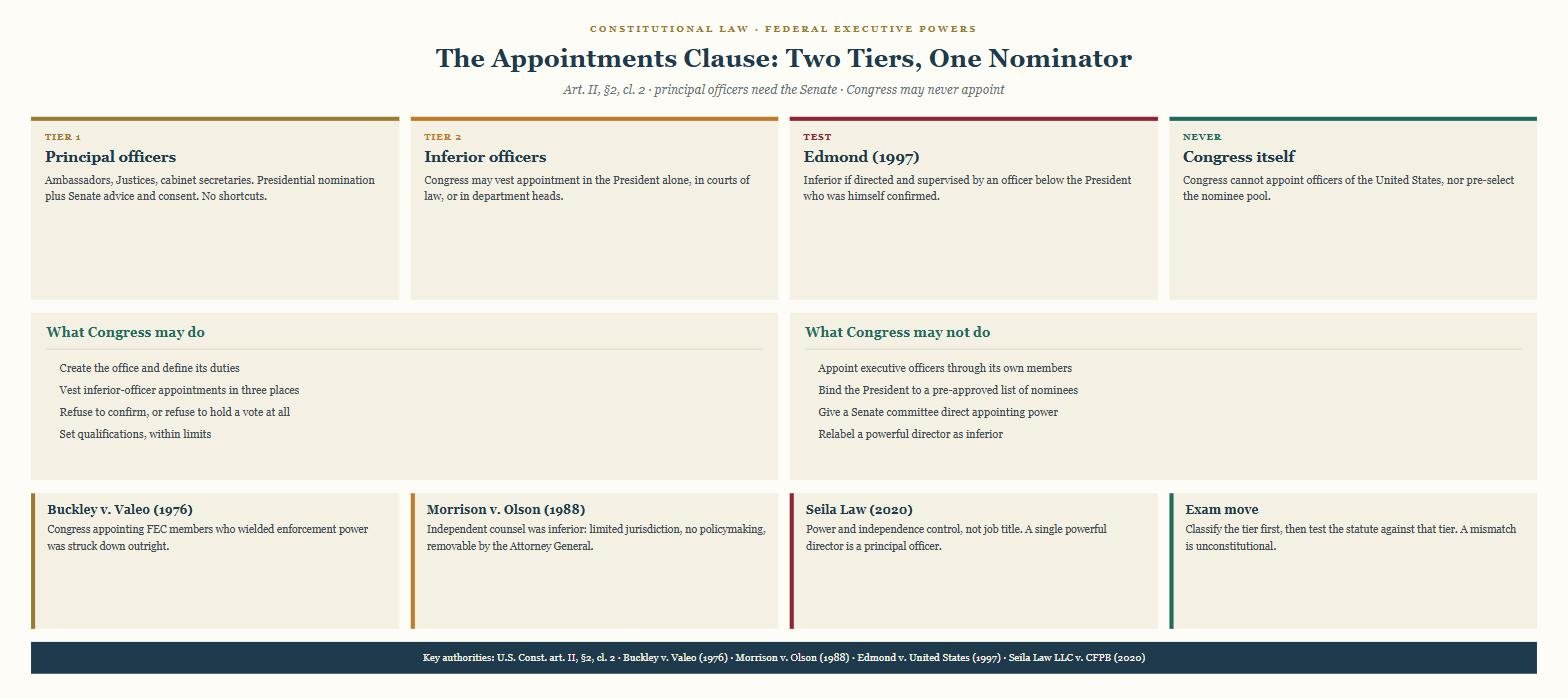
Tier one: principal officers
Principal officers include ambassadors, Supreme Court Justices, cabinet secretaries and other high-level executive officers. They require two steps and only two steps: presidential nomination, then Senate advice and consent. There is no abbreviated route and no substitute for the Senate vote.
Crucially, the nominating half belongs to the President alone. Congress cannot confine the President to a pre-approved list, and the Senate cannot propose candidates. What the Senate can do is refuse — it may vote no, or decline to hold hearings at all, without offering any justification. The 2016 nomination of Merrick Garland is the standard illustration: inaction is a permissible use of the confirmation check.
Tier two: inferior officers
An inferior officer is one whose work is directed and supervised by a superior executive official other than the President. For inferior officers, Congress has real flexibility. By law it may vest the appointment in the President alone, in the courts of law, or in the heads of executive departments. Full Senate confirmation can be skipped entirely.
The modern test comes from Edmond v. United States (1997): an officer is inferior if her work is directed and supervised at some level by an officer below the President who was himself appointed by presidential nomination and Senate confirmation. Cite Edmond rather than the looser shorthand about being removable by a superior; the supervision framing is what courts apply to close cases.
Exam tip: Congress may create the office, define its duties and choose among three appointing authorities for inferior officers. What Congress may never do is appoint an officer of the United States itself, through its members, its committees or its own officers.
| Scheme in the statute | Officer type | Valid? |
|---|---|---|
| President nominates, Senate confirms | Principal | Yes — the constitutional default |
| Appointment vested in a department head | Inferior | Yes |
| Appointment vested in a federal court | Inferior | Yes |
| Appointment vested in the President alone | Inferior | Yes |
| Speaker and President pro tempore appoint | Either | No — Buckley v. Valeo |
| President must choose from a Senate list | Principal | No — nomination is exclusive |
The three cases that decide close calls
Buckley v. Valeo (1976) struck down a scheme in which Congress itself appointed members of the Federal Election Commission, some by the Speaker and some by the President pro tempore, who then exercised executive law-enforcement functions. The holding is categorical: only the President, courts of law, or department heads may appoint officers of the United States, and the latter two only for inferior officers.
Morrison v. Olson (1988) upheld the independent counsel under the now-lapsed Ethics in Government Act as an inferior officer despite substantial investigative and prosecutorial power, because she was removable by the Attorney General, had limited jurisdiction, and lacked policymaking authority. Seila Law LLC v. Consumer Financial Protection Bureau (2020) then pushed in the other direction, treating a single director with sweeping regulatory authority as a principal officer even though the position sits outside the cabinet. The lesson is that power and independence control, never the label Congress attaches.
Worked example
Congress enacts a statute requiring the President to appoint all ambassadors from a list of five candidates pre-selected by the Senate Foreign Relations Committee. The President nominates a qualified ambassador who is not on the list, and the Senate confirms her. The committee challenges the appointment.
Ambassadors are principal officers, so the constitutional route is presidential nomination followed by Senate advice and consent. The statute inverts that structure: by narrowing the field to five committee choices, it effectively relocates the nominating power to a Senate committee. Nothing in Article II permits the Senate to propose nominees, and the confirmation that occurred here does not cure the defect, because the constraint bit before nomination. Conclusion: the appointment itself is valid, because the President nominated freely and the Senate confirmed, but the pre-selection statute is unconstitutional and unenforceable.
Change one fact. Suppose the statute instead required any nominee to have five years of diplomatic experience. A qualification requirement of general application is a far weaker intrusion than a list of names, and such conditions have historically been tolerated, so the answer shifts toward validity. The distinction is between regulating the class of eligible persons and choosing the person.
Common mistakes that cost points
- Treating Senate confirmation as a shared nominating power. The Senate confirms or rejects; it never nominates.
- Classifying officers by job title instead of actual authority and supervisory structure.
- Assuming every agency head is a principal officer, or that every non-cabinet official is inferior.
- Citing only the removable-by-a-superior shorthand instead of the Edmond supervision test.
- Believing Congress can appoint executive officers through an internal mechanism. It cannot, under any structure.
- Extending the clause to state officials or private contractors. It reaches federal officers only.
- Forgetting that multimember commissions and single-director agencies are treated differently once removal enters the picture.
- Invalidating the officer’s appointment when the correct target is the unconstitutional statute.
Frequently asked questions
Can Congress ever appoint an officer of the United States?
No. Buckley v. Valeo forecloses it completely. Congress may create offices and prescribe duties, but the appointing authority must be the President, a court of law, or a department head.
How do I tell a principal officer from an inferior one?
Apply Edmond: ask whether some Senate-confirmed officer below the President directs and supervises the officer’s work. If yes, the officer is inferior. If the officer answers to no one but the President, she is principal.
Does the Senate have to vote on a nomination?
No. The Senate may decline to act, and it owes no explanation. The President cannot compel a vote, and the vacancy simply persists.
Appointments in California and Los Angeles County government, 2026
The federal question is whether an official is a principal officer requiring Senate confirmation or an inferior officer whose appointment Congress may vest elsewhere, a distinction Lucia v. SEC (2018) applied to administrative judges. California and Los Angeles County resolve the same structural problem by very different means, and the county’s answer is unusually democratic.
Los Angeles County elects officials that most jurisdictions appoint. The Sheriff, the District Attorney and the Assessor are chosen by county-wide election rather than named by the Board of Supervisors, which gives them independent political legitimacy and makes them difficult for the Board to direct. Department heads, the chief executive and the Los Angeles County Counsel are appointed by the Board, and charter reform approved by voters contemplates an elected county executive on a phased schedule.
Appointment mechanics worth knowing:
- Judicial appointments have a distinctive filter. The Governor fills vacancies, with appellate appointments confirmed by the Commission on Judicial Appointments rather than the Legislature.
- Superior court judges stand for election. Los Angeles County judges appear on the ballot, so appointment and election coexist.
- Senate confirmation applies to many state posts. Agency heads and board members generally require confirmation within a statutory period.
- Vacancies in county elected offices are filled by the Board. An appointee then serves until the next election.
- Split appointment insulates agencies. Distributing appointments among the Governor and legislative leaders is California’s substitute for removal protection.
- Civil service governs the rest. Most county positions are filled by competitive examination under the charter, not by discretionary appointment.
In 2026, ask who appoints, who confirms and who can remove, because the three answers define the office. Read with the removal power, the nondelegation doctrine and bicameralism and presentment.
Next steps
This doctrine is almost always tested alongside its sister rule, so read the Take Care Clause for the supervision duty that motivates presidential control, then the impeachment power for the only route to removing a federal judge, and bicameralism and presentment for the broader limits on congressional self-aggrandisement.
For primary sources, read Buckley v. Valeo on Justia, review the text of Article II on Cornell Legal Information Institute, and confirm current subject coverage with the State Bar of California.
Related guides
- Advisory Opinions: Article III and Declaratory Relief
- Access to the Courts: When Filing Fees Are Unconstitutional
- Other Enumerated Powers: Postal, Bankruptcy, Admiralty
- Franchise Amendments: Congress and the Right to Vote
- Property Clause: Congress and Federal Lands Explained
- No Federal Police Power: Enumerated Powers and Enclaves
- Contracts Clause: When States May Impair Agreements
- Takings Clause: Lucas, Penn Central and Just Compensation
- Free Exercise Clause: Smith, Lukumi and Fulton Applied
- Establishment Clause: Church, State and the New Test
- Freedom of Association: Scrutiny, Dale and Disclosure
- Freedom of the Press: Publication Liability and Limits
- Campaign Finance and Anonymous Speech: The Core Rules
- Unconstitutional Conditions: Benefits and Rights Waivers
- Government Speech Doctrine: When the State Can Choose
- Vagueness and Overbreadth: Facial Challenges Explained
- Prior Restraint and Licensing: The Freedman Safeguards
- Symbolic Conduct and the O’Brien Test: The Pivot Question
- Government Employee Speech: Garcetti and Pickering Rules
- Commercial Speech and the Central Hudson Four-Part Test
- Actual Malice and the Three Tracks of Defamation Law
- Public Forum Doctrine and the Time, Place, Manner Test
- First Amendment: The Three-Question Speech Framework
- One Person, One Vote: Voting Rights Under Equal Protection
- Alienage Classifications: Strict Scrutiny and Its Pockets
- Equal Protection: The Three-Step Classification Test
- Second Amendment: The Bruen Text-and-History Standard
- Substantive Due Process After Dobbs: A Two-Step Test
- Procedural Due Process: Notice, Hearing and Mathews
- Incorporation Doctrine: Which Rights Bind the States
- Full Faith and Credit: Recognising Sister-State Judgments
- The Complete Auto Test: Taxing Interstate Commerce
- The Right to Travel: Durational Residency Explained
- Article IV Privileges and Immunities: The Comity Rule
- Federal Preemption: The Three-Step Ladder Explained
- The Supremacy Clause: Floors, Ceilings and Preemption
- Intergovernmental Immunity: The Shield Runs One Way
- The Presidential Pardon Power: Four Limits That Matter
- Executive Privilege: A Qualified Right That Must Yield
- Presidential Immunity: Criminal, Civil and Private Acts
- The Removal Power: At-Will Firing and Its Exceptions
- Take Care Clause: Enforcement Discretion and Its Limits
- Commander-in-Chief Power: Deploy Without Declaring War
- Executive Agreements: The President’s Sole Foreign Power
- The Treaty Power: Senate Advice and Consent Explained
- The Presidential Veto Power, Override and Pocket Veto
- Bicameralism and Presentment: Two Vetoes Struck Down
- The Nondelegation Doctrine and the Intelligible Principle
- Speech or Debate Clause: Absolute but Narrow Immunity
- The Impeachment Power: House Majority, Senate Two-Thirds
- Congress’s Naturalization Power and Citizenship Limits
- Congressional War Powers: Declare, Fund and Command
- Anti-Commandeering Doctrine and the Tenth Amendment
- Section 5 Enforcement Power: Remedy, Do Not Redefine
- The Spending Power and the Five Dole Test Conditions
- Congress’s Taxing Power: When a Penalty Is Really a Tax
- The Necessary and Proper Clause: Congress’s Multiplier
- Ex Post Facto Clause: Retroactive Criminal Laws Barred
- Bills of Attainder: Legislative Punishment Explained
- The Writ of Habeas Corpus: Testing Unlawful Detention
- Supreme Court Jurisdiction: Original vs Appellate Power
- Abstention Doctrine: 4 Ways Federal Courts Step Aside
- Dormant Commerce Clause: Discrimination vs Pike Balancing
- The Commerce Clause: 3 Categories and 2 Hard Limits
- State Action Doctrine: The Government Conduct Threshold
- The Eleventh Amendment and State Sovereign Immunity
- Political Question Doctrine: What Courts Will Not Decide
- Ripeness and Mootness: Timing Rules in Federal Court
- Standing in Federal Court: The 3-Part Article III Test
- Marbury v. Madison and the Power of Judicial Review
- The Youngstown Framework: Presidential Power in 3 Zones
- The IRAC Method: How to Structure a Bar Exam Answer
- Piercing the Corporate Veil: A Two-Prong Alter Ego Test
- Defamation Elements, Fault Standards and Privileges
- The Parol Evidence Rule: Integration and Exceptions
- Recording Acts: Race, Notice and Race-Notice Explained
- Partner Liability and Authority Under RUPA Explained
- Trustee Duties: Care, Loyalty, Impartiality, Accounts
- Specific Performance: A Six-Element Bar Exam Framework
- Will Execution Requirements: Formalities and Rescue
- Community Property Presumptions in California Explained
- Easements Explained: Creation, Scope and Termination
- Products Liability: The Three Defect Theories Explained
- Miranda Rights: Custody, Interrogation and Invocation
- The Character Evidence Rules: Propensity Bar and Doorways
- Adverse Possession Elements: OCEAN and the Tax Rule
- Business Judgment Rule and Directors’ Fiduciary Duties
- The Statute of Frauds: MYLEGS and How to Satisfy It
- Res Judicata vs Collateral Estoppel: Bar Exam Guide
- The Erie Doctrine Explained: A 4-Step Bar Exam Guide
- Conflicts of Interest: A 6-Step Decision Tree for the Bar
- The Rule Against Perpetuities Explained Step by Step
- Murder and Manslaughter: The Homicide Ladder Explained
- Consideration in Contract Law: Rules and Exceptions
- The Four Elements of Negligence: Bar Exam Breakdown
- The Hearsay Rule Explained: Exceptions and Exemptions
- Personal Jurisdiction: The 3-Step Bar Exam Framework
- 3 Levels of Scrutiny in Constitutional Law Explained
- The Citizenship Clause After Trump v. Barbara