
The adverse possession elements are easy to memorise and easy to misapply. Candidates lose points not because they forget the list but because they treat the elements as a checklist to be ticked rather than conditions that must all hold simultaneously, without interruption, for the entire statutory period.
This guide works through each element with the fact patterns that defeat it, then covers the statutory clock, tacking between successive possessors, the special rules for co-tenants and tenants, and the California tax requirement that quietly kills most real-world claims.
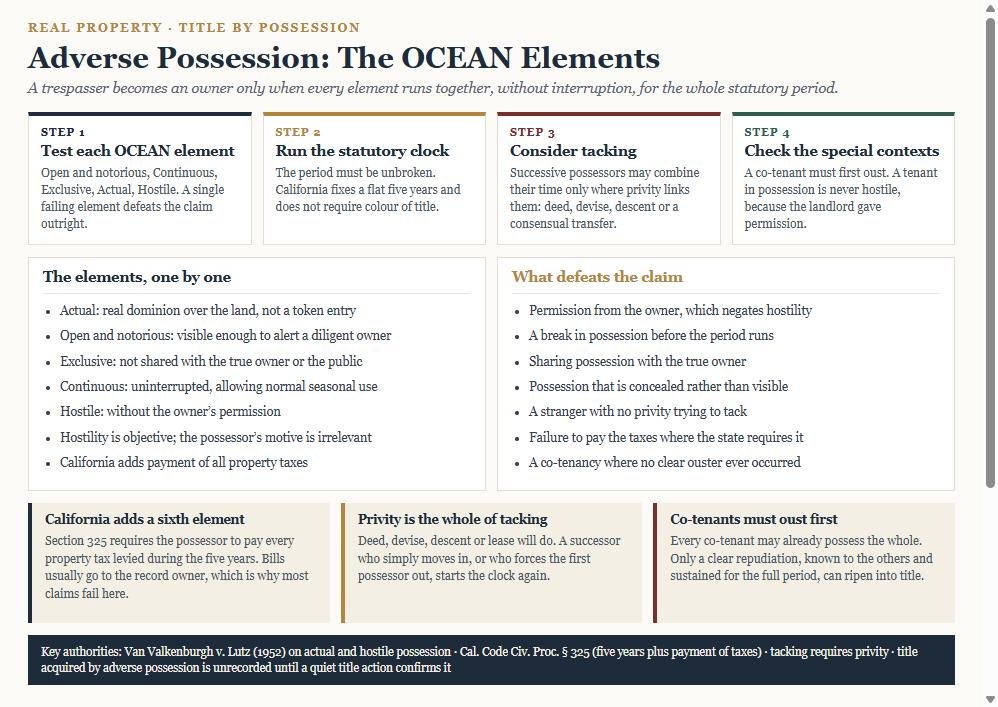
What adverse possession does
Adverse possession converts a trespasser into an owner. Once the elements have run for the statutory period, title passes by operation of law, an outcome the quiet title action later confirms on the record, and the former owner’s right to eject is gone. The doctrine operates as an alternative title system running alongside the recording acts: nothing appears in the public records until the new owner brings a quiet title action to confirm what possession has already accomplished.
That structural point matters. Because adverse possession is part of the common-law property regime, courts have consistently rejected the argument that it amounts to an uncompensated taking. The original owner’s loss follows from property law itself rather than from government action, so there is no claim against the state.
The elements, one by one
The familiar mnemonic is OCEAN: open and notorious, continuous, exclusive, actual, hostile. The order does not matter; the conjunction does.
Actual possession
The claimant must exercise real dominion over the land in the way an owner of that kind of property would: cultivating, building, fencing, maintaining. A token entry or occasional trespass is not enough. Where the claimant occupies only part of a parcel, possession usually extends no further than the area actually used.
Open and notorious
The use must be visible enough that a reasonably diligent owner inspecting the property would discover it. Secret or concealed occupation fails, because the doctrine ultimately rests on the owner’s failure to act on notice they could have had. A fence is the classic proof of openness.
Exclusive
Possession must not be shared with the true owner or with the general public. Sharing with the owner defeats the element outright, though possession jointly with a co-claimant in privity does not.
Continuous
Continuity is measured against the normal use of that type of land, so seasonal occupation of a summer cabin can be continuous while sporadic weekend visits to a suburban lot are not. Any genuine abandonment, or a successful ejectment action by the owner, resets the clock to zero.
Hostile
Hostile simply means without the owner’s permission. The test is objective: the possessor’s state of mind and motives are irrelevant in most jurisdictions, and a good-faith mistake about a boundary line is as hostile as a deliberate land grab. Permission, by contrast, destroys the element completely, which is why a licence or a lease can never ripen into title.
The statutory clock
The period is set by statute and varies widely between jurisdictions. California fixes a flat five years under Code of Civil Procedure section 325, with no separate longer period and no colour of title requirement. Some jurisdictions shorten the period where the possessor holds under colour of title or pays taxes; others do not.
Two doctrines can stop the clock. Where the owner is under a disability at the moment the possession begins, many statutes toll the period. And where the possessor’s interest is subordinate to another, as with a tenant, the clock never starts at all.
California adds a sixth element
California requires the adverse possessor to have paid all property taxes levied on the disputed land throughout the five-year period. This is the element that defeats the majority of California claims, because tax bills are sent to the record owner and a possessor who never receives one rarely thinks to pay. If a question tells you who paid the taxes, that fact is doing work.
| Element | Satisfied by | Defeated by |
|---|---|---|
| Actual | Cultivation, fencing, building, maintenance | A token or occasional entry |
| Open and notorious | Visible use a diligent owner would find | Concealed or secret occupation |
| Exclusive | Sole possession, or possession with a privy | Sharing with the true owner or the public |
| Continuous | Unbroken use normal for that land | Abandonment or a successful ejectment |
| Hostile | Absence of permission | A licence, lease or other consent |
| Statutory period | The full term, e.g. five years in California | A break before the term expires |
| Taxes (California) | Payment of every levy for five years | Bills paid by the record owner |
Exam tip: examiners rarely give you a claim that fails on two elements. Find the single weak element, prove it fails, and then say in one sentence that the remaining elements are satisfied. That structure reads as control rather than as a recital.
Tacking: combining successive possessors
A claimant may add a predecessor’s time to their own, but only where privity connects them. Privity means a non-hostile legal nexus, and four relationships qualify.
- A deed from the first possessor to the second.
- A devise, where the first possessor leaves the land by will.
- Descent, where the successor takes by intestate succession.
- A lease or other consensual transfer of the possessory interest.
Where privity is absent, tacking fails and the newcomer starts a fresh clock. Two situations recur in questions. A stranger who simply moves in after the first possessor leaves cannot borrow that time. And a successor who ousts the first possessor by force or intimidation breaks the chain, because an ouster is the opposite of the non-hostile nexus privity requires.
Co-tenants and the requirement of ouster
Every co-tenant already holds the right to possess the whole property, so exclusive occupation by one of them is not hostile to the others. A possessing co-tenant can only begin to acquire the others’ shares after an ouster: a clear repudiation of the cotenancy, by words or conduct denying the others’ right to possess, of which they have actual or constructive knowledge, sustained for the full statutory period.
After ouster, the ordinary elements apply as usual, including the California tax requirement. Paying taxes and insurance is not itself required to prove ouster in most jurisdictions, but it strengthens the claim by showing the possessor was acting as sole owner rather than as one co-owner among several.
Landlords and tenants
A tenant’s possession is permissive and therefore never hostile, so a lease cannot mature into title. A tenant who holds over after the term ends occupies a different position, but the hostility clock only begins once the possession genuinely ceases to be under the landlord’s permission, and a landlord who accepts rent restarts consent.
Common mistakes that cost points
- Treating the elements as sequential rather than simultaneous and continuous.
- Importing a good-faith requirement into hostility. Motive is irrelevant in most jurisdictions.
- Forgetting that permission at any point destroys hostility for that period.
- Applying the general rule to a co-tenant without first finding an ouster.
- Allowing tacking between strangers with no deed, devise, descent or lease.
- Overlooking California’s tax payment requirement, which is the usual reason a claim fails.
- Assuming title appears in the record automatically, rather than through a quiet title action.
Frequently asked questions
Does the possessor need to believe the land is theirs?
In most jurisdictions, no. Hostility is judged objectively by the absence of permission. A minority of courts once asked about the possessor’s claim of right, and a few older cases treated an admission that the land belonged to someone else as fatal, but the modern majority rule looks only at consent.
Can you adversely possess against the government?
Generally not. Public land held for public use is ordinarily immune, and the principle of sovereign immunity reinforces the bar, and statutes commonly bar adverse possession against the state or its subdivisions outright. Treat a government owner as a complete answer unless the question tells you otherwise.
How much land does the possessor acquire?
Only the area actually possessed, unless the claimant entered under colour of title, in which case constructive possession may extend to the whole parcel described in the defective instrument. In boundary disputes this usually means the disputed strip and nothing more.
Adverse possession in California: the tax payment trap, 2026
California makes adverse possession considerably harder than most states, and the reason is a single statutory requirement that catches out claimants who satisfy every common law element. Under the California Code of Civil Procedure the limitation period is five years, which is short, but section 325 additionally requires that the claimant have paid all taxes levied and assessed on the property for the entire five-year period.
In Los Angeles County that requirement is usually decisive. The Assessor bills the record owner, and payments are credited to the assessment for the parcel as described in the roll, so an occupier of a strip of a neighbour’s lot ordinarily cannot show payment of taxes on that strip at all. Claims therefore tend to succeed only where a whole parcel is occupied under a defective deed and the occupier has been receiving and paying the tax bill, or where an assessment genuinely covers the disputed area.
The elements, with the California variations:
- Actual possession. Physical occupation and use consistent with ownership, evidenced by enclosure, cultivation or improvement.
- Open and notorious. Visible enough that a reasonably attentive owner would notice.
- Hostile and under claim of right or colour of title. Permission defeats the claim entirely.
- Exclusive and continuous for five years. Sharing possession with the owner is fatal, and tacking requires privity.
- Payment of all taxes. The distinctively Californian requirement, and the usual reason claims fail.
- Government land is immune. Property held for public use cannot be acquired by adverse possession.
In 2026, obtain the tax payment history from the county before evaluating any claim, and consider whether an equitable easement is the realistic remedy instead. Read with easements, the recording acts and the statute of frauds.
Next steps
Adverse possession is one of two places where property rights change without a signed instrument, so it pairs naturally with the writing rules. Read it alongside the statute of frauds and MYLEGS to see how land contracts are treated when nothing was written, and then the rule against perpetuities for the other property doctrine examiners use to separate careful candidates from confident ones.
For practice, take a single boundary-fence fact pattern and vary one element at a time: add permission, add a gap in occupation, change who paid the taxes, and insert a stranger as successor. Then read the adverse possession overview at Cornell’s Legal Information Institute to confirm how your jurisdiction frames colour of title and tolling.
Related guides
- Advisory Opinions: Article III and Declaratory Relief
- Access to the Courts: When Filing Fees Are Unconstitutional
- Other Enumerated Powers: Postal, Bankruptcy, Admiralty
- Franchise Amendments: Congress and the Right to Vote
- Property Clause: Congress and Federal Lands Explained
- No Federal Police Power: Enumerated Powers and Enclaves
- Contracts Clause: When States May Impair Agreements
- Takings Clause: Lucas, Penn Central and Just Compensation
- Free Exercise Clause: Smith, Lukumi and Fulton Applied
- Establishment Clause: Church, State and the New Test
- Freedom of Association: Scrutiny, Dale and Disclosure
- Freedom of the Press: Publication Liability and Limits
- Campaign Finance and Anonymous Speech: The Core Rules
- Unconstitutional Conditions: Benefits and Rights Waivers
- Government Speech Doctrine: When the State Can Choose
- Vagueness and Overbreadth: Facial Challenges Explained
- Prior Restraint and Licensing: The Freedman Safeguards
- Symbolic Conduct and the O’Brien Test: The Pivot Question
- Government Employee Speech: Garcetti and Pickering Rules
- Commercial Speech and the Central Hudson Four-Part Test
- Actual Malice and the Three Tracks of Defamation Law
- Public Forum Doctrine and the Time, Place, Manner Test
- First Amendment: The Three-Question Speech Framework
- One Person, One Vote: Voting Rights Under Equal Protection
- Alienage Classifications: Strict Scrutiny and Its Pockets
- Equal Protection: The Three-Step Classification Test
- Second Amendment: The Bruen Text-and-History Standard
- Substantive Due Process After Dobbs: A Two-Step Test
- Procedural Due Process: Notice, Hearing and Mathews
- Incorporation Doctrine: Which Rights Bind the States
- Full Faith and Credit: Recognising Sister-State Judgments
- The Complete Auto Test: Taxing Interstate Commerce
- The Right to Travel: Durational Residency Explained
- Article IV Privileges and Immunities: The Comity Rule
- Federal Preemption: The Three-Step Ladder Explained
- The Supremacy Clause: Floors, Ceilings and Preemption
- Intergovernmental Immunity: The Shield Runs One Way
- The Presidential Pardon Power: Four Limits That Matter
- Executive Privilege: A Qualified Right That Must Yield
- Presidential Immunity: Criminal, Civil and Private Acts
- The Removal Power: At-Will Firing and Its Exceptions
- The Appointment Power: Principal and Inferior Officers
- Take Care Clause: Enforcement Discretion and Its Limits
- Commander-in-Chief Power: Deploy Without Declaring War
- Executive Agreements: The President’s Sole Foreign Power
- The Treaty Power: Senate Advice and Consent Explained
- The Presidential Veto Power, Override and Pocket Veto
- Bicameralism and Presentment: Two Vetoes Struck Down
- The Nondelegation Doctrine and the Intelligible Principle
- Speech or Debate Clause: Absolute but Narrow Immunity
- The Impeachment Power: House Majority, Senate Two-Thirds
- Congress’s Naturalization Power and Citizenship Limits
- Congressional War Powers: Declare, Fund and Command
- Anti-Commandeering Doctrine and the Tenth Amendment
- Section 5 Enforcement Power: Remedy, Do Not Redefine
- The Spending Power and the Five Dole Test Conditions
- Congress’s Taxing Power: When a Penalty Is Really a Tax
- The Necessary and Proper Clause: Congress’s Multiplier
- Ex Post Facto Clause: Retroactive Criminal Laws Barred
- Bills of Attainder: Legislative Punishment Explained
- The Writ of Habeas Corpus: Testing Unlawful Detention
- Supreme Court Jurisdiction: Original vs Appellate Power
- Abstention Doctrine: 4 Ways Federal Courts Step Aside
- Dormant Commerce Clause: Discrimination vs Pike Balancing
- The Commerce Clause: 3 Categories and 2 Hard Limits
- State Action Doctrine: The Government Conduct Threshold
- The Eleventh Amendment and State Sovereign Immunity
- Political Question Doctrine: What Courts Will Not Decide
- Ripeness and Mootness: Timing Rules in Federal Court
- Standing in Federal Court: The 3-Part Article III Test
- Marbury v. Madison and the Power of Judicial Review
- The Youngstown Framework: Presidential Power in 3 Zones
- The IRAC Method: How to Structure a Bar Exam Answer
- Piercing the Corporate Veil: A Two-Prong Alter Ego Test
- Defamation Elements, Fault Standards and Privileges
- The Parol Evidence Rule: Integration and Exceptions
- Recording Acts: Race, Notice and Race-Notice Explained
- Partner Liability and Authority Under RUPA Explained
- Trustee Duties: Care, Loyalty, Impartiality, Accounts
- Specific Performance: A Six-Element Bar Exam Framework
- Will Execution Requirements: Formalities and Rescue
- Community Property Presumptions in California Explained
- Easements Explained: Creation, Scope and Termination
- Products Liability: The Three Defect Theories Explained
- Miranda Rights: Custody, Interrogation and Invocation
- The Character Evidence Rules: Propensity Bar and Doorways
- Business Judgment Rule and Directors’ Fiduciary Duties
- The Statute of Frauds: MYLEGS and How to Satisfy It
- Res Judicata vs Collateral Estoppel: Bar Exam Guide
- The Erie Doctrine Explained: A 4-Step Bar Exam Guide
- Conflicts of Interest: A 6-Step Decision Tree for the Bar
- The Rule Against Perpetuities Explained Step by Step
- Murder and Manslaughter: The Homicide Ladder Explained
- Consideration in Contract Law: Rules and Exceptions
- The Four Elements of Negligence: Bar Exam Breakdown
- The Hearsay Rule Explained: Exceptions and Exemptions
- Personal Jurisdiction: The 3-Step Bar Exam Framework
- 3 Levels of Scrutiny in Constitutional Law Explained
- The Citizenship Clause After Trump v. Barbara