
The Fifth Amendment provides that private property shall not be taken for public use without just compensation, and it binds the states through the Fourteenth. The power it regulates — eminent domain — is not prohibited; it is priced. The government may take what it needs for public purposes, but it must pay.
The analytical difficulty is that most modern disputes do not involve the state seizing land at all. They involve regulation that leaves title untouched while destroying much of what the owner hoped to do. That is why the doctrine splits into possessory takings, which are absolute, and regulatory takings, which divide again into the categorical rule of Lucas and the balancing test of Penn Central. This guide sets out each branch, the denominator rule that quietly decides many cases, and the exaction line from Nollan to Koontz.
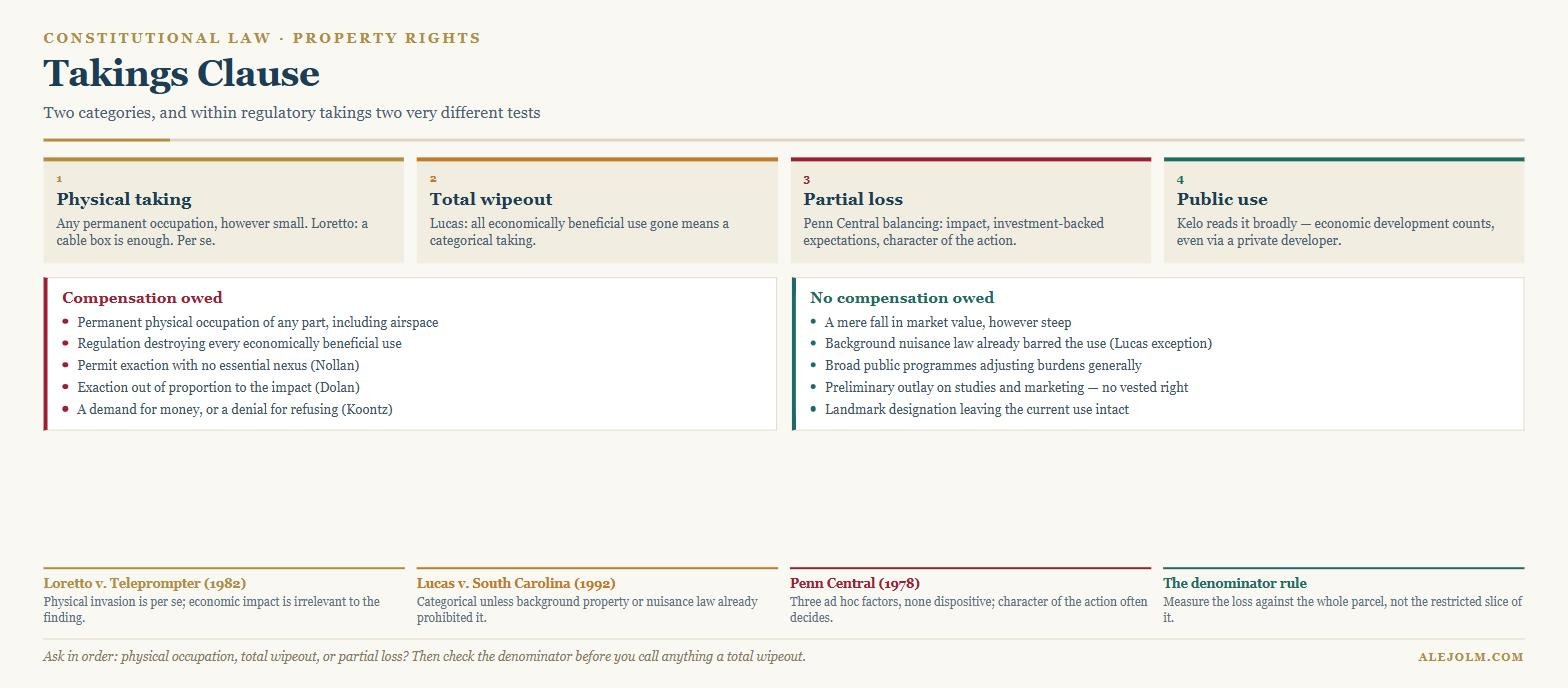
Possessory takings: physical occupation is per se
Where the government physically confiscates property or permanently occupies it, there is a taking and compensation is owed. No balancing, no inquiry into how much the owner has lost, no weighing of the public benefit. The rule extends to partial occupation and to airspace as readily as to the surface.
Loretto v. Teleprompter Manhattan CATV Corp. (1982) fixes just how little is required. A statute obliged landlords to permit installation of cable equipment — a small box and some cabling on the building. The economic impact was trivial, arguably positive for the property, and the public benefit obvious. It was still a per se taking, because the intrusion was permanent and physical. The character of the invasion, not its magnitude, is what triggers the rule.
Two distinctions keep this branch tidy. Permanence matters: a temporary entry is assessed differently from a permanent occupation. And occupation must be distinguished from restriction — forbidding an owner to build is regulation, whereas installing something on the land is occupation. Where the facts describe anything the government or its licensee physically places on or takes from the property, start here and stop.
Lucas: destroying all economically beneficial use
Regulation that leaves the owner in possession can still be a taking. Lucas v. South Carolina Coastal Council (1992) established the categorical rule: where a regulation deprives an owner of all economically beneficial use of the property, that is a taking without further balancing.
The word doing the work is “all”. A regulation that reduces value dramatically is not within Lucas; a mere decline in market value, however painful, does not amount to a taking. The claimant must show the property has been rendered economically valueless, which is a demanding threshold and one the denominator rule makes harder still.
There is one significant escape for the government. No taking occurs where the state shows that background principles of its own property and nuisance law already prohibited the use. If building on the land would always have been an actionable nuisance, the regulation has taken nothing the owner ever had. Note carefully what this does not permit: the defence is confined to pre-existing background law. A newly enacted environmental or planning policy, however meritorious, is a regulation rather than a background principle, and asserting a strong public interest is not a substitute.
Penn Central: balancing partial losses
Where there is no physical occupation and no total wipeout, the case is governed by the three ad hoc factors from Penn Central Transportation Co. v. New York City (1978). None is dispositive, and the exercise is deliberately fact-specific.
- The economic impact on the owner. How much value has actually been lost, measured against the whole property rather than the restricted part.
- Interference with reasonable investment-backed expectations. What the owner legitimately planned and relied upon, judged against the regulatory landscape when the property was acquired.
- The character of the government action. Whether the measure resembles a physical invasion or a targeted imposition on one owner — which weighs towards a taking — or is a broad public programme adjusting the benefits and burdens of economic life generally, which weighs against.
The third factor is the one that most often decides the outcome and the one most often skipped. A landmark-preservation ordinance applying across a city, or a zoning scheme applying across a district, is a general adjustment of burdens; singling out one parcel for a restriction that serves the public at that owner’s expense looks much more like an appropriation. Expectations also deserve care: only substantial construction undertaken in reliance on a valid permit creates a vested right. Preliminary expenditure on feasibility studies, design work and marketing does not.
Exam tip: fix the denominator before you classify the case. Restricting ten acres of a hundred-acre parcel is a ninety per cent retained value, not a total wipeout — so it is Penn Central, not Lucas.
The denominator rule
Economic impact is measured against the property as a whole, not against the portion the regulation restricts. If ten of a hundred acres become unbuildable, the denominator is one hundred acres. The owner has lost a tenth of the parcel’s development potential, not the entirety of the affected strip.
This is why so many claims that look categorical on first reading collapse into balancing. A claimant naturally frames the loss as total by defining the property narrowly — the restricted strip, the wetland portion, the setback area. The rule refuses that framing. Since Lucas requires the elimination of all economically beneficial use, and the denominator is generously drawn, genuine categorical regulatory takings are rare, and most litigation ends up in Penn Central.
Public use, and exactions
Even a plain taking is lawful if it is for public use and compensated. Kelo v. City of New London (2005) read the public-use requirement expansively: economic development qualifies, and property may be transferred to private developers as part of an integrated redevelopment plan. The practical effect is that public use rarely defeats a taking, and the real contest is almost always over whether a taking occurred and what compensation is due. Many states responded by enacting statutory limits on economic-development takings, which is a matter of state law rather than federal doctrine.
The exaction cases sit at the junction of takings and unconstitutional conditions. Nollan v. California Coastal Commission (1987) requires an essential nexus between a permit condition and the harm the permit requirement addresses. Dolan v. City of Tigard (1994) adds rough proportionality between the exaction and the development’s projected impact. Koontz v. St. Johns River Water Management District (2013) closed the obvious loopholes: the analysis applies where the permit is refused for declining the condition, and where the demand is for money rather than land.
Compensation itself is measured by fair market value at the time of the taking — what a willing buyer would pay a willing seller — rather than by the owner’s subjective valuation or the gain the government expects to realise.
| Government action | Category |
|---|---|
| Permanent installation of equipment on a building | Physical (Loretto) |
| Permanent occupation of airspace | Physical |
| Ban on all construction, land now valueless | Categorical (Lucas) |
| Ban on construction where background nuisance law applied | Lucas exception |
| Landmark designation, current use continues | Penn Central |
| Restriction on part of a larger parcel | Denominator rule |
| Transfer to a private developer for redevelopment | Public use (Kelo) |
| Permit condition with no nexus or proportionality | Exaction (Nollan, Dolan) |
| Monetary demand, or denial for refusing a condition | Exaction (Koontz) |
Worked example
City Z designates a privately owned century-old building as a historic landmark. The owner may not demolish it or materially alter the exterior without approval, but may continue operating the offices and retail units, may renovate the interior, and may sell or lease freely. The owner establishes that market value has fallen by roughly thirty per cent, because a larger and more profitable building can no longer be erected on the site, and sues for compensation.
Work through the categories in order. There is no physical occupation — nothing has been installed and nobody has entered — so Loretto is out. Nor is this a total wipeout: the building remains in profitable commercial use and remains saleable, so Lucas is out as well, and the loss of the most profitable potential use is not the loss of all economically beneficial use. That leaves Penn Central. On economic impact, a thirty per cent diminution is real but well short of decisive on its own. On investment-backed expectations, the owner has not been prevented from continuing the use actually being made of the property; the frustrated plan was a hoped-for future redevelopment, which is a weaker expectation than an existing operation. On character, a landmark-preservation ordinance applying across the city is a broad public programme adjusting burdens generally, not a targeted imposition on this owner — and that factor weighs heavily against a taking. On balance, no compensation is owed.
Change one fact. Suppose the ordinance had also required the owner to open the lobby to the public for guided tours during business hours. That is a permanent physical invasion authorised by the state, and under Loretto the balancing exercise never begins — the magnitude of the burden becomes irrelevant and compensation is owed for the occupation, however modest. The same statute, one added clause, and an entirely different branch of the doctrine.
Common mistakes that cost points
- Treating a steep fall in market value as a taking. Diminution alone is not enough; Lucas requires the elimination of all economically beneficial use.
- Ignoring the denominator rule and defining the property as the restricted portion. Measure against the whole parcel.
- Balancing a physical occupation. Loretto is per se, and the economic impact is irrelevant to whether a taking occurred.
- Treating a new regulation as a background principle of property law. The Lucas defence is confined to pre-existing nuisance and property doctrine.
- Skipping the character-of-the-action factor, which is frequently what decides a Penn Central case.
- Treating preliminary outlay as a vested right. Only substantial construction in reliance on a valid permit qualifies.
- Arguing that public use defeats the taking. After Kelo the requirement is read broadly and rarely does any work.
- Overlooking Koontz where the permit was refused, or where the demand was for money rather than land.
Frequently asked questions
Is a large drop in property value a taking?
Not by itself. A regulatory taking requires either a permanent physical occupation or the elimination of all economically beneficial use. Anything short of that is assessed under Penn Central balancing, where a substantial diminution is one factor among three and rarely carries the case alone.
What is the denominator rule?
It fixes what the loss is measured against: the whole parcel, not the regulated part. Restrict ten acres of a hundred-acre holding and the owner retains ninety per cent of the property’s potential, so there is no total wipeout and the case proceeds under Penn Central rather than Lucas.
Can the government take property and give it to a private developer?
Yes, if the taking serves a public purpose and just compensation is paid. Kelo held that economic development satisfies the public-use requirement even where title passes to private parties under a redevelopment plan. Many states have since restricted such takings by statute, so the state-law position must always be checked.
Takings law in California and Los Angeles County in 2026
California does not simply mirror the federal test. Article I, section 19 of the state constitution requires compensation when property is “taken or damaged” for public use, and that extra word matters: California recognises inverse condemnation claims for physical damage caused by public improvements on something close to a strict liability basis, without the fault showing a negligence claim would demand. A Los Angeles County homeowner whose lot is undermined by a county flood control channel or a municipal water main is therefore in a materially stronger position under state law than the federal Fifth Amendment alone would suggest.
The procedural route also differs. Eminent domain in California runs through title 7 of the California Code of Civil Procedure, which governs the resolution of necessity, deposit of probable compensation, and the owner’s right to a jury on valuation. Because Knick v. Township of Scott (2019) removed the old requirement to exhaust state compensation procedures first, a 2026 claimant in Los Angeles County can often choose between the Los Angeles Superior Court and the federal Central District of California, and that choice drives everything from jury pool to appellate law.
Several features are distinctly local and worth knowing before you advise anyone here:
- Redevelopment takings are largely gone. California dissolved its redevelopment agencies in 2011, and Proposition 99 (2008) already barred taking an owner-occupied residence to convey it to a private party. The Kelo scenario is close to a dead letter in the state, so do not assume federal permissiveness translates into state practice.
- Exactions are the live battleground. Los Angeles County Regional Planning and the City of Los Angeles routinely attach dedications, setbacks and impact fees to entitlements. Sheetz v. County of El Dorado (2024) confirmed that legislatively imposed conditions are not exempt from the Nollan and Dolan nexus and rough proportionality tests, which reopened a great deal of fee litigation.
- The Mitigation Fee Act supplies the deadlines. Government Code section 66000 and following imposes short protest and limitations periods for challenging development fees. Missing them forfeits an otherwise sound constitutional argument, a trap that catches competent lawyers.
- Coastal permits add a second regulator. Malibu and the Santa Monica Bay shoreline sit inside the coastal zone, so a Coastal Commission condition can be the operative government act rather than any county decision.
- Rent and tenancy rules are regulatory, not possessory. Los Angeles County and City rent stabilisation and eviction limits are analysed under Penn Central balancing, not as physical occupations, and courts have consistently rejected the per se framing.
- Wildfire and utility claims are a distinct stream. Inverse condemnation against investor-owned utilities has reshaped California liability exposure, and the doctrine is state constitutional rather than federal.
For 2026 the practical instruction is to plead both constitutions, calendar the statutory fee deadlines immediately, and treat the state claim as the stronger one where physical damage is involved. Read this alongside the unconstitutional conditions doctrine, which supplies the reasoning Sheetz applied, and easements, since many exactions are dedications of an easement interest. Confirm current fee schedules and local ordinances directly with the county before relying on any figure, because these change annually.
Next steps
The exaction cases straddle two doctrines, so read this alongside the unconstitutional conditions doctrine, which applies the same nexus reasoning to benefits generally. For the other constitutional constraints on state interference with economic arrangements, see the Contracts Clause and substantive due process. Where the complaint is about the process by which a designation or permit decision was made rather than its substance, the relevant framework is procedural due process.
The opinions in Lucas and Penn Central are the two most useful to read in full and are freely available through Justia’s Fifth Amendment collection. Cornell’s Legal Information Institute keeps a concise entry with current citations, and candidates should confirm the tested scope against the outlines published by the State Bar of California.
Related guides
- Advisory Opinions: Article III and Declaratory Relief
- Access to the Courts: When Filing Fees Are Unconstitutional
- Other Enumerated Powers: Postal, Bankruptcy, Admiralty
- Franchise Amendments: Congress and the Right to Vote
- Property Clause: Congress and Federal Lands Explained
- No Federal Police Power: Enumerated Powers and Enclaves
- Contracts Clause: When States May Impair Agreements
- Free Exercise Clause: Smith, Lukumi and Fulton Applied
- Establishment Clause: Church, State and the New Test
- Freedom of Association: Scrutiny, Dale and Disclosure
- Freedom of the Press: Publication Liability and Limits
- Campaign Finance and Anonymous Speech: The Core Rules
- Unconstitutional Conditions: Benefits and Rights Waivers
- Government Speech Doctrine: When the State Can Choose
- Vagueness and Overbreadth: Facial Challenges Explained
- Prior Restraint and Licensing: The Freedman Safeguards
- Symbolic Conduct and the O’Brien Test: The Pivot Question
- Government Employee Speech: Garcetti and Pickering Rules
- Commercial Speech and the Central Hudson Four-Part Test
- Actual Malice and the Three Tracks of Defamation Law
- Public Forum Doctrine and the Time, Place, Manner Test
- First Amendment: The Three-Question Speech Framework
- One Person, One Vote: Voting Rights Under Equal Protection
- Alienage Classifications: Strict Scrutiny and Its Pockets
- Equal Protection: The Three-Step Classification Test
- Second Amendment: The Bruen Text-and-History Standard
- Substantive Due Process After Dobbs: A Two-Step Test
- Procedural Due Process: Notice, Hearing and Mathews
- Incorporation Doctrine: Which Rights Bind the States
- Full Faith and Credit: Recognising Sister-State Judgments
- The Complete Auto Test: Taxing Interstate Commerce
- The Right to Travel: Durational Residency Explained
- Article IV Privileges and Immunities: The Comity Rule
- Federal Preemption: The Three-Step Ladder Explained
- The Supremacy Clause: Floors, Ceilings and Preemption
- Intergovernmental Immunity: The Shield Runs One Way
- The Presidential Pardon Power: Four Limits That Matter
- Executive Privilege: A Qualified Right That Must Yield
- Presidential Immunity: Criminal, Civil and Private Acts
- The Removal Power: At-Will Firing and Its Exceptions
- The Appointment Power: Principal and Inferior Officers
- Take Care Clause: Enforcement Discretion and Its Limits
- Commander-in-Chief Power: Deploy Without Declaring War
- Executive Agreements: The President’s Sole Foreign Power
- The Treaty Power: Senate Advice and Consent Explained
- The Presidential Veto Power, Override and Pocket Veto
- Bicameralism and Presentment: Two Vetoes Struck Down
- The Nondelegation Doctrine and the Intelligible Principle
- Speech or Debate Clause: Absolute but Narrow Immunity
- The Impeachment Power: House Majority, Senate Two-Thirds
- Congress’s Naturalization Power and Citizenship Limits
- Congressional War Powers: Declare, Fund and Command
- Anti-Commandeering Doctrine and the Tenth Amendment
- Section 5 Enforcement Power: Remedy, Do Not Redefine
- The Spending Power and the Five Dole Test Conditions
- Congress’s Taxing Power: When a Penalty Is Really a Tax
- The Necessary and Proper Clause: Congress’s Multiplier
- Ex Post Facto Clause: Retroactive Criminal Laws Barred
- Bills of Attainder: Legislative Punishment Explained
- The Writ of Habeas Corpus: Testing Unlawful Detention
- Supreme Court Jurisdiction: Original vs Appellate Power
- Abstention Doctrine: 4 Ways Federal Courts Step Aside
- Dormant Commerce Clause: Discrimination vs Pike Balancing
- The Commerce Clause: 3 Categories and 2 Hard Limits
- State Action Doctrine: The Government Conduct Threshold
- The Eleventh Amendment and State Sovereign Immunity
- Political Question Doctrine: What Courts Will Not Decide
- Ripeness and Mootness: Timing Rules in Federal Court
- Standing in Federal Court: The 3-Part Article III Test
- Marbury v. Madison and the Power of Judicial Review
- The Youngstown Framework: Presidential Power in 3 Zones
- The IRAC Method: How to Structure a Bar Exam Answer
- Piercing the Corporate Veil: A Two-Prong Alter Ego Test
- Defamation Elements, Fault Standards and Privileges
- The Parol Evidence Rule: Integration and Exceptions
- Recording Acts: Race, Notice and Race-Notice Explained
- Partner Liability and Authority Under RUPA Explained
- Trustee Duties: Care, Loyalty, Impartiality, Accounts
- Specific Performance: A Six-Element Bar Exam Framework
- Will Execution Requirements: Formalities and Rescue
- Community Property Presumptions in California Explained
- Easements Explained: Creation, Scope and Termination
- Products Liability: The Three Defect Theories Explained
- Miranda Rights: Custody, Interrogation and Invocation
- The Character Evidence Rules: Propensity Bar and Doorways
- Adverse Possession Elements: OCEAN and the Tax Rule
- Business Judgment Rule and Directors’ Fiduciary Duties
- The Statute of Frauds: MYLEGS and How to Satisfy It
- Res Judicata vs Collateral Estoppel: Bar Exam Guide
- The Erie Doctrine Explained: A 4-Step Bar Exam Guide
- Conflicts of Interest: A 6-Step Decision Tree for the Bar
- The Rule Against Perpetuities Explained Step by Step
- Murder and Manslaughter: The Homicide Ladder Explained
- Consideration in Contract Law: Rules and Exceptions
- The Four Elements of Negligence: Bar Exam Breakdown
- The Hearsay Rule Explained: Exceptions and Exemptions
- Personal Jurisdiction: The 3-Step Bar Exam Framework
- 3 Levels of Scrutiny in Constitutional Law Explained
- The Citizenship Clause After Trump v. Barbara