
Forum analysis is the third step of the speech framework, and it does something unusual: it makes the standard of review depend on real estate. The same leaflet handed out on a pavement, in a school corridor and on a subway platform attracts three different levels of judicial protection, and the whole doctrine consists of classifying the property and then reading off the consequence.
There are four categories and one recurring test. Get the classification right and the rest is close to mechanical. Get it wrong and every subsequent sentence is measured against the wrong standard.
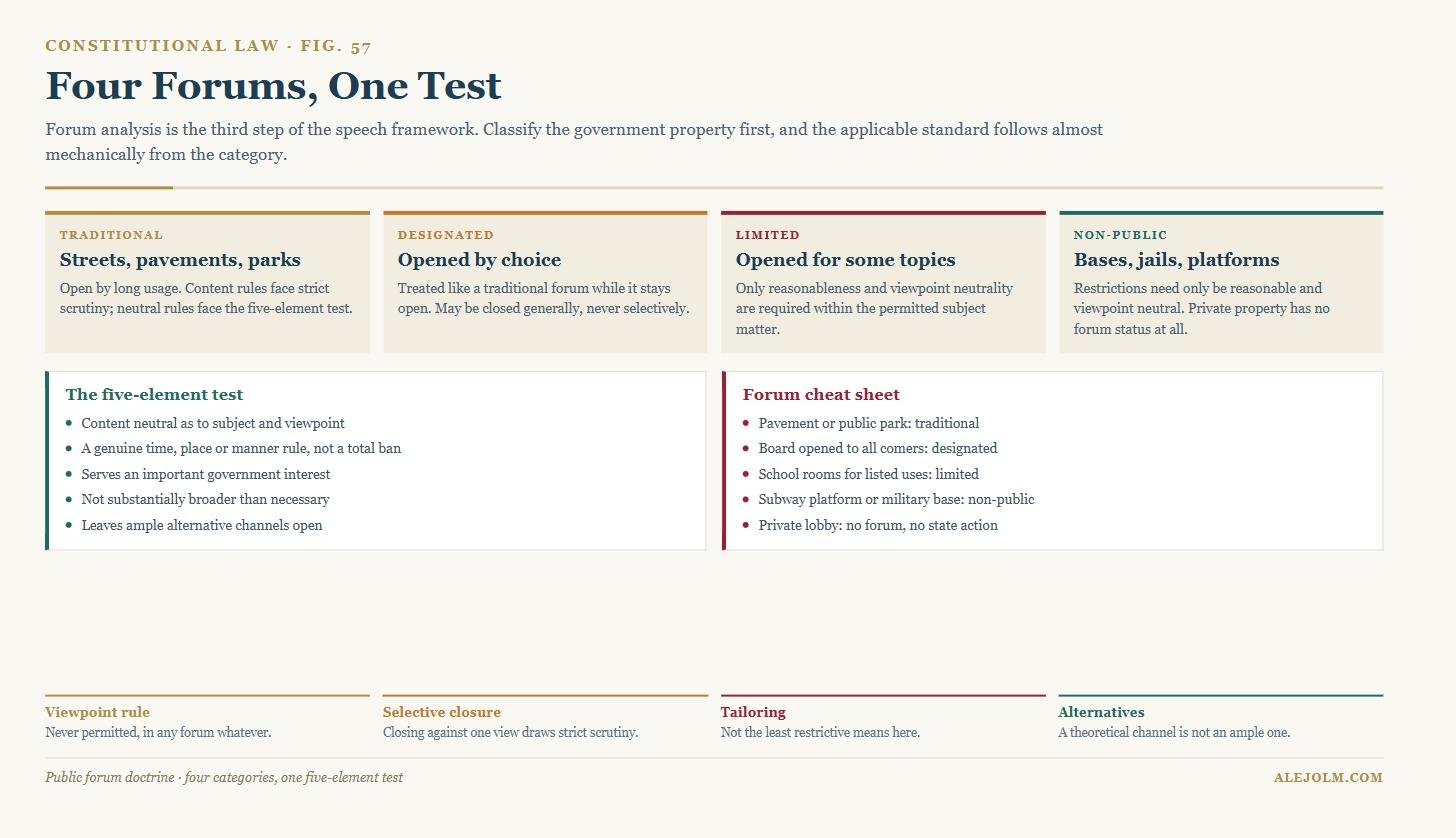
Traditional public forums
Streets, pavements, parks and public plazas have been open to assembly and expression for so long that the government is treated as constitutionally obliged to keep them available. Speech here receives the highest protection: a content-based restriction draws strict scrutiny, and even a neutral rule must satisfy the five-element test in full.
Note that the classification is historical rather than functional. A space does not become a traditional forum because it is outdoors, or busy, or owned by a city. It qualifies because that type of property has been dedicated to public expression by long usage.
The five-element test
A content-neutral restriction in a traditional or fully designated forum must satisfy every one of five requirements, and failure of a single element is fatal. The rule must be neutral as to both subject matter and viewpoint. It must be a genuine regulation of time, place or manner rather than a total prohibition. It must serve an important government interest, of which noise control, traffic flow and public safety are the standard examples. It must be narrowly tailored, meaning not substantially broader than necessary. And it must leave open ample alternative channels of communication.
Two elements repay close attention. Tailoring here is a weaker requirement than under strict scrutiny: the government need not adopt the least restrictive means, only avoid a rule substantially broader than its objective requires. The alternative-channels element, by contrast, is stronger than candidates assume. It is not satisfied by the bare existence of some other option. The alternative must be genuinely adequate to reach the intended audience, so a rule banning evening assembly can fail even though daytime assembly remains available, because the audience a speaker wants at seven in the evening is not the audience available at eleven in the morning.
Exam tip: work the five elements as a list and say so. Examiners are looking for the structure, and because failure of any one element is fatal you cannot reach a defensible conclusion by discussing only the interest and the tailoring.
Designated and limited forums
A designated public forum is property with no history of public expression that the government has nonetheless opened by policy or practice: school halls made available after hours, advertising space sold on buses, a noticeboard thrown open to community postings. While it remains open it is treated exactly like a traditional forum.
The government retains one significant power and is denied another. It may close a designated forum altogether, withdrawing the space from expressive use entirely, and no violation follows. What it may not do is close the forum selectively, shutting out one viewpoint while others continue to enjoy access. Selective closure is viewpoint discrimination wearing a procedural disguise, and it draws strict scrutiny.
A limited public forum is opened only for particular subjects or particular classes of speaker — rooms available to registered student societies, a consultation accepting comment on specified issues. Here the standard drops considerably: restrictions need only be reasonable and viewpoint neutral. The government may legitimately confine the forum by subject matter, and the frequent error is to apply the full five-element test to a limited forum, which over-protects the speech and reaches the wrong result.
| Forum | Content-based rules |
|---|---|
| Traditional public forum | Strict scrutiny |
| Designated public forum | Strict scrutiny |
| Limited public forum | Reasonable and viewpoint neutral |
| Non-public forum | Reasonable and viewpoint neutral |
| Private property | No forum status |
Non-public forums and private property
Military installations, prisons, government workplaces, internal mail systems, airport terminals and subway platforms are property the government may close to expression and has closed. Restrictions there must be reasonable and viewpoint neutral, and reasonableness is genuinely deferential: no compelling interest, no narrow tailoring, no ample-alternatives inquiry.
Viewpoint neutrality nonetheless survives everywhere. Even in a non-public forum the government may not take sides on a subject it has allowed. Barring all political material from a transit platform is a subject-matter restriction and permissible; barring criticism of the transit authority while permitting praise is viewpoint discrimination and is not.
Private property has no forum status, and a private owner may exclude speakers for any reason without answering to the First Amendment. The exception arrives through state action rather than through forum doctrine: where a private entity has taken on functions traditionally performed by government, as in the classic company-town case, its streets and pavements can be treated as public forums after all.
Worked example
A city opens the plaza beside its town hall as a free-speech zone with three rules: signs may not exceed two feet by three, speakers must register a day in advance, and no religious messages are permitted. An activist with an oversized sign criticising the mayor and a faith group wanting to post religious material are both refused.
The plaza is a designated public forum, deliberately opened for expression, so it is treated as traditional while open. The size limit is content neutral, serves orderly management of a shared space, is specific rather than sweeping, and leaves smaller signs and leafleting available; it should survive. The advance-registration requirement is likewise neutral and serves scheduling, though a rule admitting no exceptions for responses to breaking events would strain the tailoring and alternative-channels elements. The third rule is different in kind. Excluding religious messages sorts speech by subject matter on the face of the rule, so it is content-based and the five-element test never applies. Strict scrutiny governs, the city has no compelling interest in excluding religious expression from a forum it has opened to everything else, and if secular messages on the same questions are permitted the rule is viewpoint discriminatory as well. It falls.
Change one fact. Suppose the plaza had never been opened for expression and remained a secure approach to a government building, with all posting prohibited. It would be a non-public forum, the restriction would need only to be reasonable and viewpoint neutral, and a blanket ban on all signs by everyone would satisfy that standard comfortably.
Common mistakes that cost points
- Applying the five-element test to a limited or non-public forum, where reasonableness and viewpoint neutrality are all that is required.
- Requiring the least restrictive means under time, place and manner review, where the tailoring standard is weaker.
- Treating the existence of any alternative channel as satisfying the ample-alternatives element.
- Missing viewpoint discrimination hidden inside a rule that looks like ordinary forum management.
- Assuming a designated forum can never be closed, when general closure is permitted and only selective closure is not.
- Classifying property as a traditional forum because it is government-owned and outdoors rather than by historical dedication.
- Forgetting that viewpoint neutrality binds the government even in a non-public forum.
- Overlooking that a licensing scheme conferring unfettered discretion fails as a prior restraint whatever the forum.
Frequently asked questions
Can the government charge a fee for a demonstration permit?
A modest fee covering genuine administrative costs can survive as a manner regulation. What fails is a scheme in which an official enjoys unfettered discretion over whether to grant the permit or how much to charge, because that operates as a prior restraint and is invalid independently of forum classification.
Is begging or panhandling protected speech?
Yes, because a request for assistance communicates a message. The outcome then turns on forum. On a pavement the speaker is in a traditional forum and is well protected; on a subway platform a reasonable, viewpoint-neutral restriction will be upheld; in a privately owned lobby there is no state action and no claim. A ban framed specifically as prohibiting solicitation is content-based and draws strict scrutiny.
What is the difference between a designated and a limited public forum?
A designated forum has been opened to expression generally and is treated like a traditional forum while it stays open. A limited forum has been opened only for defined subjects or speakers, and restrictions within it need only be reasonable and viewpoint neutral. The distinction determines whether the five-element test applies at all.
Public forums in Los Angeles County: airports, beaches and malls, 2026
The leading airport forum case came from Los Angeles. In Board of Airport Commissioners v. Jews for Jesus (1987) the Court struck down a resolution banning all First Amendment activity in the central terminal area at Los Angeles International Airport, holding the prohibition facially overbroad because it swept in even ordinary conversation. Later authority treated airport terminals as non-public forums subject to reasonableness review, so the modern position is that the county and city may regulate solicitation and leafleting sensibly but may not prohibit expression outright.
California then adds a category federal law does not recognise. Under Robins v. Pruneyard Shopping Center and its successors, privately owned shopping centres designed as public gathering places function as forums for speech and petitioning under the California Constitution. Ralphs Grocery narrowed this to genuine plaza-type spaces, so the physical design of the property is the decisive fact.
Forum classification across the county:
- Streets, sidewalks and parks are traditional forums. County and city permit schemes must be content neutral, narrowly tailored and leave ample alternative channels.
- Beaches and boardwalks are heavily regulated. Vending and performance rules on the Venice boardwalk have repeatedly been litigated, and the distinction between expressive activity and commerce is where cases turn.
- Transit property is generally non-public. Advertising space on county transit has been treated as a limited or non-public forum, so viewpoint neutrality is the key constraint.
- School and campus facilities depend on designation. Opening a room to community groups can create a limited public forum with its own neutrality obligations.
- Government social media accounts can be forums. Blocking constituents for viewpoint has produced liability for public officials.
- Private malls may impose reasonable rules. Registration requirements and designated areas have been upheld even where Pruneyard applies.
For 2026, classify the property, then match the standard, then ask whether California independently protects the speech. Read with the First Amendment framework, state action and symbolic conduct.
Next steps
This doctrine only makes sense as the third step of a larger routine, so start with the First Amendment framework and return here once you have classified the restriction. The levels of scrutiny explains the standards each category invokes, the state action doctrine governs whether private property can be reached at all, and the incorporation doctrine explains why municipal rules are subject to the Amendment in the first place.
The leading opinions are collected at Justia, the amendment is annotated by the Cornell Legal Information Institute, and current examination scope is published by the State Bar of California.
Related guides
- Advisory Opinions: Article III and Declaratory Relief
- Access to the Courts: When Filing Fees Are Unconstitutional
- Other Enumerated Powers: Postal, Bankruptcy, Admiralty
- Franchise Amendments: Congress and the Right to Vote
- Property Clause: Congress and Federal Lands Explained
- No Federal Police Power: Enumerated Powers and Enclaves
- Contracts Clause: When States May Impair Agreements
- Takings Clause: Lucas, Penn Central and Just Compensation
- Free Exercise Clause: Smith, Lukumi and Fulton Applied
- Establishment Clause: Church, State and the New Test
- Freedom of Association: Scrutiny, Dale and Disclosure
- Freedom of the Press: Publication Liability and Limits
- Campaign Finance and Anonymous Speech: The Core Rules
- Unconstitutional Conditions: Benefits and Rights Waivers
- Government Speech Doctrine: When the State Can Choose
- Vagueness and Overbreadth: Facial Challenges Explained
- Prior Restraint and Licensing: The Freedman Safeguards
- Symbolic Conduct and the O’Brien Test: The Pivot Question
- Government Employee Speech: Garcetti and Pickering Rules
- Commercial Speech and the Central Hudson Four-Part Test
- Actual Malice and the Three Tracks of Defamation Law
- First Amendment: The Three-Question Speech Framework
- One Person, One Vote: Voting Rights Under Equal Protection
- Alienage Classifications: Strict Scrutiny and Its Pockets
- Equal Protection: The Three-Step Classification Test
- Second Amendment: The Bruen Text-and-History Standard
- Substantive Due Process After Dobbs: A Two-Step Test
- Procedural Due Process: Notice, Hearing and Mathews
- Incorporation Doctrine: Which Rights Bind the States
- Full Faith and Credit: Recognising Sister-State Judgments
- The Complete Auto Test: Taxing Interstate Commerce
- The Right to Travel: Durational Residency Explained
- Article IV Privileges and Immunities: The Comity Rule
- Federal Preemption: The Three-Step Ladder Explained
- The Supremacy Clause: Floors, Ceilings and Preemption
- Intergovernmental Immunity: The Shield Runs One Way
- The Presidential Pardon Power: Four Limits That Matter
- Executive Privilege: A Qualified Right That Must Yield
- Presidential Immunity: Criminal, Civil and Private Acts
- The Removal Power: At-Will Firing and Its Exceptions
- The Appointment Power: Principal and Inferior Officers
- Take Care Clause: Enforcement Discretion and Its Limits
- Commander-in-Chief Power: Deploy Without Declaring War
- Executive Agreements: The President’s Sole Foreign Power
- The Treaty Power: Senate Advice and Consent Explained
- The Presidential Veto Power, Override and Pocket Veto
- Bicameralism and Presentment: Two Vetoes Struck Down
- The Nondelegation Doctrine and the Intelligible Principle
- Speech or Debate Clause: Absolute but Narrow Immunity
- The Impeachment Power: House Majority, Senate Two-Thirds
- Congress’s Naturalization Power and Citizenship Limits
- Congressional War Powers: Declare, Fund and Command
- Anti-Commandeering Doctrine and the Tenth Amendment
- Section 5 Enforcement Power: Remedy, Do Not Redefine
- The Spending Power and the Five Dole Test Conditions
- Congress’s Taxing Power: When a Penalty Is Really a Tax
- The Necessary and Proper Clause: Congress’s Multiplier
- Ex Post Facto Clause: Retroactive Criminal Laws Barred
- Bills of Attainder: Legislative Punishment Explained
- The Writ of Habeas Corpus: Testing Unlawful Detention
- Supreme Court Jurisdiction: Original vs Appellate Power
- Abstention Doctrine: 4 Ways Federal Courts Step Aside
- Dormant Commerce Clause: Discrimination vs Pike Balancing
- The Commerce Clause: 3 Categories and 2 Hard Limits
- State Action Doctrine: The Government Conduct Threshold
- The Eleventh Amendment and State Sovereign Immunity
- Political Question Doctrine: What Courts Will Not Decide
- Ripeness and Mootness: Timing Rules in Federal Court
- Standing in Federal Court: The 3-Part Article III Test
- Marbury v. Madison and the Power of Judicial Review
- The Youngstown Framework: Presidential Power in 3 Zones
- The IRAC Method: How to Structure a Bar Exam Answer
- Piercing the Corporate Veil: A Two-Prong Alter Ego Test
- Defamation Elements, Fault Standards and Privileges
- The Parol Evidence Rule: Integration and Exceptions
- Recording Acts: Race, Notice and Race-Notice Explained
- Partner Liability and Authority Under RUPA Explained
- Trustee Duties: Care, Loyalty, Impartiality, Accounts
- Specific Performance: A Six-Element Bar Exam Framework
- Will Execution Requirements: Formalities and Rescue
- Community Property Presumptions in California Explained
- Easements Explained: Creation, Scope and Termination
- Products Liability: The Three Defect Theories Explained
- Miranda Rights: Custody, Interrogation and Invocation
- The Character Evidence Rules: Propensity Bar and Doorways
- Adverse Possession Elements: OCEAN and the Tax Rule
- Business Judgment Rule and Directors’ Fiduciary Duties
- The Statute of Frauds: MYLEGS and How to Satisfy It
- Res Judicata vs Collateral Estoppel: Bar Exam Guide
- The Erie Doctrine Explained: A 4-Step Bar Exam Guide
- Conflicts of Interest: A 6-Step Decision Tree for the Bar
- The Rule Against Perpetuities Explained Step by Step
- Murder and Manslaughter: The Homicide Ladder Explained
- Consideration in Contract Law: Rules and Exceptions
- The Four Elements of Negligence: Bar Exam Breakdown
- The Hearsay Rule Explained: Exceptions and Exemptions
- Personal Jurisdiction: The 3-Step Bar Exam Framework
- 3 Levels of Scrutiny in Constitutional Law Explained
- The Citizenship Clause After Trump v. Barbara