
Preclusion questions look intimidating because two doctrines share the same courtroom. Res judicata vs collateral estoppel is really a question of scale: claim preclusion removes an entire cause of action, while issue preclusion removes a single decided question and leaves the rest of the case standing. Get the scale right and the elements follow easily.
This guide separates the two doctrines, lists their elements in the order courts apply them, explains what “on the merits” actually means, and walks through the defensive and offensive uses of non-mutual issue preclusion that examiners test most often.
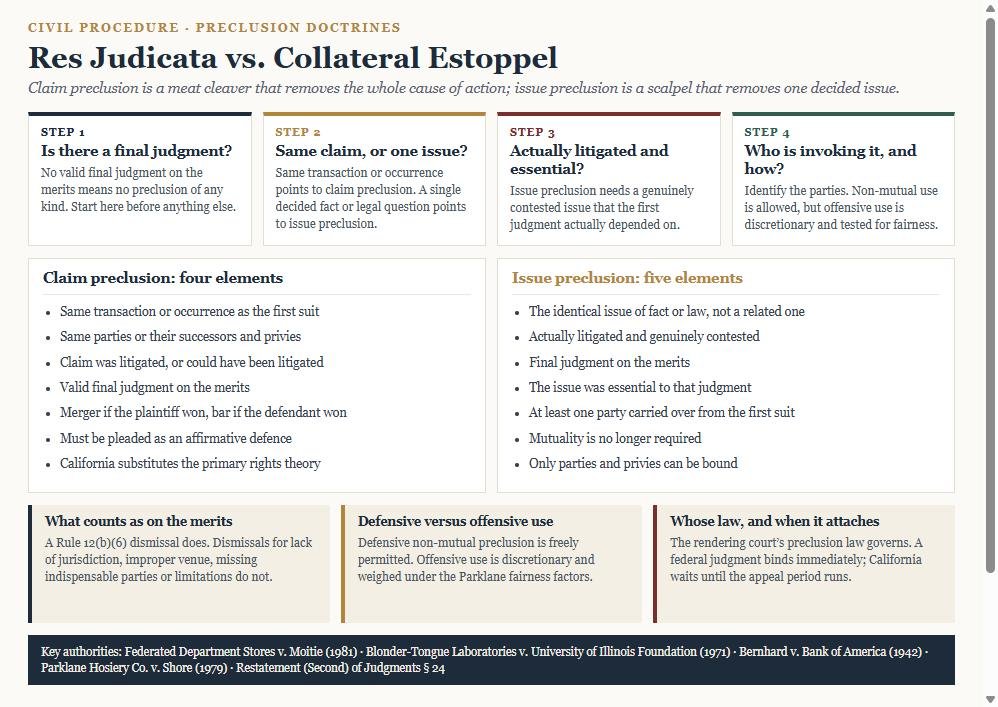
The two doctrines in one sentence each
Res judicata, or claim preclusion, bars a second suit on the same claim once a valid final judgment on the merits has been entered between the same parties. Collateral estoppel, or issue preclusion, bars relitigation of a specific issue of fact or law that was actually litigated, decided, and essential to a prior judgment.
The traditional image is worth remembering. Claim preclusion is a meat cleaver: it takes off the whole cause of action, including every theory the plaintiff could have raised but did not. Issue preclusion is a scalpel: it excises one finding and leaves the surrounding claim intact.
Claim preclusion: the four elements
- Same claim. Federal courts use the transactional test from the Restatement approach: any claim arising out of the same transaction or occurrence, or series of connected transactions, is the same claim.
- Same parties or their privies. The same plaintiff must be suing the same defendant, or a successor in interest, someone who controlled the earlier litigation, or a party bound by a special legal relationship.
- Litigated or capable of being litigated. Every theory available within that transaction is barred, even one the plaintiff never raised and even one the plaintiff did not know about.
- Valid final judgment on the merits. Without a merits judgment from a court with proper jurisdiction, nothing is precluded.
If the plaintiff won the first case, the claim merges into the judgment. If the defendant won, the plaintiff is barred. Either way, claim preclusion is an affirmative defence: a defendant who does not plead it in the answer waives it.
What “on the merits” includes and excludes
Judgments are presumed to be on the merits unless the order says otherwise. The exceptions are narrow and worth memorising because they generate most of the wrong answers.
| Disposition | On the merits? |
|---|---|
| Verdict after trial | Yes |
| Summary judgment | Yes |
| Rule 12(b)(6) dismissal for failure to state a claim | Yes |
| Default judgment, where jurisdiction was proper | Yes for claim preclusion |
| Dismissal for lack of subject-matter or personal jurisdiction | No |
| Dismissal for improper venue | No |
| Dismissal for failure to join an indispensable party | No |
| Dismissal on statute of limitations grounds | No |
Issue preclusion: the five elements
- The identical issue of fact or law, not merely a related or similar one.
- Actually litigated. The issue must have been genuinely contested, which excludes issues resolved by default, consent or settlement.
- Final judgment on the merits in the first action.
- Essential to the judgment. If the first court would have reached the same result without deciding the issue, the finding was collateral and carries no preclusive force.
- At least one party carried over from the first action into the second.
All five are mandatory. The fourth is the one candidates skip, and it is often the difference between a passing and a strong answer: an alternative holding that the judgment did not depend on is not preclusive.
Mutuality is dead: defensive and offensive use
Classic doctrine allowed only the original parties and their privies to invoke preclusion. That mutuality requirement has effectively disappeared, so a stranger to the first suit may now use a prior finding against someone who was a party to it. How freely depends on direction.
Defensive non-mutual issue preclusion
A plaintiff sues the first defendant and loses on a key issue, then sues a second defendant on the same issue. The new defendant, a stranger to the first case, raises the finding as a shield. Courts permit this readily, as in Blonder-Tongue Laboratories v. University of Illinois Foundation, because the plaintiff chose the first forum and had a full and fair opportunity to litigate.
Offensive non-mutual issue preclusion
Now reverse it. One plaintiff wins on an issue, and a second plaintiff who never appeared in that case uses the finding as a sword against the same defendant. Parklane Hosiery Co. v. Shore leaves this to the trial court’s discretion, guided by fairness factors.
- Did the defendant have a full and fair opportunity to litigate the issue the first time?
- Was multiple litigation foreseeable, giving the defendant an incentive to defend vigorously rather than treat the first case as the tip of an iceberg?
- Could the second plaintiff easily have joined the first action? A wait-and-see free rider is disfavoured.
- Are there inconsistent prior judgments on the same issue? Inconsistency defeats offensive use.
Exam tip: when a stranger invokes preclusion, always state the direction first. Defensive use gets a short paragraph and usually succeeds. Offensive use requires the four fairness factors, and the free-rider factor is the one graders look for.
Who can be bound, and whose law applies
Only parties and their privies can be bound. Binding a true stranger who had no notice, no chance to participate and no relationship to a party would violate due process, so a defendant cannot preclude someone who never had a day in court. Joint tortfeasors are a common illustration: because their liability is several rather than derivative, a judgment against one does not automatically bind or benefit another.
Two mechanical points decide close questions. First, the preclusion law of the court that rendered the first judgment governs, so a federal judgment carries federal preclusion law even into a later state action, reinforced by the full faith and credit statute. Second, timing differs by system: a federal judgment has preclusive effect immediately, even while an appeal is pending, whereas California withholds finality until the appeal is resolved or the time to appeal has run.
California’s primary rights theory
California does not use the federal transactional test for claim preclusion. It asks which primary right of the plaintiff was violated and which corresponding duty the defendant owed. Several legal theories that vindicate the same primary right count as one claim and cannot be split across suits, but distinct primary rights arising from a single event remain separate. Personal injury and property damage from the same collision are the standard example: one accident, two primary rights, two permissible lawsuits.
Common mistakes that cost points
- Using the two labels interchangeably. Name the doctrine you are applying before listing elements.
- Forgetting that claim preclusion reaches theories that were never raised, not just those actually litigated.
- Treating a limitations dismissal or a jurisdictional dismissal as a merits judgment.
- Skipping the “essential to the judgment” element of issue preclusion.
- Applying offensive non-mutual preclusion without the fairness factors, or applying the factors to a defensive use where they are not needed.
- Assuming a judgment against one joint tortfeasor resolves the claim against the others.
- Applying the second forum’s preclusion law instead of the rendering court’s.
Frequently asked questions
Can a settlement create issue preclusion?
Generally no, because the issue was never actually litigated. A settlement may support claim preclusion if it was entered as a judgment with prejudice, and the terms of a release can bar later suits by contract, but it does not establish findings for issue preclusion.
Does an erroneous first judgment still preclude?
Yes. Finality outweighs correctness, which is the lesson of Federated Department Stores v. Moitie. The remedy for an incorrect judgment is an appeal, not a second lawsuit.
Which doctrine should I raise first in an essay?
Claim preclusion, because if it applies the second suit is over and issue preclusion becomes unnecessary. If the claims differ, move to issue preclusion and work through the five elements.
Preclusion in California: primary rights and Bernhard, 2026
California preclusion doctrine differs from federal doctrine in two significant ways, and both originated in the California Supreme Court. The first concerns claim preclusion. Federal courts use a transactional test, barring claims arising from the same transaction or series of transactions. California instead applies the primary rights theory: a cause of action is defined by the primary right invaded, so a single course of conduct that violates two distinct primary rights can support two successive actions.
The second is more famous. In Bernhard v. Bank of America (1942) Justice Traynor abandoned the requirement of mutuality of estoppel, allowing a stranger to the earlier action to invoke a prior determination against a party who had litigated and lost it. That reasoning was later adopted federally and in most states, but California got there first, and it remains the governing approach in the Los Angeles Superior Court.
The elements and the traps:
- Issue preclusion needs identity, actual litigation and necessity. The issue must be identical, actually litigated, necessarily decided, and asserted against a party or privy to the earlier action.
- Finality is required. In California a judgment is not final for preclusion purposes while an appeal is pending, which differs from the federal position.
- Primary rights can multiply actions. Personal injury and property damage from one accident have been treated as separate primary rights in some contexts, so analyse the right rather than the incident.
- Arbitration awards are limited. Under Vandenberg v. Superior Court (1999) a private arbitration award has no collateral estoppel effect against third parties unless the parties agreed otherwise.
- Administrative findings can preclude. A county administrative decision that was subject to judicial review may bar relitigation if the writ was not pursued.
- Sister-state judgments are recognised. Preclusive effect is given under full faith and credit according to the rendering state’s law.
In 2026, define the primary right precisely before assuming a claim is barred. Read with the Erie doctrine, full faith and credit and personal jurisdiction.
Next steps
Preclusion sits at the end of the civil procedure sequence, so it rewards students who already understand how a case gets to judgment. Review the personal jurisdiction framework to confirm the first court had authority over the defendant, then the Erie doctrine guide to see which body of law supplied the rule of decision, since the rendering court’s law also controls preclusive effect.
For drilling, take one fact pattern and write two answers: one where the second suit involves the same transaction, and one where only a single issue overlaps. Comparing them side by side makes the cleaver-and-scalpel distinction permanent. The text of Rule 13 on counterclaims is worth reading alongside, because a compulsory counterclaim that goes unasserted is lost to claim preclusion.
Related guides
- Advisory Opinions: Article III and Declaratory Relief
- Access to the Courts: When Filing Fees Are Unconstitutional
- Other Enumerated Powers: Postal, Bankruptcy, Admiralty
- Franchise Amendments: Congress and the Right to Vote
- Property Clause: Congress and Federal Lands Explained
- No Federal Police Power: Enumerated Powers and Enclaves
- Contracts Clause: When States May Impair Agreements
- Takings Clause: Lucas, Penn Central and Just Compensation
- Free Exercise Clause: Smith, Lukumi and Fulton Applied
- Establishment Clause: Church, State and the New Test
- Freedom of Association: Scrutiny, Dale and Disclosure
- Freedom of the Press: Publication Liability and Limits
- Campaign Finance and Anonymous Speech: The Core Rules
- Unconstitutional Conditions: Benefits and Rights Waivers
- Government Speech Doctrine: When the State Can Choose
- Vagueness and Overbreadth: Facial Challenges Explained
- Prior Restraint and Licensing: The Freedman Safeguards
- Symbolic Conduct and the O’Brien Test: The Pivot Question
- Government Employee Speech: Garcetti and Pickering Rules
- Commercial Speech and the Central Hudson Four-Part Test
- Actual Malice and the Three Tracks of Defamation Law
- Public Forum Doctrine and the Time, Place, Manner Test
- First Amendment: The Three-Question Speech Framework
- One Person, One Vote: Voting Rights Under Equal Protection
- Alienage Classifications: Strict Scrutiny and Its Pockets
- Equal Protection: The Three-Step Classification Test
- Second Amendment: The Bruen Text-and-History Standard
- Substantive Due Process After Dobbs: A Two-Step Test
- Procedural Due Process: Notice, Hearing and Mathews
- Incorporation Doctrine: Which Rights Bind the States
- Full Faith and Credit: Recognising Sister-State Judgments
- The Complete Auto Test: Taxing Interstate Commerce
- The Right to Travel: Durational Residency Explained
- Article IV Privileges and Immunities: The Comity Rule
- Federal Preemption: The Three-Step Ladder Explained
- The Supremacy Clause: Floors, Ceilings and Preemption
- Intergovernmental Immunity: The Shield Runs One Way
- The Presidential Pardon Power: Four Limits That Matter
- Executive Privilege: A Qualified Right That Must Yield
- Presidential Immunity: Criminal, Civil and Private Acts
- The Removal Power: At-Will Firing and Its Exceptions
- The Appointment Power: Principal and Inferior Officers
- Take Care Clause: Enforcement Discretion and Its Limits
- Commander-in-Chief Power: Deploy Without Declaring War
- Executive Agreements: The President’s Sole Foreign Power
- The Treaty Power: Senate Advice and Consent Explained
- The Presidential Veto Power, Override and Pocket Veto
- Bicameralism and Presentment: Two Vetoes Struck Down
- The Nondelegation Doctrine and the Intelligible Principle
- Speech or Debate Clause: Absolute but Narrow Immunity
- The Impeachment Power: House Majority, Senate Two-Thirds
- Congress’s Naturalization Power and Citizenship Limits
- Congressional War Powers: Declare, Fund and Command
- Anti-Commandeering Doctrine and the Tenth Amendment
- Section 5 Enforcement Power: Remedy, Do Not Redefine
- The Spending Power and the Five Dole Test Conditions
- Congress’s Taxing Power: When a Penalty Is Really a Tax
- The Necessary and Proper Clause: Congress’s Multiplier
- Ex Post Facto Clause: Retroactive Criminal Laws Barred
- Bills of Attainder: Legislative Punishment Explained
- The Writ of Habeas Corpus: Testing Unlawful Detention
- Supreme Court Jurisdiction: Original vs Appellate Power
- Abstention Doctrine: 4 Ways Federal Courts Step Aside
- Dormant Commerce Clause: Discrimination vs Pike Balancing
- The Commerce Clause: 3 Categories and 2 Hard Limits
- State Action Doctrine: The Government Conduct Threshold
- The Eleventh Amendment and State Sovereign Immunity
- Political Question Doctrine: What Courts Will Not Decide
- Ripeness and Mootness: Timing Rules in Federal Court
- Standing in Federal Court: The 3-Part Article III Test
- Marbury v. Madison and the Power of Judicial Review
- The Youngstown Framework: Presidential Power in 3 Zones
- The IRAC Method: How to Structure a Bar Exam Answer
- Piercing the Corporate Veil: A Two-Prong Alter Ego Test
- Defamation Elements, Fault Standards and Privileges
- The Parol Evidence Rule: Integration and Exceptions
- Recording Acts: Race, Notice and Race-Notice Explained
- Partner Liability and Authority Under RUPA Explained
- Trustee Duties: Care, Loyalty, Impartiality, Accounts
- Specific Performance: A Six-Element Bar Exam Framework
- Will Execution Requirements: Formalities and Rescue
- Community Property Presumptions in California Explained
- Easements Explained: Creation, Scope and Termination
- Products Liability: The Three Defect Theories Explained
- Miranda Rights: Custody, Interrogation and Invocation
- The Character Evidence Rules: Propensity Bar and Doorways
- Adverse Possession Elements: OCEAN and the Tax Rule
- Business Judgment Rule and Directors’ Fiduciary Duties
- The Statute of Frauds: MYLEGS and How to Satisfy It
- The Erie Doctrine Explained: A 4-Step Bar Exam Guide
- Conflicts of Interest: A 6-Step Decision Tree for the Bar
- The Rule Against Perpetuities Explained Step by Step
- Murder and Manslaughter: The Homicide Ladder Explained
- Consideration in Contract Law: Rules and Exceptions
- The Four Elements of Negligence: Bar Exam Breakdown
- The Hearsay Rule Explained: Exceptions and Exemptions
- Personal Jurisdiction: The 3-Step Bar Exam Framework
- 3 Levels of Scrutiny in Constitutional Law Explained
- The Citizenship Clause After Trump v. Barbara