
Specific performance is the remedy candidates reach for too quickly. Equity does not compel performance because a promise was broken; it does so only where money cannot repair the injury, and only where five further conditions are also met. Because the elements are cumulative, a single weakness ends the claim.
This guide sets out the six elements in the order courts apply them, explains the uniqueness gateway that decides most cases, distinguishes land from goods from personal services, and covers the equitable defences that defeat an otherwise sound request.
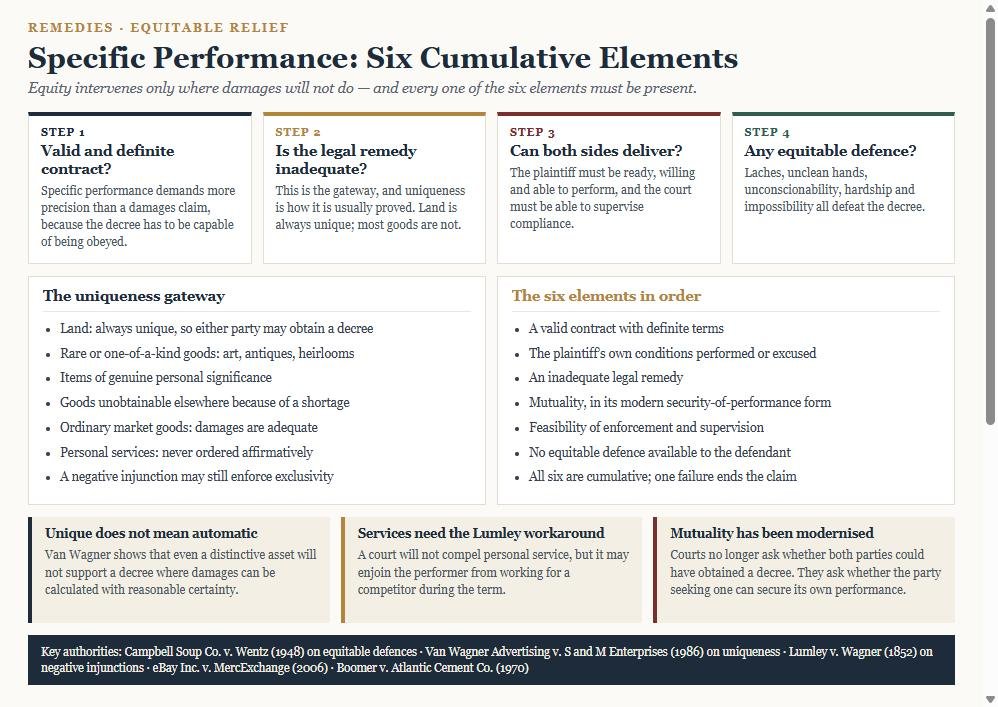
Why the remedy is exceptional
Damages are the default response to breach. Equity intervenes only where that default fails, which is why every equitable remedy, from specific performance to injunctions to rescission and reformation, begins with the same threshold enquiry into the adequacy of the legal remedy. The modern statement of that threshold in eBay Inc. v. MercExchange shows how far the requirement reaches beyond contract law.
Keep the hierarchy visible in your answer. Say that damages are the presumptive remedy, then explain why they will not serve here. Skipping that sentence is the most common structural error in remedies essays.
Element one: a valid contract with definite terms
Offer, acceptance, consideration and definiteness are needed, and the definiteness requirement is more demanding than for a damages claim. The reason is practical: a court that orders performance must be able to say exactly what the defendant has to do and to tell later whether it was done. Terms that a jury could value in money may still be too vague to command.
Element two: the plaintiff’s own conditions
The plaintiff must have performed, be ready willing and able to perform, or be excused. Minor defects in the plaintiff’s performance are tolerated, particularly where the plaintiff is a seller, since equity does not deny relief over trifles. What it will not do is compel one party to perform in favour of another who cannot or will not do their own part.
Element three: the inadequate legal remedy
This is the gateway, and uniqueness is the usual route through it. If the subject matter cannot be replaced on the market, damages cannot make the plaintiff whole, and equity has a reason to act.
Land is always unique
Every parcel of land is treated as unique, which makes the land-sale contract the paradigm case. Both sides may obtain a decree: the buyer because no substitute parcel will do, and the seller through the doctrine of mutuality of remedy, which historically allowed the seller to compel the purchase price.
Goods are usually not unique
Ordinary market goods can be bought elsewhere, so damages measured by the cost of a substitute are adequate. Uniqueness may nevertheless be established for a rare or one-of-a-kind item such as a painting, an antique or an heirloom, for an object of genuine personal significance, or where circumstances at the time of litigation make the goods unobtainable, as with a wartime or shortage-driven supply failure.
Even then the conclusion is not automatic. Van Wagner Advertising Corp. v. S and M Enterprises refused a decree over a distinctive billboard location because damages could be calculated with reasonable certainty. Physical uniqueness is not the test; the inadequacy of money is.
Personal services are never compelled
A court will not order someone to work. The reasons are constitutional, since compelled labour edges toward involuntary servitude, and practical, because supervising the quality of a performance is beyond judicial competence. The workaround comes from Lumley v. Wagner: a negative injunction may restrain the performer from working for a competitor during the contract term, which enforces the exclusivity promise without commanding the affirmative one.
Element four: mutuality, in its modern form
The old rule asked whether both parties would have been entitled to specific performance, and denied the remedy if either would not. Modern courts have abandoned that symmetry and ask instead whether the party seeking the decree can give adequate security for their own performance. A seller cannot compel a buyer who is unable to pay unless something, typically an escrow arrangement, assures the seller’s side of the exchange.
Element five: feasibility of enforcement
The court must be able to supervise compliance without becoming the manager of an ongoing relationship. A single conveyance is easy to police; a five-year construction project with continuing quality obligations is not. Feasibility also has a territorial dimension, since a court may hesitate to order acts to be performed beyond its practical reach.
Element six: no equitable defences
- Laches. Unreasonable delay that prejudiced the defendant.
- Unclean hands. Misconduct by the plaintiff connected to the transaction.
- Unconscionability. Oppressive terms or a grossly unfair bargaining process.
- Hardship. Where the burden on the defendant substantially outweighs the benefit to the plaintiff.
- Impossibility. Performance that cannot now be rendered, for example because the subject matter was sold to a protected third party.
Campbell Soup Co. v. Wentz is the classic illustration. The carrots were unique enough, but the contract’s harsh and one-sided terms made a decree inequitable, so the court left the buyer to its damages claim.
| Subject matter | Damages adequate? | Specific performance? |
|---|---|---|
| Land | No | Yes, for either party |
| Rare art or an heirloom | Usually no | Yes |
| Standard commercial goods | Yes | No |
| Goods unobtainable due to shortage | No | Yes |
| Output or requirements supply contract | Often no | Frequently yes |
| Personal services | Yes, plus supervision problems | No, but a negative injunction may issue |
| A promise to lend money | Yes | No |
Exam tip: state the six elements as a checklist, then spend your words on the two that are actually contested. Examiners build fact patterns where uniqueness or an equitable defence is the battleground, and a mechanical recital of all six earns less than a focused argument on the live ones.
Where injunctions fit
Specific performance is the contract-side equitable remedy; the injunction is its tort and property counterpart. Both require the same inadequacy threshold and both are subject to a balancing of hardships, which is why Boomer v. Atlantic Cement Co. awarded permanent damages instead of closing a cement plant despite a proven nuisance. When a question asks for equitable relief generally, identify which of the two you are seeking before you list elements.
Common mistakes that cost points
- Treating specific performance as an alternative the plaintiff may simply elect, rather than an exceptional remedy.
- Equating physical uniqueness with inadequacy of damages.
- Ordering personal services instead of considering a negative injunction.
- Applying the historical mutuality rule rather than the modern security-of-performance test.
- Ignoring feasibility where the obligation is long-running or requires supervision.
- Forgetting the equitable defences, especially laches and hardship.
- Applying the damages standard of definiteness to a request for a decree.
- Failing to say why money would not compensate, which is the sentence the gateway requires.
Frequently asked questions
Can a buyer of goods ever get specific performance under the UCC?
Yes. The Code authorises specific performance where the goods are unique or in other proper circumstances, which is deliberately broader than the common law formula, and it also provides for replevin where the buyer cannot reasonably obtain cover.
Does a liquidated damages clause bar the remedy?
Not automatically. A clause fixing damages is evidence that the parties considered money an adequate substitute, and some clauses are drafted as the exclusive remedy, but unless the contract makes that election clear, equitable relief may remain available.
What if the defendant already sold the property to someone else?
Performance may be impossible against a purchaser who took for value and without notice, in which case the plaintiff falls back on damages or on a constructive trust over the proceeds. A buyer with notice, by contrast, can be reached.
Specific performance in California: land and Hollywood contracts, 2026
California codifies this remedy, and two of its provisions are unusually consequential in Los Angeles County. Section 3387 of the California Civil Code presumes that the breach of an agreement to transfer real property cannot be adequately compensated in damages, and for a buyer of a single-family dwelling the presumption is conclusive. That reverses the ordinary burden and makes specific performance the expected remedy in county property litigation rather than an exceptional one.
The second is the entertainment industry rule. California generally refuses to specifically enforce a contract for personal services, but it permits injunctive relief restraining a performer of unique character from rendering services to others during the contract term, provided the contract guarantees compensation above statutory thresholds. Alongside it sits the seven-year rule in the California Labor Code, which limits enforcement of a personal service contract beyond seven years and was shaped by litigation brought by a film actor against a studio in the 1940s. Together these provisions define how talent agreements are drafted in Los Angeles.
The requirements to plead and prove:
- Definite terms. The agreement must be sufficiently certain for the court to know what to order.
- Adequate consideration and fairness. Section 3391 bars relief where consideration is inadequate or the contract was obtained by unfair practices.
- Ability to perform on both sides. A buyer must show tender or readiness, which usually means proof of funds.
- Mutuality of remedy. The court must be able to secure performance by the plaintiff as well.
- No affirmative order for personal services. Only a negative injunction is available, and only against a unique performer.
- Record a lis pendens. In a real property action the notice protects the claim against intervening transfers.
In 2026, plead specific performance and damages in the alternative, and preserve the property claim by recording notice. Read with consideration, the statute of frauds and the parol evidence rule.
Next steps
Remedies questions are easier once the underlying claim is secure, so revise this guide after the formation material. Start with consideration in contract law to confirm the contract exists, then the statute of frauds and MYLEGS to confirm it is enforceable, and only then ask what relief a court will grant. Land contracts recur throughout, so the easements: creation and termination guide is a useful companion when the decree would transfer an interest in property.
For practice, take a single sale contract and change only the subject matter: a house, a Picasso, a thousand tonnes of wheat, then a singer’s appearance. Then read the specific performance overview at Cornell’s Legal Information Institute and the text of UCC 2-716 to see how the statutory standard differs from the equitable one.
Related guides
- Advisory Opinions: Article III and Declaratory Relief
- Access to the Courts: When Filing Fees Are Unconstitutional
- Other Enumerated Powers: Postal, Bankruptcy, Admiralty
- Franchise Amendments: Congress and the Right to Vote
- Property Clause: Congress and Federal Lands Explained
- No Federal Police Power: Enumerated Powers and Enclaves
- Contracts Clause: When States May Impair Agreements
- Takings Clause: Lucas, Penn Central and Just Compensation
- Free Exercise Clause: Smith, Lukumi and Fulton Applied
- Establishment Clause: Church, State and the New Test
- Freedom of Association: Scrutiny, Dale and Disclosure
- Freedom of the Press: Publication Liability and Limits
- Campaign Finance and Anonymous Speech: The Core Rules
- Unconstitutional Conditions: Benefits and Rights Waivers
- Government Speech Doctrine: When the State Can Choose
- Vagueness and Overbreadth: Facial Challenges Explained
- Prior Restraint and Licensing: The Freedman Safeguards
- Symbolic Conduct and the O’Brien Test: The Pivot Question
- Government Employee Speech: Garcetti and Pickering Rules
- Commercial Speech and the Central Hudson Four-Part Test
- Actual Malice and the Three Tracks of Defamation Law
- Public Forum Doctrine and the Time, Place, Manner Test
- First Amendment: The Three-Question Speech Framework
- One Person, One Vote: Voting Rights Under Equal Protection
- Alienage Classifications: Strict Scrutiny and Its Pockets
- Equal Protection: The Three-Step Classification Test
- Second Amendment: The Bruen Text-and-History Standard
- Substantive Due Process After Dobbs: A Two-Step Test
- Procedural Due Process: Notice, Hearing and Mathews
- Incorporation Doctrine: Which Rights Bind the States
- Full Faith and Credit: Recognising Sister-State Judgments
- The Complete Auto Test: Taxing Interstate Commerce
- The Right to Travel: Durational Residency Explained
- Article IV Privileges and Immunities: The Comity Rule
- Federal Preemption: The Three-Step Ladder Explained
- The Supremacy Clause: Floors, Ceilings and Preemption
- Intergovernmental Immunity: The Shield Runs One Way
- The Presidential Pardon Power: Four Limits That Matter
- Executive Privilege: A Qualified Right That Must Yield
- Presidential Immunity: Criminal, Civil and Private Acts
- The Removal Power: At-Will Firing and Its Exceptions
- The Appointment Power: Principal and Inferior Officers
- Take Care Clause: Enforcement Discretion and Its Limits
- Commander-in-Chief Power: Deploy Without Declaring War
- Executive Agreements: The President’s Sole Foreign Power
- The Treaty Power: Senate Advice and Consent Explained
- The Presidential Veto Power, Override and Pocket Veto
- Bicameralism and Presentment: Two Vetoes Struck Down
- The Nondelegation Doctrine and the Intelligible Principle
- Speech or Debate Clause: Absolute but Narrow Immunity
- The Impeachment Power: House Majority, Senate Two-Thirds
- Congress’s Naturalization Power and Citizenship Limits
- Congressional War Powers: Declare, Fund and Command
- Anti-Commandeering Doctrine and the Tenth Amendment
- Section 5 Enforcement Power: Remedy, Do Not Redefine
- The Spending Power and the Five Dole Test Conditions
- Congress’s Taxing Power: When a Penalty Is Really a Tax
- The Necessary and Proper Clause: Congress’s Multiplier
- Ex Post Facto Clause: Retroactive Criminal Laws Barred
- Bills of Attainder: Legislative Punishment Explained
- The Writ of Habeas Corpus: Testing Unlawful Detention
- Supreme Court Jurisdiction: Original vs Appellate Power
- Abstention Doctrine: 4 Ways Federal Courts Step Aside
- Dormant Commerce Clause: Discrimination vs Pike Balancing
- The Commerce Clause: 3 Categories and 2 Hard Limits
- State Action Doctrine: The Government Conduct Threshold
- The Eleventh Amendment and State Sovereign Immunity
- Political Question Doctrine: What Courts Will Not Decide
- Ripeness and Mootness: Timing Rules in Federal Court
- Standing in Federal Court: The 3-Part Article III Test
- Marbury v. Madison and the Power of Judicial Review
- The Youngstown Framework: Presidential Power in 3 Zones
- The IRAC Method: How to Structure a Bar Exam Answer
- Piercing the Corporate Veil: A Two-Prong Alter Ego Test
- Defamation Elements, Fault Standards and Privileges
- The Parol Evidence Rule: Integration and Exceptions
- Recording Acts: Race, Notice and Race-Notice Explained
- Partner Liability and Authority Under RUPA Explained
- Trustee Duties: Care, Loyalty, Impartiality, Accounts
- Will Execution Requirements: Formalities and Rescue
- Community Property Presumptions in California Explained
- Easements Explained: Creation, Scope and Termination
- Products Liability: The Three Defect Theories Explained
- Miranda Rights: Custody, Interrogation and Invocation
- The Character Evidence Rules: Propensity Bar and Doorways
- Adverse Possession Elements: OCEAN and the Tax Rule
- Business Judgment Rule and Directors’ Fiduciary Duties
- The Statute of Frauds: MYLEGS and How to Satisfy It
- Res Judicata vs Collateral Estoppel: Bar Exam Guide
- The Erie Doctrine Explained: A 4-Step Bar Exam Guide
- Conflicts of Interest: A 6-Step Decision Tree for the Bar
- The Rule Against Perpetuities Explained Step by Step
- Murder and Manslaughter: The Homicide Ladder Explained
- Consideration in Contract Law: Rules and Exceptions
- The Four Elements of Negligence: Bar Exam Breakdown
- The Hearsay Rule Explained: Exceptions and Exemptions
- Personal Jurisdiction: The 3-Step Bar Exam Framework
- 3 Levels of Scrutiny in Constitutional Law Explained
- The Citizenship Clause After Trump v. Barbara