
The Youngstown framework is the reason a bar exam answer never says the President “has” or “lacks” a power in the abstract. Executive authority is relational: it is at its height when Congress has authorised the action, at its weakest when Congress has forbidden it, and somewhere uncertain in between. Justice Jackson’s concurrence in the Steel Seizure Case turned that insight into three zones that still govern every separation-of-powers question.
This guide explains each zone and its burden of proof, how to tell congressional silence from congressional disapproval, when historical practice can lift an action into a stronger zone, and why winning under Youngstown does not end the analysis.
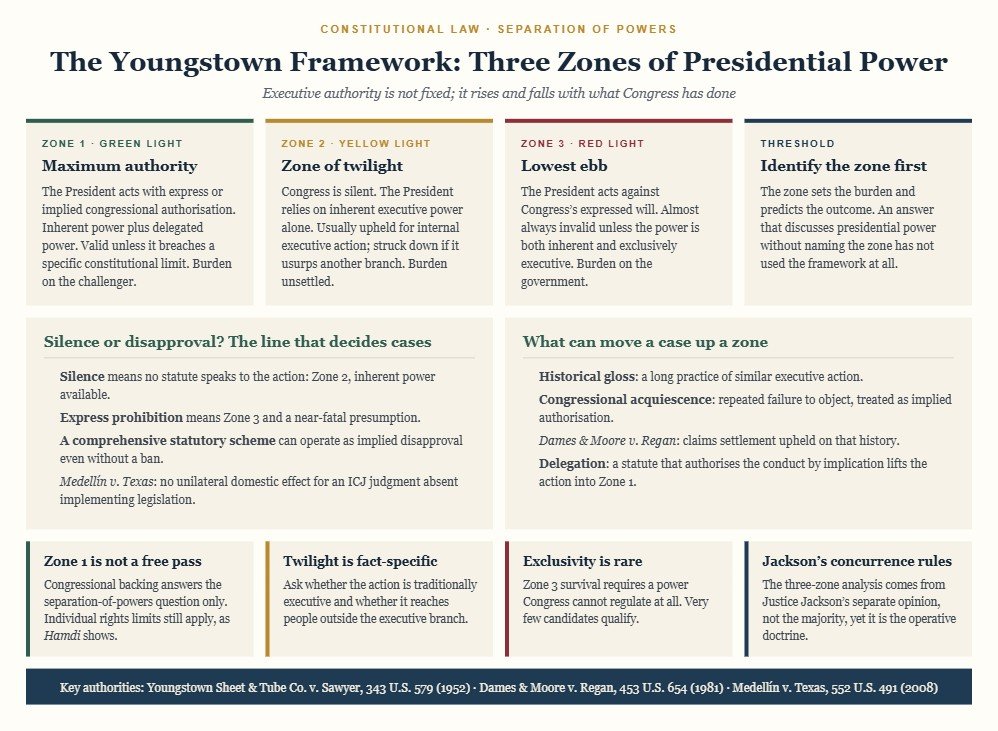
Where the framework comes from
During the Korean War, President Truman ordered the seizure of the country’s steel mills to head off a strike. Congress had considered seizure as a labour remedy and declined to authorise it, choosing other machinery instead. The Supreme Court held the seizure unconstitutional in Youngstown Sheet & Tube Co. v. Sawyer, but the majority opinion is not what survived. Justice Jackson’s concurrence, which sorted presidential action into three categories according to congressional posture, became the operative doctrine and is cited far more often than the judgment itself.
The framework earned that status because it is predictive. Once you place the action in a zone, you know who bears the burden and roughly how the case will come out. That is why the first sentence of any answer on executive power should name the zone.
The three zones
Zone 1: express or implied authorisation
When the President acts pursuant to a statute, the two political branches are aligned and executive power is at its apex: inherent Article II authority plus whatever Congress has delegated. The action is valid unless it collides with a specific constitutional prohibition. The challenger carries the burden, and it is a heavy one.
Note that authorisation need not be explicit. A statutory scheme that plainly contemplates the conduct, or a delegation broad enough to cover it, produces Zone 1 treatment without any magic words.
Zone 2: the zone of twilight
Congress has said nothing. The President is left with inherent executive power, and the analysis becomes fact-specific. Two questions do most of the work: is the action within traditional executive competence, and does it reach beyond the executive branch? Directing federal agencies, setting internal priorities and managing the diplomatic posture of the United States sit comfortably here. Imposing duties on private parties without statutory backing does not.
Zone 3: the lowest ebb
When the President acts against the expressed will of Congress, the action is presumptively unconstitutional. It survives only if the power is both inherent in the executive and exclusive to it, meaning Congress has no authority to regulate it at all. The government carries the burden, and very few claimed powers meet that description. This is where the steel seizure itself failed.
| Zone | Congressional posture | Who bears the burden | Likely outcome |
|---|---|---|---|
| 1 — apex | Express or implied authorisation | Challenger | Upheld unless a specific constitutional limit is breached |
| 2 — twilight | Silence | Contested; depends on context | Fact-specific; upheld if traditionally executive and self-contained |
| 3 — lowest ebb | Express or implied prohibition | Government | Struck down unless the power is inherent and exclusive |
Exam tip: identify the zone before you write anything else, and say out loud why the statute you have been given is authorisation, silence or prohibition. That single sentence frames the rest of the answer.
Silence or disapproval? The line that decides cases
The hardest zone question is not what the zones mean but which one applies. A statute that forbids the action is easy. The difficulty arises when Congress has legislated comprehensively in the field without banning the specific step the President has taken. Courts often read that scheme as an implied boundary, which pushes the case toward Zone 3.
Medellín v. Texas is the standard illustration. The President sought to give an International Court of Justice judgment domestic effect by memorandum. No statute forbade it, but the constitutional and statutory architecture for turning international obligations into enforceable domestic law ran through Congress. The Court treated that architecture as a limit and refused to let the memorandum do the work of implementing legislation.
Courts also examine legislative history when Congress has considered and rejected a proposed power. Rejection is generally treated as disapproval rather than silence, which is precisely how the steel seizure came to sit in Zone 3.
Historical gloss and congressional acquiescence
Practice can create authority. Where Presidents have repeatedly exercised a power and Congress has repeatedly failed to object, courts may treat the pattern as implied authorisation and analyse the case at the top of Zone 2 or in Zone 1 outright. Dames & Moore v. Regan upheld the settlement of claims against Iran on exactly that basis: a long, unbroken practice of executive claims settlement that Congress had tolerated and sometimes ratified.
The argument cuts both ways in an essay. If the facts give you a history of similar executive action, use it to move up a zone. If the facts emphasise novelty, say so, because a first-of-its-kind assertion of power gets no gloss.
Winning under Youngstown is not winning the case
The framework answers a structural question: may the executive branch act at all. It says nothing about whether the manner of acting respects individual rights. Hamdi v. Rumsfeld makes the point sharply: even assuming congressional authorisation for the detention of an enemy combatant, a citizen detainee was still owed notice and a meaningful opportunity to be heard. Zone 1 disposed of the separation-of-powers objection and left the due process objection untouched.
So run the zones, reach a conclusion, and then ask the second question separately. Whether a heightened standard applies to the substantive right in play is a distinct inquiry, set out in 3 Levels of Scrutiny in Constitutional Law Explained.
A worked example
Suppose the President issues an executive order requiring every federal contractor to meet climate-neutrality benchmarks, with contract termination as the penalty. No statute authorises climate procurement standards, and none forbids them.
- Zone: congressional silence, so Zone 2 rather than Zone 3.
- Traditionally executive? Setting the terms on which the government buys goods and services has long been treated as executive housekeeping, which favours the order.
- Does it reach outside the branch? It binds private contractors, which weakens the claim, although only as a condition of a voluntary contract.
- Does it invade a congressional power? Congress controls appropriations, and a sufficiently aggressive condition starts to look like reallocating funds by executive fiat.
- Resolution: a court could plausibly uphold the order as procurement management or strike it down as de facto spending policy. The zone analysis does not guarantee an answer; it guarantees the right question.
Common mistakes that cost points
- Discussing executive power without naming a zone, which abandons the framework entirely.
- Treating congressional silence as disapproval, or a comprehensive statutory scheme as silence.
- Second-guessing a Zone 1 action by asking whether it was reasonable or necessary. Zone 1 does not impose that scrutiny.
- Assuming Zone 3 is automatically fatal without addressing whether the power is inherent and exclusive.
- Ignoring historical gloss when the facts supply a long practice of similar action.
- Stopping at the structural question and missing a lurking individual rights violation.
- Attributing the three zones to the majority opinion rather than Justice Jackson’s concurrence.
Frequently asked questions
Does Youngstown apply to foreign affairs?
Yes, and that is where it does most of its work. Foreign policy and war powers questions frequently land in the twilight zone because Congress legislates sparsely there, which is also why historical practice matters so much in this area.
Is an executive order different from other presidential action?
Not for these purposes. The label is irrelevant; the analysis turns on the source of authority. An executive order, a memorandum, a proclamation and an informal directive all get the same zone treatment.
Can Congress authorise something the President could not do alone?
Often, yes. That is the point of Zone 1: the combined authority of both branches is greater than either acting alone. The limit is that no combination of the two can breach an express constitutional prohibition or an individual right.
Youngstown applied to California emergency powers, 2026
Justice Jackson’s three zones are usually taught as a federal separation of powers tool, but they translate directly to the relationship between the Governor of California and the Legislature, and that translation was tested extensively during the emergency orders of 2020 and 2021.
The California Emergency Services Act in the California Government Code grants the Governor broad authority during a proclaimed emergency, including power to suspend statutes and regulations that would impede the response. Litigation over whether particular orders went beyond suspension and amounted to legislating produced conflicting results, with one superior court holding that the Governor had exceeded his authority before the judgment was reversed on appeal. In Jackson’s terms, the dispute was about whether the Governor acted with statutory authorisation, in the zone of twilight, or against the Legislature’s expressed will.
How the zones map onto county and state action:
- Express statutory authority is the strongest zone. Orders squarely within the emergency statute are almost always upheld.
- County health officers have independent power. The Health and Safety Code gives local health officers their own authority, so Los Angeles County orders do not depend on the Governor’s proclamation.
- Conflict with statute is the weakest zone. An order contradicting a specific legislative choice is very difficult to defend.
- Duration invites scrutiny. Courts grew less deferential as emergencies extended, and legislative oversight increased.
- Neutrality constraints still apply. Tandon v. Newsom (2021) showed that even validly authorised orders fail if they treat comparable secular activity better than religious exercise.
- Local ordinances can be preempted upward. County rules may be displaced by state orders, and state orders by federal law.
In 2026, name the zone before arguing the merits, because the burden of justification shifts with it. Read with the Take Care Clause, the nondelegation doctrine and the Free Exercise Clause.
Next steps
Drill the framework by taking a single fact pattern and rewriting it three times, changing only what Congress has done, so that the same presidential action moves through all three zones. Then structure the answer using the discipline described in The IRAC Method: How to Structure a Bar Exam Answer, and see how a modern separation-of-powers dispute plays out in practice in The Citizenship Clause After Trump v. Barbara.
For primary sources, read Youngstown Sheet & Tube Co. v. Sawyer for Jackson’s concurrence, Dames & Moore v. Regan for historical gloss, and Medellín v. Texas for implied disapproval. Cornell’s overview of executive power collects the surrounding doctrine.
Related guides
- Advisory Opinions: Article III and Declaratory Relief
- Access to the Courts: When Filing Fees Are Unconstitutional
- Other Enumerated Powers: Postal, Bankruptcy, Admiralty
- Franchise Amendments: Congress and the Right to Vote
- Property Clause: Congress and Federal Lands Explained
- No Federal Police Power: Enumerated Powers and Enclaves
- Contracts Clause: When States May Impair Agreements
- Takings Clause: Lucas, Penn Central and Just Compensation
- Free Exercise Clause: Smith, Lukumi and Fulton Applied
- Establishment Clause: Church, State and the New Test
- Freedom of Association: Scrutiny, Dale and Disclosure
- Freedom of the Press: Publication Liability and Limits
- Campaign Finance and Anonymous Speech: The Core Rules
- Unconstitutional Conditions: Benefits and Rights Waivers
- Government Speech Doctrine: When the State Can Choose
- Vagueness and Overbreadth: Facial Challenges Explained
- Prior Restraint and Licensing: The Freedman Safeguards
- Symbolic Conduct and the O’Brien Test: The Pivot Question
- Government Employee Speech: Garcetti and Pickering Rules
- Commercial Speech and the Central Hudson Four-Part Test
- Actual Malice and the Three Tracks of Defamation Law
- Public Forum Doctrine and the Time, Place, Manner Test
- First Amendment: The Three-Question Speech Framework
- One Person, One Vote: Voting Rights Under Equal Protection
- Alienage Classifications: Strict Scrutiny and Its Pockets
- Equal Protection: The Three-Step Classification Test
- Second Amendment: The Bruen Text-and-History Standard
- Substantive Due Process After Dobbs: A Two-Step Test
- Procedural Due Process: Notice, Hearing and Mathews
- Incorporation Doctrine: Which Rights Bind the States
- Full Faith and Credit: Recognising Sister-State Judgments
- The Complete Auto Test: Taxing Interstate Commerce
- The Right to Travel: Durational Residency Explained
- Article IV Privileges and Immunities: The Comity Rule
- Federal Preemption: The Three-Step Ladder Explained
- The Supremacy Clause: Floors, Ceilings and Preemption
- Intergovernmental Immunity: The Shield Runs One Way
- The Presidential Pardon Power: Four Limits That Matter
- Executive Privilege: A Qualified Right That Must Yield
- Presidential Immunity: Criminal, Civil and Private Acts
- The Removal Power: At-Will Firing and Its Exceptions
- The Appointment Power: Principal and Inferior Officers
- Take Care Clause: Enforcement Discretion and Its Limits
- Commander-in-Chief Power: Deploy Without Declaring War
- Executive Agreements: The President’s Sole Foreign Power
- The Treaty Power: Senate Advice and Consent Explained
- The Presidential Veto Power, Override and Pocket Veto
- Bicameralism and Presentment: Two Vetoes Struck Down
- The Nondelegation Doctrine and the Intelligible Principle
- Speech or Debate Clause: Absolute but Narrow Immunity
- The Impeachment Power: House Majority, Senate Two-Thirds
- Congress’s Naturalization Power and Citizenship Limits
- Congressional War Powers: Declare, Fund and Command
- Anti-Commandeering Doctrine and the Tenth Amendment
- Section 5 Enforcement Power: Remedy, Do Not Redefine
- The Spending Power and the Five Dole Test Conditions
- Congress’s Taxing Power: When a Penalty Is Really a Tax
- The Necessary and Proper Clause: Congress’s Multiplier
- Ex Post Facto Clause: Retroactive Criminal Laws Barred
- Bills of Attainder: Legislative Punishment Explained
- The Writ of Habeas Corpus: Testing Unlawful Detention
- Supreme Court Jurisdiction: Original vs Appellate Power
- Abstention Doctrine: 4 Ways Federal Courts Step Aside
- Dormant Commerce Clause: Discrimination vs Pike Balancing
- The Commerce Clause: 3 Categories and 2 Hard Limits
- State Action Doctrine: The Government Conduct Threshold
- The Eleventh Amendment and State Sovereign Immunity
- Political Question Doctrine: What Courts Will Not Decide
- Ripeness and Mootness: Timing Rules in Federal Court
- Standing in Federal Court: The 3-Part Article III Test
- Marbury v. Madison and the Power of Judicial Review
- The IRAC Method: How to Structure a Bar Exam Answer
- Piercing the Corporate Veil: A Two-Prong Alter Ego Test
- Defamation Elements, Fault Standards and Privileges
- The Parol Evidence Rule: Integration and Exceptions
- Recording Acts: Race, Notice and Race-Notice Explained
- Partner Liability and Authority Under RUPA Explained
- Trustee Duties: Care, Loyalty, Impartiality, Accounts
- Specific Performance: A Six-Element Bar Exam Framework
- Will Execution Requirements: Formalities and Rescue
- Community Property Presumptions in California Explained
- Easements Explained: Creation, Scope and Termination
- Products Liability: The Three Defect Theories Explained
- Miranda Rights: Custody, Interrogation and Invocation
- The Character Evidence Rules: Propensity Bar and Doorways
- Adverse Possession Elements: OCEAN and the Tax Rule
- Business Judgment Rule and Directors’ Fiduciary Duties
- The Statute of Frauds: MYLEGS and How to Satisfy It
- Res Judicata vs Collateral Estoppel: Bar Exam Guide
- The Erie Doctrine Explained: A 4-Step Bar Exam Guide
- Conflicts of Interest: A 6-Step Decision Tree for the Bar
- The Rule Against Perpetuities Explained Step by Step
- Murder and Manslaughter: The Homicide Ladder Explained
- Consideration in Contract Law: Rules and Exceptions
- The Four Elements of Negligence: Bar Exam Breakdown
- The Hearsay Rule Explained: Exceptions and Exemptions
- Personal Jurisdiction: The 3-Step Bar Exam Framework
- 3 Levels of Scrutiny in Constitutional Law Explained
- The Citizenship Clause After Trump v. Barbara