
Conflicts of interest are the most reliably tested area of Professional Responsibility, and they are also the easiest place to lose marks by answering intuitively. The rules prohibit representing clients whose interests are materially adverse to each other, or to the lawyer’s own interests, unless the lawyer reasonably believes competent representation is still possible and obtains informed written consent.
The safest way to handle any conflicts question is to stop reasoning from instinct and run a fixed six-step check. The tree below is the order to follow, and this guide works through each step.
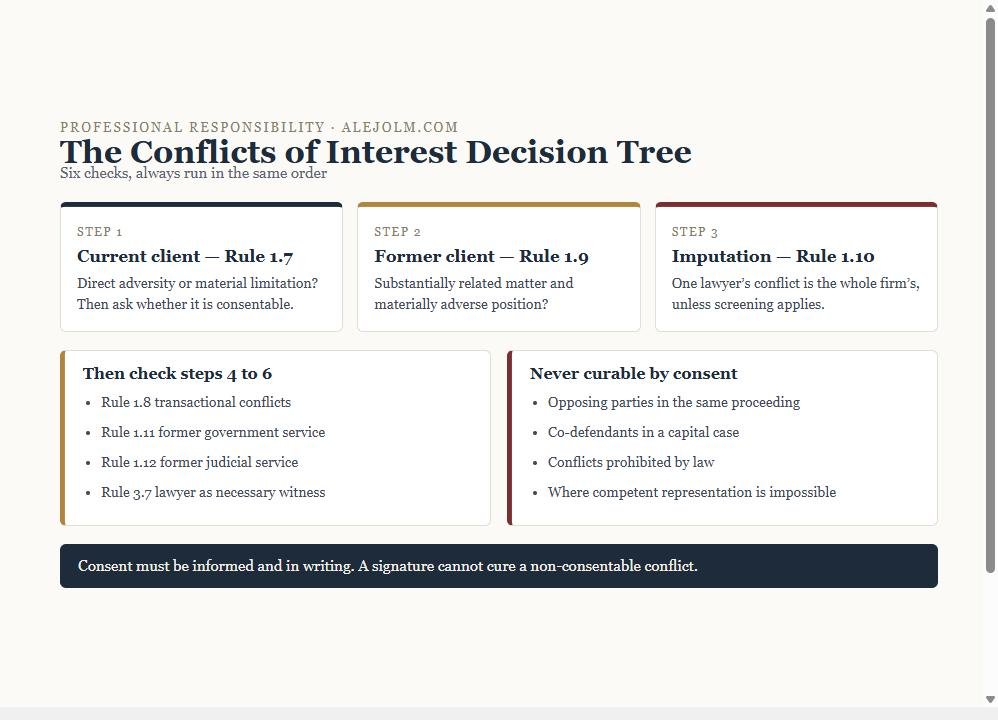
Step 1: current client conflicts under Rule 1.7
Ask first whether the affected person is a current client. If so, there are two triggers.
- Direct adversity — representing two clients whose interests are directly opposed in the same matter. Co-defendants where one wants to plead guilty and the other wants trial is the classic illustration.
- Material limitation — representing one client in a way that materially limits the representation of another. Joint representation of insurer and insured where coverage is disputed is the standard example.
Consentable or not?
Some current-client conflicts can be cured by informed written consent from each affected client. Others cannot be cured at all, and this distinction is where answers separate.
| Non-consentable | Consentable with informed written consent |
|---|---|
| Opposing parties in the same proceeding | Concurrent representation in unrelated matters |
| Co-defendants in a capital case | Joint representation where interests are aligned |
| Conflicts prohibited by law | Some personal-interest conflicts |
| Any case where competent representation is impossible | Material limitation the lawyer can still manage |
A worked example makes the point. A lawyer asked to represent both a debtor and a creditor in the same transaction faces clients who both want the deal to close, but whose interests diverge sharply on price. Where the price is disputed, the adversity is structural, and signed consent forms do not save the representation.
Consent is not a magic word. Where the conflict is non-consentable, discussing the quality of the disclosure is beside the point and signals that the classification step was skipped.
Step 2: former client conflicts under Rule 1.9
For a former client, two tests must both be satisfied before a conflict exists: the new matter must be substantially related to the old one, and the new client’s position must be materially adverse to the former client.
If both are met, the former client’s informed written consent is required. Where the matters are genuinely unrelated, no conflict arises even though the lawyer once acted for the opposing side.
Do not forget prospective clients. Under Rule 1.18 even a consultation that never becomes a representation can generate duties, because the lawyer may have received disqualifying information.
Step 3: imputation under Rule 1.10
One lawyer’s conflict is generally imputed to the entire firm. That is the default and it catches many candidates who analyse only the individual lawyer.
- The exception: a purely personal-interest conflict that is not material to the representation of others is not imputed.
- The cure: screening a lateral lawyer, with written notice to the affected former client, can prevent imputation in the jurisdictions that permit it.
Steps 4 to 6: the specialised checks
Rule 1.8 transactional conflicts
Rule 1.8 lists specific prohibitions with their own requirements rather than a general balancing test. A business transaction with a client under Rule 1.8(a) has four requirements: fair and reasonable terms, full written disclosure, advice to seek independent counsel, and informed written consent.
The rest of Rule 1.8 covers gifts from clients, literary and media rights, third-party payers, aggregate settlements, prospective malpractice waivers, financial assistance to clients, proprietary interests in litigation and sexual relations with clients. Each has its own standard, so identify the sub-rule before analysing.
Rules 1.11 and 1.12: former government and judicial service
A lawyer who previously worked for the government, or served as a judge, arbitrator or mediator, is disqualified from certain matters in which they participated personally and substantially. Screening provisions can protect the firm even where the individual is disqualified.
Rule 3.7: the lawyer as witness
Where the lawyer will be a necessary witness, the disqualification is personal only. The firm may usually continue unless an independent Rule 1.7 or 1.9 conflict exists. Treating this as a firm-wide bar is a common error.
What informed written consent actually requires
Consent has to be genuinely informed. That means explaining the nature of the conflict, the reasonably foreseeable consequences, the alternatives available to the client, and the risk that confidential information may be limited or that the lawyer may have to withdraw. California adds a distinct disclosure obligation about the lawyer’s relationships with other parties, which has no direct counterpart in the ABA Model Rules.
Common mistakes that cost points
- Analysing the quality of consent for a conflict that is non-consentable.
- Applying only the substantial-relationship test to a former client and ignoring material adversity.
- Checking the individual lawyer without addressing imputation to the firm.
- Using a general balancing analysis for a Rule 1.8 conflict that has enumerated elements.
- Disqualifying the whole firm under Rule 3.7 when the bar is personal.
- Overlooking Rule 1.18 duties arising from a preliminary consultation.
Frequently asked questions
Can a lawyer represent both spouses in a divorce with consent?
No. They are opposing parties in the same proceeding, which is the paradigm non-consentable conflict, whatever the parties are willing to sign.
Does moving firms automatically disqualify the new firm?
Not necessarily. Imputation is the starting point, but timely screening of the lateral lawyer with written notice to the affected former client can preserve the new firm’s ability to act.
Must consent always be in writing?
Under the current rules, yes for conflicts consent. Oral consent is not sufficient, and the writing should record the disclosure that was actually made.
Conflicts of interest under the California rules, 2026
California’s professional conduct rules were renumbered in 2018 to track the model rules, but the substance still departs from them in ways that matter, and the departures are concentrated in this area. The California Rules of Professional Conduct generally require informed written consent for conflict waivers, meaning both the disclosure and the client’s agreement must be in writing. Oral consent, which suffices in many jurisdictions for some conflicts, does not satisfy the California rule.
The second distinctive feature is the treatment of potential conflicts. California requires written disclosure of a lawyer’s relationships with parties, witnesses or the subject matter that would reasonably cause a client to question the lawyer’s loyalty, even where those relationships do not amount to a conflict requiring consent. That obligation has no direct model rule counterpart and is a frequent subject of State Bar discipline.
Points that arise in Los Angeles practice:
- Screening can prevent imputation. California permits an effective ethical screen to avoid disqualification of a firm when a lateral lawyer joins, and the adequacy of the screen is judged on its timing and rigour.
- Disqualification motions are common. The Los Angeles Superior Court decides them frequently, and the moving party must show a substantial relationship between the matters.
- Business transactions with clients need extra formality. Written disclosure, advice to seek independent counsel and written consent are required.
- Joint representation carries disclosure duties. Confidentiality between jointly represented clients cannot be maintained, and this must be explained in advance.
- Advance waivers are viewed sceptically. A general future-conflicts waiver may be ineffective if the later conflict was not adequately described.
- Former government lawyers face specific restrictions. Lawyers leaving the Los Angeles County District Attorney or the Los Angeles County Counsel must observe rules on matters they handled personally and substantially.
In 2026, put every disclosure and consent in writing and confirm the current rule text with the State Bar of California. Read with fiduciary duties, the business judgment rule and the IRAC method.
Next steps
Conflicts sit alongside confidentiality, competence and withdrawal, and the decision-tree habit transfers well to other subjects. See how the same approach works in our guides to the Rule Against Perpetuities, personal jurisdiction and the hearsay rule.
The primary sources are the California Rules of Professional Conduct and the ABA Model Rules, both published in full online.
Practise by writing only the six step labels for twenty fact patterns, marking which steps are triggered. Once the order is automatic, you will stop missing the imputation and Rule 3.7 issues that carry easy marks.
Related guides
- Advisory Opinions: Article III and Declaratory Relief
- Access to the Courts: When Filing Fees Are Unconstitutional
- Other Enumerated Powers: Postal, Bankruptcy, Admiralty
- Franchise Amendments: Congress and the Right to Vote
- Property Clause: Congress and Federal Lands Explained
- No Federal Police Power: Enumerated Powers and Enclaves
- Contracts Clause: When States May Impair Agreements
- Takings Clause: Lucas, Penn Central and Just Compensation
- Free Exercise Clause: Smith, Lukumi and Fulton Applied
- Establishment Clause: Church, State and the New Test
- Freedom of Association: Scrutiny, Dale and Disclosure
- Freedom of the Press: Publication Liability and Limits
- Campaign Finance and Anonymous Speech: The Core Rules
- Unconstitutional Conditions: Benefits and Rights Waivers
- Government Speech Doctrine: When the State Can Choose
- Vagueness and Overbreadth: Facial Challenges Explained
- Prior Restraint and Licensing: The Freedman Safeguards
- Symbolic Conduct and the O’Brien Test: The Pivot Question
- Government Employee Speech: Garcetti and Pickering Rules
- Commercial Speech and the Central Hudson Four-Part Test
- Actual Malice and the Three Tracks of Defamation Law
- Public Forum Doctrine and the Time, Place, Manner Test
- First Amendment: The Three-Question Speech Framework
- One Person, One Vote: Voting Rights Under Equal Protection
- Alienage Classifications: Strict Scrutiny and Its Pockets
- Equal Protection: The Three-Step Classification Test
- Second Amendment: The Bruen Text-and-History Standard
- Substantive Due Process After Dobbs: A Two-Step Test
- Procedural Due Process: Notice, Hearing and Mathews
- Incorporation Doctrine: Which Rights Bind the States
- Full Faith and Credit: Recognising Sister-State Judgments
- The Complete Auto Test: Taxing Interstate Commerce
- The Right to Travel: Durational Residency Explained
- Article IV Privileges and Immunities: The Comity Rule
- Federal Preemption: The Three-Step Ladder Explained
- The Supremacy Clause: Floors, Ceilings and Preemption
- Intergovernmental Immunity: The Shield Runs One Way
- The Presidential Pardon Power: Four Limits That Matter
- Executive Privilege: A Qualified Right That Must Yield
- Presidential Immunity: Criminal, Civil and Private Acts
- The Removal Power: At-Will Firing and Its Exceptions
- The Appointment Power: Principal and Inferior Officers
- Take Care Clause: Enforcement Discretion and Its Limits
- Commander-in-Chief Power: Deploy Without Declaring War
- Executive Agreements: The President’s Sole Foreign Power
- The Treaty Power: Senate Advice and Consent Explained
- The Presidential Veto Power, Override and Pocket Veto
- Bicameralism and Presentment: Two Vetoes Struck Down
- The Nondelegation Doctrine and the Intelligible Principle
- Speech or Debate Clause: Absolute but Narrow Immunity
- The Impeachment Power: House Majority, Senate Two-Thirds
- Congress’s Naturalization Power and Citizenship Limits
- Congressional War Powers: Declare, Fund and Command
- Anti-Commandeering Doctrine and the Tenth Amendment
- Section 5 Enforcement Power: Remedy, Do Not Redefine
- The Spending Power and the Five Dole Test Conditions
- Congress’s Taxing Power: When a Penalty Is Really a Tax
- The Necessary and Proper Clause: Congress’s Multiplier
- Ex Post Facto Clause: Retroactive Criminal Laws Barred
- Bills of Attainder: Legislative Punishment Explained
- The Writ of Habeas Corpus: Testing Unlawful Detention
- Supreme Court Jurisdiction: Original vs Appellate Power
- Abstention Doctrine: 4 Ways Federal Courts Step Aside
- Dormant Commerce Clause: Discrimination vs Pike Balancing
- The Commerce Clause: 3 Categories and 2 Hard Limits
- State Action Doctrine: The Government Conduct Threshold
- The Eleventh Amendment and State Sovereign Immunity
- Political Question Doctrine: What Courts Will Not Decide
- Ripeness and Mootness: Timing Rules in Federal Court
- Standing in Federal Court: The 3-Part Article III Test
- Marbury v. Madison and the Power of Judicial Review
- The Youngstown Framework: Presidential Power in 3 Zones
- The IRAC Method: How to Structure a Bar Exam Answer
- Piercing the Corporate Veil: A Two-Prong Alter Ego Test
- Defamation Elements, Fault Standards and Privileges
- The Parol Evidence Rule: Integration and Exceptions
- Recording Acts: Race, Notice and Race-Notice Explained
- Partner Liability and Authority Under RUPA Explained
- Trustee Duties: Care, Loyalty, Impartiality, Accounts
- Specific Performance: A Six-Element Bar Exam Framework
- Will Execution Requirements: Formalities and Rescue
- Community Property Presumptions in California Explained
- Easements Explained: Creation, Scope and Termination
- Products Liability: The Three Defect Theories Explained
- Miranda Rights: Custody, Interrogation and Invocation
- The Character Evidence Rules: Propensity Bar and Doorways
- Adverse Possession Elements: OCEAN and the Tax Rule
- Business Judgment Rule and Directors’ Fiduciary Duties
- The Statute of Frauds: MYLEGS and How to Satisfy It
- Res Judicata vs Collateral Estoppel: Bar Exam Guide
- The Erie Doctrine Explained: A 4-Step Bar Exam Guide
- The Rule Against Perpetuities Explained Step by Step
- Murder and Manslaughter: The Homicide Ladder Explained
- Consideration in Contract Law: Rules and Exceptions
- The Four Elements of Negligence: Bar Exam Breakdown
- The Hearsay Rule Explained: Exceptions and Exemptions
- Personal Jurisdiction: The 3-Step Bar Exam Framework
- 3 Levels of Scrutiny in Constitutional Law Explained
- The Citizenship Clause After Trump v. Barbara