
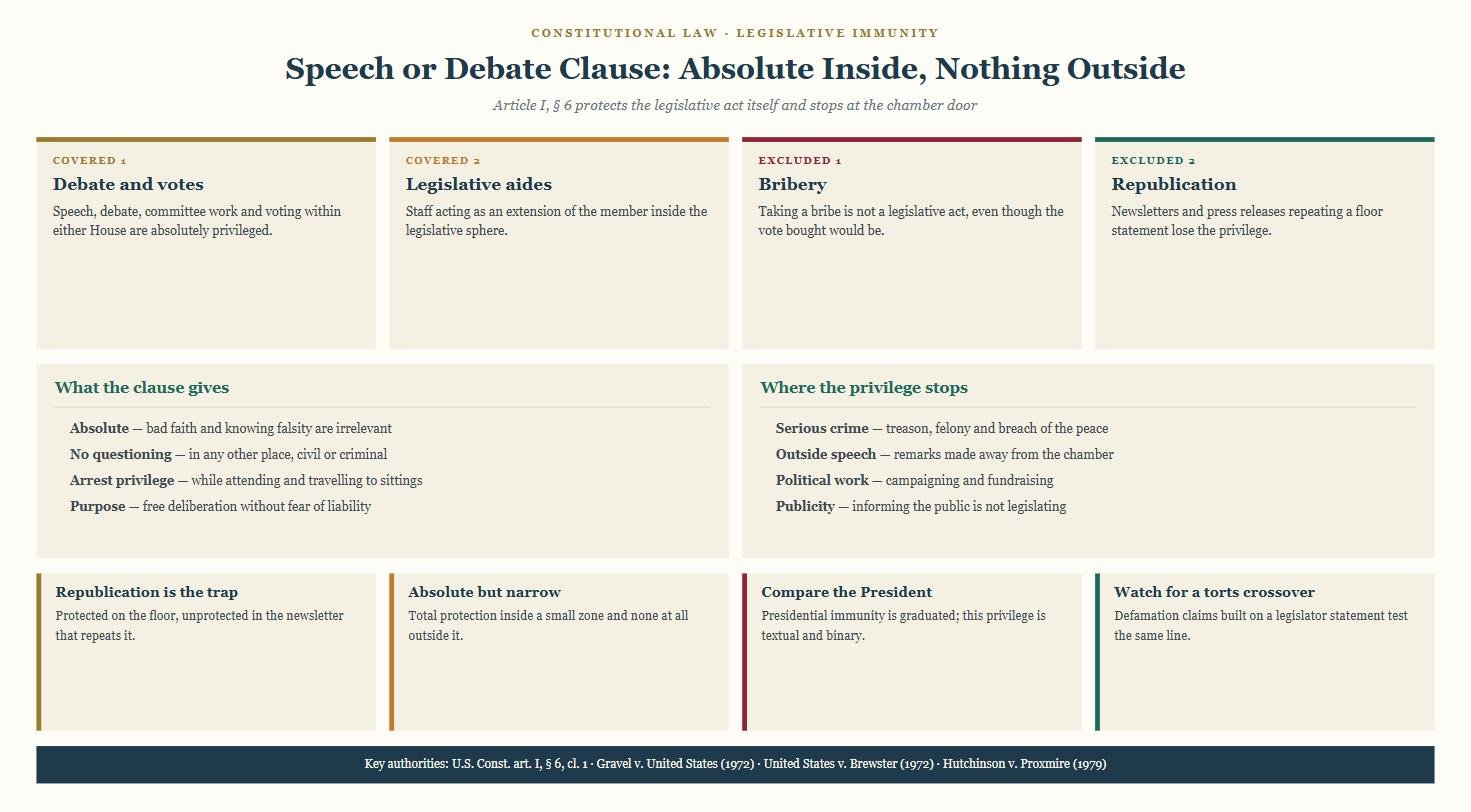
The Speech or Debate Clause of Article I, section 6 provides that for any speech or debate in either House, members of Congress shall not be questioned in any other place. The privilege it creates is absolute, and it is also remarkably narrow. Almost every examinable problem turns on that combination.
This guide explains which acts fall inside the legislative sphere, why legislative aides are covered, why bribery and republication are not, and how to distinguish this immunity from the graduated protection the President enjoys.
Why the clause exists
Legislators cannot deliberate freely if every speech invites a lawsuit and every vote invites a prosecution. The clause therefore removes the legislative act itself from the reach of the other two branches. It is a structural protection for the institution rather than a personal benefit for the member, which is why its boundaries are drawn by reference to the legislative function.
Alongside the immunity, the clause confers a privilege from arrest while members are attending a sitting of their House and travelling to and from it. That privilege does not apply to treason, felony or breach of the peace, so in modern practice it has very little practical reach.
Exam tip: do not ask whether the member behaved well. Ask whether the act was an integral part of legislating.
What falls inside the legislative sphere
- Floor speech and debate. Including statements that are false, malicious, or defamatory. The immunity cannot be defeated by proof of bad faith.
- Voting. A vote is the paradigm legislative act and can never be the basis of liability.
- Committee proceedings. Hearings, questioning of witnesses and the preparation of reports form part of the deliberative process.
- Legislative aides. Gravel v. United States held that the privilege extends to staff who act as an extension of the member within the legislative sphere, because the modern legislator cannot function otherwise.
What falls outside it
The exclusions are where questions are won and lost. Accepting a bribe is not a legislative act, and United States v. Brewster confirmed that a member may be prosecuted for taking one even though the vote promised in return would itself have been privileged. The prosecution simply may not use the legislative act to prove its case.
Republication is the other classic exclusion. In Hutchinson v. Proxmire the Court held that press releases and newsletters repeating statements made on the floor are not protected, because informing the public is not itself a legislative act, however useful it may be politically. Speeches given away from the chamber, constituent services and campaign activity fall outside the sphere for the same reason.
| Conduct | Privileged? | Reason |
|---|---|---|
| Accusing a private citizen of crimes during floor debate | Yes | Speech in either House, absolutely privileged |
| Repeating the same accusation in a constituent newsletter | No | Republication is not legislating |
| Voting for a statute later held unconstitutional | Yes | Voting is the core legislative act |
| Accepting money in exchange for a promised vote | No | Bribery is outside the legislative sphere |
| An aide gathering material for a committee report | Yes | Acting as an extension of the member |
| The same aide privately publishing that material | No | Private dissemination is not a legislative act |
Worked example: the floor speech and the newsletter
A member of Congress accuses a private citizen of criminal conduct during a speech on the floor of the House. The citizen sues for defamation. The issue is whether the claim can proceed. The rule is that speech or debate in either House is absolutely privileged. Applying it, the statement was made in the chamber in the course of legislative business, so the privilege applies even if the member knew the accusation was false. The claim fails.
The member then sends the same accusation to constituents in a newsletter and to the press in a release. The citizen sues again. That claim survives. The republication was not made in either House, and disseminating information to the public is not a legislative act, so nothing shields it. The two halves of the problem produce opposite answers on the same words.
How it compares with other immunities
This privilege is textual, absolute and narrow. Presidential immunity is judicially constructed and graduated, running from absolute protection for core constitutional functions through a presumption for other official acts to no protection at all for private conduct. Both immunities are justified by the same separation-of-powers concern, but they are structured very differently, and swapping their vocabulary is an easy way to lose marks.
The clause also belongs to the family of exclusively congressional prerogatives that courts decline to supervise, along with the impeachment power and much of what falls under the political question doctrine.
Common mistakes that cost points
- Describing the immunity as qualified. Within its scope it is absolute.
- Extending it to everything a legislator does. Only legislative acts are covered.
- Missing republication, which is the most heavily tested exclusion.
- Assuming bribery is protected because the vote would have been.
- Forgetting that aides are covered when acting within the sphere.
- Treating the arrest privilege as significant. Felonies are excluded, so it rarely matters.
- Confusing the clause with a First Amendment defence, which is qualified and available to everyone.
- Overlooking the cross-subject defamation issue that these facts usually carry.
Frequently asked questions
Does the clause protect state legislators?
Article I speaks only to Congress, but most state constitutions contain their own equivalents and federal courts have recognised a comparable common-law legislative immunity for state and local legislators acting legislatively.
Can a prosecutor use a floor speech as evidence?
No. The clause bars questioning the member about legislative acts in any other place, so a prosecution must be built entirely from unprotected conduct.
Is committee testimony by a private witness protected?
The clause protects members and their aides, not witnesses. A witness relies on other privileges and on ordinary immunity doctrines.
Legislative immunity for the Los Angeles County Board, 2026
The federal Speech or Debate Clause protects members of Congress from being questioned in any other place for their legislative acts, and California provides a parallel immunity for state legislators in article IV of the California Constitution. Neither provision covers county supervisors, yet Los Angeles County officials enjoy a functionally similar protection from a different source.
In Bogan v. Scott-Harris (1998) the Supreme Court held that local legislators are absolutely immune from civil liability for their legislative activities, and the immunity turns on the nature of the act rather than the actor’s title. When the Board of Supervisors votes on an ordinance or a budget, the members cannot be sued personally over that vote even if the motive was improper. When they make individual employment or contracting decisions, they are performing administrative acts and only qualified immunity is available.
Drawing the line in practice:
- Legislative acts are general and prospective. Adopting an ordinance, setting a budget or establishing policy qualifies.
- Administrative acts target individuals. Dismissing an employee or awarding a specific contract does not attract absolute immunity.
- The county entity remains liable. Immunity protects officials personally; the county can still be sued for an unconstitutional policy.
- Injunctive relief is available. The immunity bars damages, not a challenge to the ordinance itself.
- Open meeting law is a separate constraint. The Brown Act in the California Government Code governs how the Board may deliberate, and violations can void action regardless of immunity.
- Federal legislators’ protection is broader. It covers evidentiary use of legislative acts, not merely liability, which is why congressional subpoena litigation looks different.
In 2026, characterise the act before assessing exposure, because immunity follows function. Read with the Eleventh Amendment, bills of attainder and the state action doctrine.
Next steps
Read this next to the neighbouring separation-of-powers material. Start with The Impeachment Power: House Majority, Senate Two-Thirds, then Defamation Elements, Fault Standards and Privileges and The Youngstown Framework: Presidential Power in 3 Zones.
For primary sources, read Gravel v. United States and Hutchinson v. Proxmire at Justia, the annotation to Article I, section 6 at Cornell LII, and the examination scope published by the State Bar of California.
Related guides
- Advisory Opinions: Article III and Declaratory Relief
- Access to the Courts: When Filing Fees Are Unconstitutional
- Other Enumerated Powers: Postal, Bankruptcy, Admiralty
- Franchise Amendments: Congress and the Right to Vote
- Property Clause: Congress and Federal Lands Explained
- No Federal Police Power: Enumerated Powers and Enclaves
- Contracts Clause: When States May Impair Agreements
- Takings Clause: Lucas, Penn Central and Just Compensation
- Free Exercise Clause: Smith, Lukumi and Fulton Applied
- Establishment Clause: Church, State and the New Test
- Freedom of Association: Scrutiny, Dale and Disclosure
- Freedom of the Press: Publication Liability and Limits
- Campaign Finance and Anonymous Speech: The Core Rules
- Unconstitutional Conditions: Benefits and Rights Waivers
- Government Speech Doctrine: When the State Can Choose
- Vagueness and Overbreadth: Facial Challenges Explained
- Prior Restraint and Licensing: The Freedman Safeguards
- Symbolic Conduct and the O’Brien Test: The Pivot Question
- Government Employee Speech: Garcetti and Pickering Rules
- Commercial Speech and the Central Hudson Four-Part Test
- Actual Malice and the Three Tracks of Defamation Law
- Public Forum Doctrine and the Time, Place, Manner Test
- First Amendment: The Three-Question Speech Framework
- One Person, One Vote: Voting Rights Under Equal Protection
- Alienage Classifications: Strict Scrutiny and Its Pockets
- Equal Protection: The Three-Step Classification Test
- Second Amendment: The Bruen Text-and-History Standard
- Substantive Due Process After Dobbs: A Two-Step Test
- Procedural Due Process: Notice, Hearing and Mathews
- Incorporation Doctrine: Which Rights Bind the States
- Full Faith and Credit: Recognising Sister-State Judgments
- The Complete Auto Test: Taxing Interstate Commerce
- The Right to Travel: Durational Residency Explained
- Article IV Privileges and Immunities: The Comity Rule
- Federal Preemption: The Three-Step Ladder Explained
- The Supremacy Clause: Floors, Ceilings and Preemption
- Intergovernmental Immunity: The Shield Runs One Way
- The Presidential Pardon Power: Four Limits That Matter
- Executive Privilege: A Qualified Right That Must Yield
- Presidential Immunity: Criminal, Civil and Private Acts
- The Removal Power: At-Will Firing and Its Exceptions
- The Appointment Power: Principal and Inferior Officers
- Take Care Clause: Enforcement Discretion and Its Limits
- Commander-in-Chief Power: Deploy Without Declaring War
- Executive Agreements: The President’s Sole Foreign Power
- The Treaty Power: Senate Advice and Consent Explained
- The Presidential Veto Power, Override and Pocket Veto
- Bicameralism and Presentment: Two Vetoes Struck Down
- The Nondelegation Doctrine and the Intelligible Principle
- The Impeachment Power: House Majority, Senate Two-Thirds
- Congress’s Naturalization Power and Citizenship Limits
- Congressional War Powers: Declare, Fund and Command
- Anti-Commandeering Doctrine and the Tenth Amendment
- Section 5 Enforcement Power: Remedy, Do Not Redefine
- The Spending Power and the Five Dole Test Conditions
- Congress’s Taxing Power: When a Penalty Is Really a Tax
- The Necessary and Proper Clause: Congress’s Multiplier
- Ex Post Facto Clause: Retroactive Criminal Laws Barred
- Bills of Attainder: Legislative Punishment Explained
- The Writ of Habeas Corpus: Testing Unlawful Detention
- Supreme Court Jurisdiction: Original vs Appellate Power
- Abstention Doctrine: 4 Ways Federal Courts Step Aside
- Dormant Commerce Clause: Discrimination vs Pike Balancing
- The Commerce Clause: 3 Categories and 2 Hard Limits
- State Action Doctrine: The Government Conduct Threshold
- The Eleventh Amendment and State Sovereign Immunity
- Political Question Doctrine: What Courts Will Not Decide
- Ripeness and Mootness: Timing Rules in Federal Court
- Standing in Federal Court: The 3-Part Article III Test
- Marbury v. Madison and the Power of Judicial Review
- The Youngstown Framework: Presidential Power in 3 Zones
- The IRAC Method: How to Structure a Bar Exam Answer
- Piercing the Corporate Veil: A Two-Prong Alter Ego Test
- Defamation Elements, Fault Standards and Privileges
- The Parol Evidence Rule: Integration and Exceptions
- Recording Acts: Race, Notice and Race-Notice Explained
- Partner Liability and Authority Under RUPA Explained
- Trustee Duties: Care, Loyalty, Impartiality, Accounts
- Specific Performance: A Six-Element Bar Exam Framework
- Will Execution Requirements: Formalities and Rescue
- Community Property Presumptions in California Explained
- Easements Explained: Creation, Scope and Termination
- Products Liability: The Three Defect Theories Explained
- Miranda Rights: Custody, Interrogation and Invocation
- The Character Evidence Rules: Propensity Bar and Doorways
- Adverse Possession Elements: OCEAN and the Tax Rule
- Business Judgment Rule and Directors’ Fiduciary Duties
- The Statute of Frauds: MYLEGS and How to Satisfy It
- Res Judicata vs Collateral Estoppel: Bar Exam Guide
- The Erie Doctrine Explained: A 4-Step Bar Exam Guide
- Conflicts of Interest: A 6-Step Decision Tree for the Bar
- The Rule Against Perpetuities Explained Step by Step
- Murder and Manslaughter: The Homicide Ladder Explained
- Consideration in Contract Law: Rules and Exceptions
- The Four Elements of Negligence: Bar Exam Breakdown
- The Hearsay Rule Explained: Exceptions and Exemptions
- Personal Jurisdiction: The 3-Step Bar Exam Framework
- 3 Levels of Scrutiny in Constitutional Law Explained
- The Citizenship Clause After Trump v. Barbara