
State law supplies the cause of action for defamation. The First Amendment supplies a set of minimum requirements layered on top of it, and those requirements are strict enough that they decide most cases outright. This article deals with that constitutional layer rather than with the elements of the tort itself, which are covered separately in the guide to defamation elements, fault standards and privileges.
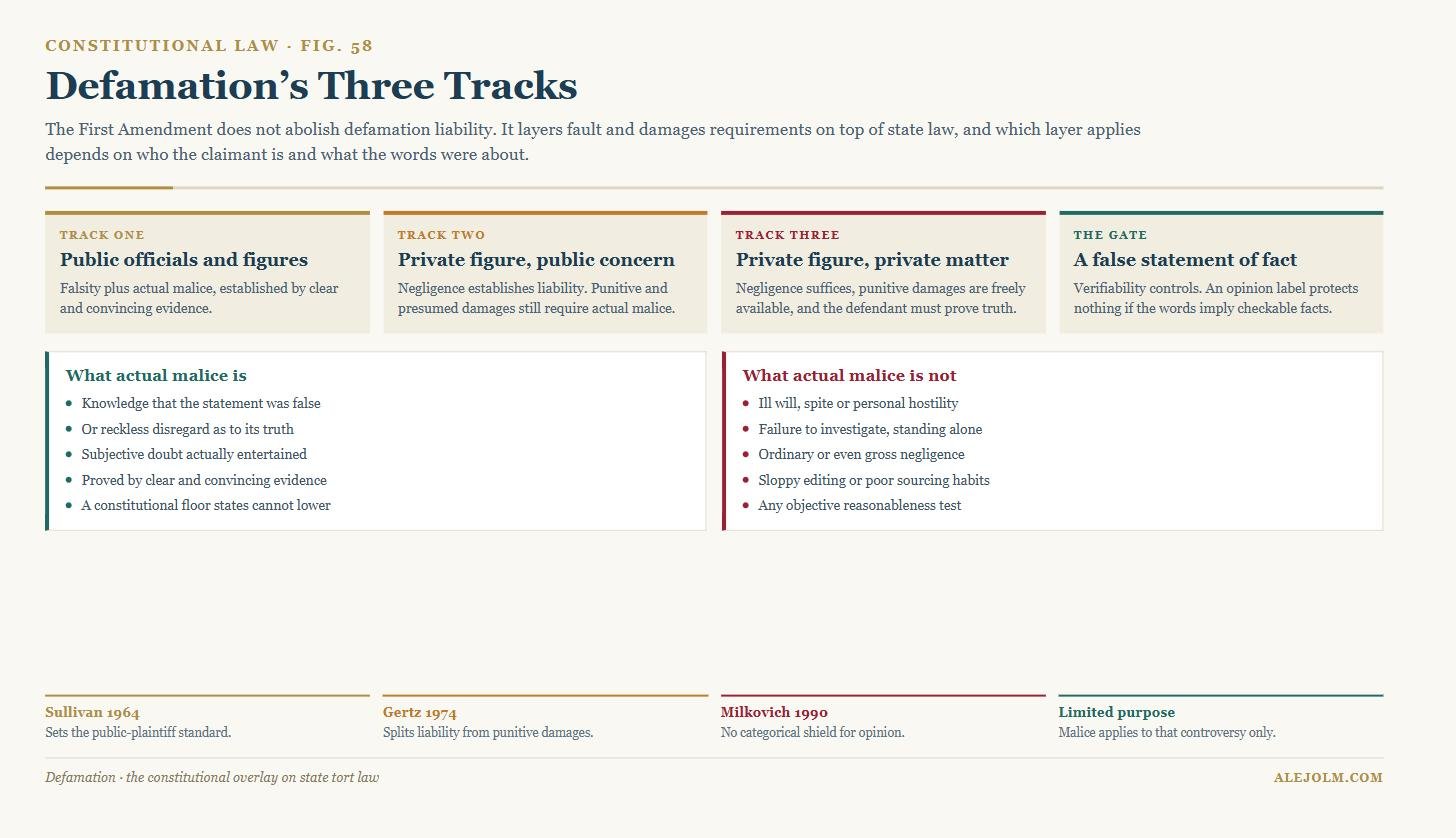
The layer has three tracks. Which one applies depends on two variables only: whether the claimant is a public or private figure, and whether the statement concerned a matter of public concern. Fix those two facts and the fault standard, the damages rules and the burden of proof all follow.
The threshold: a false statement of fact
Before any track is reached, the words must be capable of being false. Statements that cannot be proved true or untrue — genuine evaluation, rhetorical exaggeration, obvious parody — are not actionable at all, and this gate disposes of a good many claims.
But the gate is about verifiability, not vocabulary. Prefacing an assertion with “in my opinion” changes nothing if the words convey a checkable factual claim. To say that someone is a crook asserts criminal conduct; to say that someone lied under oath asserts a specific falsehood on a specific occasion. Both are verifiable and both are actionable. There is no categorical constitutional shield for anything labelled opinion.
Track one: public officials and public figures
Where the claimant holds public office or has attained genuine public prominence, recovery requires proof that the statement was false and that it was made with actual malice, and that proof must be by clear and convincing evidence rather than on the balance of probabilities. The rationale is that debate about those who govern, and about those who have sought public influence, must be able to tolerate error without the threat of ruinous liability.
Public-figure status comes in two forms. Some people are public figures for all purposes, having achieved pervasive fame or notoriety. Others are public figures for a limited purpose only, having voluntarily thrust themselves into a particular controversy. The distinction matters because the heightened standard attaches only to statements about that controversy. A campaigner who has entered a planning dispute must prove actual malice about the dispute, but remains a private figure as to unrelated allegations about her family life.
What actual malice actually means
The phrase is badly named and the misnaming causes most of the errors. Actual malice has nothing to do with spite, hostility or bad motive. It means one of two things: knowledge that the statement was false when it was made, or reckless disregard as to whether it was true or false.
Recklessness here is subjective. The defendant must have entertained serious doubts about the truth of the publication and gone ahead anyway. That is why a failure to investigate, standing alone, does not establish it, and why even gross negligence in newsroom practice falls short. What converts carelessness into recklessness is evidence that the publisher actually suspected the story was wrong — an unreliable source known to be unreliable, an internal warning ignored, an obvious avenue of verification deliberately avoided.
Exam tip: never write that a defendant acted with actual malice because he disliked the claimant or wanted to cause harm. Malice in this sense is about the defendant’s state of mind regarding truth, not regarding the claimant.
Tracks two and three: private claimants
A private claimant defamed on a matter of public concern need prove only negligence to establish liability, which asks whether the defendant exercised reasonable care in verifying the assertion. Actual malice returns, however, for presumed or punitive damages. So a careless publisher pays compensatory damages for proven loss, but escapes exemplary awards unless the higher standard is met.
Where a private claimant is defamed on a matter of purely private concern, the constitutional overlay thins out considerably. Negligence establishes liability, punitive damages become available without any showing of malice, and the burden of proving truth sits with the defendant as an affirmative defence rather than falling on the claimant as an element.
| Claimant and subject | Fault for liability |
|---|---|
| Public official or public figure | Actual malice |
| Private figure, public concern | Negligence |
| Private figure, private matter | Negligence |
| Limited-purpose public figure, within the controversy | Actual malice |
| Limited-purpose public figure, outside it | Negligence |
A floor, not a ceiling
These requirements set a minimum level of protection for the speaker. A state may be more generous to defendants than the Constitution demands — by requiring actual malice in cases where negligence would suffice, for instance — but it may not be less generous. A state rule imposing strict liability on a publisher who defames a public official is unconstitutional however clearly the legislature expressed its preference.
The protection also travels beyond the tort of defamation itself. A public figure cannot escape the actual-malice requirement by repackaging a defamation claim as intentional infliction of emotional distress arising from the same publication. Courts look at the substance of what is being remedied rather than the label on the pleading.
Worked example
A newspaper reports that a three-term city councillor embezzled fifty thousand pounds from a housing fund. The story rests on a single anonymous tip. The paper neither contacted the councillor nor checked the auditor’s records, which show no such payment. The report is false and she sues.
She is an elected official and the allegation concerns her official conduct, so track one applies: falsity plus actual malice, by clear and convincing evidence. Falsity is established. Malice is the live question, and the mere failure to investigate would not be enough on its own. What tips the balance is the combination of facts. A single anonymous source alleging a specific serious crime carries obvious reason for doubt; the auditor’s records were an available and conclusive check; and no comment was sought from the person accused. Taken together these support the inference that the paper published while actually entertaining serious doubts about the truth. Actual malice is made out and she recovers.
Change one fact. Suppose the paper had obtained the same allegation from two independent officials with direct knowledge, sought comment, and published after being told the audit was ongoing. The story would still be false, but there would be no evidence of subjective doubt. Actual malice would fail and the claim would be dismissed, which is precisely the outcome the standard is designed to produce.
Common mistakes that cost points
- Treating actual malice as ill will or improper motive rather than as knowledge of falsity or reckless disregard for truth.
- Finding actual malice from a failure to investigate alone, without evidence of subjective doubt.
- Applying the ordinary balance of probabilities to a public claimant, who must prove malice by clear and convincing evidence.
- Forgetting that a private claimant on a public-concern matter needs actual malice for punitive or presumed damages though not for liability.
- Treating anything framed as opinion as immune, when verifiability rather than labelling controls.
- Missing limited-purpose public figure status, and applying private-figure rules to a claimant who entered the controversy voluntarily.
- Applying the heightened standard to a limited-purpose public figure for statements unconnected to the controversy.
- Allowing a public figure to avoid the standard by pleading emotional distress instead of defamation.
Frequently asked questions
Is actual malice the same as malice in ordinary usage?
No, and the overlap in wording is the single biggest source of error. It refers exclusively to the defendant’s awareness of probable falsity. A publisher who loathes the claimant but honestly believes the story is true has not acted with actual malice; one who is indifferent to the claimant but privately doubts the story has.
How does someone become a limited-purpose public figure?
By voluntarily injecting themselves into a particular public controversy, typically by seeking to influence its outcome. The status is confined to that controversy, so the heightened standard applies to statements about it and the person remains a private figure for everything else.
Can a state require more protection for speech than the Constitution demands?
Yes. These rules operate as a floor, so a state may extend greater protection to defendants, for example by requiring actual malice in categories where negligence would satisfy the constitutional minimum. What it cannot do is fall below the floor by imposing strict liability where fault is required.
Actual malice in Los Angeles courts: entertainment litigation in 2026
Los Angeles is the most consequential venue in the country for this standard, because the concentration of entertainment, media and celebrity in the county means the public figure enquiry arises constantly. The federal rule from New York Times v. Sullivan requires a public official or public figure to prove knowledge of falsity or reckless disregard for the truth by clear and convincing evidence, and California courts apply it faithfully while surrounding it with procedural protections that make it harder still to overcome.
The most important of those is the special motion to strike under section 425.16 of the California Code of Civil Procedure. A media defendant sued over a publication on a matter of public interest can force the plaintiff to produce admissible evidence establishing a probability of prevailing, including evidence of actual malice, before discovery has run its course. Losing plaintiffs pay the defendant’s fees. That sequence, more than the substantive standard, explains why so many claims filed in the Los Angeles Superior Court resolve early.
What shapes the analysis here:
- Limited purpose public figures are the usual category. Someone who has voluntarily entered a particular controversy must prove actual malice as to that controversy only.
- The retraction statute limits damages. Section 48a of the California Civil Code restricts a plaintiff who fails to demand a timely correction from a newspaper or broadcaster to special damages.
- The fair report privilege protects coverage of proceedings. Accurate reports of public official proceedings are privileged under section 47.
- Opinion is judged by context. Reviews, commentary and rhetorical hyperbole in trade press are frequently held non-actionable.
- Actual malice is about belief, not spite. Ill will is admissible circumstantially but is not the test, and students lose marks by conflating the two.
- Deadlines are short. California allows one year from publication, and the single publication rule fixes accrual at first general distribution.
For 2026, decide plaintiff status first, then fault, then run the anti-SLAPP timetable. Read with defamation generally, freedom of the press and the First Amendment framework.
Next steps
This overlay sits inside a wider structure, so read the First Amendment framework for the three-question routine that places defamation among the less-protected categories, and the tort of defamation for the underlying elements, the libel and slander distinction and the privileges. Public forum doctrine and the levels of scrutiny complete the surrounding speech material.
The leading opinions are collected at Justia, the amendment is annotated by the Cornell Legal Information Institute, and current examination scope is published by the State Bar of California.
Related guides
- Advisory Opinions: Article III and Declaratory Relief
- Access to the Courts: When Filing Fees Are Unconstitutional
- Other Enumerated Powers: Postal, Bankruptcy, Admiralty
- Franchise Amendments: Congress and the Right to Vote
- Property Clause: Congress and Federal Lands Explained
- No Federal Police Power: Enumerated Powers and Enclaves
- Contracts Clause: When States May Impair Agreements
- Takings Clause: Lucas, Penn Central and Just Compensation
- Free Exercise Clause: Smith, Lukumi and Fulton Applied
- Establishment Clause: Church, State and the New Test
- Freedom of Association: Scrutiny, Dale and Disclosure
- Freedom of the Press: Publication Liability and Limits
- Campaign Finance and Anonymous Speech: The Core Rules
- Unconstitutional Conditions: Benefits and Rights Waivers
- Government Speech Doctrine: When the State Can Choose
- Vagueness and Overbreadth: Facial Challenges Explained
- Prior Restraint and Licensing: The Freedman Safeguards
- Symbolic Conduct and the O’Brien Test: The Pivot Question
- Government Employee Speech: Garcetti and Pickering Rules
- Commercial Speech and the Central Hudson Four-Part Test
- Public Forum Doctrine and the Time, Place, Manner Test
- First Amendment: The Three-Question Speech Framework
- One Person, One Vote: Voting Rights Under Equal Protection
- Alienage Classifications: Strict Scrutiny and Its Pockets
- Equal Protection: The Three-Step Classification Test
- Second Amendment: The Bruen Text-and-History Standard
- Substantive Due Process After Dobbs: A Two-Step Test
- Procedural Due Process: Notice, Hearing and Mathews
- Incorporation Doctrine: Which Rights Bind the States
- Full Faith and Credit: Recognising Sister-State Judgments
- The Complete Auto Test: Taxing Interstate Commerce
- The Right to Travel: Durational Residency Explained
- Article IV Privileges and Immunities: The Comity Rule
- Federal Preemption: The Three-Step Ladder Explained
- The Supremacy Clause: Floors, Ceilings and Preemption
- Intergovernmental Immunity: The Shield Runs One Way
- The Presidential Pardon Power: Four Limits That Matter
- Executive Privilege: A Qualified Right That Must Yield
- Presidential Immunity: Criminal, Civil and Private Acts
- The Removal Power: At-Will Firing and Its Exceptions
- The Appointment Power: Principal and Inferior Officers
- Take Care Clause: Enforcement Discretion and Its Limits
- Commander-in-Chief Power: Deploy Without Declaring War
- Executive Agreements: The President’s Sole Foreign Power
- The Treaty Power: Senate Advice and Consent Explained
- The Presidential Veto Power, Override and Pocket Veto
- Bicameralism and Presentment: Two Vetoes Struck Down
- The Nondelegation Doctrine and the Intelligible Principle
- Speech or Debate Clause: Absolute but Narrow Immunity
- The Impeachment Power: House Majority, Senate Two-Thirds
- Congress’s Naturalization Power and Citizenship Limits
- Congressional War Powers: Declare, Fund and Command
- Anti-Commandeering Doctrine and the Tenth Amendment
- Section 5 Enforcement Power: Remedy, Do Not Redefine
- The Spending Power and the Five Dole Test Conditions
- Congress’s Taxing Power: When a Penalty Is Really a Tax
- The Necessary and Proper Clause: Congress’s Multiplier
- Ex Post Facto Clause: Retroactive Criminal Laws Barred
- Bills of Attainder: Legislative Punishment Explained
- The Writ of Habeas Corpus: Testing Unlawful Detention
- Supreme Court Jurisdiction: Original vs Appellate Power
- Abstention Doctrine: 4 Ways Federal Courts Step Aside
- Dormant Commerce Clause: Discrimination vs Pike Balancing
- The Commerce Clause: 3 Categories and 2 Hard Limits
- State Action Doctrine: The Government Conduct Threshold
- The Eleventh Amendment and State Sovereign Immunity
- Political Question Doctrine: What Courts Will Not Decide
- Ripeness and Mootness: Timing Rules in Federal Court
- Standing in Federal Court: The 3-Part Article III Test
- Marbury v. Madison and the Power of Judicial Review
- The Youngstown Framework: Presidential Power in 3 Zones
- The IRAC Method: How to Structure a Bar Exam Answer
- Piercing the Corporate Veil: A Two-Prong Alter Ego Test
- Defamation Elements, Fault Standards and Privileges
- The Parol Evidence Rule: Integration and Exceptions
- Recording Acts: Race, Notice and Race-Notice Explained
- Partner Liability and Authority Under RUPA Explained
- Trustee Duties: Care, Loyalty, Impartiality, Accounts
- Specific Performance: A Six-Element Bar Exam Framework
- Will Execution Requirements: Formalities and Rescue
- Community Property Presumptions in California Explained
- Easements Explained: Creation, Scope and Termination
- Products Liability: The Three Defect Theories Explained
- Miranda Rights: Custody, Interrogation and Invocation
- The Character Evidence Rules: Propensity Bar and Doorways
- Adverse Possession Elements: OCEAN and the Tax Rule
- Business Judgment Rule and Directors’ Fiduciary Duties
- The Statute of Frauds: MYLEGS and How to Satisfy It
- Res Judicata vs Collateral Estoppel: Bar Exam Guide
- The Erie Doctrine Explained: A 4-Step Bar Exam Guide
- Conflicts of Interest: A 6-Step Decision Tree for the Bar
- The Rule Against Perpetuities Explained Step by Step
- Murder and Manslaughter: The Homicide Ladder Explained
- Consideration in Contract Law: Rules and Exceptions
- The Four Elements of Negligence: Bar Exam Breakdown
- The Hearsay Rule Explained: Exceptions and Exemptions
- Personal Jurisdiction: The 3-Step Bar Exam Framework
- 3 Levels of Scrutiny in Constitutional Law Explained
- The Citizenship Clause After Trump v. Barbara