
Some government action punishes speech after it happens. A far smaller category stops speech before it ever reaches an audience, and that difference is the whole of prior restraint doctrine. A prior restraint is a judicial order or an administrative licensing scheme that suppresses expression in advance of publication. Because it removes the speech from public circulation entirely rather than merely deterring the speaker with the threat of later liability, it sits under the heaviest presumption of invalidity anywhere in free-expression law.
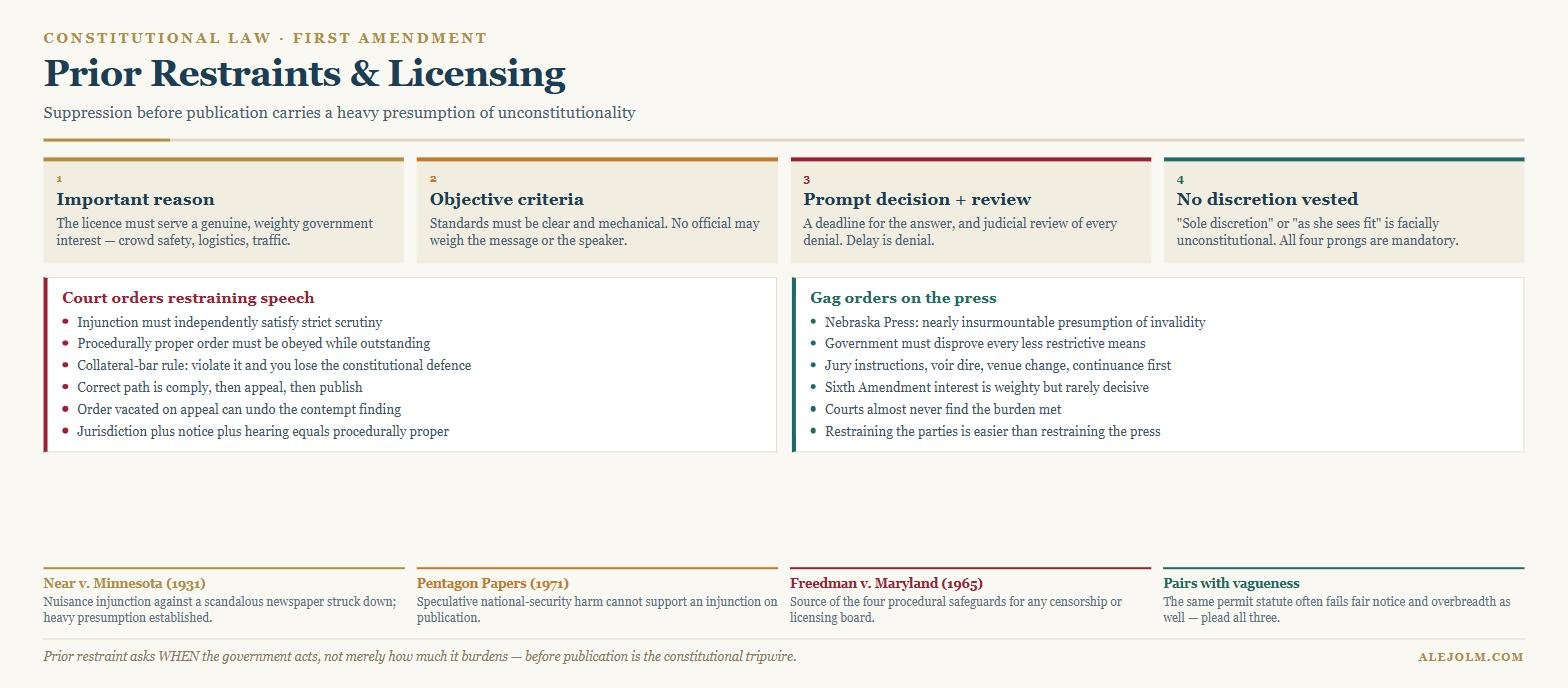
That presumption is not a tie-breaker; it is a genuine burden that the government usually cannot carry. Injunctions restraining speech must independently satisfy strict scrutiny. Permit and licensing systems survive only by satisfying every one of the four procedural safeguards drawn from Freedman v. Maryland. Gag orders on the press face a presumption that courts have described as nearly insurmountable. This guide walks through each branch, shows where the collateral-bar rule traps unwary litigants, and works a permit hypothetical end to end.
Why timing changes the constitutional analysis
Most First Amendment questions ask how heavily a law burdens expression. Prior restraint asks a different question: when does the government act? A defamation judgment, a criminal conviction for incitement, a fine for violating a noise ordinance — all of these operate after the words have been spoken. The public has heard the message; a court has a concrete record; the speaker had a chance to be heard before liability attached. Suppression before publication reverses every one of those features. Nothing reaches the audience, the record is speculative, and the decision is often made by an administrator rather than a judge.
The practical consequence is censorship by inertia. A licensing official who simply does nothing achieves the same result as a denial, and the speaker has no ruling to appeal. Delay is denial. That is why the doctrine polices procedure so aggressively — deadlines, written criteria, and a guaranteed route to a court are not technicalities but the only thing standing between a permit desk and an unreviewable veto over public debate.
The foundation is Near v. Minnesota (1931), which struck down a statute allowing courts to enjoin newspapers as public nuisances for printing malicious, scandalous or defamatory material. The Court acknowledged narrow situations in which advance suppression might conceivably be justified — troop movements in wartime, obscenity, direct incitement to violence — but treated them as exceptional. Forty years later, New York Times Co. v. United States refused to enjoin publication of the Pentagon Papers because generalised claims of diplomatic embarrassment and speculative harm to national security fell far short of the grave, direct and immediate injury the presumption demands.
The four Freedman safeguards for licensing schemes
Licensing is not forbidden. Cities plainly may require permits for parades, street festivals, sound trucks and demonstrations that consume public space and police resources. What the Constitution forbids is a permit system that hands an official the power to decide, on their own assessment of the public good, who gets to speak. Freedman v. Maryland (1965) supplies the four-part test, and each prong is independently necessary — failing one defeats the entire scheme.
- An important reason for the licence. The requirement must serve a real government interest such as crowd control, traffic management or avoiding double-booking of a venue — not a desire to preview the message.
- Clear, objective criteria. The grounds for denial must be written, narrow and mechanical, so that two different officials applying them to the same application would reach the same answer.
- Prompt determination and judicial review. A specified deadline for the decision, and a guaranteed path to a court if the answer is no. An indefinite pending application is an unreviewable ban.
- No discretion vested in the official. Language such as “sole discretion”, “as the Director sees fit”, or “if the event serves the public interest” is facially unconstitutional because it invites content and viewpoint sorting.
Prongs two and four overlap deliberately, and in practice they do most of the work. A statute that contains no standards at all necessarily vests discretion; a statute that vests discretion necessarily lacks meaningful standards. When a permit ordinance appears on an exam or across a client’s desk, read the operative verb first. If the decision-maker “may” grant a permit on their own judgement, the scheme falls on its face and the applicant need not even apply before challenging it.
One further point often missed: because the defect is facial, a speaker who marches without a permit issued under an unconstitutional scheme cannot be punished for the omission. Ordinarily a person must exhaust an administrative process, but an unconstitutional licensing requirement is treated as no requirement at all. That is a rare and powerful exception, and it is confined to prior restraints — it does not travel to ordinary regulatory permits unrelated to expression.
Exam tip: the phrase “sole discretion” in a permit statute is a fatal tell. Flag it on sight, cite Freedman prongs two and four, and remember that the applicant may speak without the permit rather than being forced to exhaust an unconstitutional process.
Court orders restraining speech and the collateral-bar rule
An injunction against speech must independently satisfy strict scrutiny — narrow tailoring to a compelling interest — and vanishingly few do. But there is a procedural trap layered on top of the substantive rule, and it catches litigants who assume that an unconstitutional order can simply be ignored. Under the collateral-bar rule, an order issued by a court with jurisdiction, after proper notice and a hearing, is procedurally proper and must be obeyed while it stands. A party who violates it and is charged with contempt may not defend by arguing that the order infringed the First Amendment.
The reasoning is institutional rather than expressive. If every litigant could decide privately that an order was invalid and act accordingly, judicial authority would depend on each party’s own constitutional reading. So the system insists on a sequence: comply, then appeal. If the appellate court agrees the order was unconstitutional, it is vacated, and a contempt finding predicated on it can be undone. If the party defies the order first, the constitutional victory on appeal may arrive too late to erase the contempt.
The exception lies in the words procedurally proper. An order from a court without jurisdiction, or entered with no notice and no opportunity to be heard, is not entitled to that protection, and defiance does not forfeit the constitutional argument. Distinguishing the two is the analytical work: check jurisdiction, then notice, then hearing. Only when all three are present does the collateral-bar rule bite.
Gag orders on the press and the fair-trial clash
When a notorious prosecution is pending, a trial judge’s instinct is to quiet the coverage. Nebraska Press Association v. Stuart holds that an order restraining the press from publishing information about a pending case is a prior restraint carrying a nearly insurmountable presumption of unconstitutionality. The Sixth Amendment interest in an untainted jury is genuinely weighty, but the government must show that no less restrictive alternative would protect it — and the list of alternatives is long.
Careful voir dire, emphatic jury instructions, sequestration, a change of venue, and a continuance until publicity subsides all address prejudicial coverage without silencing anyone. Because at least one of them is almost always available, courts almost never sustain a press gag order. Note the important distinction, though: restraining the participants — lawyers, parties, witnesses — through professional-conduct rules and protective orders is analysed far more leniently than restraining the press, which is merely reporting what it lawfully learns.
How prior restraint interacts with neighbouring doctrines
A defective permit ordinance rarely has only one flaw. The same statute that vests unfettered discretion is often also unconstitutionally vague, because a speaker cannot tell in advance what conduct will earn a denial, and frequently overbroad, because its sweep reaches substantial protected expression alongside anything it might legitimately regulate. These are distinct doctrines with distinct remedies — vagueness is a due-process fair-notice problem, overbreadth a First Amendment standing-and-scope problem, prior restraint a timing problem — and a competent challenge pleads all three.
The doctrine also has to be read against the forum. In a traditional public forum such as a street or park, content-neutral time, place and manner rules are permitted, so a well-drafted permit scheme is expected; the question is whether it satisfies Freedman. In a non-public forum the government has far more latitude over access in the first place, which changes what a permit requirement is even doing. Getting the forum right before reaching prior restraint prevents a great deal of wasted analysis.
| Branch | Standard applied |
|---|---|
| Licensing / permit scheme | All four Freedman safeguards, each necessary |
| Injunction against speech | Strict scrutiny, independently applied |
| Press gag order | Nearly insurmountable presumption of invalidity |
| Order on trial participants | Ordinary professional-conduct and protective-order analysis |
| Post-publication punishment | Whatever the underlying doctrine requires |
Worked example
City X requires a permit from the Parks Department for any outdoor public gathering. The application asks for the event’s purpose, expected attendance and requested time and place. The ordinance gives the Director “sole discretion to grant or deny permits based on the Director’s assessment of the public interest”. No deadline for a decision is specified and denials are not reviewable. A group applies to march against city policy; the Director denies the application with no explanation beyond her “sole discretion”. The group marches anyway and is arrested.
Start with what the city may legitimately do. Requiring a permit for a march is fine — the interest in policing, traffic and avoiding conflicting events is important, so prong one is satisfied. Everything after that collapses. There are no criteria at all, so prong two fails. The ordinance vests the decision in the Director’s assessment of the public interest, which is precisely the discretion prong four forbids. There is no decision deadline, so the prompt-determination requirement fails, and no judicial review of denials, so the review requirement fails. Three of four safeguards are absent and the scheme is unconstitutional on its face. Because the licensing requirement is facially invalid, the marchers cannot be prosecuted for proceeding without a permit; the unexplained denial is exactly the arbitrary sorting Freedman exists to prevent. The group should prevail.
Change one fact. Suppose that instead of an ordinance, a judge — with jurisdiction, after notice and a hearing — entered an injunction forbidding the march on the ground that it would obstruct traffic. Now the collateral-bar rule applies. The injunction is very likely unconstitutional, since traffic management is not a compelling interest narrowly served by banning a march outright, but it is procedurally proper. The group’s remedy is to seek an emergency appeal, not to march. If it marches, the contempt conviction stands even though the underlying order would have fallen on review.
Common mistakes that cost points
- Treating every licensing scheme as unconstitutional. A permit system with objective criteria, a decision deadline and judicial review is perfectly valid; the defect is discretion, not licensing.
- Applying only three of the four Freedman safeguards. Each is independently necessary, so identify which specific prongs the statute fails rather than gesturing at the test as a whole.
- Ignoring the collateral-bar rule and advising the client to defy a procedurally proper injunction. The answer is comply and appeal.
- Forgetting to test whether the order was procedurally proper in the first place. No jurisdiction, or no notice and hearing, and the collateral bar does not apply.
- Collapsing vagueness into prior restraint. Vagueness is a due-process fair-notice defect; prior restraint is about the timing of suppression. A statute can fail both.
- Assuming a fair-trial interest justifies a press gag order. Nebraska Press requires the government to eliminate every less restrictive alternative, which it almost never can.
- Treating a restraint on lawyers and witnesses as equivalent to a restraint on the press. The two are analysed under different frameworks and reach different results.
- Requiring the speaker to exhaust an unconstitutional permit process before suing. A facially invalid licensing requirement may be ignored.
Frequently asked questions
Is a prior restraint ever constitutional?
Yes, but rarely. A licensing scheme that satisfies all four Freedman safeguards is valid, and courts have long assumed that a narrow category of extreme cases — publication of troop movements during active hostilities, for instance — could support an injunction. What fails is the ordinary case: speculative harm, generalised national-security assertions, or an official’s open-ended judgement about the public interest.
What is the difference between a prior restraint and a subsequent punishment?
Timing, and it is decisive. A prior restraint prevents the expression from reaching an audience at all. A subsequent punishment — a defamation judgment, a criminal fine — attaches after the speech has been published and is judged under whatever doctrine governs that category of speech. Only the former triggers the heavy presumption of unconstitutionality.
Can I violate an unconstitutional injunction and raise the First Amendment as a defence?
Not if the injunction was procedurally proper. Under the collateral-bar rule, an order from a court with jurisdiction entered after notice and a hearing must be obeyed while it stands, and a contempt charge cannot be defended on the ground that the order was unconstitutional. Comply, appeal, and seek to have the order vacated — which can then undo the contempt.
Prior restraint in California: injunctions, gag orders and permits, 2026
The presumption against prior restraint is strong federally and stronger still in California, where article I, section 2 of the California Constitution has been read to give independent protection. The distinction that resolves most problems is between restraining speech before any adjudication and restraining repetition of speech already found unlawful.
The California Supreme Court drew that line in Balboa Island Village Inn v. Lemen (2007), holding that an injunction prohibiting a defendant from repeating statements already determined at trial to be defamatory is permissible, while a broad order barring future statements not yet adjudicated is an invalid prior restraint. In the Los Angeles Superior Court this shapes how harassment and injunctive relief requests under the California Code of Civil Procedure are drafted, because orders phrased to sweep in unadjudicated speech are routinely narrowed on appeal.
Where the doctrine bites locally:
- Filming permits are not censorship. Location permitting across the county regulates traffic, parking and safety, and survives because it is content neutral and administered by objective criteria.
- Licensing needs the Freedman safeguards. Any scheme requiring permission before expression must impose definite time limits, preserve prompt judicial review and place the burden on the government.
- Gag orders on trial participants are narrow. A court must find a substantial likelihood of prejudice and consider alternatives before restricting counsel or parties.
- Reporters have a strong shield. California’s constitutional shield provision and the California Evidence Code give journalists unusually broad protection against compelled disclosure of sources.
- Anti-SLAPP arrives early. A special motion to strike often disposes of a case faster than fighting an injunction, and it carries fee shifting.
- Sealing requires findings. Rules of court demand express findings of an overriding interest before a record is sealed, reflecting the presumption of open proceedings.
In 2026, ask whether an adjudication has occurred, then whether the order is limited to what was adjudicated. Read with the First Amendment framework, freedom of the press and vagueness and overbreadth.
Next steps
Prior restraint sits inside the larger free-expression framework, so it helps to work outward from the master test in the First Amendment analysis and then narrow. Because most permit disputes arise on streets, parks and pavements, pair this guide with public forum doctrine to establish what the government may regulate before asking how. The tiers that decide whether an injunction can survive are set out in the levels of scrutiny, and the parade and demonstration scenarios that dominate permit litigation overlap heavily with symbolic conduct and the O’Brien test.
For primary sources, the opinions in Near v. Minnesota and the Pentagon Papers case are worth reading in full and are freely available through Justia’s First Amendment collection. Cornell’s Legal Information Institute keeps a concise doctrinal overview with current citations, and practitioners preparing for admission should check the subject outlines published by the State Bar of California to confirm the current scope of testing.
Related guides
- Advisory Opinions: Article III and Declaratory Relief
- Access to the Courts: When Filing Fees Are Unconstitutional
- Other Enumerated Powers: Postal, Bankruptcy, Admiralty
- Franchise Amendments: Congress and the Right to Vote
- Property Clause: Congress and Federal Lands Explained
- No Federal Police Power: Enumerated Powers and Enclaves
- Contracts Clause: When States May Impair Agreements
- Takings Clause: Lucas, Penn Central and Just Compensation
- Free Exercise Clause: Smith, Lukumi and Fulton Applied
- Establishment Clause: Church, State and the New Test
- Freedom of Association: Scrutiny, Dale and Disclosure
- Freedom of the Press: Publication Liability and Limits
- Campaign Finance and Anonymous Speech: The Core Rules
- Unconstitutional Conditions: Benefits and Rights Waivers
- Government Speech Doctrine: When the State Can Choose
- Vagueness and Overbreadth: Facial Challenges Explained
- Symbolic Conduct and the O’Brien Test: The Pivot Question
- Government Employee Speech: Garcetti and Pickering Rules
- Commercial Speech and the Central Hudson Four-Part Test
- Actual Malice and the Three Tracks of Defamation Law
- Public Forum Doctrine and the Time, Place, Manner Test
- First Amendment: The Three-Question Speech Framework
- One Person, One Vote: Voting Rights Under Equal Protection
- Alienage Classifications: Strict Scrutiny and Its Pockets
- Equal Protection: The Three-Step Classification Test
- Second Amendment: The Bruen Text-and-History Standard
- Substantive Due Process After Dobbs: A Two-Step Test
- Procedural Due Process: Notice, Hearing and Mathews
- Incorporation Doctrine: Which Rights Bind the States
- Full Faith and Credit: Recognising Sister-State Judgments
- The Complete Auto Test: Taxing Interstate Commerce
- The Right to Travel: Durational Residency Explained
- Article IV Privileges and Immunities: The Comity Rule
- Federal Preemption: The Three-Step Ladder Explained
- The Supremacy Clause: Floors, Ceilings and Preemption
- Intergovernmental Immunity: The Shield Runs One Way
- The Presidential Pardon Power: Four Limits That Matter
- Executive Privilege: A Qualified Right That Must Yield
- Presidential Immunity: Criminal, Civil and Private Acts
- The Removal Power: At-Will Firing and Its Exceptions
- The Appointment Power: Principal and Inferior Officers
- Take Care Clause: Enforcement Discretion and Its Limits
- Commander-in-Chief Power: Deploy Without Declaring War
- Executive Agreements: The President’s Sole Foreign Power
- The Treaty Power: Senate Advice and Consent Explained
- The Presidential Veto Power, Override and Pocket Veto
- Bicameralism and Presentment: Two Vetoes Struck Down
- The Nondelegation Doctrine and the Intelligible Principle
- Speech or Debate Clause: Absolute but Narrow Immunity
- The Impeachment Power: House Majority, Senate Two-Thirds
- Congress’s Naturalization Power and Citizenship Limits
- Congressional War Powers: Declare, Fund and Command
- Anti-Commandeering Doctrine and the Tenth Amendment
- Section 5 Enforcement Power: Remedy, Do Not Redefine
- The Spending Power and the Five Dole Test Conditions
- Congress’s Taxing Power: When a Penalty Is Really a Tax
- The Necessary and Proper Clause: Congress’s Multiplier
- Ex Post Facto Clause: Retroactive Criminal Laws Barred
- Bills of Attainder: Legislative Punishment Explained
- The Writ of Habeas Corpus: Testing Unlawful Detention
- Supreme Court Jurisdiction: Original vs Appellate Power
- Abstention Doctrine: 4 Ways Federal Courts Step Aside
- Dormant Commerce Clause: Discrimination vs Pike Balancing
- The Commerce Clause: 3 Categories and 2 Hard Limits
- State Action Doctrine: The Government Conduct Threshold
- The Eleventh Amendment and State Sovereign Immunity
- Political Question Doctrine: What Courts Will Not Decide
- Ripeness and Mootness: Timing Rules in Federal Court
- Standing in Federal Court: The 3-Part Article III Test
- Marbury v. Madison and the Power of Judicial Review
- The Youngstown Framework: Presidential Power in 3 Zones
- The IRAC Method: How to Structure a Bar Exam Answer
- Piercing the Corporate Veil: A Two-Prong Alter Ego Test
- Defamation Elements, Fault Standards and Privileges
- The Parol Evidence Rule: Integration and Exceptions
- Recording Acts: Race, Notice and Race-Notice Explained
- Partner Liability and Authority Under RUPA Explained
- Trustee Duties: Care, Loyalty, Impartiality, Accounts
- Specific Performance: A Six-Element Bar Exam Framework
- Will Execution Requirements: Formalities and Rescue
- Community Property Presumptions in California Explained
- Easements Explained: Creation, Scope and Termination
- Products Liability: The Three Defect Theories Explained
- Miranda Rights: Custody, Interrogation and Invocation
- The Character Evidence Rules: Propensity Bar and Doorways
- Adverse Possession Elements: OCEAN and the Tax Rule
- Business Judgment Rule and Directors’ Fiduciary Duties
- The Statute of Frauds: MYLEGS and How to Satisfy It
- Res Judicata vs Collateral Estoppel: Bar Exam Guide
- The Erie Doctrine Explained: A 4-Step Bar Exam Guide
- Conflicts of Interest: A 6-Step Decision Tree for the Bar
- The Rule Against Perpetuities Explained Step by Step
- Murder and Manslaughter: The Homicide Ladder Explained
- Consideration in Contract Law: Rules and Exceptions
- The Four Elements of Negligence: Bar Exam Breakdown
- The Hearsay Rule Explained: Exceptions and Exemptions
- Personal Jurisdiction: The 3-Step Bar Exam Framework
- 3 Levels of Scrutiny in Constitutional Law Explained
- The Citizenship Clause After Trump v. Barbara