
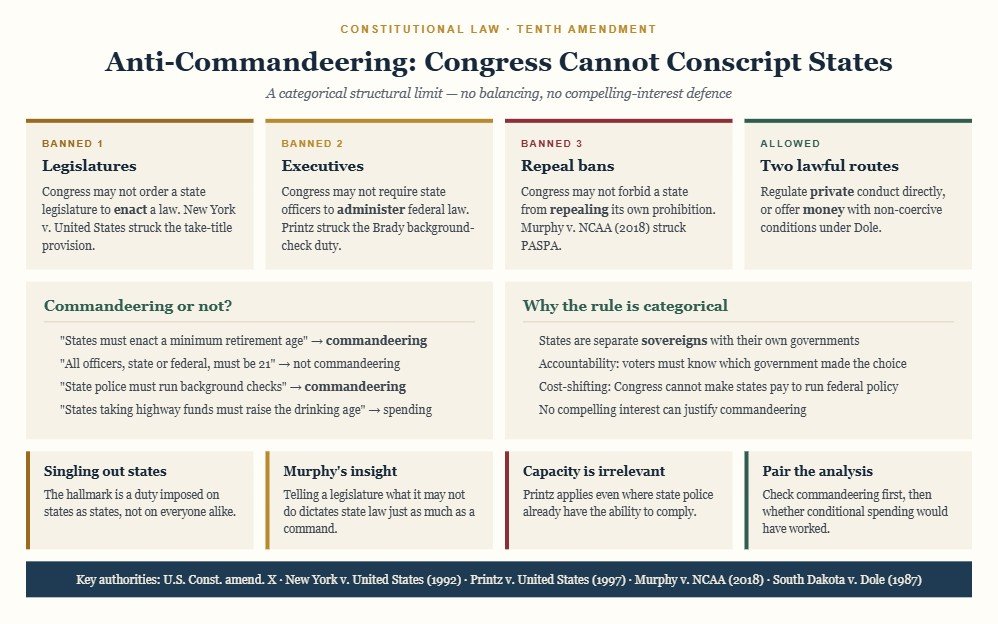
The anti-commandeering doctrine holds that Congress may not issue direct orders requiring states to enact legislation or to enforce federal law. It is a structural inference from the Tenth Amendment and from the design of a system in which states are separate sovereigns rather than administrative units of the federal government.
This guide explains the three forms of commandeering identified in New York v. United States, Printz v. United States and Murphy v. NCAA, why the rule admits no balancing, how to tell a command to states from ordinary regulation that happens to bind states, and why conditional spending is the lawful alternative.
Why the doctrine exists
Three structural concerns drive the rule. States have their own governments and their own electorates, so converting state officials into federal agents blurs the line between two sovereigns. Political accountability suffers when voters cannot tell which government made an unpopular decision. And commandeering lets Congress impose the administrative cost of federal policy on state budgets.
Because the objection is structural, the rule is categorical. There is no compelling-interest defence and no balancing. If a statute commandeers, it is unconstitutional however important the federal aim.
Exam tip: commandeering is fatal. Do not look for a justification; look for whether Congress singled out states as states and told them what to do.
Commandeering the legislature: New York v. United States
Federal legislation on low-level radioactive waste gave states a choice: regulate the waste according to federal standards, or take title to it and assume liability for it. The Court held that the take-title provision commandeered state legislatures, because neither branch of the supposed choice was one Congress could have compelled on its own. Offering a coerced election between two unconstitutional demands is still a command.
Commandeering the executive: Printz v. United States
The Brady Act required local chief law enforcement officers to conduct background checks on prospective handgun purchasers. The Court struck the provision down. Congress may not press state executive officers into service to administer a federal programme, and it does not matter that the officers already have the practical capacity to do the work.
Commandeering by prohibition: Murphy v. NCAA
Murphy extended the doctrine to federal statutes framed as prohibitions rather than commands. The Professional and Amateur Sports Protection Act did not tell states to do anything; it barred them from authorising or licensing sports gambling. The Court held that this was commandeering all the same, because a federal law dictating what a state legislature may not enact controls the content of state law just as directly as one dictating what it must enact.
The practical significance is large. Murphy means the doctrine reaches attempts to freeze state law in place, so a statute forbidding a state to repeal or decline to re-enact its own prohibition is invalid.
What is not commandeering
Congress may regulate private conduct directly under its enumerated powers, and states must obey those laws like everyone else. The distinguishing feature of commandeering is that the statute singles out states as states and directs their legislative or executive machinery.
Congress may also pre-empt state law under the Supremacy Clause where it regulates a field it has power over, and it may offer money on conditions. A statute that applies uniformly to all actors in a market, public and private alike, is not commandeering even though state agencies must comply.
| Federal statute | Commandeering? | Reason |
|---|---|---|
| States must enact a minimum retirement age for police | Yes | Direct order to legislate (New York) |
| Every law enforcement officer, state or federal, must be over 21 | No | Uniform regulation, not a command to states |
| State police must perform federal background checks | Yes | Conscription of state executives (Printz) |
| No state may authorise sports gambling | Yes | Dictates the content of state law (Murphy) |
| States accepting highway funds must raise the drinking age | No | Conditional spending (Dole) |
| All employers must provide health insurance | No | Direct regulation of private conduct |
Worked example: the state commission
Congress requires every state to create a commission overseeing firearms regulation and to report compliance to a federal agency. No funding accompanies the mandate. The statute is addressed to states as states, requires them to build administrative machinery, and directs them to administer federal oversight. That is commandeering of both the legislative and executive functions and it fails under New York and Printz.
Now redraft the statute. Congress offers grants for state firearms enforcement, conditioned on the recipient establishing such a commission, with only the new grant at stake if a state declines. The condition is clear, related to the funded programme, violates no independent right, and leaves refusal a genuine option. The same policy goal is achieved lawfully through conditional spending.
The relationship with conditional spending
The two doctrines are complementary and should be discussed together. Congress cannot order states, but it can pay them, and the payment analysis has its own limits: the five South Dakota v. Dole conditions, including the anti-coercion prong added by NFIB v. Sebelius. A condition backed by the threat of losing all existing funding is coercive, and a statute so framed may raise both problems at once.
Common mistakes that cost points
- Confusing commandeering with regulation that binds states incidentally. Uniform rules are permissible.
- Looking for a compelling interest. The limit is structural and categorical.
- Assuming a command must be affirmative. Murphy covers federal bans on state repeal.
- Arguing that Printz allows conscription where state officers already have capacity. It does not.
- Missing the conditional-spending alternative, which is usually the point of the question.
- Treating a coerced choice between two options as consent, which New York rejects.
- Forgetting that pre-emption is different: displacing state law is not the same as commanding a state to act.
- Overlooking the accountability rationale, which explains why the doctrine matters for voters as well as for states.
Frequently asked questions
Can Congress require states to provide information?
Reporting duties imposed on states as states sit uneasily with Printz, though minor administrative requirements applied to everyone have generally been treated differently from conscription into a federal programme.
Does the doctrine protect cities and counties?
Local governments are creatures of the state, and Printz itself involved local sheriffs, so orders directed at them raise the same objection.
How does pre-emption differ from commandeering?
Pre-emption displaces state law that conflicts with valid federal law. Commandeering conscripts state institutions to carry out federal policy. The first is permitted; the second is not.
Anti-commandeering and California sanctuary law in 2026
California has become the practical showcase for this doctrine. The principle from New York v. United States (1992) and Printz v. United States (1997) is that Congress may not compel states to enact regulatory programmes or direct state officers to administer federal law, and Murphy v. NCAA (2018) restated it broadly enough to cover federal commands that a state maintain an existing prohibition.
That reasoning underpinned California’s limits on local participation in federal immigration enforcement. When the United States challenged the legislation, the Ninth Circuit largely upheld the restrictions on information sharing and cooperation, on the basis that a state may decline to devote its own personnel to a federal programme even where it may not affirmatively obstruct one. The same logic explains why California could legalise cannabis for state purposes: it withdrew its own prohibition rather than nullifying the federal one.
How it operates in Los Angeles County:
- Detainer requests are requests. The Sheriff’s Department is not obliged to hold someone past release on a federal civil detainer, and honouring one without authority has generated Fourth Amendment liability elsewhere.
- Funding conditions are the federal counter-move. Congress may attach conditions to grants, so the fight often shifts from commandeering to the spending power and its limits on coercion.
- Obstruction remains unlawful. Actively impeding federal officers is not protected by the doctrine, and the distinction is one of refusal versus interference.
- Preemption can still displace state law. Where Congress regulates private parties directly, anti-commandeering gives the state nothing.
- The doctrine protects structure, not individuals. A defendant cannot invoke it as a personal right; it is a federalism limit.
- Counties are bound by state policy. Los Angeles County must follow California law here, so local discretion is limited from above as well as below.
For 2026, ask whether Congress is regulating private conduct, conditioning money, or ordering state officers about, because only the third is barred outright. Read with preemption, the Supremacy Clause and the spending power.
Next steps
Commandeering is best learned alongside the powers Congress actually may use. Read The Spending Power and the Five Dole Test Conditions, then The Commerce Clause: 3 Categories and 2 Hard Limits and The Necessary and Proper Clause: Congress’s Multiplier.
For primary sources, read New York v. United States and Printz v. United States at Justia, the annotation to the Tenth Amendment at Cornell LII, and the examination scope published by the State Bar of California.
Related guides
- Advisory Opinions: Article III and Declaratory Relief
- Access to the Courts: When Filing Fees Are Unconstitutional
- Other Enumerated Powers: Postal, Bankruptcy, Admiralty
- Franchise Amendments: Congress and the Right to Vote
- Property Clause: Congress and Federal Lands Explained
- No Federal Police Power: Enumerated Powers and Enclaves
- Contracts Clause: When States May Impair Agreements
- Takings Clause: Lucas, Penn Central and Just Compensation
- Free Exercise Clause: Smith, Lukumi and Fulton Applied
- Establishment Clause: Church, State and the New Test
- Freedom of Association: Scrutiny, Dale and Disclosure
- Freedom of the Press: Publication Liability and Limits
- Campaign Finance and Anonymous Speech: The Core Rules
- Unconstitutional Conditions: Benefits and Rights Waivers
- Government Speech Doctrine: When the State Can Choose
- Vagueness and Overbreadth: Facial Challenges Explained
- Prior Restraint and Licensing: The Freedman Safeguards
- Symbolic Conduct and the O’Brien Test: The Pivot Question
- Government Employee Speech: Garcetti and Pickering Rules
- Commercial Speech and the Central Hudson Four-Part Test
- Actual Malice and the Three Tracks of Defamation Law
- Public Forum Doctrine and the Time, Place, Manner Test
- First Amendment: The Three-Question Speech Framework
- One Person, One Vote: Voting Rights Under Equal Protection
- Alienage Classifications: Strict Scrutiny and Its Pockets
- Equal Protection: The Three-Step Classification Test
- Second Amendment: The Bruen Text-and-History Standard
- Substantive Due Process After Dobbs: A Two-Step Test
- Procedural Due Process: Notice, Hearing and Mathews
- Incorporation Doctrine: Which Rights Bind the States
- Full Faith and Credit: Recognising Sister-State Judgments
- The Complete Auto Test: Taxing Interstate Commerce
- The Right to Travel: Durational Residency Explained
- Article IV Privileges and Immunities: The Comity Rule
- Federal Preemption: The Three-Step Ladder Explained
- The Supremacy Clause: Floors, Ceilings and Preemption
- Intergovernmental Immunity: The Shield Runs One Way
- The Presidential Pardon Power: Four Limits That Matter
- Executive Privilege: A Qualified Right That Must Yield
- Presidential Immunity: Criminal, Civil and Private Acts
- The Removal Power: At-Will Firing and Its Exceptions
- The Appointment Power: Principal and Inferior Officers
- Take Care Clause: Enforcement Discretion and Its Limits
- Commander-in-Chief Power: Deploy Without Declaring War
- Executive Agreements: The President’s Sole Foreign Power
- The Treaty Power: Senate Advice and Consent Explained
- The Presidential Veto Power, Override and Pocket Veto
- Bicameralism and Presentment: Two Vetoes Struck Down
- The Nondelegation Doctrine and the Intelligible Principle
- Speech or Debate Clause: Absolute but Narrow Immunity
- The Impeachment Power: House Majority, Senate Two-Thirds
- Congress’s Naturalization Power and Citizenship Limits
- Congressional War Powers: Declare, Fund and Command
- Section 5 Enforcement Power: Remedy, Do Not Redefine
- The Spending Power and the Five Dole Test Conditions
- Congress’s Taxing Power: When a Penalty Is Really a Tax
- The Necessary and Proper Clause: Congress’s Multiplier
- Ex Post Facto Clause: Retroactive Criminal Laws Barred
- Bills of Attainder: Legislative Punishment Explained
- The Writ of Habeas Corpus: Testing Unlawful Detention
- Supreme Court Jurisdiction: Original vs Appellate Power
- Abstention Doctrine: 4 Ways Federal Courts Step Aside
- Dormant Commerce Clause: Discrimination vs Pike Balancing
- The Commerce Clause: 3 Categories and 2 Hard Limits
- State Action Doctrine: The Government Conduct Threshold
- The Eleventh Amendment and State Sovereign Immunity
- Political Question Doctrine: What Courts Will Not Decide
- Ripeness and Mootness: Timing Rules in Federal Court
- Standing in Federal Court: The 3-Part Article III Test
- Marbury v. Madison and the Power of Judicial Review
- The Youngstown Framework: Presidential Power in 3 Zones
- The IRAC Method: How to Structure a Bar Exam Answer
- Piercing the Corporate Veil: A Two-Prong Alter Ego Test
- Defamation Elements, Fault Standards and Privileges
- The Parol Evidence Rule: Integration and Exceptions
- Recording Acts: Race, Notice and Race-Notice Explained
- Partner Liability and Authority Under RUPA Explained
- Trustee Duties: Care, Loyalty, Impartiality, Accounts
- Specific Performance: A Six-Element Bar Exam Framework
- Will Execution Requirements: Formalities and Rescue
- Community Property Presumptions in California Explained
- Easements Explained: Creation, Scope and Termination
- Products Liability: The Three Defect Theories Explained
- Miranda Rights: Custody, Interrogation and Invocation
- The Character Evidence Rules: Propensity Bar and Doorways
- Adverse Possession Elements: OCEAN and the Tax Rule
- Business Judgment Rule and Directors’ Fiduciary Duties
- The Statute of Frauds: MYLEGS and How to Satisfy It
- Res Judicata vs Collateral Estoppel: Bar Exam Guide
- The Erie Doctrine Explained: A 4-Step Bar Exam Guide
- Conflicts of Interest: A 6-Step Decision Tree for the Bar
- The Rule Against Perpetuities Explained Step by Step
- Murder and Manslaughter: The Homicide Ladder Explained
- Consideration in Contract Law: Rules and Exceptions
- The Four Elements of Negligence: Bar Exam Breakdown
- The Hearsay Rule Explained: Exceptions and Exemptions
- Personal Jurisdiction: The 3-Step Bar Exam Framework
- 3 Levels of Scrutiny in Constitutional Law Explained
- The Citizenship Clause After Trump v. Barbara