
The Free Exercise Clause protects religious belief and practice from government interference, and the analysis is refreshingly mechanical once two questions are answered in order. Is the belief a protected religious one? And is the burdening law neutral and genuinely generally applicable? The second question decides the standard of review, and the standard decides the case.
What makes the area genuinely difficult in 2026 is that the second question has become far more searching than it once was. Employment Division v. Smith established that a neutral, generally applicable law attracts only rational basis, however heavily it burdens religion. Fulton v. City of Philadelphia then held that a policy containing any mechanism for individualised, discretionary exemptions is not generally applicable at all. That single move has redirected a great many cases into strict scrutiny.
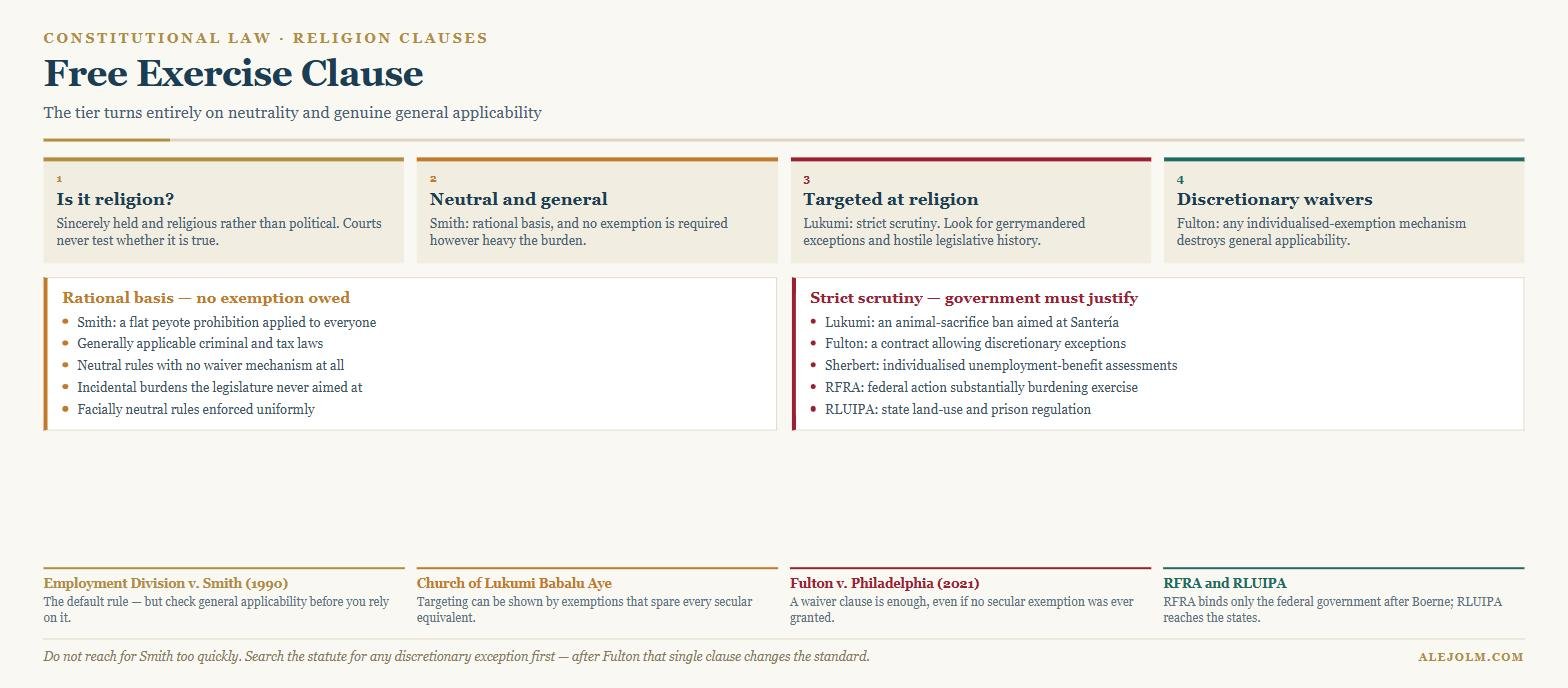
The threshold: is it religion, and is it sincere?
Two requirements and one prohibition. The belief must be religious in nature rather than political, philosophical or merely a matter of personal preference, and it must be sincerely held. What the court may never do is inquire into whether the belief is true, orthodox, theologically coherent or shared by anyone else.
The religious character of a belief is assessed by looking for the ordinary indicia of religion — whether it addresses a higher power, an afterlife or ultimate questions of meaning; whether it involves rituals, observances or holidays; whether it generates a system of moral obligation. A belief need not belong to a recognised denomination, an established institution or a popular faith. Small, idiosyncratic and newly founded religions are protected on the same terms as ancient ones.
Sincerity, by contrast, is a factual question a court may examine, and it is the appropriate place to test a claim that appears opportunistic — asserted for the first time to avoid an obligation, or contradicted by the claimant’s own conduct. The distinction is important: probing sincerity is legitimate, probing doctrinal validity is not.
Smith: neutral, generally applicable laws get rational basis
Employment Division v. Smith (1990) is the default rule and it is unforgiving. Oregon prohibited peyote generally. Members of the Native American Church used peyote in religious ceremonies and were caught by the prohibition. Because the law was facially neutral — it did not single out religious use — and generally applicable — it applied to all peyote use by anyone — it received only rational-basis review, and no religious exemption was constitutionally required.
The doctrinal point is worth stating starkly, because it surprises people: under Smith the size of the burden is irrelevant. A neutral, generally applicable law may make a central religious practice impossible, and the Free Exercise Clause still supplies no remedy. The reasoning is institutional — a constitutional right to exemptions from generally applicable law would put every citizen’s conscience above every statute — and the remedy is legislative rather than judicial.
So Smith is where the argument ends if the law really is neutral and really is generally applicable. The modern practice of free-exercise litigation consists almost entirely of showing that it is not.
Lukumi: targeting triggers strict scrutiny
Where a law is not neutral — where it is aimed at religious practice, or at a particular religion — strict scrutiny applies, and the government must show the measure is necessary to a compelling interest and uses the least restrictive means. Church of Lukumi Babalu Aye v. Hialeah is the model. The city prohibited animal sacrifice in an ordinance enacted in response to Santería practice, and the ordinance could not survive.
Targeting is rarely admitted, so it has to be inferred, and the two most reliable indicators are worth memorising. First, the pattern of exemptions: if a statute forbids the religious conduct while sparing every comparable secular activity that causes the same harm, the exemptions reveal what the legislature actually cared about. Second, the surrounding record: statements at enactment, the timing relative to the practice, and the closeness of fit between the prohibition and one faith’s ritual. A law gerrymandered around a religion is not neutral however neutrally it is phrased.
Fulton: discretionary waivers destroy general applicability
Fulton v. City of Philadelphia (2021) is now the most heavily tested wrinkle in the area. The city’s foster-care contracts required agencies to certify same-sex couples as foster parents. Catholic Social Services sought a religious exemption and was refused. The policy looked neutral and generally applicable, so on a quick reading Smith would supply rational basis and the agency would lose.
It did not. The Court held that a policy is not generally applicable where it provides a system of individualised, discretionary exemptions — and the contract gave a city official authority to grant exceptions at her sole discretion. Crucially, it did not matter that no secular exemption had ever actually been granted. The existence of the mechanism was enough, because a government that has reserved the power to make exceptions must explain, under strict scrutiny, why it declines to make one for religion. Philadelphia could identify no compelling interest in refusing, and lost.
Smith survives formally but its practical reach has narrowed considerably, since discretionary waiver clauses are extremely common in licensing schemes, contracts, zoning codes and benefit programmes. The lineage here runs back to Sherbert v. Verner, where unemployment benefits were denied to a claimant who would not work Saturdays for religious reasons; that scheme involved individualised assessment of each claimant’s good cause, which is exactly the structure Fulton now targets.
Exam tip: never apply Smith before searching the statute for words like “in the discretion of”, “for good cause”, “may grant an exception” or “unless waived”. One such clause moves the whole problem into strict scrutiny under Fulton.
RFRA and RLUIPA: statutory strict scrutiny
Congress responded to Smith legislatively, and the resulting statutes matter enormously in practice. The Religious Freedom Restoration Act restores strict scrutiny wherever government action substantially burdens sincere religious exercise. Its application to the states was struck down in City of Boerne v. Flores as exceeding Congress’s enforcement power under Section 5, so RFRA now binds the federal government only.
The Religious Land Use and Institutionalized Persons Act fills part of the resulting gap. It imposes strict scrutiny on state land-use and prison regulations that substantially burden religious exercise, and it is valid because it rests on the Spending and Commerce Clauses rather than on Section 5. So a congregation challenging a zoning refusal, or a prisoner challenging a restriction on religious observance, has a statutory route to strict scrutiny that the Constitution alone would not supply.
The allocation is therefore easy to state and easy to get wrong: federal action, use RFRA; state land-use or prison regulation, use RLUIPA; any other state action, you are back to the constitutional analysis and must establish targeting or a discretionary-exemption mechanism to escape rational basis. Some states have enacted their own restoration statutes, which is a matter of local law rather than federal constitutional doctrine.
| Law or actor | Analysis |
|---|---|
| Neutral, generally applicable state law | Smith |
| Law aimed at a religious practice | Lukumi |
| Neutral law with a discretionary waiver clause | Fulton |
| Individualised benefit assessments | Sherbert |
| Federal action burdening religious exercise | RFRA |
| State law generally | RFRA inapplicable (Boerne) |
| State land-use regulation | RLUIPA |
| Prison regulation of religious practice | RLUIPA |
Worked example
A city zoning code provides that places of assembly may not operate in a residential district, but adds that the planning director “may grant an exception where she determines that the use is compatible with the neighbourhood”. A small congregation applies to hold weekly worship in a converted house and is refused, the director stating only that she is not persuaded the use is compatible. No exception has ever been granted to anyone.
The tempting analysis is that this is a classic neutral, generally applicable zoning rule: it restricts all places of assembly, religious or not, and under Smith the congregation would receive rational basis and lose. That analysis is wrong, and identifying why is the whole answer. The code contains an individualised exemption mechanism — the director “may grant an exception” on her own assessment of compatibility — and under Fulton that destroys general applicability. The fact that no secular exception has ever been granted is expressly irrelevant; what matters is that the city reserved the power to make exceptions and must therefore justify refusing one for religious exercise. Strict scrutiny applies, and a bare statement of incompatibility will not establish a compelling interest pursued by the least restrictive means. The congregation should prevail. Note also that RLUIPA supplies an independent statutory route to the same standard, since this is state land-use regulation.
Change one fact. Suppose the code flatly prohibited all places of assembly in residential districts with no waiver provision of any kind, and the city had never made an exception because it had no power to. Now the rule is genuinely neutral and genuinely generally applicable, Smith governs the constitutional claim, and the substantial burden on the congregation would not entitle it to an exemption. The congregation would have to rely on RLUIPA instead — which is precisely why the statute exists.
Common mistakes that cost points
- Applying Smith without checking general applicability. After Fulton, a single discretionary waiver clause changes the standard.
- Assuming Fulton requires proof that a secular exemption was actually granted. The existence of the mechanism suffices.
- Inquiring into whether a belief is theologically valid. Courts may test sincerity, never truth or orthodoxy.
- Requiring that a religion be established, recognised or popular. Idiosyncratic and new faiths receive the same protection.
- Thinking a severe burden alone defeats a neutral, generally applicable law. Under Smith the magnitude of the burden is irrelevant.
- Applying RFRA to state action. City of Boerne v. Flores struck that down; RFRA binds the federal government only.
- Overlooking RLUIPA in land-use and prison cases, where it supplies strict scrutiny against the states.
- Missing targeting shown through exemptions. A law sparing every comparable secular activity is not neutral, whatever its wording.
Frequently asked questions
Does a neutral law that makes a religious practice impossible violate free exercise?
Not under Smith, provided the law really is neutral and generally applicable. The magnitude of the burden does not raise the standard of review, and no exemption is constitutionally required. The realistic strategy is to show the law is not truly generally applicable, or to invoke RFRA or RLUIPA where they apply.
What exactly did Fulton change?
It narrowed general applicability. A policy that allows individualised, discretionary exemptions is not generally applicable, so refusing a religious exemption must be justified under strict scrutiny — and this holds even if no secular exemption was ever granted. Smith remains formally intact but applies to far fewer laws than it once did.
Can the government question whether my religious belief is genuine?
It can question sincerity, which is a factual matter and the proper place to address an opportunistic claim. It cannot question whether the belief is true, orthodox, internally consistent or shared by others. The belief must be religious rather than merely political or philosophical, but it need not belong to any recognised tradition.
Free exercise in California: from South Bay to Fulton, 2026
California generated the most important free exercise litigation of the pandemic era, and the cases are now standard authority on neutrality. Restrictions on indoor worship were challenged in a series of actions including South Bay United Pentecostal Church v. Newsom and a case brought by a Pasadena congregation, and in Tandon v. Newsom (2021) the Supreme Court held that California’s limits on gatherings in private homes were not neutral because comparable secular activities were treated more favourably.
Tandon established the comparator method that now drives these disputes: a rule is not generally applicable if it treats any comparable secular activity better than religious exercise, and the comparison is made by reference to the risk the government says it is addressing rather than by category. That reasoning, together with Fulton v. City of Philadelphia (2021) on individualised exemptions, means many rules that would once have survived Employment Division v. Smith now face strict scrutiny.
California specifics worth knowing:
- California has no state religious freedom statute. There is no state analogue to the federal restoration act, so claimants rely on constitutional doctrine.
- School immunisation has no religious exemption. California eliminated the personal belief exemption, and the courts have upheld that choice.
- Employment accommodation is statutory and generous. The Fair Employment and Housing Act requires reasonable accommodation of religious observance, with a higher threshold for employers than federal law long imposed.
- Land use has federal protection. Religious land use legislation constrains county and city zoning decisions affecting places of worship, and applications through Los Angeles County Regional Planning are assessed with that in mind.
- Ministerial exception bars many claims. Employment disputes involving those who perform religious functions are outside judicial competence.
- Look for individualised exemptions. A discretionary exemption mechanism destroys general applicability, which is often the winning point.
For 2026, build the comparator argument first and the burden argument second. Read with the Establishment Clause, the levels of scrutiny and unconstitutional conditions.
Next steps
The religion clauses work as a pair and frequently collide on the same facts, so read this beside the Establishment Clause and place both within the First Amendment analysis. Because everything here turns on which tier applies, it is worth revisiting the levels of scrutiny, and the Fulton reasoning about discretionary exemptions belongs alongside the unconstitutional conditions doctrine, which polices the same instinct to trade benefits for rights.
The opinions in Smith and Fulton are the two most useful to read in full and are freely available through Justia’s First Amendment collection. Cornell’s Legal Information Institute keeps a concise entry with current citations, and candidates should confirm the tested scope against the outlines published by the State Bar of California.
Related guides
- Advisory Opinions: Article III and Declaratory Relief
- Access to the Courts: When Filing Fees Are Unconstitutional
- Other Enumerated Powers: Postal, Bankruptcy, Admiralty
- Franchise Amendments: Congress and the Right to Vote
- Property Clause: Congress and Federal Lands Explained
- No Federal Police Power: Enumerated Powers and Enclaves
- Contracts Clause: When States May Impair Agreements
- Takings Clause: Lucas, Penn Central and Just Compensation
- Establishment Clause: Church, State and the New Test
- Freedom of Association: Scrutiny, Dale and Disclosure
- Freedom of the Press: Publication Liability and Limits
- Campaign Finance and Anonymous Speech: The Core Rules
- Unconstitutional Conditions: Benefits and Rights Waivers
- Government Speech Doctrine: When the State Can Choose
- Vagueness and Overbreadth: Facial Challenges Explained
- Prior Restraint and Licensing: The Freedman Safeguards
- Symbolic Conduct and the O’Brien Test: The Pivot Question
- Government Employee Speech: Garcetti and Pickering Rules
- Commercial Speech and the Central Hudson Four-Part Test
- Actual Malice and the Three Tracks of Defamation Law
- Public Forum Doctrine and the Time, Place, Manner Test
- First Amendment: The Three-Question Speech Framework
- One Person, One Vote: Voting Rights Under Equal Protection
- Alienage Classifications: Strict Scrutiny and Its Pockets
- Equal Protection: The Three-Step Classification Test
- Second Amendment: The Bruen Text-and-History Standard
- Substantive Due Process After Dobbs: A Two-Step Test
- Procedural Due Process: Notice, Hearing and Mathews
- Incorporation Doctrine: Which Rights Bind the States
- Full Faith and Credit: Recognising Sister-State Judgments
- The Complete Auto Test: Taxing Interstate Commerce
- The Right to Travel: Durational Residency Explained
- Article IV Privileges and Immunities: The Comity Rule
- Federal Preemption: The Three-Step Ladder Explained
- The Supremacy Clause: Floors, Ceilings and Preemption
- Intergovernmental Immunity: The Shield Runs One Way
- The Presidential Pardon Power: Four Limits That Matter
- Executive Privilege: A Qualified Right That Must Yield
- Presidential Immunity: Criminal, Civil and Private Acts
- The Removal Power: At-Will Firing and Its Exceptions
- The Appointment Power: Principal and Inferior Officers
- Take Care Clause: Enforcement Discretion and Its Limits
- Commander-in-Chief Power: Deploy Without Declaring War
- Executive Agreements: The President’s Sole Foreign Power
- The Treaty Power: Senate Advice and Consent Explained
- The Presidential Veto Power, Override and Pocket Veto
- Bicameralism and Presentment: Two Vetoes Struck Down
- The Nondelegation Doctrine and the Intelligible Principle
- Speech or Debate Clause: Absolute but Narrow Immunity
- The Impeachment Power: House Majority, Senate Two-Thirds
- Congress’s Naturalization Power and Citizenship Limits
- Congressional War Powers: Declare, Fund and Command
- Anti-Commandeering Doctrine and the Tenth Amendment
- Section 5 Enforcement Power: Remedy, Do Not Redefine
- The Spending Power and the Five Dole Test Conditions
- Congress’s Taxing Power: When a Penalty Is Really a Tax
- The Necessary and Proper Clause: Congress’s Multiplier
- Ex Post Facto Clause: Retroactive Criminal Laws Barred
- Bills of Attainder: Legislative Punishment Explained
- The Writ of Habeas Corpus: Testing Unlawful Detention
- Supreme Court Jurisdiction: Original vs Appellate Power
- Abstention Doctrine: 4 Ways Federal Courts Step Aside
- Dormant Commerce Clause: Discrimination vs Pike Balancing
- The Commerce Clause: 3 Categories and 2 Hard Limits
- State Action Doctrine: The Government Conduct Threshold
- The Eleventh Amendment and State Sovereign Immunity
- Political Question Doctrine: What Courts Will Not Decide
- Ripeness and Mootness: Timing Rules in Federal Court
- Standing in Federal Court: The 3-Part Article III Test
- Marbury v. Madison and the Power of Judicial Review
- The Youngstown Framework: Presidential Power in 3 Zones
- The IRAC Method: How to Structure a Bar Exam Answer
- Piercing the Corporate Veil: A Two-Prong Alter Ego Test
- Defamation Elements, Fault Standards and Privileges
- The Parol Evidence Rule: Integration and Exceptions
- Recording Acts: Race, Notice and Race-Notice Explained
- Partner Liability and Authority Under RUPA Explained
- Trustee Duties: Care, Loyalty, Impartiality, Accounts
- Specific Performance: A Six-Element Bar Exam Framework
- Will Execution Requirements: Formalities and Rescue
- Community Property Presumptions in California Explained
- Easements Explained: Creation, Scope and Termination
- Products Liability: The Three Defect Theories Explained
- Miranda Rights: Custody, Interrogation and Invocation
- The Character Evidence Rules: Propensity Bar and Doorways
- Adverse Possession Elements: OCEAN and the Tax Rule
- Business Judgment Rule and Directors’ Fiduciary Duties
- The Statute of Frauds: MYLEGS and How to Satisfy It
- Res Judicata vs Collateral Estoppel: Bar Exam Guide
- The Erie Doctrine Explained: A 4-Step Bar Exam Guide
- Conflicts of Interest: A 6-Step Decision Tree for the Bar
- The Rule Against Perpetuities Explained Step by Step
- Murder and Manslaughter: The Homicide Ladder Explained
- Consideration in Contract Law: Rules and Exceptions
- The Four Elements of Negligence: Bar Exam Breakdown
- The Hearsay Rule Explained: Exceptions and Exemptions
- Personal Jurisdiction: The 3-Step Bar Exam Framework
- 3 Levels of Scrutiny in Constitutional Law Explained
- The Citizenship Clause After Trump v. Barbara