
The state action doctrine is the first question in every constitutional law problem and the one candidates most often skip. The Constitution restrains government, not private parties. A private club, employer or landlord may act in ways that would be plainly unconstitutional if a city did the same thing, and no amount of outrage converts that conduct into a constitutional violation.
This guide explains the baseline rule and its single true exception, the two routes by which private conduct is treated as governmental, the cases on each side of the line, and why the doctrine belongs at the very top of an answer.
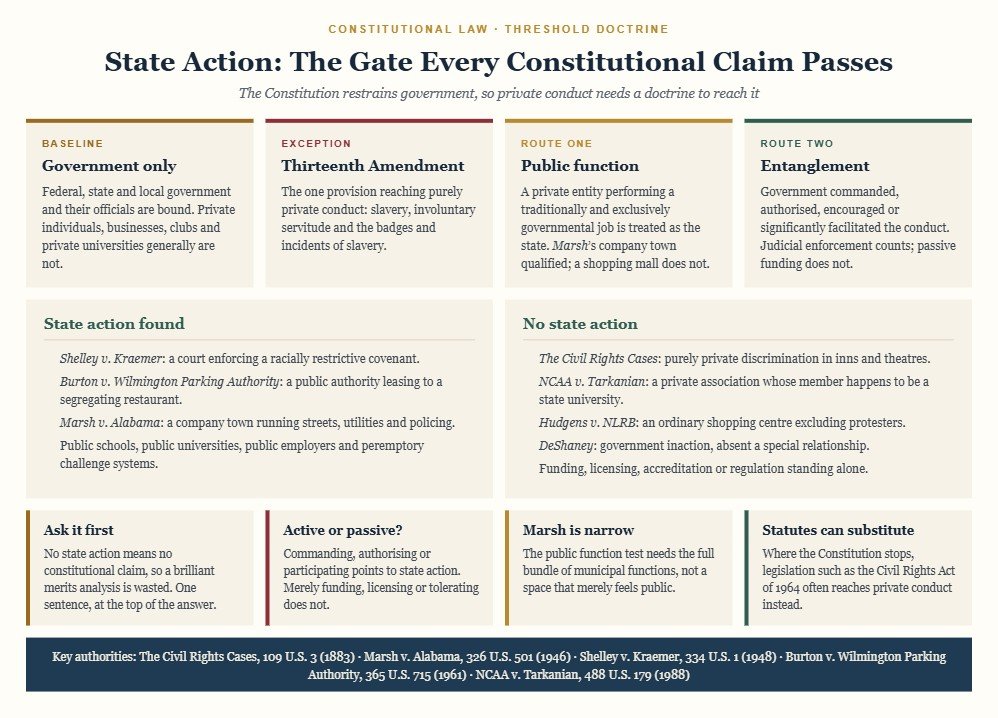
The baseline and where it came from
The Civil Rights Cases established the rule in 1883. The Fourteenth Amendment speaks to what a state may do, so Congress’s power to enforce it reaches state conduct rather than private discrimination. On that basis the Court struck down the public accommodations provisions of the Civil Rights Act of 1875. Everything interesting in the modern doctrine exists because later courts had to work out when nominally private conduct is close enough to government to count.
The practical consequence is easy to state and easy to forget. A privately owned restaurant that refuses service on racial grounds commits no constitutional violation; a municipally owned one does. A private employer that discriminates by sex breaches no constitutional guarantee, although it may well breach a statute; a public employer breaches both.
The only genuine exception
The Thirteenth Amendment is the single constitutional provision that reaches purely private behaviour. It abolishes slavery and involuntary servitude directly, and Congress may legislate against the badges and incidents of slavery in private hands. Do not generalise from it. No comparable move is available under the First or Fourteenth Amendments.
Route one: the public function exception
A private entity that performs a function traditionally and exclusively governmental is treated as the state for constitutional purposes. Marsh v. Alabama is the paradigm: a company town that owned the streets, ran the sewerage and utilities, provided policing and delivered the post could not use trespass law to exclude religious pamphleteers, because it had assumed the whole apparatus of municipal government.
The exception is narrower than it looks. In Hudgens v. NLRB the Court declined to extend Marsh to shopping centres, however central they are to a community’s commercial life, because hosting shops and gathering space is not the exclusive province of government. Running elections, by contrast, is, which is why private party primaries that controlled access to the ballot were held to be state action.
Exam tip: for the public function test, ask what the private entity has replaced. If the answer is a town government or an electoral system, the exception is live. If the answer is a landlord or a trade association, it is not.
Route two: entanglement
The second route asks whether government commanded, authorised, encouraged or significantly facilitated the conduct. Shelley v. Kraemer shows how little it can take. A racially restrictive covenant between private homeowners was not state action, but a state court order enforcing it was, because the judiciary supplied the coercive power that made the private agreement effective.
Burton v. Wilmington Parking Authority found the same conclusion on different facts. A public parking authority owned the building, leased space to a restaurant that refused to serve Black customers, and depended on the rent. The relationship was symbiotic enough that the discrimination could not be separated from the public landlord.
NCAA v. Tarkanian marks the boundary. A state university voluntarily followed the eligibility rules of a private national association, and the Court held that the association was not thereby transformed into a state actor. Government regulation and funding of one member did not make the association’s independent decisions governmental.
| Government’s role | Character | State action? |
|---|---|---|
| Court order enforcing a private agreement | Active coercion | Yes |
| Public landlord leasing to a discriminating tenant it depends on | Symbiotic participation | Yes |
| Delegating policing or election administration to a private body | Delegated public function | Yes |
| Funding, licensing or accrediting a private institution | Passive relationship | No |
| Regulating a member of a private association | Indirect | No |
| Failing to intervene to prevent private harm | Inaction | No, absent a special relationship |
Two worked examples
A homeowners association bans political signs on aesthetic grounds and a member sues on First Amendment grounds. The association is private, membership was voluntary and contractual, and regulating the appearance of a private development is not an exclusively governmental function. Nothing in the facts shows government command or participation. There is no state action, and the claim ends there.
Change one fact. A statute now requires such associations to enforce aesthetic harmony and equips them with binding arbitration and lien powers. The entanglement argument becomes real, because the state has authorised private enforcement and supplied the legal machinery. Whether that suffices is genuinely contested, and the strength of the argument tracks how specifically the statute directs the restriction at issue.
Why it belongs at the top of the answer
State action is a gate, not a garnish. If it fails, the analysis stops, and every paragraph of scrutiny analysis written afterwards earns nothing. Treat it as its own complete issue in the sense described in The IRAC Method: How to Structure a Bar Exam Answer, and only then move to the tiers explained in 3 Levels of Scrutiny in Constitutional Law Explained.
The doctrine also travels. In criminal procedure it decides whether a search or an interrogation triggers constitutional protection, which is why a private security guard’s questioning does not require the warnings discussed in Miranda Rights: Custody, Interrogation and Invocation.
Common mistakes that cost points
- Diving into scrutiny analysis before confirming the defendant is a government actor.
- Treating government funding, licensing or accreditation as sufficient involvement.
- Extending Marsh to shopping malls, stadiums or private campuses that merely feel public.
- Applying Thirteenth Amendment reasoning to First or Fourteenth Amendment claims.
- Reading Shelley as making every privately agreed restriction unconstitutional.
- Confusing state action with sovereign immunity, which is a separate question about who may be sued.
- Ignoring a statutory route, such as civil rights legislation, that reaches private conduct where the Constitution cannot.
- Treating government inaction as action without identifying a special relationship or custody.
Frequently asked questions
Are private universities bound by the First Amendment?
Not as a constitutional matter. A private institution’s speech policies are governed by its own contracts and by any applicable statute, while a public university is a state actor and is bound directly. That distinction explains why litigation against private and public institutions often proceeds under different legal theories.
Does receiving federal money make an organisation a state actor?
Generally no. Funding creates statutory obligations under the conditions attached to the money, but it does not convert independent decisions into governmental ones. That said, extensive funding combined with government direction of the specific conduct can support an entanglement argument.
Is a social media platform a state actor?
On current doctrine, no. Hosting public discussion is not a traditionally exclusive government function, and moderation decisions taken independently are private. Government pressure to remove particular content raises a genuine entanglement question, which is why those cases focus on what officials did rather than on what the platform is.
State action in California: Pruneyard and Los Angeles County in 2026
California is the single most important exception to the assumption that private property owners are free of constitutional speech obligations, and the case that did it arose from a shopping centre. In Robins v. Pruneyard Shopping Center the California Supreme Court held that article I, section 2 of the California Constitution protects speech and petitioning in privately owned shopping centres, and the United States Supreme Court affirmed in 1980 that a state may grant broader rights than the federal Constitution requires. There was no state action in the federal sense at all.
That matters enormously in Los Angeles County, where large privately owned retail centres function as the practical town squares of many communities. Later decisions narrowed the rule considerably: Ralphs Grocery Co. v. United Food & Commercial Workers (2012) confined it to areas designed and furnished as public gathering places, so the apron in front of a single store entrance is not a Pruneyard forum while a central plaza with seating and landscaping generally is.
The tools that displace the state action requirement here:
- The Unruh Civil Rights Act reaches private businesses. Section 51 of the California Civil Code prohibits discrimination by all business establishments, so no governmental nexus is needed for a discrimination claim.
- Section 52.1 covers interference with rights. The Bane Act supplies a state damages remedy against private and public actors who use threats or coercion.
- Pruneyard turns on design, not size. Photograph the space and document seating, events and public use before litigating.
- Reasonable time, place and manner rules survive. A centre may impose neutral regulations and require permits, and courts uphold sensible ones.
- Private residential associations are not forums. Gated communities and common interest developments are governed by the Davis-Stirling Act instead.
- Section 1983 still needs colour of law. The state constitutional route gives no federal cause of action, so plead the state claim expressly.
In 2026 the working rule is to ask what the California Constitution independently requires before concluding a private defendant is beyond reach. Read this with public forum doctrine and the First Amendment framework, and with the Eleventh Amendment for suits against public bodies.
Next steps
Build the habit of writing one sentence on state action before anything else, naming the actor and the route if a route is needed. Then continue with the structural doctrines that decide who may be sued and where, including The Eleventh Amendment and State Sovereign Immunity and Standing in Federal Court: The 3-Part Article III Test.
For primary sources, read Marsh v. Alabama, Shelley v. Kraemer and NCAA v. Tarkanian. Cornell’s note on the state action doctrine is a concise summary.
Related guides
- Advisory Opinions: Article III and Declaratory Relief
- Access to the Courts: When Filing Fees Are Unconstitutional
- Other Enumerated Powers: Postal, Bankruptcy, Admiralty
- Franchise Amendments: Congress and the Right to Vote
- Property Clause: Congress and Federal Lands Explained
- No Federal Police Power: Enumerated Powers and Enclaves
- Contracts Clause: When States May Impair Agreements
- Takings Clause: Lucas, Penn Central and Just Compensation
- Free Exercise Clause: Smith, Lukumi and Fulton Applied
- Establishment Clause: Church, State and the New Test
- Freedom of Association: Scrutiny, Dale and Disclosure
- Freedom of the Press: Publication Liability and Limits
- Campaign Finance and Anonymous Speech: The Core Rules
- Unconstitutional Conditions: Benefits and Rights Waivers
- Government Speech Doctrine: When the State Can Choose
- Vagueness and Overbreadth: Facial Challenges Explained
- Prior Restraint and Licensing: The Freedman Safeguards
- Symbolic Conduct and the O’Brien Test: The Pivot Question
- Government Employee Speech: Garcetti and Pickering Rules
- Commercial Speech and the Central Hudson Four-Part Test
- Actual Malice and the Three Tracks of Defamation Law
- Public Forum Doctrine and the Time, Place, Manner Test
- First Amendment: The Three-Question Speech Framework
- One Person, One Vote: Voting Rights Under Equal Protection
- Alienage Classifications: Strict Scrutiny and Its Pockets
- Equal Protection: The Three-Step Classification Test
- Second Amendment: The Bruen Text-and-History Standard
- Substantive Due Process After Dobbs: A Two-Step Test
- Procedural Due Process: Notice, Hearing and Mathews
- Incorporation Doctrine: Which Rights Bind the States
- Full Faith and Credit: Recognising Sister-State Judgments
- The Complete Auto Test: Taxing Interstate Commerce
- The Right to Travel: Durational Residency Explained
- Article IV Privileges and Immunities: The Comity Rule
- Federal Preemption: The Three-Step Ladder Explained
- The Supremacy Clause: Floors, Ceilings and Preemption
- Intergovernmental Immunity: The Shield Runs One Way
- The Presidential Pardon Power: Four Limits That Matter
- Executive Privilege: A Qualified Right That Must Yield
- Presidential Immunity: Criminal, Civil and Private Acts
- The Removal Power: At-Will Firing and Its Exceptions
- The Appointment Power: Principal and Inferior Officers
- Take Care Clause: Enforcement Discretion and Its Limits
- Commander-in-Chief Power: Deploy Without Declaring War
- Executive Agreements: The President’s Sole Foreign Power
- The Treaty Power: Senate Advice and Consent Explained
- The Presidential Veto Power, Override and Pocket Veto
- Bicameralism and Presentment: Two Vetoes Struck Down
- The Nondelegation Doctrine and the Intelligible Principle
- Speech or Debate Clause: Absolute but Narrow Immunity
- The Impeachment Power: House Majority, Senate Two-Thirds
- Congress’s Naturalization Power and Citizenship Limits
- Congressional War Powers: Declare, Fund and Command
- Anti-Commandeering Doctrine and the Tenth Amendment
- Section 5 Enforcement Power: Remedy, Do Not Redefine
- The Spending Power and the Five Dole Test Conditions
- Congress’s Taxing Power: When a Penalty Is Really a Tax
- The Necessary and Proper Clause: Congress’s Multiplier
- Ex Post Facto Clause: Retroactive Criminal Laws Barred
- Bills of Attainder: Legislative Punishment Explained
- The Writ of Habeas Corpus: Testing Unlawful Detention
- Supreme Court Jurisdiction: Original vs Appellate Power
- Abstention Doctrine: 4 Ways Federal Courts Step Aside
- Dormant Commerce Clause: Discrimination vs Pike Balancing
- The Commerce Clause: 3 Categories and 2 Hard Limits
- The Eleventh Amendment and State Sovereign Immunity
- Political Question Doctrine: What Courts Will Not Decide
- Ripeness and Mootness: Timing Rules in Federal Court
- Standing in Federal Court: The 3-Part Article III Test
- Marbury v. Madison and the Power of Judicial Review
- The Youngstown Framework: Presidential Power in 3 Zones
- The IRAC Method: How to Structure a Bar Exam Answer
- Piercing the Corporate Veil: A Two-Prong Alter Ego Test
- Defamation Elements, Fault Standards and Privileges
- The Parol Evidence Rule: Integration and Exceptions
- Recording Acts: Race, Notice and Race-Notice Explained
- Partner Liability and Authority Under RUPA Explained
- Trustee Duties: Care, Loyalty, Impartiality, Accounts
- Specific Performance: A Six-Element Bar Exam Framework
- Will Execution Requirements: Formalities and Rescue
- Community Property Presumptions in California Explained
- Easements Explained: Creation, Scope and Termination
- Products Liability: The Three Defect Theories Explained
- Miranda Rights: Custody, Interrogation and Invocation
- The Character Evidence Rules: Propensity Bar and Doorways
- Adverse Possession Elements: OCEAN and the Tax Rule
- Business Judgment Rule and Directors’ Fiduciary Duties
- The Statute of Frauds: MYLEGS and How to Satisfy It
- Res Judicata vs Collateral Estoppel: Bar Exam Guide
- The Erie Doctrine Explained: A 4-Step Bar Exam Guide
- Conflicts of Interest: A 6-Step Decision Tree for the Bar
- The Rule Against Perpetuities Explained Step by Step
- Murder and Manslaughter: The Homicide Ladder Explained
- Consideration in Contract Law: Rules and Exceptions
- The Four Elements of Negligence: Bar Exam Breakdown
- The Hearsay Rule Explained: Exceptions and Exemptions
- Personal Jurisdiction: The 3-Step Bar Exam Framework
- 3 Levels of Scrutiny in Constitutional Law Explained
- The Citizenship Clause After Trump v. Barbara