
Standing asks a question that has nothing to do with whether a law is constitutional: is this the right plaintiff? Article III confines federal courts to cases and controversies, so a litigant who cannot show a personal stake is turned away before any judge looks at the merits. An airtight free speech claim brought by the wrong party is dismissed just as firmly as a hopeless one.
This guide explains the three constitutional minima, why past injury does not automatically support an injunction, how the prudential limits on generalised grievances and third-party claims operate, and how standing differs from ripeness and mootness.
Why standing comes first
Standing is jurisdictional. If it is absent, the court lacks constitutional authority to decide anything, so it cannot reach the substantive question even to say the statute is invalid. In an essay this has a practical consequence: standing gets its own complete analysis before the merits, with its own rule statement and its own conclusion, exactly as described in The IRAC Method: How to Structure a Bar Exam Answer.
The doctrine also does real work in shaping who litigates constitutional questions. Because generalised grievances are excluded, the party challenging a government programme is normally someone the programme touches directly rather than a citizen with a strong opinion about it.
The three constitutional minima
Injury in fact
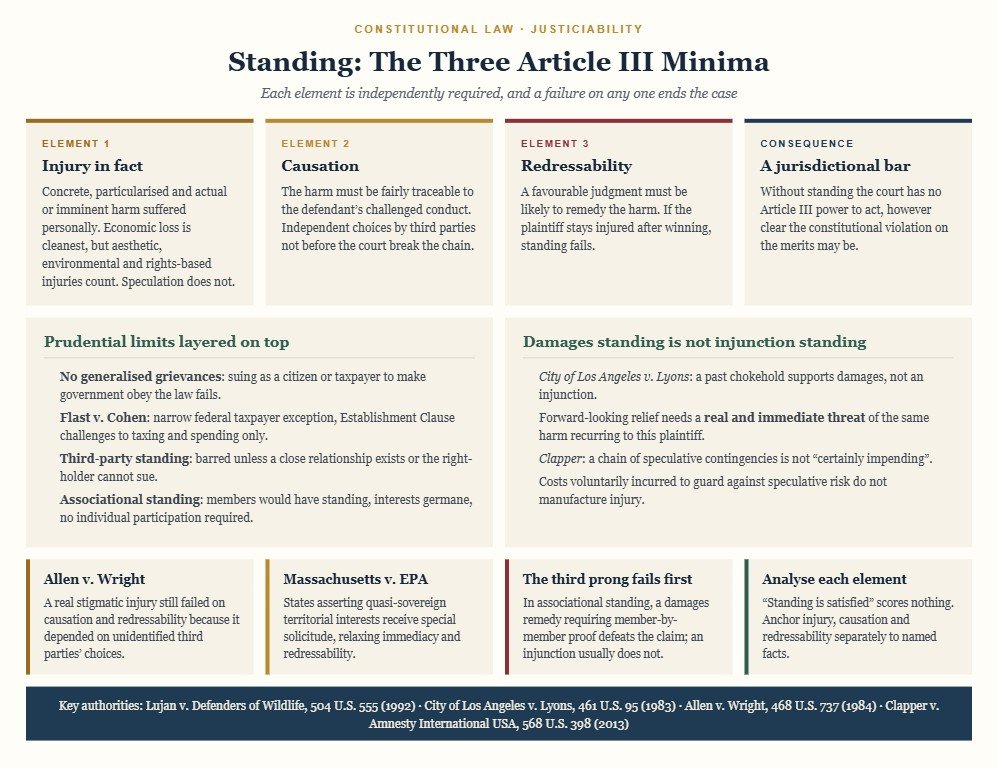
The harm must be concrete, particularised and either actual or imminent. Economic loss is the cleanest example, but the category is wider than money: the violation of a constitutional or statutory right, loss of aesthetic or recreational enjoyment of a place the plaintiff actually uses, and certain stigmatic harms all qualify. What does not qualify is a harm shared with the public at large or one that depends on a chain of assumptions about what other people may do.
Where the relief sought is forward-looking, the injury must be forward-looking too. A plaintiff seeking an injunction must show a credible, non-speculative prospect of being harmed again personally.
Causation, or traceability
The injury must be fairly traceable to the conduct being challenged. The link breaks in two familiar ways: the plaintiff would have suffered the same harm regardless of the defendant’s action, or the harm arrives only through the independent decisions of third parties who are not before the court.
Allen v. Wright is the classic failure. Parents of Black schoolchildren challenged the Internal Revenue Service for granting tax exemptions to racially discriminatory private schools, arguing that the exemptions sustained segregation. The injury was genuine, but whether withdrawing exemptions would change any particular school’s behaviour, and whether that would improve integration in the plaintiffs’ district, depended on choices by parties nobody had sued.
Redressability
A favourable judgment must be likely, though not certain, to remedy the harm. This is the element candidates skip. If the plaintiff would remain injured after winning, because the remedy is inadequate or because the real cause lies elsewhere, standing fails even though the injury and the defendant’s conduct are both real.
Exam tip: write three sentences, one per element, each beginning with the fact that satisfies it. “Here the injury is the ten per cent salary withheld; causation is direct because the district ordered the withholding; redressability follows because back pay would restore the loss.”
The Lyons trap: damages standing is not injunction standing
In City of Los Angeles v. Lyons the plaintiff had been placed in a chokehold by police officers during a traffic stop. That past injury supported a damages claim without difficulty. What it did not support was an injunction against the practice, because Lyons could not show a real and immediate threat that he personally would be choked again. The general risk to the public was not his risk.
The lesson generalises. Every time a fact pattern shifts from compensation to prospective relief, re-run the injury analysis on the future harm. Clapper v. Amnesty International USA applies the same logic to surveillance: an injury resting on a series of speculative contingencies is not certainly impending, and money spent guarding against that speculative risk does not convert it into an actual one.
| Relief sought | What injury must be shown | Typical failure |
|---|---|---|
| Damages for past harm | The completed injury itself | Harm too diffuse or shared with the public generally |
| Injunction | Real and immediate threat of recurrence to this plaintiff | Only a general risk to a class of people — the Lyons problem |
| Declaratory judgment | A concrete, present dispute with adverse parties | Abstract question with no one ready to enforce |
| Relief on behalf of members | Members’ own standing, plus no individual participation needed | Damages requiring member-by-member proof |
Prudential limits sitting on top of the constitutional test
Beyond the three minima, courts apply judge-made restrictions that Congress can sometimes adjust.
- No generalised grievances. A plaintiff suing as a citizen or taxpayer to compel the government to obey the law has no standing. The interest in lawful government is shared by everyone and particular to no one.
- The Establishment Clause taxpayer exception. Flast v. Cohen permits a federal taxpayer to challenge congressional taxing and spending as an establishment of religion. The exception is narrow on both axes: only congressional spending, and only the Establishment Clause.
- Third-party standing. Ordinarily a litigant asserts only their own rights. Courts relax this where a close relationship exists between the litigant and the right-holder, or where the right-holder faces a practical obstacle to suing.
- Associational standing. An organisation may sue for its members where the members would have standing, the interests are germane to the organisation’s purpose, and neither the claim nor the relief requires individual member participation.
That last requirement is where associational claims usually break. An injunction can be framed without reference to any individual member, but damages that must be proved member by member cannot, and the organisation is left unable to carry the suit alone.
When the plaintiff is a state
Massachusetts v. EPA recognised that a state asserting quasi-sovereign interests in its own territory occupies a different position from a private litigant. The Court granted “special solicitude” in the standing analysis, relaxing the immediacy and redressability showings for a claim about coastal land threatened by rising sea levels. Where a fact pattern gives you a sovereign plaintiff protecting its territory or its residents, say so explicitly.
Standing, ripeness and mootness are three questions
They overlap in the facts and diverge in doctrine. Standing asks whether this plaintiff has a personal stake. Ripeness asks whether the dispute has matured enough for judicial resolution. Mootness asks whether the dispute still exists. A pre-enforcement challenge may fail on both standing and ripeness; a student who graduates mid-litigation may have had perfect standing and still lose to mootness.
Related but distinct is the bar on advisory opinions, which asks whether there is any real, adverse dispute at all. A declaratory judgment about prospective conduct is perfectly justiciable so long as the controversy between the parties is concrete.
Common mistakes that cost points
- Assuming a past injury supports an injunction as well as damages.
- Asserting that standing exists without separately analysing all three elements.
- Skipping redressability, the element most often decisive in agency and tax cases.
- Treating a citizen or taxpayer interest in lawful government as an injury.
- Stretching the Flast exception beyond Establishment Clause challenges to congressional spending.
- Ignoring the third prong of associational standing in a damages case.
- Conflating standing with ripeness or mootness, which reverses the analytical order.
- Overlooking that a state plaintiff may receive special solicitude.
Frequently asked questions
Can Congress create standing by statute?
Congress can create legal rights whose violation counts as an injury, and it can lift prudential barriers. What it cannot do is dispense with the constitutional minima. A statute authorising any citizen to sue over a violation, with no concrete personal harm, does not satisfy Article III.
Is loss of enjoyment of a natural area enough?
Yes, provided the plaintiff actually uses the area affected. Members of a hiking club who walk in the specific forest facing a timber sale have a particularised aesthetic and recreational injury. A general concern about national environmental degradation is a generalised grievance.
When is standing decided?
It is assessed at the outset and must persist throughout. Standing that existed when the complaint was filed can be destroyed later by events, at which point the case is dismissed as moot rather than for want of standing.
Standing in California and Los Angeles County courts in 2026
This is one of the places where state practice diverges most sharply from federal doctrine, and candidates who memorise only the federal test get California questions wrong. The state constitution contains no equivalent of the Article III “cases and controversies” limitation, so California courts are not bound by the injury, causation and redressability triad as a constitutional floor. They apply a looser “beneficial interest” requirement that is statutory and judge-made, and they relax it further whenever a matter of public right is at stake.
The practical consequence in Los Angeles County is significant. Section 526a of the California Code of Civil Procedure lets essentially any person who has paid a tax to a local agency sue to restrain illegal expenditure of that agency’s funds. A resident who objects to how the County of Los Angeles spends money on a contract or programme can often get into the Los Angeles Superior Court without demonstrating anything resembling federal injury in fact. Traditional mandamus under section 1085 is similarly generous where the claim is that a public official has failed to perform a mandatory public duty.
Points that decide real Los Angeles County cases:
- Forum choice is strategy, not formality. A plaintiff with a weak federal injury story may have full state standing, so filing in the Los Angeles Superior Court rather than the Central District of California can save the case outright.
- Taxpayer suits reach local agencies, not the state. Section 526a targets local government spending, which is why it is such a common vehicle against county and city decisions.
- Government Claims Act deadlines come first. For damages claims against the county, Government Code sections 905 and 911.2 require presenting a claim before suing, generally within six months for injury or property damage. Standing means nothing if the claim was never presented.
- Public interest standing is discretionary. Courts will entertain a citizen suit on an important public question, but they are not obliged to, and the argument must be made expressly.
- Environmental and land use claims have their own rules. Challenges to county approvals carry short statutory limitations periods that operate independently of standing.
- Removal resets the test. A case with valid state standing that is removed to federal court can be dismissed for want of Article III standing, so plead carefully.
For 2026, treat standing as two separate questions asked in sequence: whether the federal test is met, and whether the more permissive California route is available. Read this next to ripeness and mootness and advisory opinions, which supply the rest of the justiciability picture, and the Eleventh Amendment, which governs who may be sued at all.
Next steps
Practise by taking one fact pattern and changing only the remedy sought, so you can feel the injury analysis shift. Then place standing inside the wider structure of federal jurisdiction alongside Marbury v. Madison and the Power of Judicial Review, the party-based limits on state court reach in Personal Jurisdiction: The 3-Step Bar Exam Framework, and the preclusion rules that decide who is bound by a judgment in Res Judicata vs Collateral Estoppel: Bar Exam Guide.
For primary sources, the modern test is set out in Lujan v. Defenders of Wildlife, the injunction problem in City of Los Angeles v. Lyons, and the causation problem in Allen v. Wright. Cornell’s note on standing gives a compact overview.
Related guides
- Advisory Opinions: Article III and Declaratory Relief
- Access to the Courts: When Filing Fees Are Unconstitutional
- Other Enumerated Powers: Postal, Bankruptcy, Admiralty
- Franchise Amendments: Congress and the Right to Vote
- Property Clause: Congress and Federal Lands Explained
- No Federal Police Power: Enumerated Powers and Enclaves
- Contracts Clause: When States May Impair Agreements
- Takings Clause: Lucas, Penn Central and Just Compensation
- Free Exercise Clause: Smith, Lukumi and Fulton Applied
- Establishment Clause: Church, State and the New Test
- Freedom of Association: Scrutiny, Dale and Disclosure
- Freedom of the Press: Publication Liability and Limits
- Campaign Finance and Anonymous Speech: The Core Rules
- Unconstitutional Conditions: Benefits and Rights Waivers
- Government Speech Doctrine: When the State Can Choose
- Vagueness and Overbreadth: Facial Challenges Explained
- Prior Restraint and Licensing: The Freedman Safeguards
- Symbolic Conduct and the O’Brien Test: The Pivot Question
- Government Employee Speech: Garcetti and Pickering Rules
- Commercial Speech and the Central Hudson Four-Part Test
- Actual Malice and the Three Tracks of Defamation Law
- Public Forum Doctrine and the Time, Place, Manner Test
- First Amendment: The Three-Question Speech Framework
- One Person, One Vote: Voting Rights Under Equal Protection
- Alienage Classifications: Strict Scrutiny and Its Pockets
- Equal Protection: The Three-Step Classification Test
- Second Amendment: The Bruen Text-and-History Standard
- Substantive Due Process After Dobbs: A Two-Step Test
- Procedural Due Process: Notice, Hearing and Mathews
- Incorporation Doctrine: Which Rights Bind the States
- Full Faith and Credit: Recognising Sister-State Judgments
- The Complete Auto Test: Taxing Interstate Commerce
- The Right to Travel: Durational Residency Explained
- Article IV Privileges and Immunities: The Comity Rule
- Federal Preemption: The Three-Step Ladder Explained
- The Supremacy Clause: Floors, Ceilings and Preemption
- Intergovernmental Immunity: The Shield Runs One Way
- The Presidential Pardon Power: Four Limits That Matter
- Executive Privilege: A Qualified Right That Must Yield
- Presidential Immunity: Criminal, Civil and Private Acts
- The Removal Power: At-Will Firing and Its Exceptions
- The Appointment Power: Principal and Inferior Officers
- Take Care Clause: Enforcement Discretion and Its Limits
- Commander-in-Chief Power: Deploy Without Declaring War
- Executive Agreements: The President’s Sole Foreign Power
- The Treaty Power: Senate Advice and Consent Explained
- The Presidential Veto Power, Override and Pocket Veto
- Bicameralism and Presentment: Two Vetoes Struck Down
- The Nondelegation Doctrine and the Intelligible Principle
- Speech or Debate Clause: Absolute but Narrow Immunity
- The Impeachment Power: House Majority, Senate Two-Thirds
- Congress’s Naturalization Power and Citizenship Limits
- Congressional War Powers: Declare, Fund and Command
- Anti-Commandeering Doctrine and the Tenth Amendment
- Section 5 Enforcement Power: Remedy, Do Not Redefine
- The Spending Power and the Five Dole Test Conditions
- Congress’s Taxing Power: When a Penalty Is Really a Tax
- The Necessary and Proper Clause: Congress’s Multiplier
- Ex Post Facto Clause: Retroactive Criminal Laws Barred
- Bills of Attainder: Legislative Punishment Explained
- The Writ of Habeas Corpus: Testing Unlawful Detention
- Supreme Court Jurisdiction: Original vs Appellate Power
- Abstention Doctrine: 4 Ways Federal Courts Step Aside
- Dormant Commerce Clause: Discrimination vs Pike Balancing
- The Commerce Clause: 3 Categories and 2 Hard Limits
- State Action Doctrine: The Government Conduct Threshold
- The Eleventh Amendment and State Sovereign Immunity
- Political Question Doctrine: What Courts Will Not Decide
- Ripeness and Mootness: Timing Rules in Federal Court
- Marbury v. Madison and the Power of Judicial Review
- The Youngstown Framework: Presidential Power in 3 Zones
- The IRAC Method: How to Structure a Bar Exam Answer
- Piercing the Corporate Veil: A Two-Prong Alter Ego Test
- Defamation Elements, Fault Standards and Privileges
- The Parol Evidence Rule: Integration and Exceptions
- Recording Acts: Race, Notice and Race-Notice Explained
- Partner Liability and Authority Under RUPA Explained
- Trustee Duties: Care, Loyalty, Impartiality, Accounts
- Specific Performance: A Six-Element Bar Exam Framework
- Will Execution Requirements: Formalities and Rescue
- Community Property Presumptions in California Explained
- Easements Explained: Creation, Scope and Termination
- Products Liability: The Three Defect Theories Explained
- Miranda Rights: Custody, Interrogation and Invocation
- The Character Evidence Rules: Propensity Bar and Doorways
- Adverse Possession Elements: OCEAN and the Tax Rule
- Business Judgment Rule and Directors’ Fiduciary Duties
- The Statute of Frauds: MYLEGS and How to Satisfy It
- Res Judicata vs Collateral Estoppel: Bar Exam Guide
- The Erie Doctrine Explained: A 4-Step Bar Exam Guide
- Conflicts of Interest: A 6-Step Decision Tree for the Bar
- The Rule Against Perpetuities Explained Step by Step
- Murder and Manslaughter: The Homicide Ladder Explained
- Consideration in Contract Law: Rules and Exceptions
- The Four Elements of Negligence: Bar Exam Breakdown
- The Hearsay Rule Explained: Exceptions and Exemptions
- Personal Jurisdiction: The 3-Step Bar Exam Framework
- 3 Levels of Scrutiny in Constitutional Law Explained
- The Citizenship Clause After Trump v. Barbara