
Habeas corpus is a judicial order requiring that a detained person be produced in court so a judge can examine whether the detention is lawful. It is not an appeal, not an ordinary civil action, and not a review of guilt. It is a direct challenge to the authority of whoever holds the petitioner.
This guide explains what the writ tests, how the Suspension Clause limits its removal, how Hamdi v. Rumsfeld added a due process layer, how Boumediene v. Bush extended the clause beyond formal sovereign territory, and how to keep habeas separate from direct criminal appeal.
What the writ actually tests
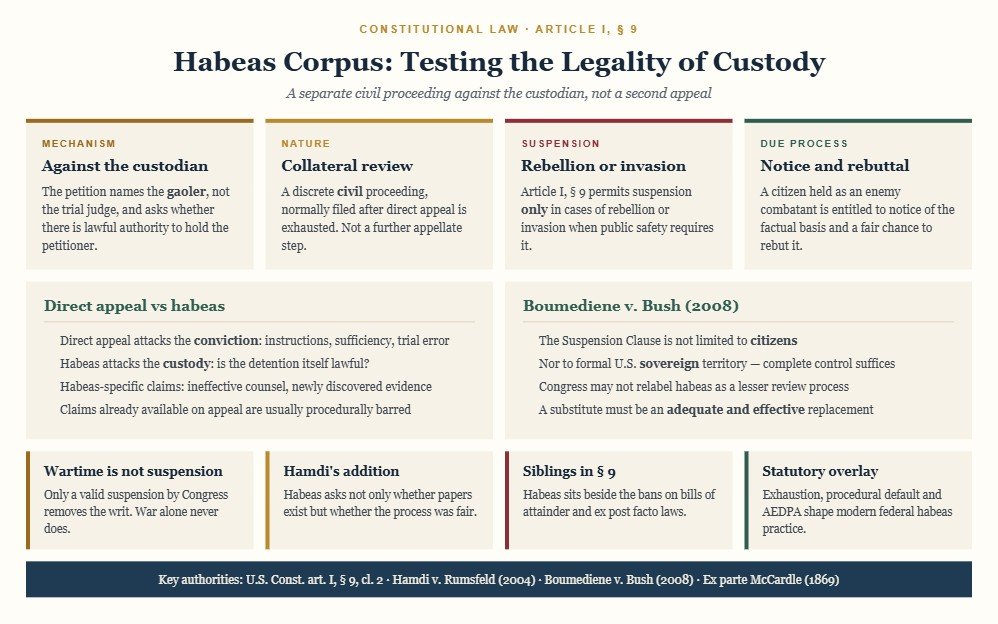
The question in habeas is narrow and concrete: does the custodian have lawful authority to detain this person right now? The petition is filed against the warden, the military commander or whoever holds the body, and the relief sought is release. A conviction may be the reason for the custody, but the conviction is not the subject of the proceeding.
That structural point produces three consequences. The defendant is different from the defendant in the criminal case. The proceeding is civil, not criminal. And the claims available are different too, because habeas exists to reach defects that the trial record could not show.
Exam tip: if a question describes someone detained without any charge at all, habeas is the vehicle and the government must come to court and defend its authority.
The Suspension Clause
Article I, § 9, cl. 2 provides that the privilege of the writ shall not be suspended unless in cases of rebellion or invasion when the public safety may require it. Two features matter. The grounds are extraordinarily narrow, and suspension is a legislative act, not something the executive may declare for itself.
The practical result is that the writ is almost always available. Armed conflict, a declared emergency or a national security justification does not amount to suspension. Absent a valid suspension, a court must entertain the petition and require the custodian to justify the detention.
Hamdi v. Rumsfeld: the due process layer
Hamdi concerned a United States citizen held as an enemy combatant. The Court held that such a detainee is entitled to notice of the factual basis for the detention and a meaningful opportunity to rebut it before a neutral decisionmaker, with habeas as the vehicle for testing whether that process was given.
Hamdi therefore converts habeas from a formal inquiry into a substantive one. The court asks not merely whether an order of detention exists but whether the detainee had a fair chance to contest the facts said to justify it.
Boumediene v. Bush: reach beyond the water’s edge
Boumediene held that foreign nationals detained as enemy combatants at Guantanamo Bay hold a constitutional right to habeas corpus, because the United States exercises complete jurisdiction and practical control over the base even without formal sovereignty. The Military Commissions Act’s attempt to strip federal habeas jurisdiction failed on two grounds: Congress had not invoked the Suspension Clause, and the substitute status-review procedure was not an adequate and effective replacement for habeas.
The lesson is a general one. Congress cannot escape the Suspension Clause by giving habeas review a different name, and the clause can follow effective control rather than stopping at a border.
Habeas compared with direct appeal
| Feature | Direct appeal | Habeas corpus |
|---|---|---|
| Target | The conviction or sentence | The legality of the custody |
| Opposing party | The prosecuting authority | The custodian holding the petitioner |
| Nature | Continuation of the criminal case | Separate civil proceeding |
| Typical claims | Instructional error, insufficiency, evidentiary rulings | Ineffective counsel, newly discovered evidence, unlawful detention |
| Timing | Immediately after judgment | Usually after direct appeal is exhausted |
Worked example: detention without charge
A man is seized and held as a suspected terrorist. He is never charged and never tried. He petitions for habeas, arguing that there is no legal basis for holding him. No rebellion or invasion is alleged, so the writ has not been suspended. The petition must be heard, the custodian must state its authority, and under Hamdi the detainee is entitled to notice of the alleged facts and a fair chance to answer them.
Change the facts. The same man was convicted after a full trial, lost his direct appeal, and now files a habeas petition complaining that the trial court wrongly denied a suppression motion. That claim was available on appeal and was decided there, so it is ordinarily barred in habeas unless he can show cause and prejudice or fits a recognised exception. Habeas is not a second appeal.
Common mistakes that cost points
- Treating habeas as the next step in the criminal appellate process rather than a separate civil suit.
- Naming the trial judge or the state as respondent instead of the custodian.
- Assuming that wartime or a national emergency suspends the writ. Only a valid legislative suspension does.
- Missing the Hamdi due process layer and analysing only whether a detention order exists.
- Believing the Suspension Clause protects only citizens, or only detentions on sovereign soil. Boumediene rejects both.
- Recycling claims already litigated on direct appeal without addressing procedural default.
- Forgetting that habeas relief is release from unlawful custody, not damages.
- Overlooking the Article I, § 9 family: habeas, bills of attainder and ex post facto all keep punishment inside the judicial process.
Frequently asked questions
Who can suspend the writ?
The clause appears in Article I, which is the legislative article, so suspension is understood to be a congressional act. The executive cannot suspend the writ on its own authority.
Is habeas available before any criminal charge?
Yes, and that is its classic use. The writ tests custody, so a person held without charge is precisely the paradigm case.
Does habeas apply outside criminal law?
Yes. Any custody imposed by government authority can be tested, which is why immigration detention and military detention both generate habeas litigation.
Habeas corpus in California and Los Angeles County, 2026
California habeas practice is unusually rich, because the Legislature has created several statutory grounds for post-conviction relief that operate through the habeas petition and have no federal counterpart. Sections 1473 and following of the California Penal Code govern the writ, and both the Los Angeles Superior Court and the California Supreme Court exercise original habeas jurisdiction.
Three California-specific grounds do most of the work in Los Angeles County. Legislation narrowing accomplice liability for murder created a resentencing route for people convicted under the former felony murder rule. A separate provision allows a conviction to be vacated where the defendant did not meaningfully understand its immigration consequences. And the state’s racial justice legislation permits relief where race, ethnicity or national origin influenced the charge, conviction or sentence, with a statutory framework for proving disparity that does not require showing intentional discrimination.
The procedural architecture:
- State and federal tracks are separate. Federal habeas requires exhaustion of state remedies and is subject to a one-year limitation period and deferential review of state court determinations.
- Timeliness in California is judged by reasonableness. There is no fixed deadline, but substantial delay must be explained.
- Successive petitions face strict limits. Claims that could have been raised earlier are generally barred absent a recognised exception.
- Custody is construed broadly. Parole, probation and immigration detention consequences can satisfy the requirement.
- Conditions of confinement are litigable. County jail conditions have been addressed through habeas and class litigation over many years.
- Capital petitions have their own regime. California adopted a restructured timetable for capital post-conviction review by initiative in 2016.
For 2026, screen every old conviction against the newer statutory grounds before assuming finality. Read with Supreme Court jurisdiction, Miranda rights and the Ex Post Facto Clause.
Next steps
Habeas belongs with the other Article I, § 9 limits and with the wider law of federal jurisdiction. Read Bills of Attainder: Legislative Punishment Explained and Supreme Court Jurisdiction: Original vs Appellate Power, and compare the deference rules in Abstention Doctrine: 4 Ways Federal Courts Step Aside.
For primary sources, read Hamdi v. Rumsfeld and Boumediene v. Bush at Justia, the entries on habeas corpus and the Suspension Clause at Cornell LII, and the examination scope published by the State Bar of California.
Related guides
- Advisory Opinions: Article III and Declaratory Relief
- Access to the Courts: When Filing Fees Are Unconstitutional
- Other Enumerated Powers: Postal, Bankruptcy, Admiralty
- Franchise Amendments: Congress and the Right to Vote
- Property Clause: Congress and Federal Lands Explained
- No Federal Police Power: Enumerated Powers and Enclaves
- Contracts Clause: When States May Impair Agreements
- Takings Clause: Lucas, Penn Central and Just Compensation
- Free Exercise Clause: Smith, Lukumi and Fulton Applied
- Establishment Clause: Church, State and the New Test
- Freedom of Association: Scrutiny, Dale and Disclosure
- Freedom of the Press: Publication Liability and Limits
- Campaign Finance and Anonymous Speech: The Core Rules
- Unconstitutional Conditions: Benefits and Rights Waivers
- Government Speech Doctrine: When the State Can Choose
- Vagueness and Overbreadth: Facial Challenges Explained
- Prior Restraint and Licensing: The Freedman Safeguards
- Symbolic Conduct and the O’Brien Test: The Pivot Question
- Government Employee Speech: Garcetti and Pickering Rules
- Commercial Speech and the Central Hudson Four-Part Test
- Actual Malice and the Three Tracks of Defamation Law
- Public Forum Doctrine and the Time, Place, Manner Test
- First Amendment: The Three-Question Speech Framework
- One Person, One Vote: Voting Rights Under Equal Protection
- Alienage Classifications: Strict Scrutiny and Its Pockets
- Equal Protection: The Three-Step Classification Test
- Second Amendment: The Bruen Text-and-History Standard
- Substantive Due Process After Dobbs: A Two-Step Test
- Procedural Due Process: Notice, Hearing and Mathews
- Incorporation Doctrine: Which Rights Bind the States
- Full Faith and Credit: Recognising Sister-State Judgments
- The Complete Auto Test: Taxing Interstate Commerce
- The Right to Travel: Durational Residency Explained
- Article IV Privileges and Immunities: The Comity Rule
- Federal Preemption: The Three-Step Ladder Explained
- The Supremacy Clause: Floors, Ceilings and Preemption
- Intergovernmental Immunity: The Shield Runs One Way
- The Presidential Pardon Power: Four Limits That Matter
- Executive Privilege: A Qualified Right That Must Yield
- Presidential Immunity: Criminal, Civil and Private Acts
- The Removal Power: At-Will Firing and Its Exceptions
- The Appointment Power: Principal and Inferior Officers
- Take Care Clause: Enforcement Discretion and Its Limits
- Commander-in-Chief Power: Deploy Without Declaring War
- Executive Agreements: The President’s Sole Foreign Power
- The Treaty Power: Senate Advice and Consent Explained
- The Presidential Veto Power, Override and Pocket Veto
- Bicameralism and Presentment: Two Vetoes Struck Down
- The Nondelegation Doctrine and the Intelligible Principle
- Speech or Debate Clause: Absolute but Narrow Immunity
- The Impeachment Power: House Majority, Senate Two-Thirds
- Congress’s Naturalization Power and Citizenship Limits
- Congressional War Powers: Declare, Fund and Command
- Anti-Commandeering Doctrine and the Tenth Amendment
- Section 5 Enforcement Power: Remedy, Do Not Redefine
- The Spending Power and the Five Dole Test Conditions
- Congress’s Taxing Power: When a Penalty Is Really a Tax
- The Necessary and Proper Clause: Congress’s Multiplier
- Ex Post Facto Clause: Retroactive Criminal Laws Barred
- Bills of Attainder: Legislative Punishment Explained
- Supreme Court Jurisdiction: Original vs Appellate Power
- Abstention Doctrine: 4 Ways Federal Courts Step Aside
- Dormant Commerce Clause: Discrimination vs Pike Balancing
- The Commerce Clause: 3 Categories and 2 Hard Limits
- State Action Doctrine: The Government Conduct Threshold
- The Eleventh Amendment and State Sovereign Immunity
- Political Question Doctrine: What Courts Will Not Decide
- Ripeness and Mootness: Timing Rules in Federal Court
- Standing in Federal Court: The 3-Part Article III Test
- Marbury v. Madison and the Power of Judicial Review
- The Youngstown Framework: Presidential Power in 3 Zones
- The IRAC Method: How to Structure a Bar Exam Answer
- Piercing the Corporate Veil: A Two-Prong Alter Ego Test
- Defamation Elements, Fault Standards and Privileges
- The Parol Evidence Rule: Integration and Exceptions
- Recording Acts: Race, Notice and Race-Notice Explained
- Partner Liability and Authority Under RUPA Explained
- Trustee Duties: Care, Loyalty, Impartiality, Accounts
- Specific Performance: A Six-Element Bar Exam Framework
- Will Execution Requirements: Formalities and Rescue
- Community Property Presumptions in California Explained
- Easements Explained: Creation, Scope and Termination
- Products Liability: The Three Defect Theories Explained
- Miranda Rights: Custody, Interrogation and Invocation
- The Character Evidence Rules: Propensity Bar and Doorways
- Adverse Possession Elements: OCEAN and the Tax Rule
- Business Judgment Rule and Directors’ Fiduciary Duties
- The Statute of Frauds: MYLEGS and How to Satisfy It
- Res Judicata vs Collateral Estoppel: Bar Exam Guide
- The Erie Doctrine Explained: A 4-Step Bar Exam Guide
- Conflicts of Interest: A 6-Step Decision Tree for the Bar
- The Rule Against Perpetuities Explained Step by Step
- Murder and Manslaughter: The Homicide Ladder Explained
- Consideration in Contract Law: Rules and Exceptions
- The Four Elements of Negligence: Bar Exam Breakdown
- The Hearsay Rule Explained: Exceptions and Exemptions
- Personal Jurisdiction: The 3-Step Bar Exam Framework
- 3 Levels of Scrutiny in Constitutional Law Explained
- The Citizenship Clause After Trump v. Barbara